
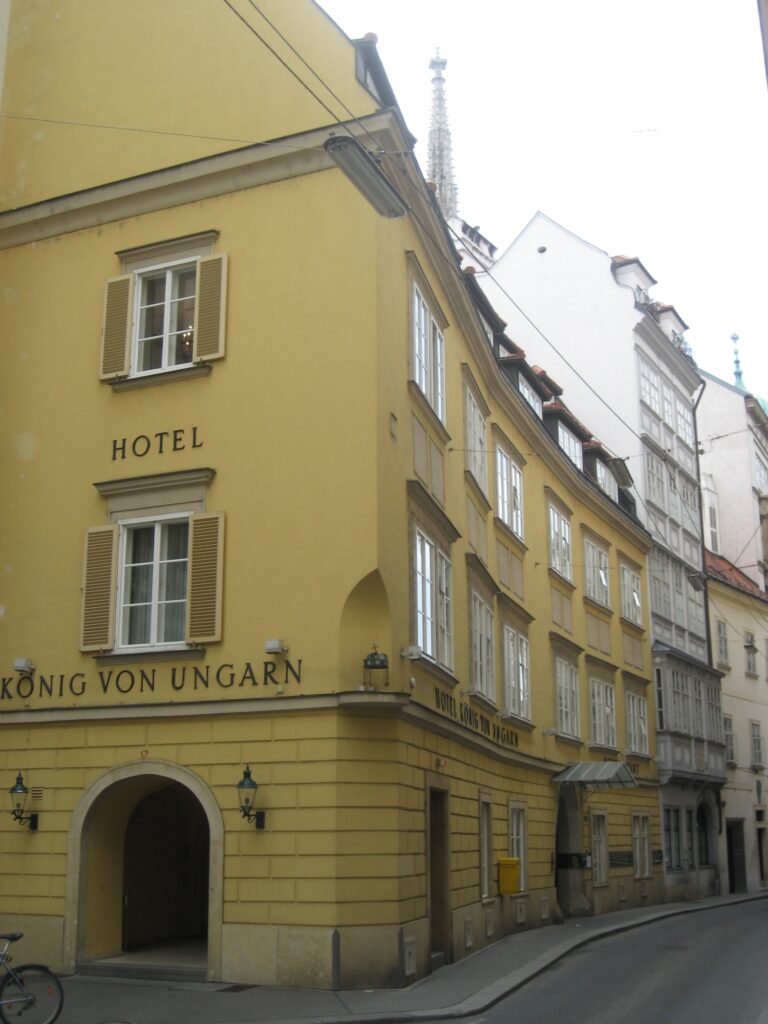

A house first recorded in 1349, known as “The White Rose” in the sixteenth century and as “The King of Hungary” since the seventeenth. It stands two streets from the cathedral and is still an inn, which is what it has been for most of its recorded life.
At a glance
The house fills the corner of Schulerstraße and Domgasse, in the tight grid of lanes just east of St Stephen’s Cathedral. Austria’s Federal Monuments Office lists it as a former Einkehrgasthof, a coaching inn, converted into a hotel, with a core that goes back to the sixteenth century and alterations of the third quarter of the seventeenth. The City of Vienna’s history wiki traces the plot back to a document of 1349. Its name, taken over by the hotel, is recorded from the seventeenth century, and in the late nineteenth century its restaurant was the meeting place of artists’ and writers’ circles that included Anton Bruckner.
Key facts
- Where: Schulerstraße 10 / Domgasse 7, 1010 Vienna (Innere Stadt), Austria
- Protection: listed monument of the Bundesdenkmalamt (object ID 1577), entered as “Zum König von Ungarn, Zur weißen Rose”
- First record of a house on the plot: 29 September 1349
- Historic house names: Zur weißen Rose (16th century), Zum König von Ungarn (from the 17th century); a third name, Zur Post, rests on a single 1927 source
- Building fabric: core from the 16th century, altered in the third quarter of the 17th century (Bundesdenkmalamt); the historian Paul Harrer dated the present house to 1810–1818
- Current use: hotel and restaurant
- Coordinates: 48.208236, 16.375234 · open in Google Maps
History
The first document that mentions a house on this plot is dated 29 September 1349, when it was given as an endowment to fund a Mass at the altar of Our Lady in the Himmelpforte convent. The holder of the endowment could live in the house but had to lodge four poor priests in it. A later foundation that owned it had a vineyard attached and existed to provide dowries for poor young women. In 1537 the house, then called “Zur weißen Rose”, passed into private hands.
The name that stuck appears in the seventeenth century: “Zum König von Ungarn”, the King of Hungary. The hotel adopted it, and the City of Vienna’s history wiki notes that the hotel has existed for more than 150 years. A wrought-iron screen spanning the first-floor corridor carries two dates worked into the ironwork, “gegr. 1764, renov. 1923”, founded 1764 and renovated 1923. The sources do not agree on the age of the walls. Harrer’s manuscript history of Vienna’s houses placed the present building between 1810 and 1818, while the Federal Monuments Office describes a sixteenth-century core altered in the later seventeenth century. We report both datings as the sources give them.
At the end of the nineteenth century the restaurant was the seat of several associations of artists and writers. Their members included the composer Anton Bruckner, the composer Wilhelm Kienzl, Thomas Koschat, the actor Rudolf Tyrolt, the caricaturist Hanns Schließmann and the writer Eduard Pötzl. The house was spared heavy bomb damage in the Second World War, but much of its furnishing was lost while foreign civilian workers were quartered in it; the owner of the time restored the interiors afterwards. Since 1976 the ground floor has been joined to the neighbouring house at Domgasse 5.
What you see
The photograph shows the house at its corner. The walls are rendered in a warm yellow; the ground floor is banded with horizontal grooves and rests on a low stone plinth. At the corner a plain round-arched doorway opens into a vaulted passage, flanked by two wall lanterns. Above it the words HOTEL and KÖNIG VON UNGARN are painted directly onto the render, and the windows of the upper floors have wooden shutters and simple frames with small cornices.
Along the side street the facade runs back in a long line, with the hotel’s name repeated in raised letters over the ground floor and a small glass canopy over a second entrance. The heritage listing describes the upper zone as stone-framed windows grouped in pairs and the corner portal as a chamfered round arch with a keystone. On the Domgasse side the listing notes a projecting upper storey and a broad oriel carried on a row of consoles. Behind the roofs the openwork spire of St Stephen’s closes the view.
Practical information
- The house is a working hotel with a restaurant; the exterior can be seen from the street at any time.
- The corner of Schulerstraße and Domgasse is the best place to see both fronts together.
- Domgasse is narrow and busy with visitors to the Mozart house next door; early morning is quieter.
- Allow ten minutes for the exterior, more if combined with the lanes around the cathedral.
Getting there
The nearest underground station is Stephansplatz (lines U1 and U3). From the cathedral square, walk along the north-east side of the cathedral into Schulerstraße; the house stands at its corner with Domgasse, a few minutes’ walk away. The whole area is pedestrian-friendly and best explored on foot.
Nearby
- The Mozart house at Domgasse 5, where Mozart lived from 1784 to 1787, directly adjoining.
- St Stephen’s Cathedral, under 200 metres to the west.
- The Zacherlhaus on Brandstätte, Jože Plečnik’s granite-clad office building of the early 1900s, on the far side of the cathedral square (see the card).
Sources
- Bundesdenkmalamt, list of protected monuments in Vienna, Innere Stadt (as published in the Denkmalliste for Innere Stadt, Rot–Si): object 1577, “Zum König von Ungarn, Zur weißen Rose”, with the description of the core, the portal, the Domgasse oriel and the 1976 link to Domgasse 5.
- Wien Geschichte Wiki, “Schulerstraße 10”, City of Vienna: the 1349 document, the 1537 sale, the names, Harrer’s dating, the artists’ associations, the ironwork dates and the wartime losses (after Paul Harrer, Wien, seine Häuser, vol. 4/3, pp. 583–586).
- Hotel König von Ungarn, history page: the hotel’s own account of the house.
- Wikidata item Q37847739 and OpenStreetMap / Nominatim: position and address, returned as Zum König von Ungarn, 10, Schulerstraße, Innere Stadt, Wien.
Find it on the map
See this place and what’s around it →📷 Become a Cultural Heritage Online photographer
Share your photos of places: they stay published under your name as the author. The more they're seen, the more you get noticed — and soon a contest will reward the most appreciated photos.
Log in or sign up free to add a photoIs this page about you?
This page is read by travellers and heritage enthusiasts who find it on Google. Tell us how you are connected to this place and we will take it from there.