
.jpg)
The north-west corner of the Louvre closed the Tuileries palace until the fire of 1871. Rebuilt after the Commune, the pavilion and its wing were handed in 1897 to the society that promoted French decorative arts, and its museum has been here since 1905.
At a glance
The Musée des Arts Décoratifs occupies the Pavillon de Marsan and the adjoining Aile de Marsan, the part of the Louvre palace that runs along the rue de Rivoli at the Tuileries end. The first pavilion on this spot was built under Louis XIV as the northern end of the Tuileries palace. It burned with the Tuileries in 1871 and was rebuilt by Hector-Martin Lefuel from 1874. In 1897 the state assigned it to the Union centrale des arts décoratifs, a private association founded in 1864, which fitted it out as a museum and a library. The museum was inaugurated on 29 May 1905. The Louvre palace as a whole is a classified historic monument.
Key facts
- Where: 107 rue de Rivoli, 75001 Paris, in the Louvre palace
- First building: Pavillon de Marsan, 1659–1666, the north end of the Tuileries palace
- Present building: rebuilt 1874–1879 by Hector-Martin Lefuel after the fire of 1871
- Museum fit-out: 1898–1905, architect Gaston Redon, assisted by Paul Lorain
- Museum opened: 29 May 1905
- Run by: Les Arts Décoratifs, the association founded in 1864 as the Union centrale
- Protection: part of the Palais du Louvre, monument historique (classé; Mérimée PA00085992)
- Coordinates: 48.863169, 2.332951 · open in Google Maps
History
Under Louis XIV the Tuileries palace, which then closed the west side of the Louvre, was completed at its northern end by a large pavilion built between 1659 and 1666, a match for the Pavillon de Flore at the southern end by the Seine. It stood where the rue de Rivoli now passes, and in the eighteenth century took its name from Marie-Louise de Rohan.
In 1871, during the Commune, the Tuileries were set on fire and the Pavillon de Marsan burned with them. The ruins were cleared, and from 1874 Lefuel rebuilt the pavilion and the wing next to it on a slightly wider footprint, giving Marsan the architecture he had already used when he rebuilt the Pavillon de Flore in the 1860s. The Tuileries palace itself was never rebuilt, which left Marsan and Flore as the two ends of the Louvre facing the garden.
The Union centrale, founded in 1864, had been showing its collections only in temporary homes, at the Louvre in 1878 and at the Palais de l’Industrie from 1880. In 1897 it was given the Pavillon de Marsan and part of the north wing of the Louvre. Gaston Redon, with the Union’s architect Paul Lorain, converted the building; the library opened in 1904 and the museum on 29 May 1905, in the presence of the President of the Republic, Émile Loubet.
What you see
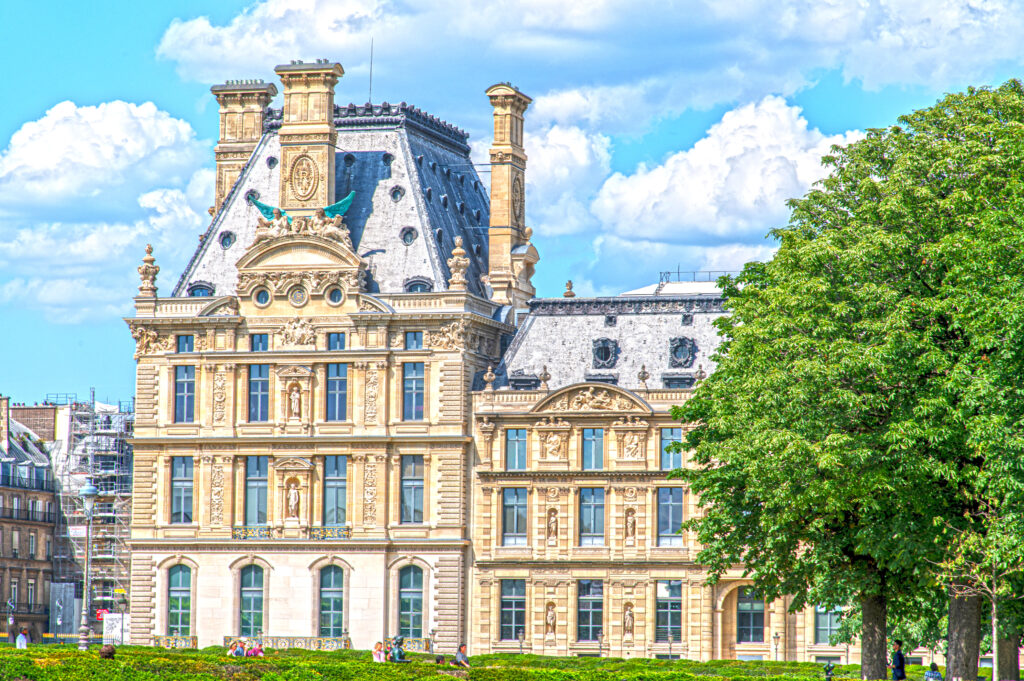
The photograph looks at the south front of the pavilion from the lawns of the Tuileries. The building is in pale limestone over three main storeys, the ground floor opened by tall round-headed windows and the upper floors by rectangular windows separated by carved panels and by statues standing in niches. A steep roof of grey slate rises above, pierced by round and oval windows, and flanked by tall carved chimney stacks.
At the top of the front, a curved pediment carries a sculptural group with green copper wings: Wikipedia and the Commons record of the pediment identify it as an allegorical winged lion by Théodore-Charles Gruyère, dated 1878. To the right, the lower Aile de Marsan continues the same vocabulary of pediments, niche statues and slate roof. At the far left of the picture, scaffolding marks restoration work in progress when the photograph was taken.
Practical information
- The Musée des Arts Décoratifs is open to the public; check the museum’s website for current opening days, hours, exhibitions and tickets.
- The entrance is on the rue de Rivoli, separate from the entrances of the Musée du Louvre.
- The south front is best seen from the Tuileries garden, which is open daily.
- Allow at least two hours for the collections; the exterior takes ten minutes.
Getting there
The nearest Métro stations are Palais Royal–Musée du Louvre (lines 1 and 7) and Tuileries (line 1), each a few minutes on foot along the rue de Rivoli. Pyramides (lines 7 and 14) is also close.
Nearby
- Louvre Museum, in the rest of the palace.
- The Tuileries garden, directly south of the pavilion.
- Palais-Royal, across the rue de Rivoli to the north-east.
Sources
- Musée des Arts Décoratifs, 29 mai 1905 : l’inauguration du Musée des Arts Décoratifs au pavillon de Marsan: the temporary exhibitions of 1878 and 1880, the assignment of 1897, Redon and Lorain, reconstruction from 1874, the inauguration of 29 May 1905 attended by President Loubet.
- Blue Lion Guides, Les pavillons de Flore et de Marsan: the first pavilion of 1659–1666 and its rebuilding in the style of Lefuel’s Flore.
- Ministère de la Culture, Mérimée PA00085992, Palais du Louvre, classified historic monument, as listed in the Liste des monuments historiques du 1er arrondissement de Paris.
- Les Arts Décoratifs, depuis 1864: the institution and its founding date.
- Wikipedia, Pavillon de Marsan: the Rohan name, the fire of 1871, Lefuel’s dates 1874–1879, the Gruyère lion of 1878.
- OpenStreetMap / Nominatim: position, returned as Musée des Arts Décoratifs, 107, Rue de Rivoli, Paris 1er.
Find it on the map
See this place and what’s around it →📷 Become a Cultural Heritage Online photographer
Share your photos of places: they stay published under your name as the author. The more they're seen, the more you get noticed — and soon a contest will reward the most appreciated photos.
Log in or sign up free to add a photoIs this page about you?
This page is read by travellers and heritage enthusiasts who find it on Google. Tell us how you are connected to this place and we will take it from there.