

Haussmann’s new boulevards pushed the old Gaîté off the boulevard du Temple, and it was rebuilt on rue Papin. Offenbach ran it, Diaghilev’s dancers premiered Stravinsky here, and after the auditorium was lost in 1989 the surviving front became a centre for digital arts and music.
At a glance
La Gaîté Lyrique occupies the former Théâtre de la Gaîté at 3 bis rue Papin, facing the square in front of the Conservatoire national des arts et métiers. The theatre opened on 3 September 1862, designed by Jacques-Ignace Hittorff with Alphonse Cusin, as the replacement for a Gaîté that had stood on the boulevard du Temple since the eighteenth century. For a century it staged melodrama, operetta and opera. The Italian-style auditorium was demolished in 1989, but the façade, the entrance hall and the grand foyer survived, and the building is inscribed as a historic monument. Restored by the architect Manuelle Gautrand, it reopened as a cultural venue of the City of Paris.
Key facts
- Where: 3 bis rue Papin, 75003 Paris (Quartier des Arts-et-Métiers)
- Built: 1861–1862; opened 3 September 1862
- Architects: Jacques-Ignace Hittorff and Alphonse Cusin, who designed the foyer decoration
- Original capacity: about 1,800 seats
- Protection: inscribed as a monument historique on 28 February 1984 (Mérimée PA00086237); owned by the City of Paris
- Restoration: Manuelle Gautrand, reopened 2010–2011
- Current use: cultural centre of the City of Paris (concerts, exhibitions, performances)
- Coordinates: 48.866581, 2.353387 · open in Google Maps
History
The Gaîté began on the boulevard du Temple, the Paris street of popular theatres, where Jean-Baptiste Nicolet opened his house in 1759. A century later Haussmann’s transformation of the district cleared the old theatre, and it was rebuilt a short distance west, on the edge of the square beside the Arts-et-Métiers. The heritage register names Hittorff as architect and dates the work to 1861; the new Gaîté opened on 3 September 1862 with about 1,800 seats.
Within ten years its repertoire moved from melodrama to operetta and opera. The theatre premiered Offenbach’s Le Roi Carotte (1872) and Le Voyage dans la Lune (1875), and Offenbach himself directed it in 1873–1874; Saint-Saëns’s opera Le Timbre d’argent had its premiere in 1877. The name Gaîté-Lyrique, used from 1907, records that shift. Between the wars Serge Diaghilev’s Ballets Russes performed here, and the theatre saw the premieres of Prokofiev’s Chout (1921) and Stravinsky’s Les Noces (1923).
After the Second World War audiences fell. Paris-Promeneurs dates the closure of the theatre to 1963. In 1989 an amusement park, Planète Magique, was installed in the building; the auditorium was destroyed, and only the façade, the entrance hall with its staircase and the grand foyer were kept. The park closed in 1991. The City of Paris decided in 2001 to give the building to contemporary music and digital arts, and the architect Manuelle Gautrand rebuilt the interior behind the historic front. La Gaîté Lyrique opened in December 2010 and has been run since 2023 by a group of partners for the city.
What you see
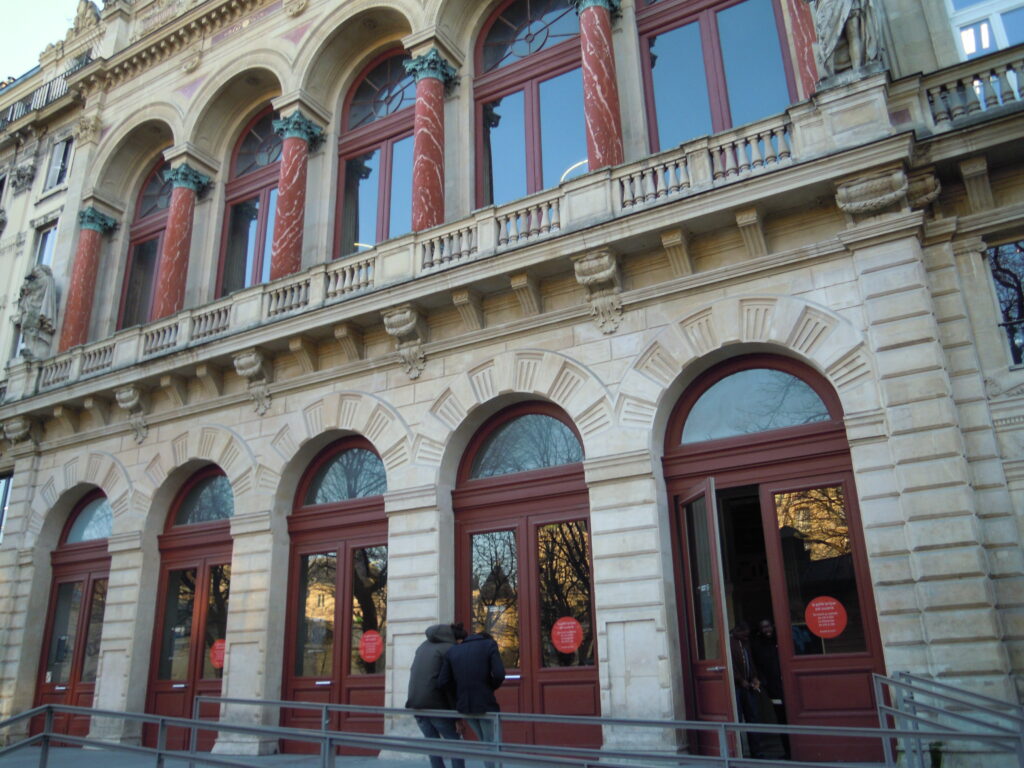
The photograph shows the front from close to the ground. The lower storey is an arcade of round arches in heavily rusticated stone, the voussoirs cut in bold wedges, each arch filled with a wine-red door and a fanlight. A cornice on carved stone brackets carries a stone balustrade running the length of the front.
Above it the upper storey opens as a loggia of tall arched windows, separated by columns whose shafts are painted a mottled red in imitation of marble, under greenish Corinthian capitals. A sculpted figure stands at the right-hand end of the loggia; the Blue Lion guide identifies the two statues of the front as Drama, in the person of Hamlet, and Comedy, in the person of Scapin. Behind this loggia is the historic foyer, where Cusin’s 1862 decoration and the painted allegories by Armand Jobbé-Duval survive.
Practical information
- La Gaîté Lyrique is a public cultural venue; the ground floor is open Tuesday to Sunday, with longer hours on weekdays. Check the official site for current hours and programme.
- The façade can be seen at any time from the square in front.
- Allow half an hour to see the front and the public spaces.
Getting there
The nearest Métro stations are Réaumur–Sébastopol (lines 3 and 4) and Arts et Métiers (lines 3 and 11), each a few minutes on foot. The theatre faces the square on the east side of the boulevard de Sébastopol; the entrance is on rue Papin.
Nearby
- The tree-planted square in front of the theatre, behind its iron railings.
- The Musée des Arts et Métiers, in the former priory of Saint-Martin-des-Champs, across rue Réaumur.
- The boulevard du Temple, where the original Gaîté stood, a ten-minute walk east.
Sources
- Ministère de la Culture, POP / Mérimée PA00086237, Théâtre de la Gaîté Lyrique: address, 1861, architect Hittorff, inscription of 28 February 1984, municipal ownership.
- Paris-Promeneurs, La Gaîté Lyrique: the move from the boulevard du Temple, the name of 1907, closure in 1963, the 1989 amusement park, the city’s decision of 2001, Gautrand’s project. This source credits Cusin alone and dates the new building to 1863.
- Blue Lion Guides, La Gaîté Lyrique: Nicolet in 1759, the statues of Drama and Comedy, the foyer by Cusin and the paintings by Jobbé-Duval.
- La Gaîté Lyrique, official site: current status as a cultural establishment of the City of Paris and its partners since 2023.
- Wikipedia, Théâtre de la Gaîté (rue Papin): opening date, capacity, Offenbach’s tenure and the premieres of 1872–1923.
- OpenStreetMap / Nominatim: position, returned as La Gaîté lyrique, 3 bis, Rue Papin, Paris 3e.
Find it on the map
See this place and what’s around it →📷 Become a Cultural Heritage Online photographer
Share your photos of places: they stay published under your name as the author. The more they're seen, the more you get noticed — and soon a contest will reward the most appreciated photos.
Log in or sign up free to add a photoIs this page about you?
This page is read by travellers and heritage enthusiasts who find it on Google. Tell us how you are connected to this place and we will take it from there.