

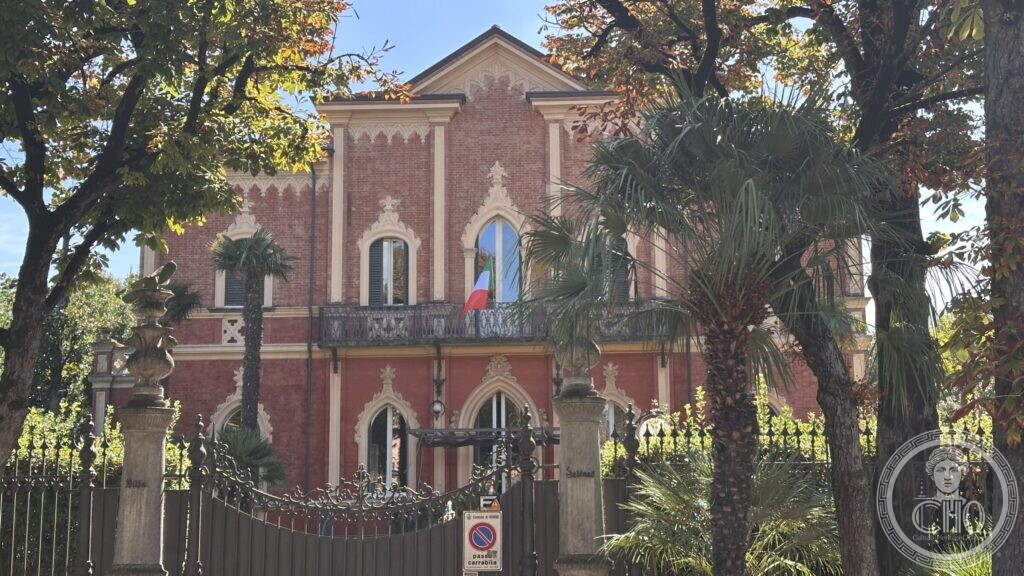
Rimini gave the land away for nothing to get this house built. It was a bet on a new kind of town — the seaside quarter — and it paid.
At a glance
Villa Solinas stands on viale Principe Amedeo, next to the parish church of San Girolamo, and it is the most inventive of the first villas built on Rimini’s marina. It was designed in 1874 by Gaetano Urbani, the town’s municipal engineer, for Gian Maria Solinas Apostoli, a Sardinian financier and member of parliament who got the plot free from the town council. Urbani gave him the “modern Gothic” that was then sweeping European eclecticism: brick walls, pale stone and terracotta dressings, cusped pointed windows, and a garden laid out in the English manner with statues and winding paths.
Key facts
- Built: from 1874
- Architect: Gaetano Urbani (1823–1879), municipal engineer of Rimini, who designed the first villas of the marina
- Client: Gian Maria Solinas Apostoli, born in Sassari, died in Rome in 1914; a member of the national parliament and of the financial world, later appointed senator
- The land: granted free by Rimini town council under mayor Pietro Fagnani, who had municipalised the bathing establishment
- Style: “modern Gothic”, within European eclecticism
- Materials: selected brick under lime tints, window sills in San Marino stone (still the original ones), Istrian stone, terracotta ornament, and decorative work in coloured cement
- Restored by: the architect Massimo Mori, who returned the original colours, materials and facade cresting
- The monograph: Giovanni Rimondini, Villa Solinas. Le prime dieci ville di Marina centro e l’opera dell’ingegnere comunale Gaetano Urbani (1823–1879), Maggioli, 1998
- Coordinates: 44.070260, 12.575950 — Google Maps
History
Rimini’s seaside town did not grow by itself; it was built on purpose, and it began with bathing. In 1843 the brothers Ruggero and Alessandro Baldini opened the first bathing establishment on this shore. Thirty years later the municipality, under mayor Pietro Fagnani, took the establishment into public hands and set about turning the empty ground between the city and the sea into a residential quarter. The avenue that now carries Prince Amedeo’s name was then known simply as the Stradone dei bagni, the baths road, with trees along both pavements.
To get villas built, the council gave plots away. In 1874 Gian Maria Solinas Apostoli was awarded his for nothing. He was, in the words of the historian Giovanni Rimondini, “certainly not a nobleman of high rank, but a great bourgeois, a figure of some weight in the national Parliament and the financial world, whose career culminates and ends with his appointment as senator”. He came from Sassari and belonged to the mixed bourgeois and aristocratic world that ran post-unification Italy; the connection with Rimini may have come through Enrico Serpieri, who owned mines in Sardinia and from 1863 chaired the Cagliari chamber of commerce, or simply through Rimini’s own members of parliament.
The design went to Gaetano Urbani, the municipal engineer, who built the first villas of the new quarter and who was following what was then the newest thing in Europe: the Gothic revival inside the wider eclecticism of the 1870s. Rimini Sparita’s account is blunt about the result — Urbani gave Villa Solinas characteristics “not found in any other building” here. Rimondini devoted a whole book to the villa and to Urbani’s first ten villas of Marina Centro.
The garden was laid out in the English manner, irregular, with winding paths and statues; Urbani had seen and admired the gardens of the Ardenza at Livorno, and drew on them here and for the gardens of the bathing establishment. The fountain that faces the front of the house is the work of the Rimini sculptor Filogenio Fabbri — which places it well after the villa itself, since Fabbri was born in 1880; he is the same sculptor who made the Fountain of the Four Horses a few hundred metres away. The decorated iron railing along the street survived the regime’s requisition of metal before the Second World War, and is still there.
The setting has changed around it. In 1964 the parish church of San Girolamo went up next door in the frankly modern forms given it by the architect Luigi Fonti, and the villa now stands against it — a contrast that is the first thing anyone walking the avenue notices.
What you see
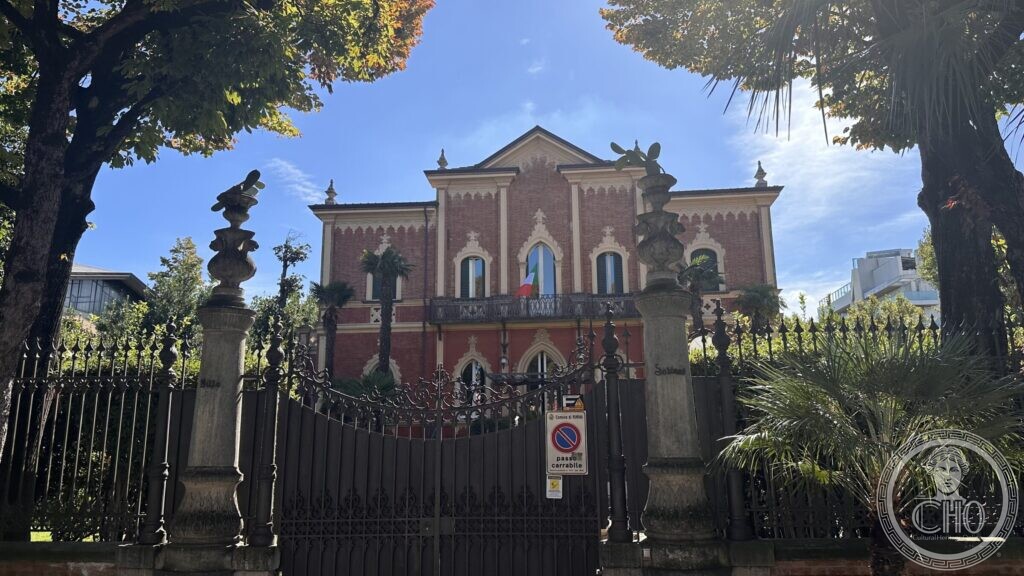
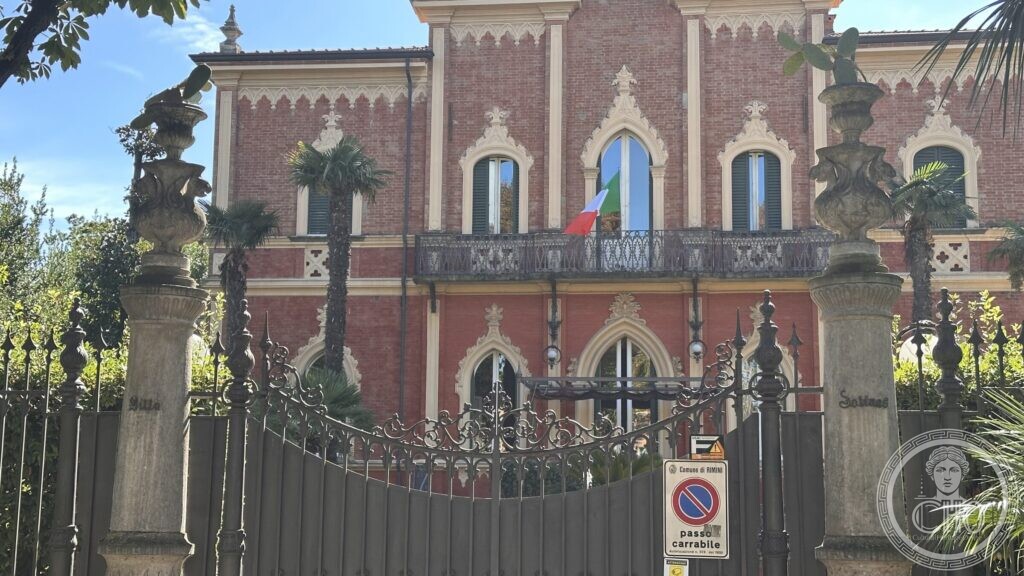
Two floors over a service basement, in warm red brick, with every opening and edge drawn in pale stone and cement. The composition is symmetrical: a central block with a steep gable crowned by a carved foliate finial, and wings on either side. The upper windows are pointed and cusped, set in moulded hoods that rise to small finials; under the eaves runs a band of miniature pointed arcading, the most Gothic thing on the building and the detail that carries round every side.
In front of the central window a long iron balcony runs on stone brackets, its railing filled with Gothic quatrefoils. The window sills are San Marino stone and are the original ones; the rampant beasts and the flowers of the cresting are in coloured cement, a cheap modern material used for an archaic effect — which is exactly what eclecticism was for.
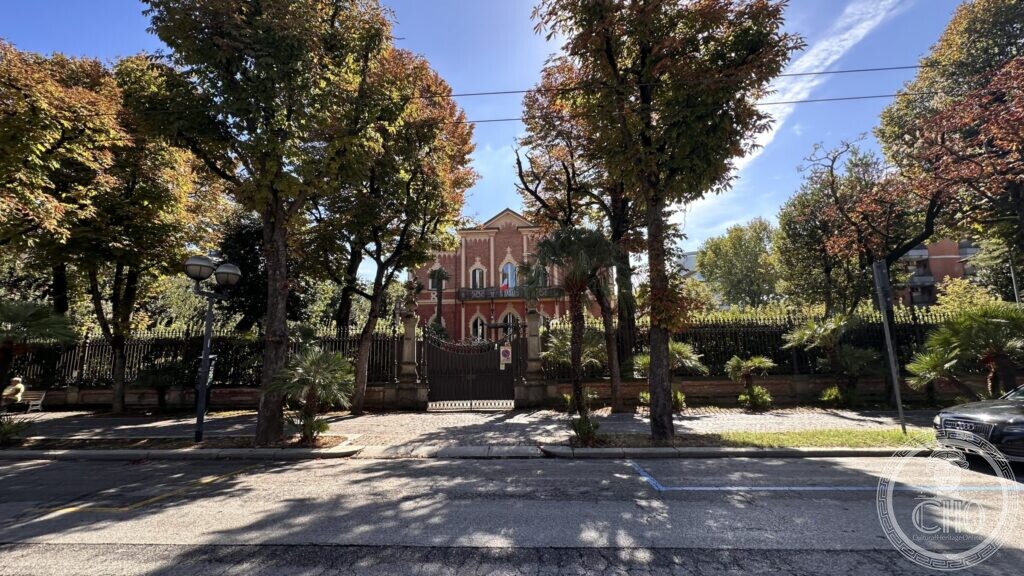
At the street, the iron railing is hung between low walls and stone pillars; the two pillars of the carriage gate are topped with carved cimase bearing curious fantastic animals, and each carries the name of the house in cursive relief: Villa on one, Solinas on the other. Behind them the garden is thick with palms and tall trees, and the house shows through in pieces.
The villa today

Practical information
- Villa Solinas is a private house. Everything on this page was photographed from the public pavement; the garden and the building are not open.
- It stands immediately beside the parish church of San Girolamo, which is the easiest landmark to find it by.
- The two gate pillars carry the name: it is the quickest way to be sure you are looking at the right villa, because the avenue has more than one brick house with pointed windows.
Getting there
Viale Principe Amedeo runs from Rimini station to the sea; the villa is about two thirds of the way down, on the seaward side, roughly fifteen minutes on foot from the station. Bus 11 along the seafront stops at Piazzale Fellini, five minutes further on.
Nearby
- Villa Lega Baldini, almost opposite: the first villa of the marina, by the same architect
- The Fontana dei Quattro Cavalli in Parco Federico Fellini, by Filogenio Fabbri, who also made the fountain in this garden
- Grand Hotel Rimini, at the sea end of the avenue, with a 360° virtual tour
- Kursaal di Rimini — the bathing palace of the same seafront, demolished in 1948
- The abandoned Liberty villa at the corner of viale Centauro, a few minutes south along the same avenue
Sources
- Giovanni Rimondini, Villa Solinas. Le prime dieci ville di Marina centro e l’opera dell’ingegnere comunale Gaetano Urbani (1823–1879), Maggioli Editore, 1998 (175 pp., ISBN 88-387-1289-1) — the monograph on this building.
- Annamaria Bernucci, «Chiamami Città», republished by the Associazione Rimini Sparita as Villa Solinas, la più bella del viale (2018) — the source for the free grant of the land, the restoration by Massimo Mori, the English garden and the fountain by Fabbri.
- Associazione Rimini Sparita, Ruggero Baldini (1824–1904) — for the 1843 bathing establishment and the making of the marina.
- Archivio storico Istituto Luce, photograph Lungo, ampio viale alberato con villini — viale Principe Amedeo (?), Rimini Marina, dated 1928, for the avenue as it was.
- Biblioteca Gambalunga, Rimini, photographic archive — Di foto in foto. Scatti di oltre un secolo di vita balneare riminese.
- The name on the gate pillars, and the building itself, photographed on site on 11 September 2026.
Find it on the map
See this place and what’s around it →Record researched and written by Luigi De Marchi for Cultural Heritage Online, 2026.
📷 Become a Cultural Heritage Online photographer
Share your photos of places: they stay published under your name as the author. The more they're seen, the more you get noticed — and soon a contest will reward the most appreciated photos.
Log in or sign up free to add a photoIs this page about you?
This page is read by travellers and heritage enthusiasts who find it on Google. Tell us how you are connected to this place and we will take it from there.