

Bangkok, Thailand · 1807–1847 · Royal temple
At a glance
A temple built around a Buddha, not the other way round. In 1807 Rama I, the king who had founded Bangkok twenty-five years earlier, had a swamp at the centre of his new capital filled with brick and stone and laid the foundation of a great hall to hold a bronze image he had brought down from the ruined royal capital of Sukhothai. He died three years later with the work barely begun. His son carved the doors. His grandson, Rama III, finished the temple, added an ordination hall beside the first one, and held the consecration in 1847, forty years after the first stone.
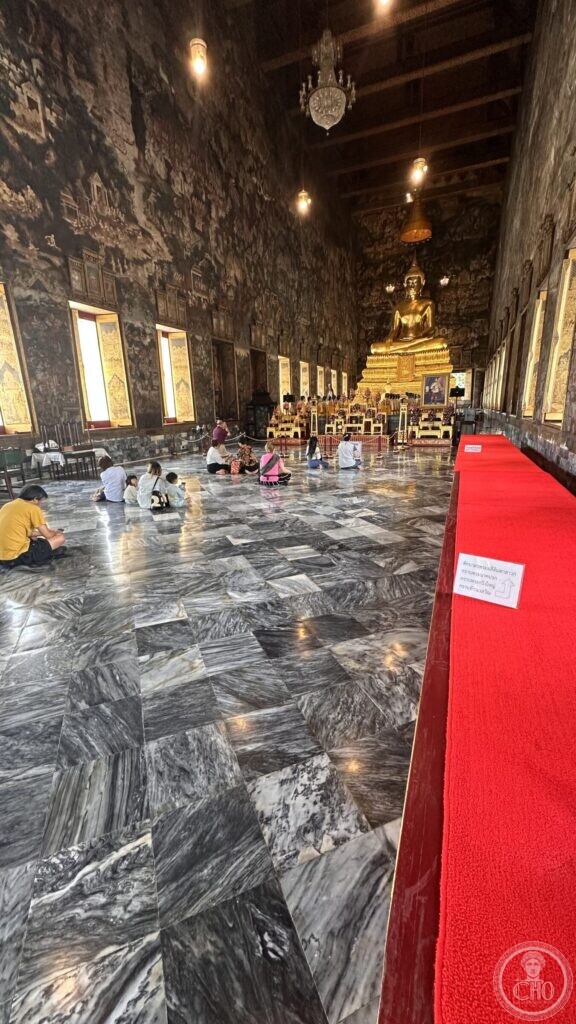
The photographs on this page were taken in that second building, the ordination hall — completed in 1843 and the longest in Thailand — where a second great bronze sits above a long row of altars in the middle of eighty disciples who lean in to listen. The walls are painted from floor to ceiling. The temple has been a registered archaeological site since 1949.
Key facts
- Full name: Wat Suthat Thepwararam Ratchaworamahawihan (วัดสุทัศนเทพวรารามราชวรมหาวิหาร)
- Begun: B.E. 2350 (1807), by King Rama I, on ground filled to carry the building
- Completed and consecrated: B.E. 2390 (1847), under King Rama III (born 1788; crowned 1 August 1824; died 2 April 1851)
- Named Wat Suthat Thepdharam by Rama III; renamed Wat Suthat Thepwararam by Rama IV
- Wihan (the first hall): the largest in Bangkok; its image, Phra Si Sakyamuni, is an 8-metre bronze, one of the largest surviving Sukhothai bronzes, brought from Wat Mahathat in Sukhothai
- The image came to Bangkok by water in B.E. 2351 (1808), in a procession that took seven days; a city gate had to be taken down to get it inside the walls
- Ubosot (ordination hall): completed 1843, the longest in Thailand, built under Rama III
- Its image, Phra Buddha Trilokachet (พระพุทธตรีโลกเชษฐ์), was cast at the Grand Palace in the same reign; the temple’s own notice presents the group as the Buddha giving instruction among the eighty great disciples (พระอสีติมหาสาวก)
- Teak doors: 5.5 metres high, 1.5 metres wide, 15 centimetres thick, from the reign of Rama II
- Cloister: 156 gilded Buddha images
- Murals: Buddhist cosmology, restored in the 1980s
- Rama VIII took the temple as the royal temple of his reign; after his death his ashes were enshrined here, and a monument to him was raised in the grounds in B.E. 2515–2516 (1972–73)
- Registered by the Fine Arts Department: Royal Gazette, vol. 66, part 64, p. 5281, 22 November 1949
- Rama III’s building programme: 19 new temples built, more than 60 repaired or added to
- Coordinates: 13.750120, 100.500960
What you see
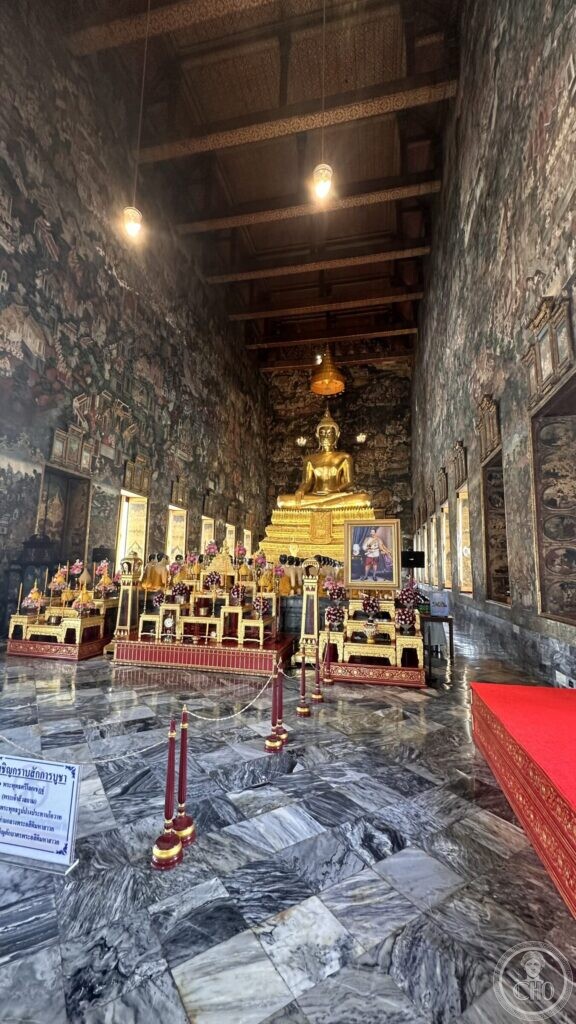
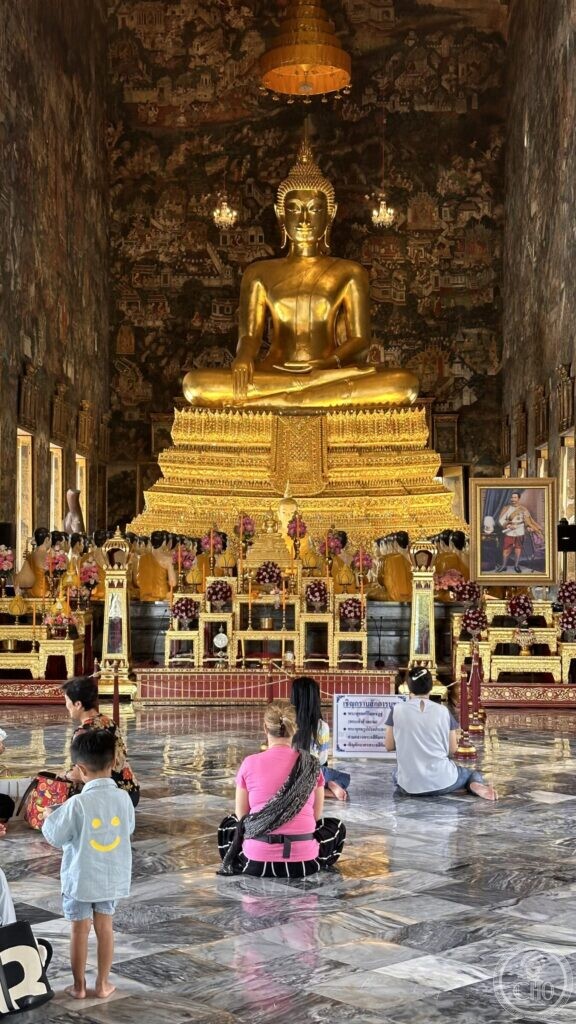
The hall is enormous and dim, and much taller than it looks from outside. The first thing you notice is that nobody is treating it as architecture. People come in barefoot, sit down on the grey marble in whatever part of the floor is free, and stay — families with small children, people on their own, people who have clearly stopped in on the way to somewhere else and are in no hurry to leave. The gold at the far end is a long way off. Overhead the ceiling is coffered in red and gold on heavy timber beams, and the height of the room is the whole point: it was built to make a seated figure look far away.
The windows are set low, so what daylight there is lands on the marble and on the bottom two or three metres of the paintings; everything above stays in half dark, and the eye has to work its way up. The floor is grey and white marble laid on the diagonal. Between the visitor and the image runs a long table of gilded altars loaded with flowers, candles and small images, and a framed royal portrait stands at one side of it on an easel. A red carpeted platform runs along one wall for the monks. There is no ticket desk in this hall and no route through it. A printed notice on a stand asks, in Thai and English, that visitors pay respect properly; nobody is supervising whether they do.
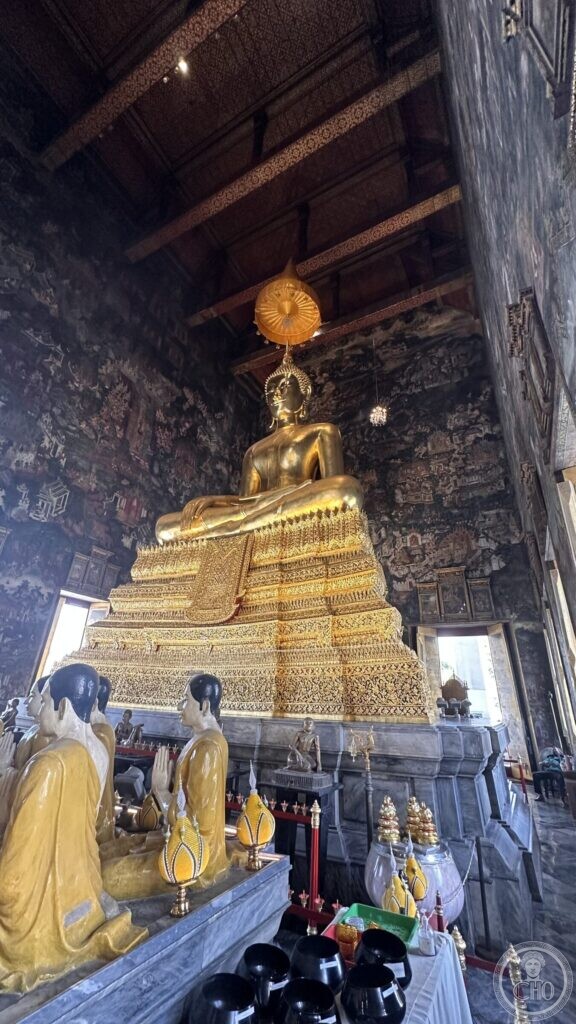
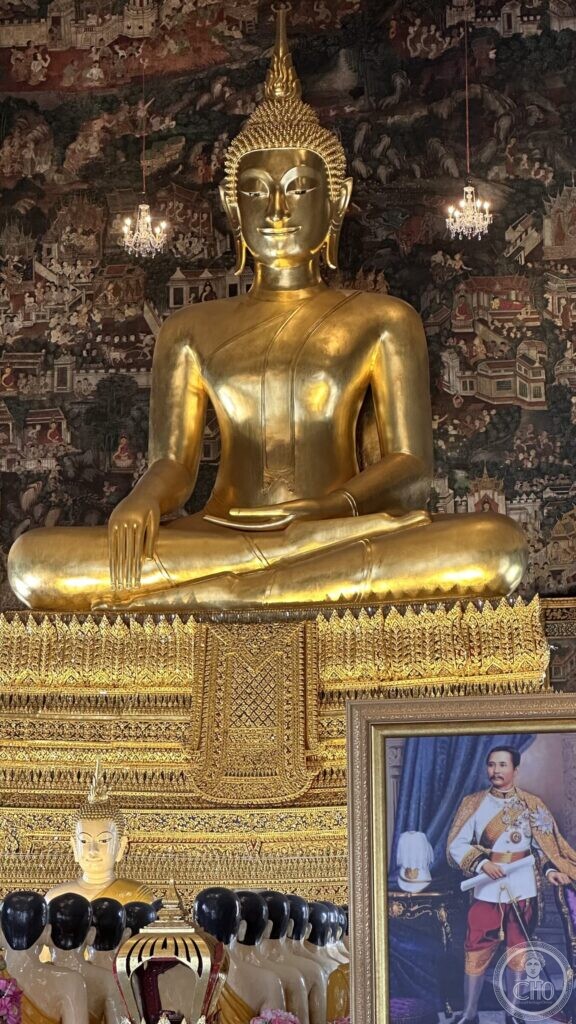
At the end of the hall the Buddha sits on a tall tiered base, gilded to the last centimetre, under a ribbed gold parasol hung from the roof structure, and the gold is the only thing in the room that is properly lit. The figure sits with the legs folded, the left hand open in the lap and the right laid down over the right knee. The face is smooth and the expression deliberately unemphatic, the eyes lowered, the mouth almost level; the flame at the crown rises out of a cap of tight curls. The temple’s own notice, propped on the floor by the altars, names the image Phra Buddha Trilokachet and presents the whole group as one scene: the Buddha giving instruction to the eighty great disciples.
The disciples are the thing this hall has that no other has. They sit in rows on the floor in front of the base — small, dark-haired, in yellow robes, hands together — all facing the same way, so that from the back of the hall the great bronze looks like the far end of a congregation rather than a statue on a pedestal. The image was cast at the Grand Palace in the reign of Rama III, the reign that finished the temple, and the base beneath it is dense with carved and gilded ornament to the last centimetre. Two small cut-glass chandeliers hang in the gloom on either side, Western objects in a Thai hall, and they are not an anomaly: imported glass, mirror and European ornament turn up all through the temples finished in this reign.
In front of the first row stand the disciples’ alms bowls, black lacquer with the lids off, and the notice by the altars invites visitors to fill them: the eighty receive alms here as living monks do on a morning round. Between the bowls and the base the tables are crowded with yellow-wrapped offering sets, flowers and small gilded images. It is the clearest sign that the group is treated as a congregation and not as sculpture, and it is why the hall, for all its scale, feels like a room where something is about to be said.
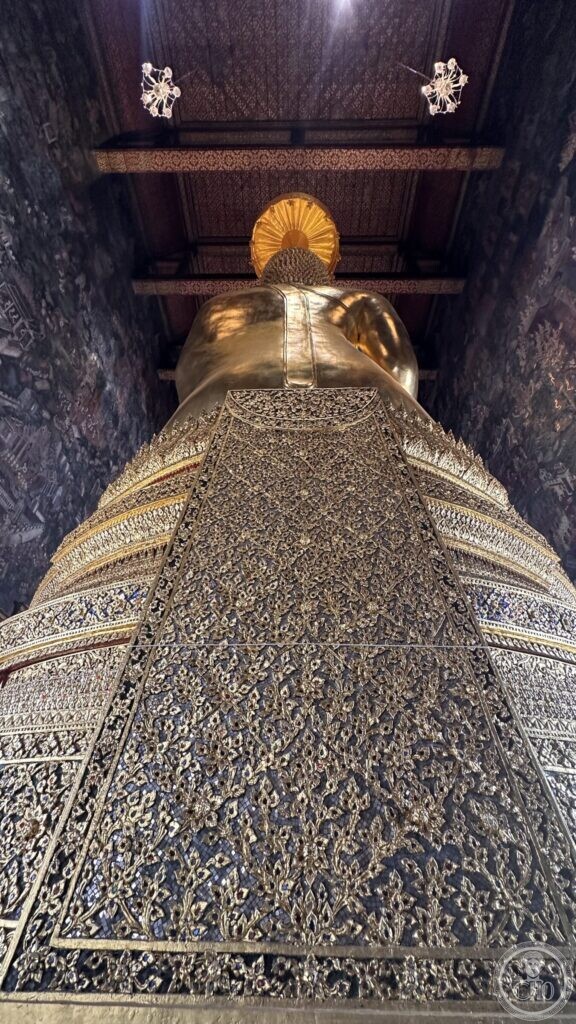
Stand at the foot of the base and look straight up and the image disappears into itself. The base is sheathed in a lattice of gilded ornament over a dark ground that runs the whole width of the room, and from directly underneath it fills the frame and the figure vanishes behind its own shoulder. The only things that stay legible are the mass of the lap, the ribbed gold disc of the parasol standing out behind the head, and the beams crossing the dark above.
It is worth walking up and doing this once. The image was made to be read from the floor at a distance; from directly underneath it stops being a portrait and becomes a shape, and you get a sense of the physical size of the thing that the view from the back of the hall carefully conceals. Then walk back, sit down, and it becomes a small bright figure at the far end of a very long room again, which is what the building was designed to do, and still does, four reigns after the king who started it died with the foundations barely out of the ground.
The paintings
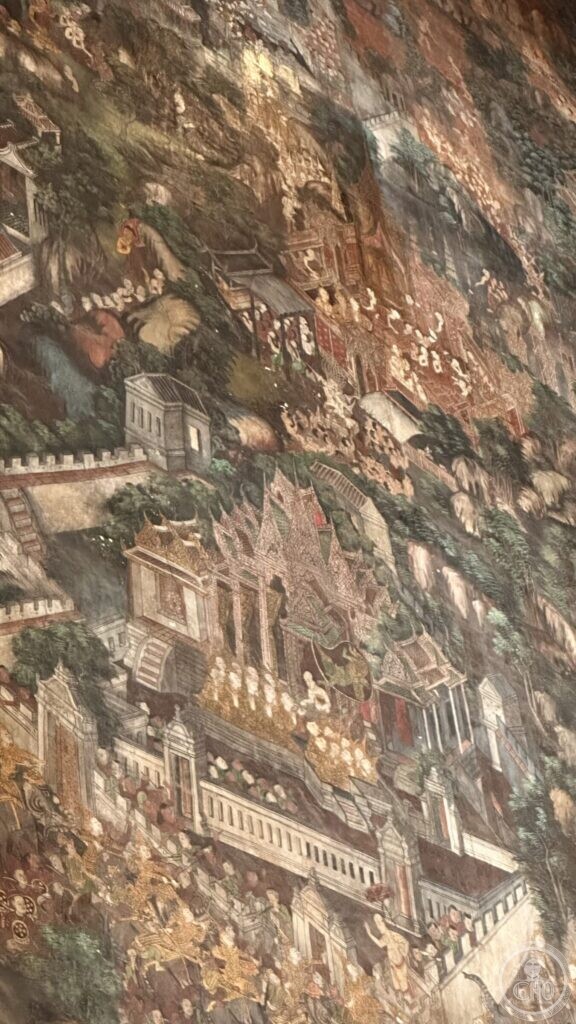
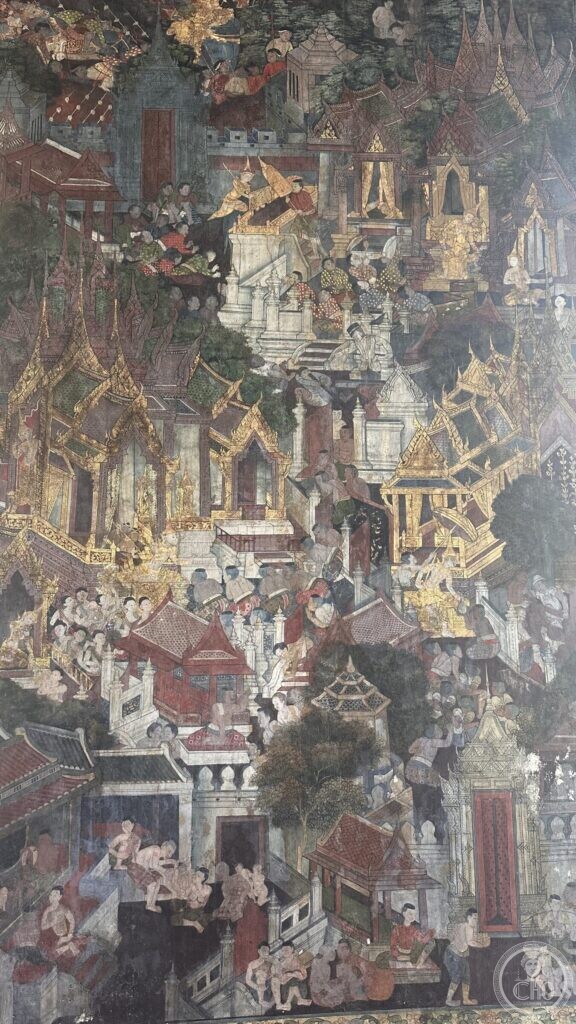
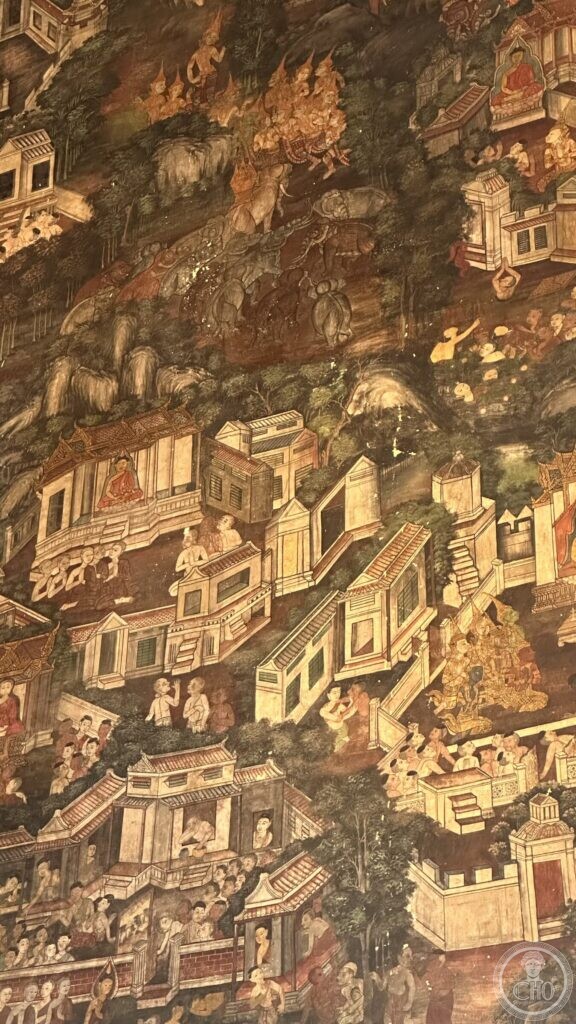
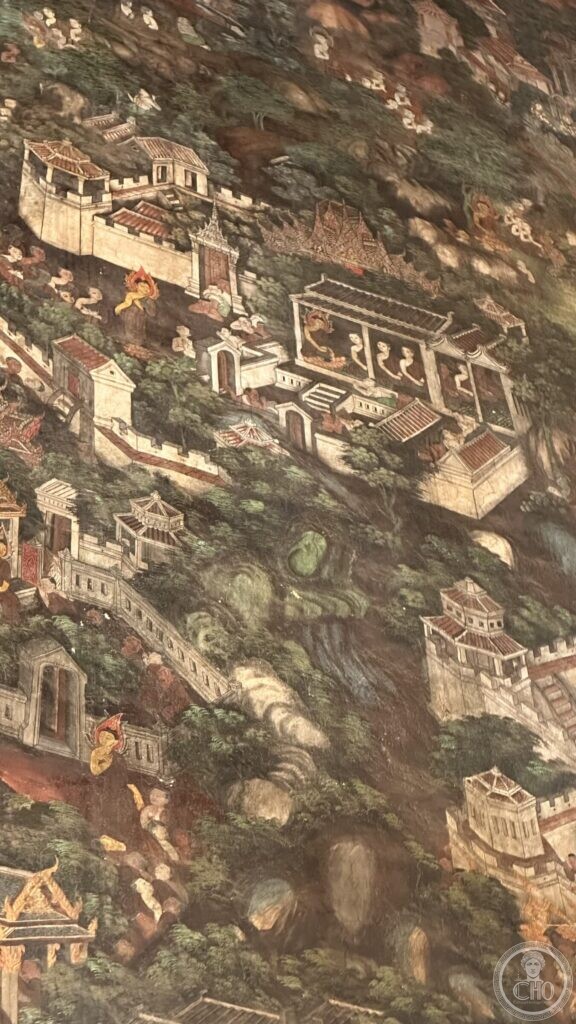
Every wall is covered, and the paintings are the reason to stay longer than it takes to look at the image. From the middle of the floor they read as dark texture; only close up do they break into thousands of separate figures. They are not decoration between the windows. They are a single continuous landscape — hills, forest, walled cities, temple compounds, rivers, processions, elephants, monks, crowds — in which the same world is drawn at a dozen scales at once, so that a hillside with two figures on it sits directly above a courtyard holding two hundred.
In one stretch a whole town is packed into a few square metres: tiled roofs overlapping, gateways, terraces with people leaning on them, monks seated in open pavilions, a flight of winged figures crossing the top of the scene. There is no single vanishing point and no horizon. The town is stacked up the wall rather than laid back into depth, and buildings that would be far away are simply drawn higher and smaller, with trees and rock forms wedged between them to keep one scene from running into the next. That device — a zigzag of landscape used as a frame — is how Thai wall painting organises a wall, and once you have seen it you can follow the divisions across the whole hall.
Higher up, the crowds thin and the landscape takes over: a procession of deities on elephants crosses a hillside above a walled city, a line of gods in flight follows the top of the wall, and forest closes in around white-walled compounds with their gates shut. The same painter who packs two hundred figures into a courtyard leaves whole slopes to rock and trees, and the change of density is what lets the eye rest.
Among the Thai roofs there are buildings that have no business being there: pedimented facades, balustrades, arcades, the architecture of somewhere else, copied by painters who were working in the 1830s and 1840s in a kingdom that was being approached by Europe. They are drawn with the same care as the temples beside them and given the same place in the landscape, as if a pedimented villa on a hillside were the most ordinary thing in the world. That collision, painted on a temple wall, is the most surprising thing in the building.
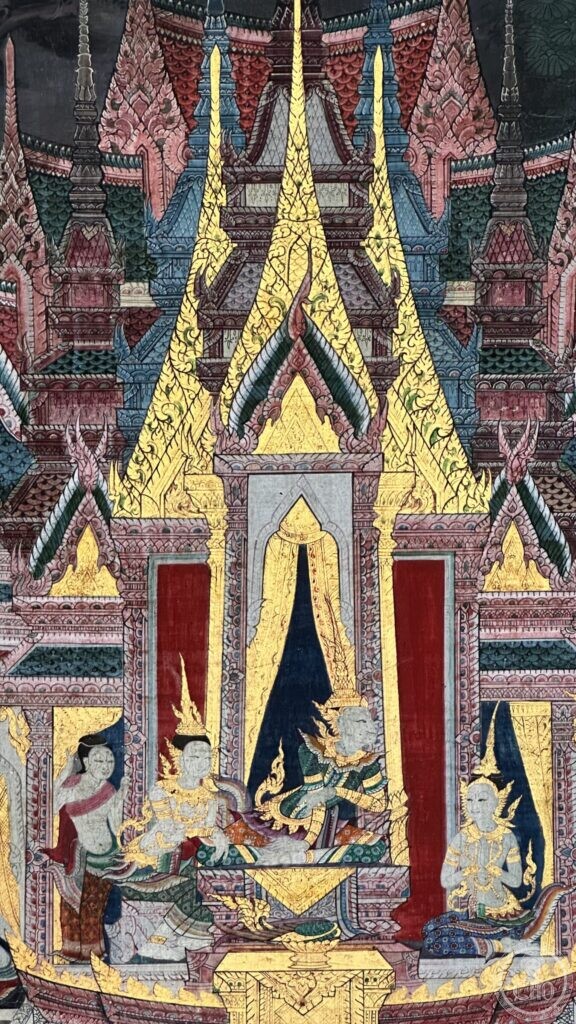
It is also of a piece with everything else the reign left here. The Chinese stone figures outside, the cut-glass chandeliers in the hall, the European buildings on the walls: the temple that Rama III completed took what arrived by sea and put it beside Thai forms without assimilating it, and the walls of the ordination hall are where that habit is easiest to see. Gold is used sparingly and precisely, on roofs, on thrones, on the spires of the painted palaces, against grounds of dark green, brick red and a brown that has gone browner with age.
Elsewhere the painter spends everything on one building. A palace rises in tiers of pink and green tiled roofs, its three gilded spires laid on in gold leaf, with a curtained throne at the centre and attendants seated on either side at a fraction of the scale, hands raised. The gold is the actual metal and it still catches whatever light reaches that height, which is the point: these upper registers were meant to be seen by lamplight and candle, not in daylight.
Lower down, in places, the surface has flaked back to the bare plaster in white patches that the eye reads as snow until it corrects itself. Nobody has painted them back in, and the decision not to is the right one. What is left is nearly two centuries old, and it is the original hand. Who held the brushes is not recorded in any source we could read; the question is in the box at the end of this page.
The side room
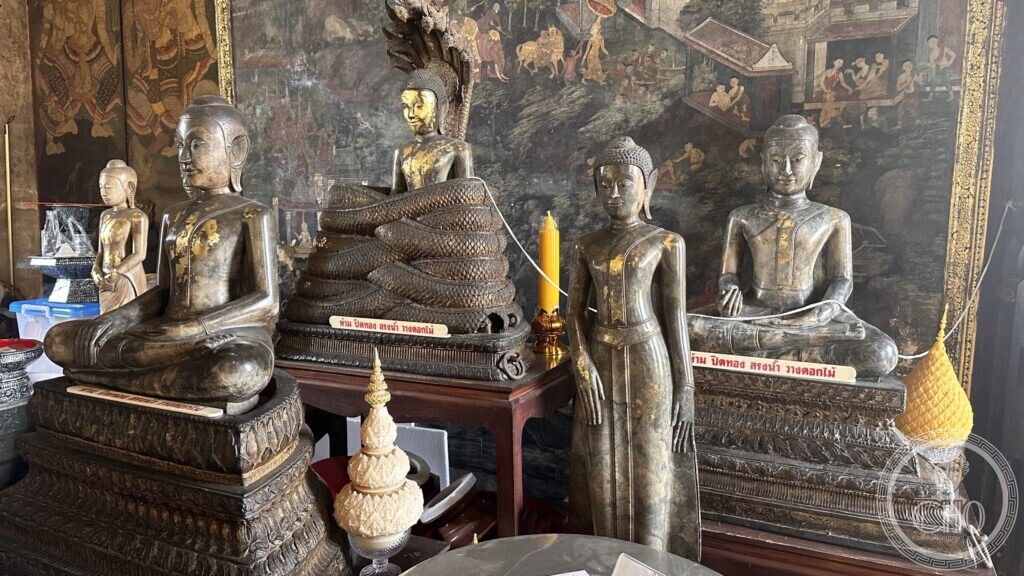
Off the main hall there is a room of smaller bronze images on wooden tables, standing and seated, including one seated under the reared hood of a serpent. They are dark with age and patched unevenly with gold leaf pressed on by worshippers over many years, in blots and streaks that follow no plan at all — a shoulder solid gold, a face bare, a knee half covered. Red notices propped in front of them now ask visitors to stop: no gold leaf, no pouring of water, no flowers. It is an unusually clear case of a devotional practice and a conservation rule colliding, and the reason for the rule is visible on the bronzes themselves.
Outside the hall
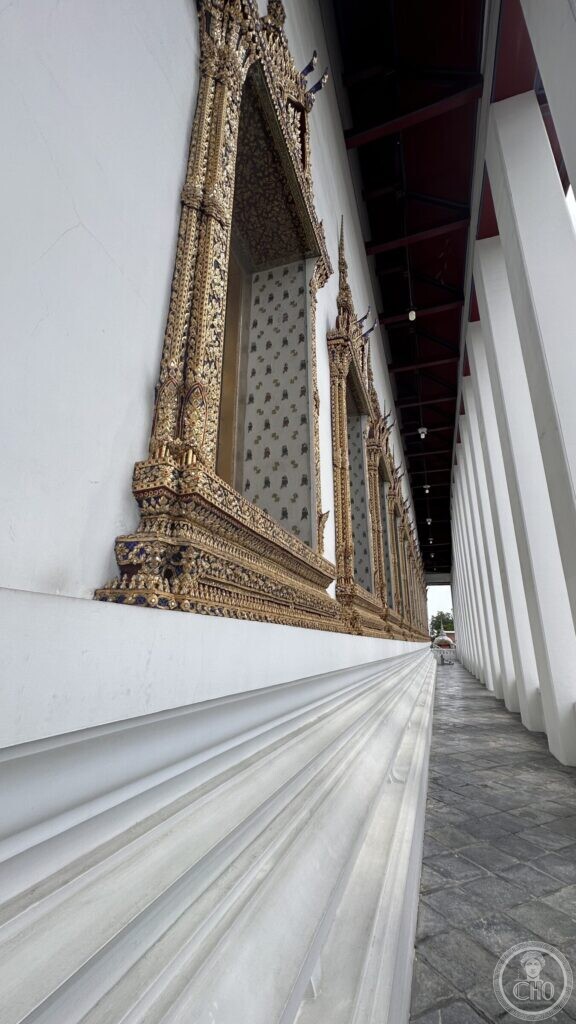
Outside, along the colonnade, the window frames are gilded and inlaid to a depth that has nothing to do with the plain white wall they are set into. Each one is a small piece of the same lacework as the base inside, and from the end of the colonnade they run away in a line of gold against whitewash, with the shade of the roof over them. The doors of the first hall, carved in the reign of Rama II, are the most famous woodwork in the temple; the windows here are the same taste applied to the second building.
The colonnade is where the scale of the ordination hall becomes measurable. Inside, the length of the room reads as distance to the image; outside it reads as a count of bays, one gilded frame after another, and the count goes on for a long time. This is the longest ordination hall in Thailand, and the walk along its side is the plainest way to feel it.
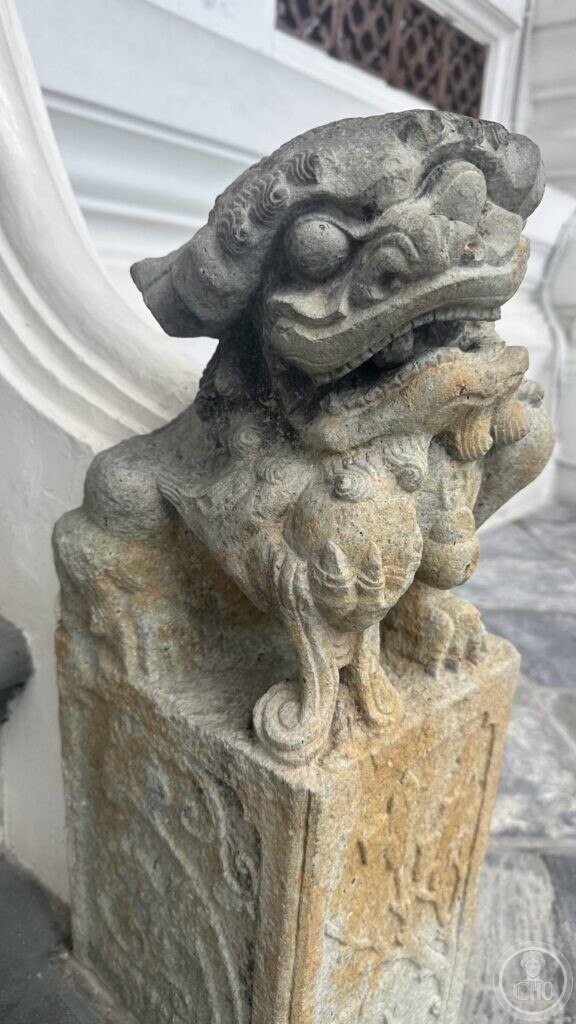
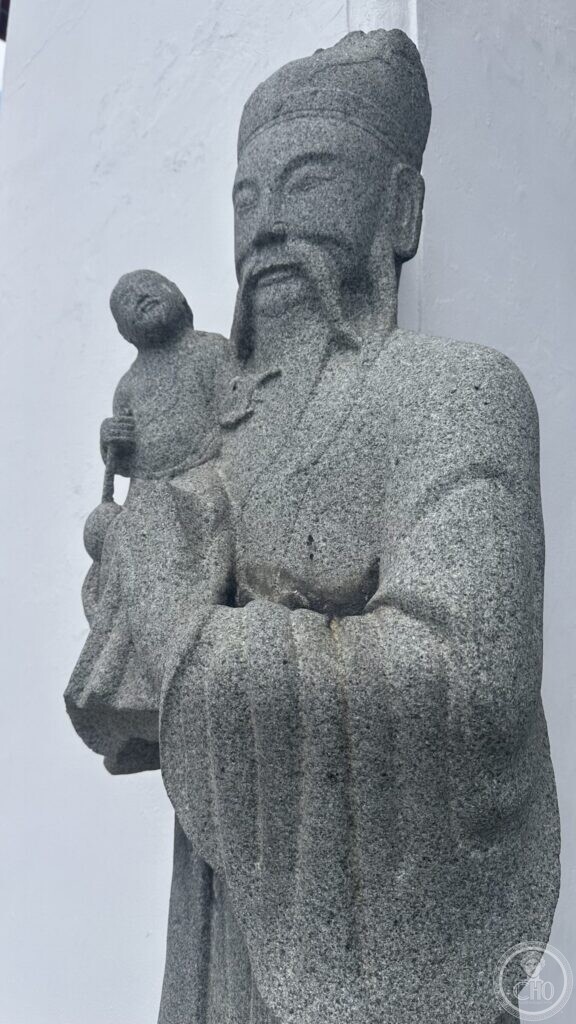
At the foot of the steps, incongruous and weathered, stand Chinese stone figures in grey and yellowish granite. One is a guardian lion, carved with the heavy mane curls, the bulging eye and the open snarling mouth of the type, a forepaw resting on a carved ball, on a pedestal with its own shallow relief. Another is a bearded official in long sleeved robes and a tall soft cap, holding a small child on one arm, the stone worn smooth where hands have touched it.
It is not Thai work and does not pretend to be. Several of the temples built or completed in the reign of Rama III carry stonework of exactly this kind, and it sits beside Thai architecture without being assimilated to it. Where these figures were carved, and when they arrived, is not something we could establish from a source we could read; they are among the things almost every visitor walks straight past on the way to the hall.
Photographs
Practical information
- This is a working temple, not a museum. The halls are in use for worship; shoes come off at the door, shoulders and knees stay covered, and people praying have priority over people photographing.
- The temple stands beside the Giant Swing (Sao Chingcha) on Bamrung Mueang Road, in Phra Nakhon district.
- Check opening times with the temple before travelling.
Do you know more?
On this page we have published what can be seen and what we were able to verify. About the painters of these murals, and the date and origin of the Chinese stone figures at the foot of the steps, we could not find a reliable source. If you know something — a name, a date, an old photograph, a document, a book that mentions it — write to Sofia, who looks after these pages.
Write to Sofia
or send a message on WhatsApp
Please start your message with the title of this page, so it reaches the right file. Every contribution is checked against independent sources before it goes on the page, and we always say where a piece of information came from.
Sources
- The Siam Society under Royal Patronage — A Visit to Three Royal Temples in Bangkok: construction begun by Rama I in 1807 and completed under Rama III; the wihan as the largest in Bangkok; the 8-metre Sukhothai bronze brought from Wat Mahathat, Sukhothai; the ubosot completed in 1843 and the longest in Thailand; the teak doors of the reign of Rama II at 5.5 × 1.5 metres and 15 centimetres thick; 156 gilded Buddha images in the cloister; the cosmology murals restored in the 1980s
- The Siam Society under Royal Patronage — A Visit to Temples Built During the Reign of King Rama III: Rama III’s dates, and the 19 new temples built and more than 60 repaired during his reign
- Princess Maha Chakri Sirindhorn Anthropology Centre (SAC), Database of archaeological sites in Thailand, record 731: the filling of the ground in B.E. 2350; the transfer of Phra Si Sakyamuni from Sukhothai, the seven-day procession by water of B.E. 2351 and the city gate taken down; the work continued under Rama II and completed under Rama III; the ubosot and the casting of Phra Buddha Trilokachet at the Grand Palace; the consecration of B.E. 2390; the changes of name; the connection with Rama VIII and the monument of B.E. 2515–2516; the Fine Arts Department registration. The record cites the Rattanakosin royal chronicles and temple histories
- Fine Arts Department, registration of the antiquities and archaeological site of Wat Suthat Thepwararam, Royal Gazette, vol. 66, part 64, p. 5281, 22 November 1949 (as cited in the SAC record)
- The temple’s own notice in the ordination hall, photographed on 24 October 2024: the image named as Phra Buddha Trilokachet, and the group presented as the Buddha giving instruction among the eighty great disciples
- Silpa Bhirasri, Thai Buddhist Art (Architecture), Thai Culture New Series no. 4, published by the Fine Arts Department, Bangkok: the definitions of the wihan, the ubosot and the prasat used here
- OpenStreetMap: coordinates of the temple precinct and of its two principal halls
Record researched and written by Luigi De Marchi for Cultural Heritage Online, 2026.
Find it on the map
See this place and what’s around it →📷 Become a Cultural Heritage Online photographer
Share your photos of places: they stay published under your name as the author. The more they're seen, the more you get noticed — and soon a contest will reward the most appreciated photos.
Log in or sign up free to add a photo