
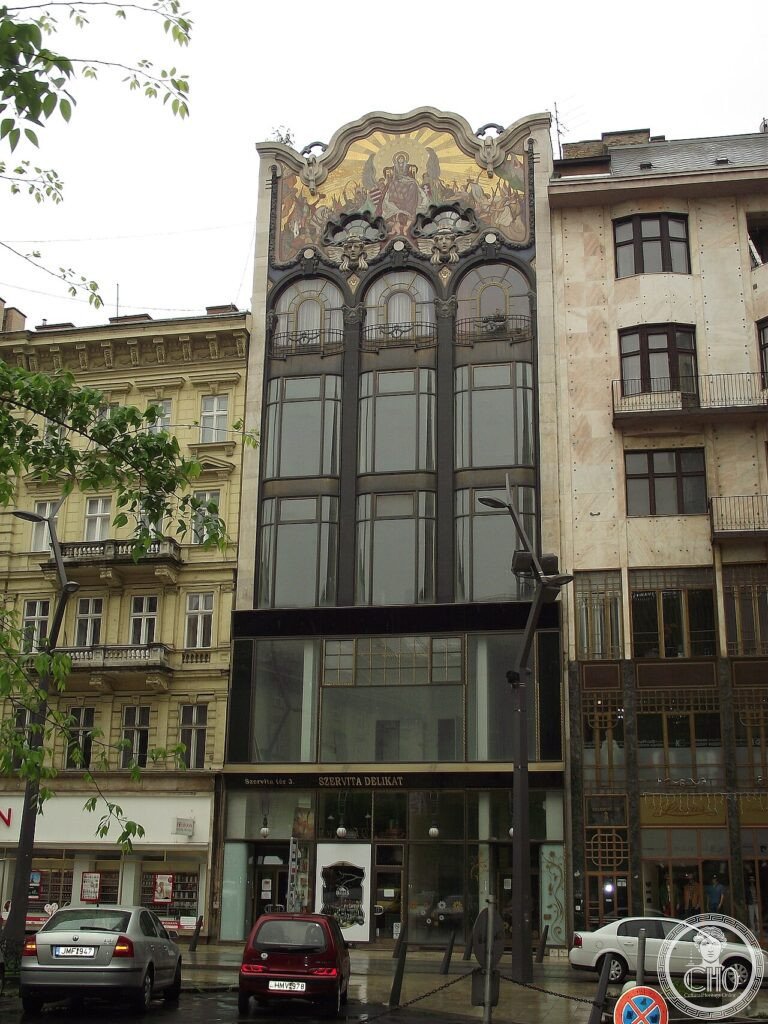

A wall of glass in 1906, crowned by a golden mosaic of Hungary enthroned among her heroes: the Török Bank House compressed the whole ambition of the Budapest Secession into one narrow facade on Szervita tér.
At a glance
Built in 1906 for the Török A. és Társa banking house — a firm founded in 1897 that grew famous organising the state class lottery — the narrow building at Szervita tér 3 is one of the boldest early curtain-wall experiments in Central Europe. Architects Ármin Hegedűs and Henrik Böhm hung a great glass facade on a modern reinforced-concrete frame, then crowned it with the gable mosaic that makes the square worth craning your neck in: the Patrona Hungariae, executed in Miksa Róth’s workshop, the largest Secession mosaic in the capital.
Key facts
- Built: 1906 (building permit issued 16 June 1906).
- Architects: Ármin Hegedűs and Henrik Böhm.
- Structure: Reinforced concrete frame with glazed curtain-like facade.
- Client: Török A. és Társa Bankház (bank founded 1897; joint-stock company from 8 May 1906).
- Crowning mosaic: Patrona Hungariae, from Miksa Róth’s workshop to Zsigmond Vajda’s design — the largest of its kind in Budapest.
- Lost detail: An illuminated globe of Tiffany favrile glass once topped the building; it disappeared in the Second World War.
- Address: Szervita tér 3, Budapest.
- GPS: 47.4954, 19.0525 — View on Google Maps.
History
The Török bank made its money on the osztálysorsjáték, the class lottery that gripped turn-of-the-century Hungary, and its headquarters was designed to advertise both modernity and patriotism. Hegedűs and Böhm delivered the modernity below — plate glass and concrete where the neighbours still wore stone — and the patriotism above: in the curved gable, Zsigmond Vajda’s composition shows Hungary as the Virgin Patroness enthroned, surrounded by great figures of the national past, all translated into glittering glass mosaic by Miksa Róth, the master who glazed half the Secession’s masterpieces. The bank itself did not survive the Second World War era; its building did, minus the Tiffany-glass globe that once glowed above the gable. Restored, the facade remains one of the most photographed details of the inner city — a lottery bank’s brief life outlived by its own advertisement.
What you see
Stand across Szervita tér and read the facade bottom to top. The lower storeys dissolve into glass — an astonishing degree of transparency for 1906, made possible by the reinforced-concrete frame that freed the front wall from carrying loads. Slender metal ribs draw the glazing into vertical bays that accelerate upward toward the curved gable. There the Patrona Hungariae takes over: the crowned Virgin enthroned at the centre, angels and the heroes of Hungarian history gathered around her, gold ground burning in afternoon sun. Binoculars or a zoom lens repay the effort — Róth’s workshop detailed faces, armour and drapery at a fineness the street barely lets you see.
Practical information
- The building is viewed from Szervita tér; the ground floor has commercial tenants.
- The mosaic faces roughly south-west — mid-to-late afternoon gives the best light on the gold ground.
- Combine with the inner-city Secession circuit: Párisi Udvar and the Postal Savings Bank are both within ten minutes on foot.
Getting there
Szervita tér lies in the heart of the Belváros, two minutes from Vörösmarty tér and the M1 metro terminus, three from Deák Ferenc tér where metro lines M1, M2 and M3 meet. The square is pedestrian-friendly; the bank house faces the Servite church that names it.
Nearby
- Párisi Udvar — the glass-vaulted arcade palace of 1913, five minutes away.
- Royal Postal Savings Bank — Lechner’s ceramic-crowned masterpiece on Hold utca, ten minutes north.
- Bedő House — Emil Vidor’s Art Nouveau house-museum on Honvéd utca.
- Budapest — Ödön Lechner and the Hungarian Szecesszió — the CHO city guide.
Sources
- Hungarian monument register (muemlekem.hu), file 621 — building data and protection.
- Hungarian Wikipedia: “Török Bankház” — bank history, 1906 permit, joint-stock transformation.
- Google Arts & Culture, “Török Bank House” — architects, glass facade, Róth mosaic.
- Budapesti Városvédő Egyesület (varosvedo.hu) — Vajda design, Tiffany glass globe, mosaic scale.
- Wikidata Q18005345 — coordinates and 1906 date.
Find it on the map
See this place and what’s around it →Record researched and written by Luigi De Marchi for Cultural Heritage Online, 2026.
📷 Become a Cultural Heritage Online photographer
Share your photos of places: they stay published under your name as the author. The more they're seen, the more you get noticed — and soon a contest will reward the most appreciated photos.
Log in or sign up free to add a photoIs this page about you?
This page is read by travellers and heritage enthusiasts who find it on Google. Tell us how you are connected to this place and we will take it from there.