
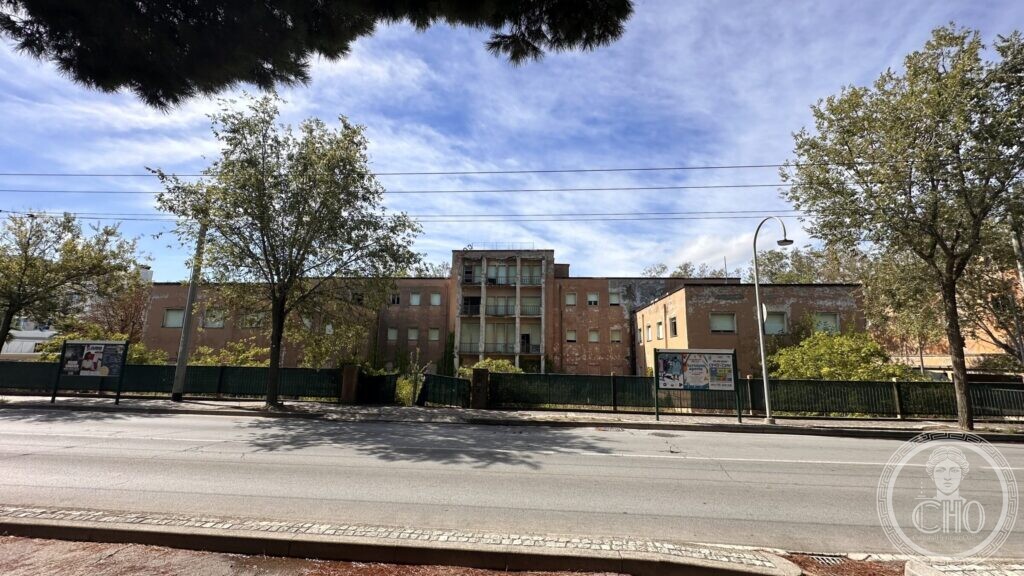
Three complexes stand empty behind a green fence, in the band where the Adriatic colonie were built. Not one of them carries a sign. We photographed them anyway, and we are asking for help.
At a glance
Between the Colonia Bolognese at Miramare and the Colonia Dalmine at Riccione, on the landward side of viale Gabriele D’Annunzio, three large complexes of the nineteen-thirties stand disused: brick and render, three and four floors, long ranges of shuttered windows, tiers of open balconies, fenced off and taken over by pines and brambles. This page records what is there, in September 2026. It does not tell you which is which, because nothing on the buildings does. There are no plaques and no signs; the only lettering is the ruin of two raised inscriptions, and we could not read either of them.
Key facts
- Where: the landward side of viale Gabriele D’Annunzio, between viale Aleardo Aleardi and viale Camillo Manfroni, in the Spontricciolo district of Riccione
- Nearest addresses: viale Gabriele D’Annunzio 229 and viale Aleardo Aleardi 2
- Condition: all three disused; fenced; windows broken or bricked up; vegetation established
- Identification: not established. No signs on site; two ruined inscriptions, illegible
- What is documented in this band: the Colonia Marina Dalmine and a colony called the «Adriatica». The Colonia Marina Reggiana, which we first looked for among these three, stands about three hundred metres to the south-east on the other side of the avenue — see below
- Coordinates (middle of the group): 44.023700, 12.631300 — Google Maps
What is documented in this band, and what we could not match to it
Between the wars this stretch of shore filled with colonie marine: institutions where provinces, party federations and companies sent working-class children for a month of sea air. Several of them are among the best modern architecture on the Adriatic, and three of the ones built here are documented in detail.
The Colonia Marina Reggiana, properly the «Amos Maramotti», was built in 1934 in three months to a design by the engineer Costantino Costantini, for the Fascist federation of Reggio Emilia, and inaugurated by Mussolini on 1 August 1934. The Ministry of Culture’s register of abandoned heritage describes it precisely: three staggered pavilions set diagonally to the coastline on the helio-thermal axis required by the hygiene codes; three floors with horizontal bands of window lighting large dormitories with balconies towards the sea; the pavilions linked by corridors and by semicircular stairwells. It is publicly owned, protected by ministerial decree of 6 April 1995, and its condition is recorded as poor. It was abandoned at the end of the 1980s; from 1989 part of it housed water-sports clubs, until access was forbidden in the summer of 2012 as a precaution after the earthquake in Emilia. It came back into the ownership of the municipality only in the second half of 2019; in February 2020 the local police cleared four people who were living in it and the building was walled up. In April 2025 Riccione put it into a bid for public money, with €5,580,224 costed for structural consolidation, the restoration of the facades and the reordering of the ground around it.
The Colonia Marina Dalmine was built in 1936 by the Milanese architect Giovanni Greppi for the children of the steelworkers of Dalmine, at viale Gabriele D’Annunzio 227; it later worked as the Hotel Le Conchiglie and is being converted again. A colony called the «Adriatica» is named alongside the Reggiana in the redevelopment plan drawn up for the two of them.
What we could not do. The identifying feature of the Reggiana — the three semicircular stair towers — does not appear in any of these photographs. Two facades carry the remains of raised letters: on one we can make out …LONI… and, further along, …A?PIO; on the other, …ENZA and …DE…. Neither yielded a name.
The Reggiana is not one of these three. We settled that in September 2026, working from the plan rather than from the facades. The Ministry of Culture describes the Reggiana as three pavilions staggered on the diagonal, their long facades turned east and west, tied together by curved stair towers. A building of exactly that shape stands about three hundred metres to the south-east, on the seaward side of viale Gabriele D’Annunzio, in the open ground behind the dunes some two hundred metres from the mouth of the Marano: three staggered blocks at 44.021574, 12.634888, with the rounded stair volumes still legible in the outline of the building. The photographs in the ministry’s own record — pale render, ribbon windows, porthole openings, a balcony running along the upper floor — show the building that faces the avenue there today. The national catalogue of architectural heritage gives the Reggiana’s address as viale D’Annunzio 164; on this avenue the even numbers run along the seaward side, and the numbering on that side puts 164 within a lot or two of where the three pavilions stand. The clue we already had points the same way.
The clue, in full. The Comune di Riccione, announcing in April 2025 a project worth €5,580,224 for the structural consolidation of the Reggiana, the restoration of its facades and the reordering of the ground around it, notes that it has already obtained regional money “for the safeguarding and enhancement of the dunes close to the colonia Reggiana”, and that the cycle and foot path of the Adriatic route now runs in front of the building. The dunes and that path are on the seaward side of viale Gabriele D’Annunzio. The three buildings on this page stand on the landward side. On its own that settled nothing — “close to” can cover a couple of hundred metres — but it pointed across the road, and the plan of the building confirms it: the dunes and the cycle path are exactly where the three pavilions stand.
What this leaves open. Our page for the ex Colonia Reggiana now carries the right position, but it still has no photograph of its own: it shows a courtesy placeholder, because no freely licensed image of the building exists and the ministry’s photographs cannot be reused. The three buildings on this page are a separate question, and that one is still unanswered: we do not know what they were. If you can name them, please write to us.
What you see
From the road the three read as one long wall of abandoned building behind a green plastic fence and a line of stone pines. The southernmost is the largest: a low wing at the left, then a taller block whose centre is a stack of open balconies four levels high, then a stepped section and another range. The render has gone from the brick in patches; the shutters are down or gone; the window openings of the lower floor are bricked or boarded.
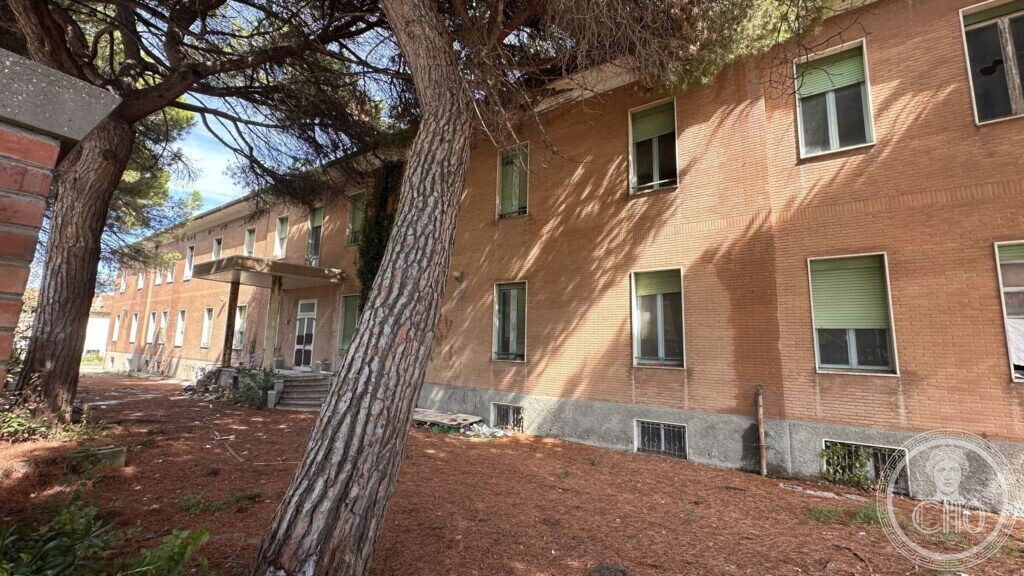
Inside the fence, where the ground is carpeted with pine needles, one entrance front survives almost complete: a symmetrical elevation with a flat canopy on square posts over the door, a balcony above it, and along the top of the wall a line of raised letters of which only fragments remain. The door still has its glazing bars. Everything else has gone: the steps are littered, and a plastic chair stands where somebody last sat.
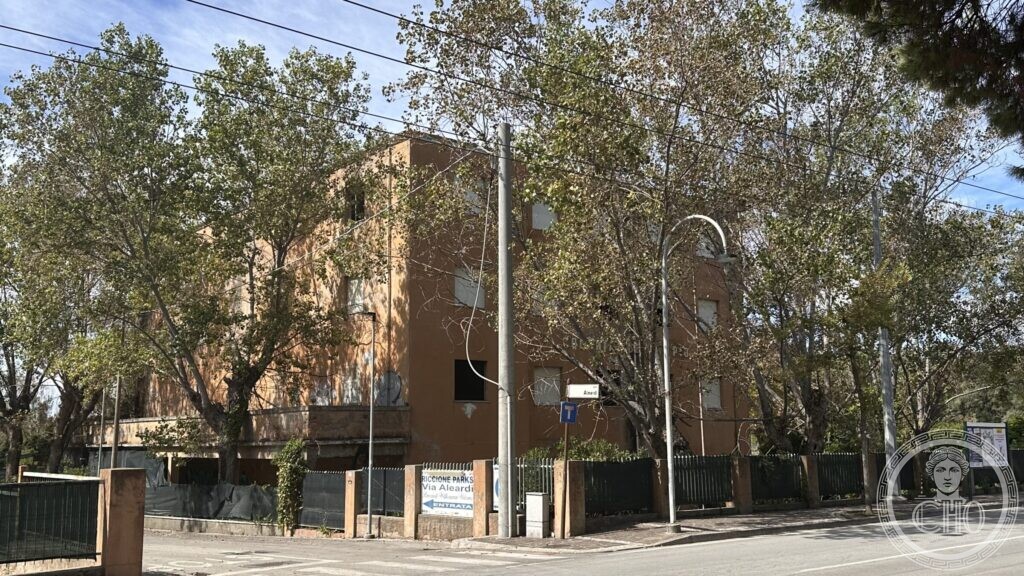
The northernmost building, at the corner of viale Aleardi, is a plain three-storey block of the same family, its render weathered to ochre, with a second line of raised letters across the second floor. Behind all three, the pines have grown taller than the buildings.
September 2026





Practical information
- These buildings are closed and unsafe. They are fenced, and at least one of them has been formally out of bounds since 2012. Look from the public pavement; do not enter.
- The stretch is walkable from the Colonia Bolognese at Miramare in about ten minutes, and from Riccione in about twenty.
- Do you know these buildings? If you can name them, please write to us. We will correct this page and credit you.
Getting there
Viale Gabriele D’Annunzio is the coast road between Rimini Miramare and Riccione. The Rimini Miramare railway stop is about fifteen minutes away on foot; the seafront bus line runs the length of the road.
Nearby
- Colonia Marina Bolognese, Miramare di Rimini (1932)
- Colonia Novarese — Peverelli’s Rationalist ship at Miramare (1934)
- Ex Colonia Reggiana (Amos Maramotti), Riccione — the page that is still waiting for a photograph
- Colonia Marina Dalmine — Greppi’s colony at Riccione (1936)
- Colonia Bertazzoni, Riccione
Sources
- DGABAP, Ministero della Cultura — Beni culturali abbandonati, record «Colonia Marina Reggiana»: address, 1934, Costantino Costantini, public ownership, protection by D.M. 6 April 1995, condition recorded as poor, and the description of the three staggered pavilions with semicircular stairwells. Used as a data source only; the portal’s photographs are not freely licensed.
- Ferruccio Canali, study of the colonia marina «Amos Maramotti» at Riccione-Miramare (1934), University of Florence research archive.
- Chiamami Città, 1 agosto 1934 — Mussolini inaugura la Colonia Reggiana di Riccione.
- Comune di Riccione, Riccione partecipa al bando per la riqualificazione delle aree dismesse lungo il torrente Marano, 8 April 2025 — for the €5,580,224 project, the dunes beside the Reggiana and the cycle path in front of it.
- RiminiToday, Sgomberata e messa in sicurezza l’ex colonia Reggiana e l’ex hotel Le Conchiglie, 12 February 2020 — for the return to municipal ownership in the second half of 2019 and the clearance.
- Catalogo generale dei Beni Culturali (ICCD), record 0800305789, «Amos Maramotti» — for the address of the Reggiana, viale D’Annunzio 164.
- OpenStreetMap, way 223809691 — the mapped outline of the three staggered pavilions on the seaward side, used to match the plan described in the DGABAP record. Checked against Google Street View imagery of August 2024, consulted for identification only.
- Cultural Heritage Online’s own records for the Colonia Dalmine and the ex Colonia Reggiana.
- Location established from the GPS in the photographs and by reverse geocoding against OpenStreetMap.
- On-site observation and photography, 11 September 2026. There were no signs or notices on the buildings.
Find it on the map
See this place and what’s around it →Record researched and written by Luigi De Marchi for Cultural Heritage Online, 2026.
📷 Become a Cultural Heritage Online photographer
Share your photos of places: they stay published under your name as the author. The more they're seen, the more you get noticed — and soon a contest will reward the most appreciated photos.
Log in or sign up free to add a photo