
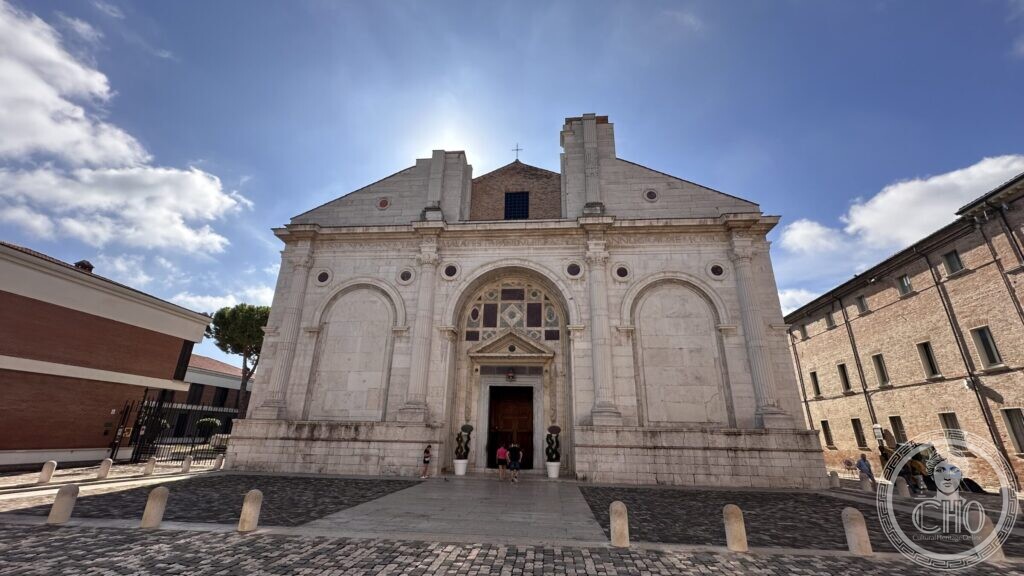
Leon Battista Alberti wrapped a Gothic friary church in the marble of a Roman triumphal arch — and left it unfinished. It is still Rimini’s cathedral.
At a glance
The Tempio Malatestiano is the cathedral of Rimini, dedicated to Saint Columba, and one of the founding buildings of Italian Renaissance architecture. Sigismondo Pandolfo Malatesta, lord of Rimini, set out to turn the Romanesque-Gothic church of San Francesco into a monument to himself, to his city and to his love for Isotta degli Atti. He gave the outside to Leon Battista Alberti and the inside to Matteo de’ Pasti, and the two halves of the building have been arguing with each other ever since. Work stopped in 1460 when Sigismondo’s fortunes collapsed, and the front has stood unfinished above its cornice for more than five centuries.
Key facts
- Also known as: the cathedral of Santa Colomba, Rimini’s Duomo
- Patron: Sigismondo Pandolfo Malatesta, lord of Rimini
- Commissioned: 1447; work on the new shell begun in 1450
- Exterior: Leon Battista Alberti — his first building
- Interior: renewed by Matteo de’ Pasti
- Work stopped: 1460, with the upper facade never built
- Became the cathedral: 1809, when it was dedicated to Saint Columba
- Consecrated a basilica: 29 September 2002
- Inside: Giotto’s Crucifix, a fresco by Piero della Francesca, reliefs by Agostino di Duccio
- Coordinates: 44.059689, 12.570230 — Google Maps
History
Sigismondo Pandolfo Malatesta ruled Rimini in the middle of the fifteenth century as a condottiero prince with a scholar’s court and an enemy in Rome. The church he chose to rebuild was San Francesco, the Franciscan church where his family already buried its dead. What he ordered was not a restoration. Rimini’s tourist board records that the temple was raised “to the immortal God and to the city”, and also to Sigismondo’s love for Isotta degli Atti, whose initial is braided through the whole building with his own.
For the outside he engaged Leon Battista Alberti, the humanist who had written the first Renaissance treatise on architecture and had not yet built anything. Alberti did not demolish the Gothic church; he built a new skin of Istrian stone around it, a marble case designed as a Roman triumphal arch, its mouldings taken from the base of the Arch of Augustus that still closes Rimini’s main street a few hundred metres away. The inside went to Matteo de’ Pasti, medallist and architect, whose pointed arches and dense carved decoration stayed loyal to an older taste. The contrast is not a mistake: it is two cultures meeting inside one building.
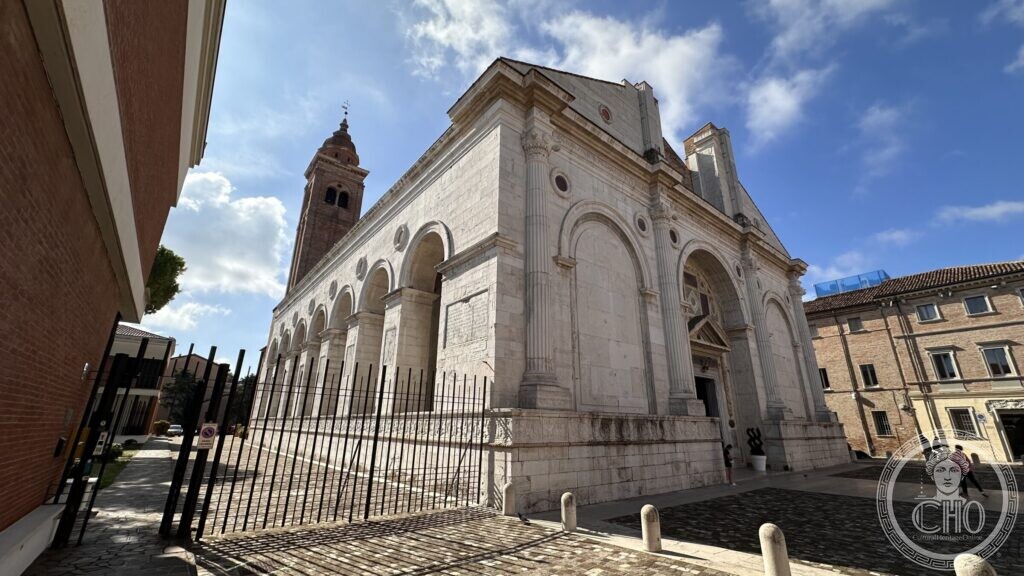
Work stopped in 1460. Sigismondo had fallen out with Pope Pius II, who excommunicated him and stripped him of most of his territory; the money and the moment were gone. The upper part of the facade was never built, and the seven arcades along the left flank, meant to hold the tombs of the Malatesta court, stand empty to this day.
In 1809 the church was dedicated to Saint Columba and raised to the rank of cathedral. In September 1926 the votive chapel to Rimini’s war dead, painted by Francesco Brici, was inaugurated inside the Tempio by King Victor Emmanuel III on the same afternoon that he unveiled the war memorial in Piazza Ferrari. The building was seriously damaged in the bombing of 1943 and first restored in 1950; further restoration, financed by the Cassa di Risparmio di Rimini Foundation in the Jubilee year, returned the marbles and colours of the side chapels. It was consecrated a basilica on 29 September 2002.
What you see
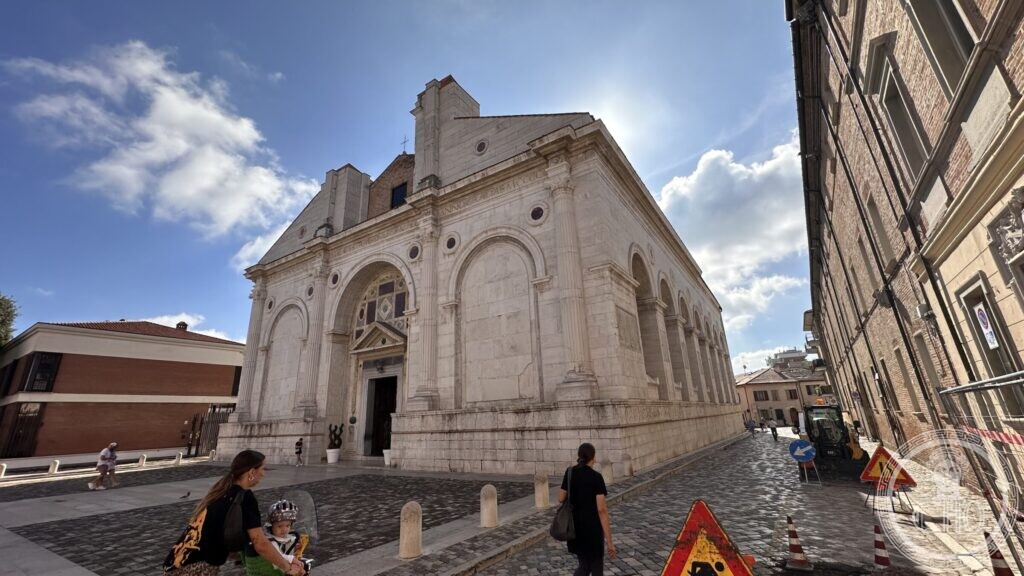
From the little square in front, the facade reads as a single Roman arch in white stone, flanked by two blind arches and framed by half-columns on tall plinths. Above the entablature the marble simply stops: the brick and the raw masonry of the old church show through, and a stepped gable of unfinished blocks stands where a dome and an upper order were meant to go. Nothing on the front tells you it is a church.
The whole building sits on a high base of Istrian stone carved with a frieze of garlands, tied with Isotta’s flower and alternating the four Malatesta devices: the elephant, the interlaced I and S for Isotta and Sigismondo, the double chequered band and the flower itself. Walk down either flank and you meet seven deep arcades divided by pilasters. On the right they hold the sarcophagi of the eminent men of the Malatesta court; on the left they are empty, the clearest measure of how suddenly the work stopped.
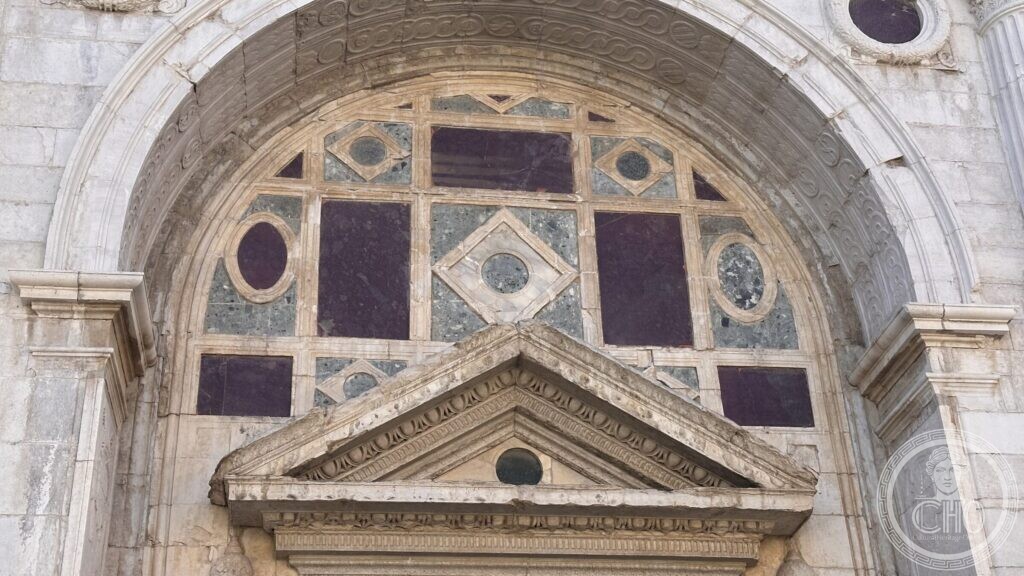
Over the main door, an inlaid lunette of porphyry and green serpentine discs set in white frames survives from the decoration that was completed — the one piece of colour in an otherwise colourless front.
Inside, the single nave runs under wide pointed arches to six side chapels closed with marble screens. The Chapel of the Planets carries reliefs of the planets and their zodiac signs; beneath Cancer, Sigismondo’s own sign, is a view of Rimini in Malatesta times, the oldest surviving image of the city. The Chapel of the Ancestors holds Agostino di Duccio’s Ark of the Ancestors and Descendants, where Sigismondo gathered the remains of his family.
The Tempio today

Practical information
- The Tempio is a working cathedral: services take priority over visits, and the church closes earlier when the rosary is said.
- Admission to the church is free. Opening hours published by Rimini Turismo (checked September 2026): Monday to Friday 8.30–12.00 and 15.30–16.45; Saturday 8.30–12.30 and 15.30–16.45; Sunday and holidays 9.00–10.30, 12.00–12.30 and 15.30–16.45. Hours change; check before travelling.
- Diocesan information: segreteria@diocesi.rimini.it
- The flanks are worth as much time as the front. Walk the right side first, then the left, and the difference between them tells the story.
Getting there
The Tempio stands in the historic centre, a few minutes on foot from Rimini station: straight ahead to Piazza Tre Martiri, then left along via IV Novembre. Piazza Ferrari and the Ponte di Tiberio car parks are the usual places to leave a car. From the airport, bus 9 stops at Arco d’Augusto, at the far end of Corso d’Augusto.
Nearby
- Palazzo Massani, the Palazzo del Governo, directly opposite the Tempio on via IV Novembre
- Piazza Tre Martiri, the Roman forum of Ariminum, two minutes away
- Piazza Cavour and the Teatro Amintore Galli
- Castel Sismondo — Sigismondo Malatesta’s castle, with a 360° virtual tour
- Palazzo Valloni, the Fulgor cinema and the Fellini Museum
Sources
- Rimini Turismo (Comune di Rimini, Assessorato al turismo) — Tempio Malatestiano, Italian and English pages, consulted 12 September 2026. The Italian page dates the start of work to 1450; the English page gives 1447 as the date of the commission.
- Comune di Rimini, Quaderno 6 — Piazza Ferrari. Un intervento tra storia e restauro, for the votive chapel to the fallen and the royal visit of 11 September 1926.
- On-site observation and photography, 11 September 2026.
Find it on the map
See this place and what’s around it →Record researched and written by Luigi De Marchi for Cultural Heritage Online, 2026.
📷 Become a Cultural Heritage Online photographer
Share your photos of places: they stay published under your name as the author. The more they're seen, the more you get noticed — and soon a contest will reward the most appreciated photos.
Log in or sign up free to add a photo