

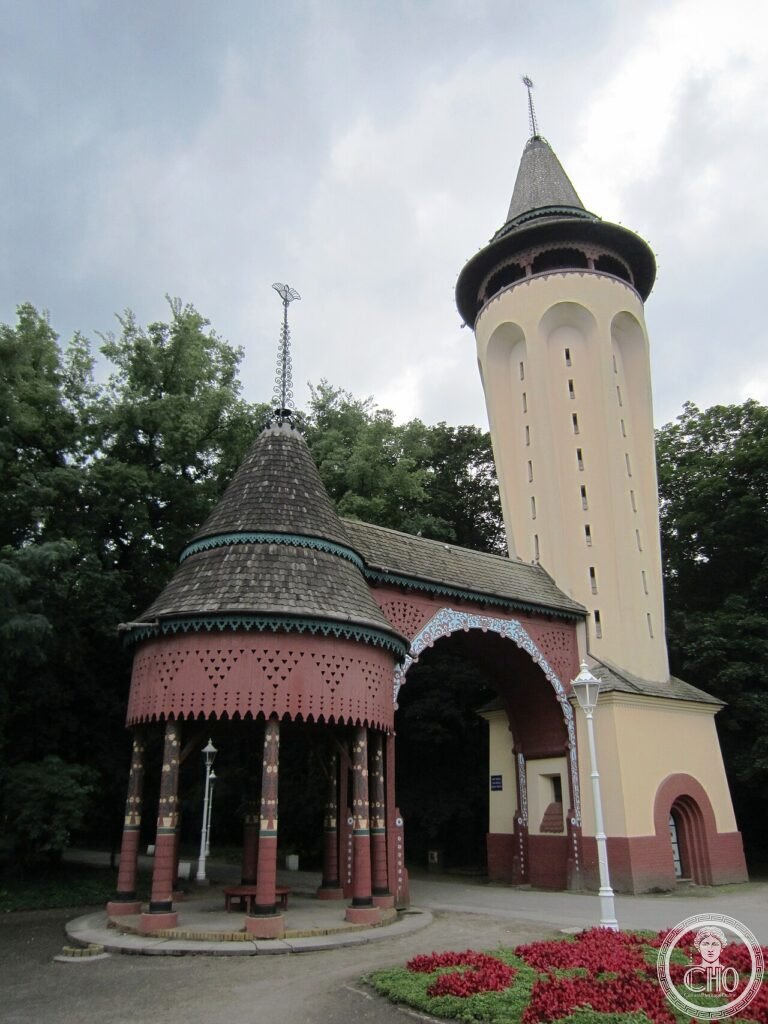

Part water tower, part triumphal gate, part tram terminus: the tower that welcomes visitors to Lake Palić compresses the whole Hungarian Secession into one timber-and-brick exclamation mark.
At a glance
On 15 September 1912 the town of Subotica unveiled its rebuilt lakeside resort at Palić, and the Water Tower was its front door: a gateway structure that stored the resort’s water, framed the entrance promenade, and received the trams arriving from the city eight kilometres away. The architects were Marcell Komor and Dezső Jakab — the Budapest partnership that had just given Subotica its City Hall and Synagogue — working in the Hungarian Secession manner inspired by Transylvanian folk art: steep roofs, timber galleries, folk-embroidery ornament translated into architecture.
Key facts
- Opened: 15 September 1912, with the resort ensemble
- Architects: Marcell Komor and Dezső Jakab
- Functions: Water tower, resort gateway and tram terminus in a single structure
- Ensemble: With the Grand Terrace, the Women’s Lido (Ženski štrand), the Music Pavilion and the Memorial Fountain
- Style: Hungarian Secession, inspired by Transylvanian folk art
- Location: Entrance to the Palić lakeside park, Vojvodina, Serbia
- GPS: 46.1089, 19.7672 — View on Google Maps
History
Lake Palić had been Subotica’s bathing resort since the nineteenth century, but the city’s early-1900s boom — the same confidence that built the Komor & Jakab City Hall — demanded a resort to match. The architects delivered a complete Secession ensemble for the 1912 season: the Water Tower at the entrance, the Grand Terrace with its carved parapets and promenades toward the lake, the Women’s Lido standing over the water on stilts, the Music Pavilion for the resort band. Trams from Subotica ran directly to the tower’s foot, and summer society stepped from the carriage straight into the park. The ensemble survived the century’s wars and border changes — Palić passed from Hungary to the Kingdom of Serbs, Croats and Slovenes in 1920 — and stands today as one of the most complete Hungarian Secession resort ensembles anywhere, restored in stages and still the gate through which every visitor enters the park.
What you see
The tower rises over the entrance arch in banded brick and timber, its water tank hidden in the shaft beneath a steep, almost pagoda-like roof; open timber galleries ring the upper levels, and the ornament — hearts, tulips, embroidered geometries — comes straight from the Transylvanian folk vocabulary the architects shared with Ödön Lechner’s school. Pass under the arch and the ensemble unfolds on axis: the promenade, the Grand Terrace’s carved parapets, and the lake beyond with the Women’s Lido standing over the shallows. Seen with Subotica’s City Hall and Synagogue, the tower completes the Komor & Jakab trilogy — civic, sacred and playful faces of one style.
Practical information
- The tower and park are freely accessible year-round; the resort is busiest in summer
- The Grand Terrace and lakeside promenade continue the ensemble — allow an hour for the full circuit
- Palić hosts the European Film Festival each summer — expect crowds in mid-July
Getting there
Palić lies 8 km east of Subotica; buses and taxis cover the distance in about fifteen minutes, following the route of the old resort tram. From Subotica’s centre, the excursion pairs naturally with the City Hall and Synagogue for a full Komor & Jakab day.
Nearby
- Subotica City Hall — Komor & Jakab’s civic masterpiece, 8 km west
- Subotica Synagogue — their domed Secession synagogue of 1902
- Raichle Palace — Ferenc Raichle’s heart-motif mansion in Subotica
- Subotica — The Hungarian Secession in the Vojvodina — the CHO city guide
Sources
- Google Arts & Culture / Ministry of Culture of the Republic of Serbia, “The Palić water tower” — 1912 opening, functions, ensemble
- Subotica Synagogue Foundation (suboticasinagoga.rs) — Komor & Jakab and the Secession context
- Wikipedia: “Palić” — resort history and ensemble components
- Wikidata Q85992981 — coordinates
Find it on the map
See this place and what’s around it →Record researched and written by Luigi De Marchi for Cultural Heritage Online, 2026.
📷 Become a Cultural Heritage Online photographer
Share your photos of places: they stay published under your name as the author. The more they're seen, the more you get noticed — and soon a contest will reward the most appreciated photos.
Log in or sign up free to add a photoIs this page about you?
This page is read by travellers and heritage enthusiasts who find it on Google. Tell us how you are connected to this place and we will take it from there.