
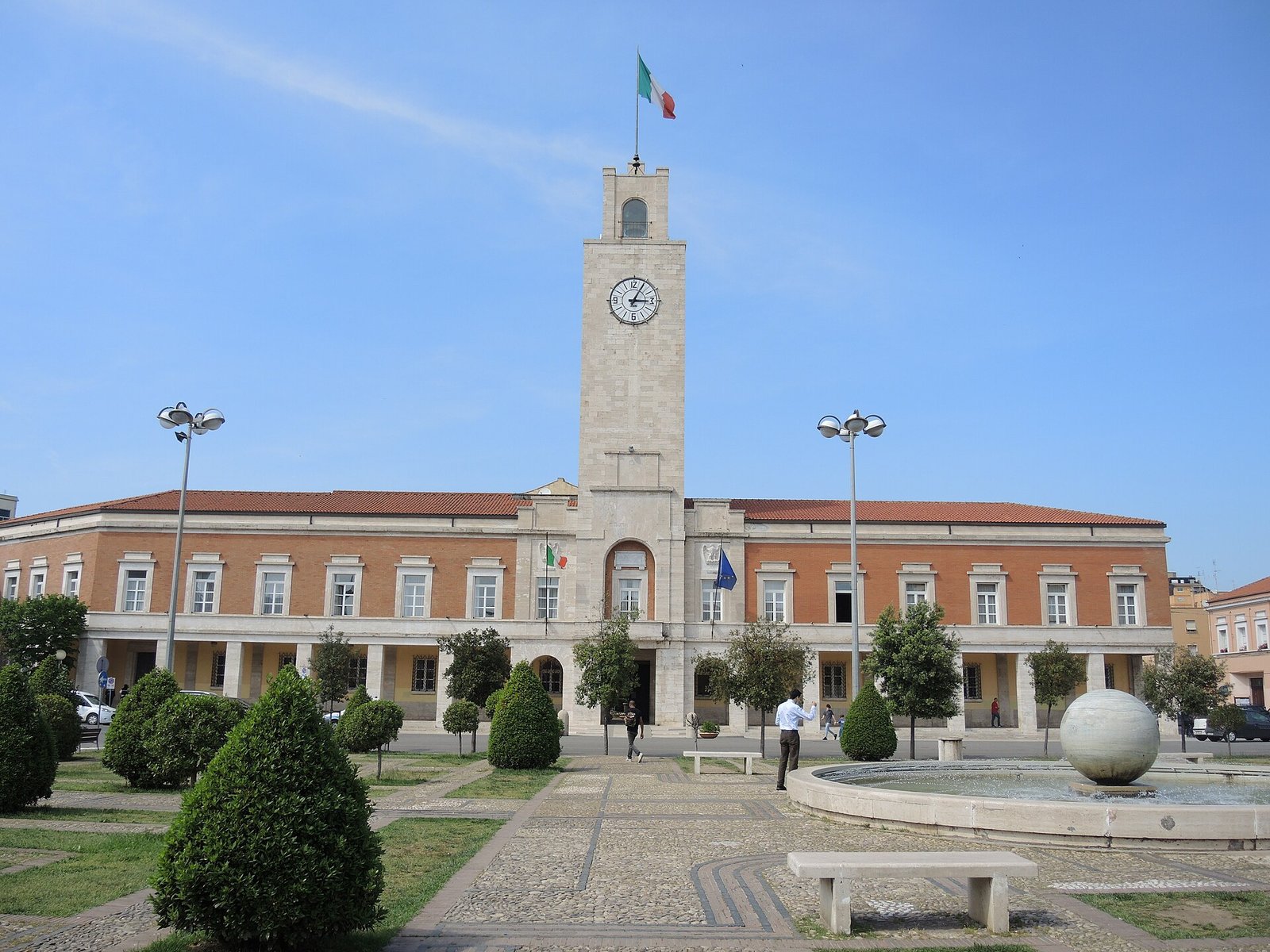
The town hall of the first Pontine new town, built by Oriolo Frezzotti at the centre of his radial plan, its travertine clock tower visible across the reclaimed plain.
At a glance
The Palazzo Comunale stands on Piazza del Popolo, the focal point of the radial plan that Oriolo Frezzotti drew for Littoria in 1932. Built in 1932–1933, it pairs a long brick-and-travertine body with a slender civic tower 32 metres high, clad entirely in travertine and carrying the town clock. When the city was inaugurated in December 1932 the tower could be seen from the whole surrounding plain — a deliberate landmark for a territory that had just been drained and settled. The city, founded as Littoria, took its present name of Latina in 1945.
Key facts
- Architect: Oriolo Frezzotti, author of the city plan of 1932.
- Built: 1932–1933; the city was inaugurated on 18 December 1932.
- Tower: civic clock tower, 32 metres, fully clad in travertine.
- Setting: Piazza del Popolo, hub of the radial street plan.
- Use: still the town hall of Latina.
- Name history: Littoria until 1945, then Latina.
History
Littoria was the first of the new towns founded on the drained Pontine Marshes, and its town hall was the first public building the settlers saw completed. Frezzotti placed it at the centre of a radiocentric plan: the main streets converge on Piazza del Popolo, and the piazza converges on the tower. The building housed the municipal offices from the start and has never changed function.
The city grew quickly beyond its founders’ plans — provincial capital in 1934, renamed Latina in 1945 — but the piazza has kept its role as civic centre. The palazzo, together with the nearby Palazzo del Governo and the cathedral of San Marco, still forms the monumental core of the founded city.
What you see
The building reads as a calm horizontal block on a travertine portico, its upper floor faced in brick with regular white-framed windows. The tower breaks the horizontality at the centre: a sheer travertine shaft with a clock near the top and a small open lantern above, closer in spirit to an Italian medieval town-hall tower than to a classical campanile — tradition translated into the plain language of the 1930s.
In front, the piazza keeps its original travertine furniture, including the round fountain with its stone sphere. Portico, brick, travertine and tower together are a compact catalogue of the materials and motifs used across all the Pontine new towns.
Practical information
- Access: a working town hall; the exterior and the piazza are freely accessible at all times.
- Best light: morning, when the sun strikes the travertine front of the tower.
- Time needed: 15–20 minutes, best as part of a walk through the founded city centre.
Getting there
Piazza del Popolo is the centre of Latina, about 70 km south of Rome. Latina railway station lies on the Rome–Naples line, some 9 km from the centre, with connecting buses; by car the city is reached from the SS148 Pontina.
Coordinates: 41.4673, 12.9039 — open in Google Maps.
Nearby
- Latina (Littoria), the founded city — the full story of the first Pontine new town.
- Palazzo del Governo — Frezzotti’s prefecture building.
- Cathedral of San Marco — the rationalist cathedral of the new town.
- Palazzo M — Frezzotti’s M-shaped rationalist block.
Sources
- FAI — Fondo per l’Ambiente Italiano, Piazza del Popolo — edifici, Latina (fondoambiente.it).
- Latina Razionalista — Palazzo del Comune (latinarazionalista.it).
- Urban Center Latina — La città (plan by Oriolo Frezzotti, 1932).
Find it on the map
See this place and what’s around it →
📷 Become a Cultural Heritage Online photographer
Share your photos of places: they stay published under your name as the author. The more they're seen, the more you get noticed — and soon a contest will reward the most appreciated photos.
Log in or sign up free to add a photoIs this page about you?
This page is read by travellers and heritage enthusiasts who find it on Google. Tell us how you are connected to this place and we will take it from there.