
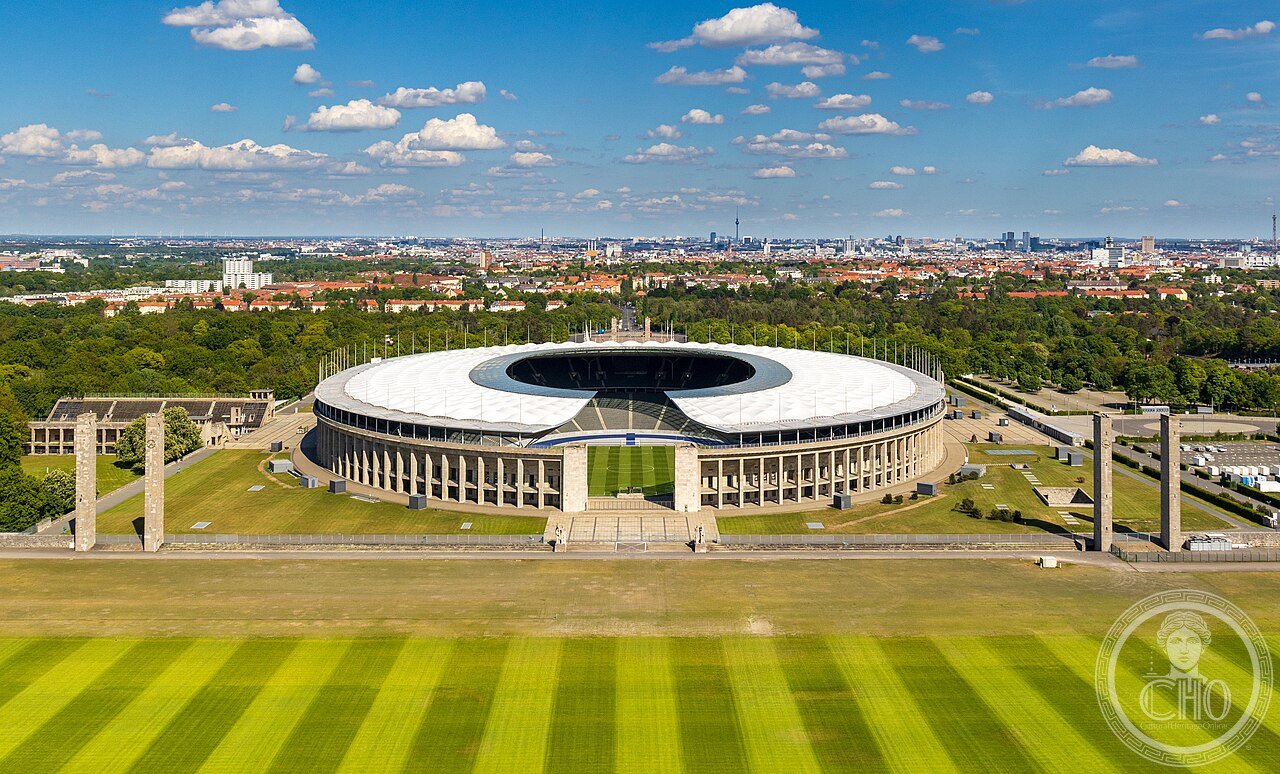
The Olympiastadion Berlin is one of the twentieth century’s most historically loaded sports arenas — a stadium built to showcase Nazi power that instead became the stage for one of sport’s greatest acts of defiance. Designed by Werner March and completed in 1936 for the Summer Olympics, the 100,000-capacity arena embodies the monumental Stripped Classicism that the Third Reich favoured for its state architecture: massive limestone walls, colonnaded galleries, and an austere grandeur meant to evoke imperial Rome. Yet the games it hosted are remembered above all for Jesse Owens, the Black American sprinter who won four gold medals here, directly contradicting Hitler’s racial ideology in front of a global audience. The stadium also launched a tradition that endures to this day: the Olympic torch relay from Olympia to the host city was conceived specifically for the 1936 Games. Extensively renovated between 2000 and 2004, the arena now hosts Bundesliga football, international athletics, and major concerts, its layered history inseparable from its identity.
At a glance
- Type
- Sports stadium
- Period
- Completed 1936; major renovation 2000–2004
- Style
- Nazi Stripped Classicism / National Socialist Architecture
- Location
- Olympischer Platz 3, 14053 Berlin, Germany
- Coordinates
- 52.5147° N, 13.2394° E
- Architect(s)
- Werner March
Overview
Set within the vast Olympiapark in western Berlin, the stadium forms the centrepiece of an ensemble of sports facilities March designed for the 1936 Games. The elliptical bowl is sunk into the ground so that its exterior rim remains at roughly street level — a deliberate device that makes the structure appear to emerge from the earth rather than tower over it. The perimeter is defined by a colonnade of squared limestone pillars, giving the exterior a rhythmic solemnity characteristic of totalitarian classicism. Yet the interior, with its track, field, and tiered seating, has a genuine civic presence that outlasted its ideological origins. The stadium is listed as a protected monument.
History
Germany had been awarded the 1936 Olympics before the Nazi rise to power, and Hitler initially considered cancelling them. Persuaded by propaganda minister Goebbels of their potential for showcasing the new Germany, he instead embraced the games with enormous investment. Werner March, who had designed an earlier stadium on the site, was commissioned to produce a grander replacement. Hitler personally intervened to demand the use of natural stone rather than the concrete March had originally planned. The games ran in August 1936 with 49 nations participating; Jesse Owens’s four gold medals — in the 100m, 200m, long jump, and 4×100m relay — became the enduring human story of the games. After the war the stadium served British occupation forces; it later hosted the 1974 FIFA World Cup final and numerous European Championship finals. The 2000–2004 renovation by von Gerkan, Marg and Partners added a modern roof while preserving the historic shell.
Architecture & Design
March’s design belongs to the tradition of monumental classicism that both fascist and Soviet states adopted in the 1930s as an architecture of power and permanence. The sunken bowl creates a dramatic sense of enclosure; spectators descend into the arena rather than ascending to it, an effect that heightens the intimacy of the spectacle. The Marathon Gate at the western end opens onto the Maifeld, a vast parade ground that reveals the stadium’s dual function as sports venue and mass-assembly space. The 2000–2004 renovation by gmp Architekten installed a tensile roof canopy spanning the full circumference, resolved long-standing drainage problems, and brought the arena into compliance with modern stadium standards — all without altering the historic exterior stonework.
Cultural significance
The Olympiastadion Berlin occupies a unique position in modern history: it was designed to celebrate a racist ideology and became instead the site of its most visible refutation. Jesse Owens’s performances here are among sport’s most resonant political acts. The stadium also gave the world the Olympic torch relay, now so naturalised as Olympic tradition that its Nazi origins are rarely recalled. As a work of architecture, it represents the mature expression of National Socialist monumentalism — a style that, unlike many totalitarian aesthetics, has not been rehabilitated but is studied as historical evidence. The listed monument status ensures its preservation as a site of memory as much as a functioning sports venue.
Visiting today
The stadium is open to visitors on non-event days with guided and self-guided tours available. Audio guides cover both the architectural history and the 1936 Olympics story in depth. The surrounding Olympiapark, including the bell tower and the Maifeld, is freely accessible. The stadium hosts Hertha BSC home matches, major international athletics meetings, and large concerts — check the programme before visiting to plan around events. The on-site museum documents the 1936 Games with particular attention to Jesse Owens.
Getting there
The stadium is served directly by the S-Bahn (S5 line, Olympiastadion station) and U-Bahn (U2 line, Olympia-Stadion station), both a short walk from the entrance. From central Berlin the journey takes approximately 20–25 minutes by public transport. Berlin Brandenburg Airport connects to the city centre in about 30 minutes via the Airport Express train. Parking is available in the Olympiapark on event days.
Sources & resources
Find it on the map
See this place and what’s around it →Record researched and written by Luigi De Marchi for Cultural Heritage Online, 2026.
📷 Become a Cultural Heritage Online photographer
Share your photos of places: they stay published under your name as the author. The more they're seen, the more you get noticed — and soon a contest will reward the most appreciated photos.
Log in or sign up free to add a photoIs this page about you?
This page is read by travellers and heritage enthusiasts who find it on Google. Tell us how you are connected to this place and we will take it from there.