
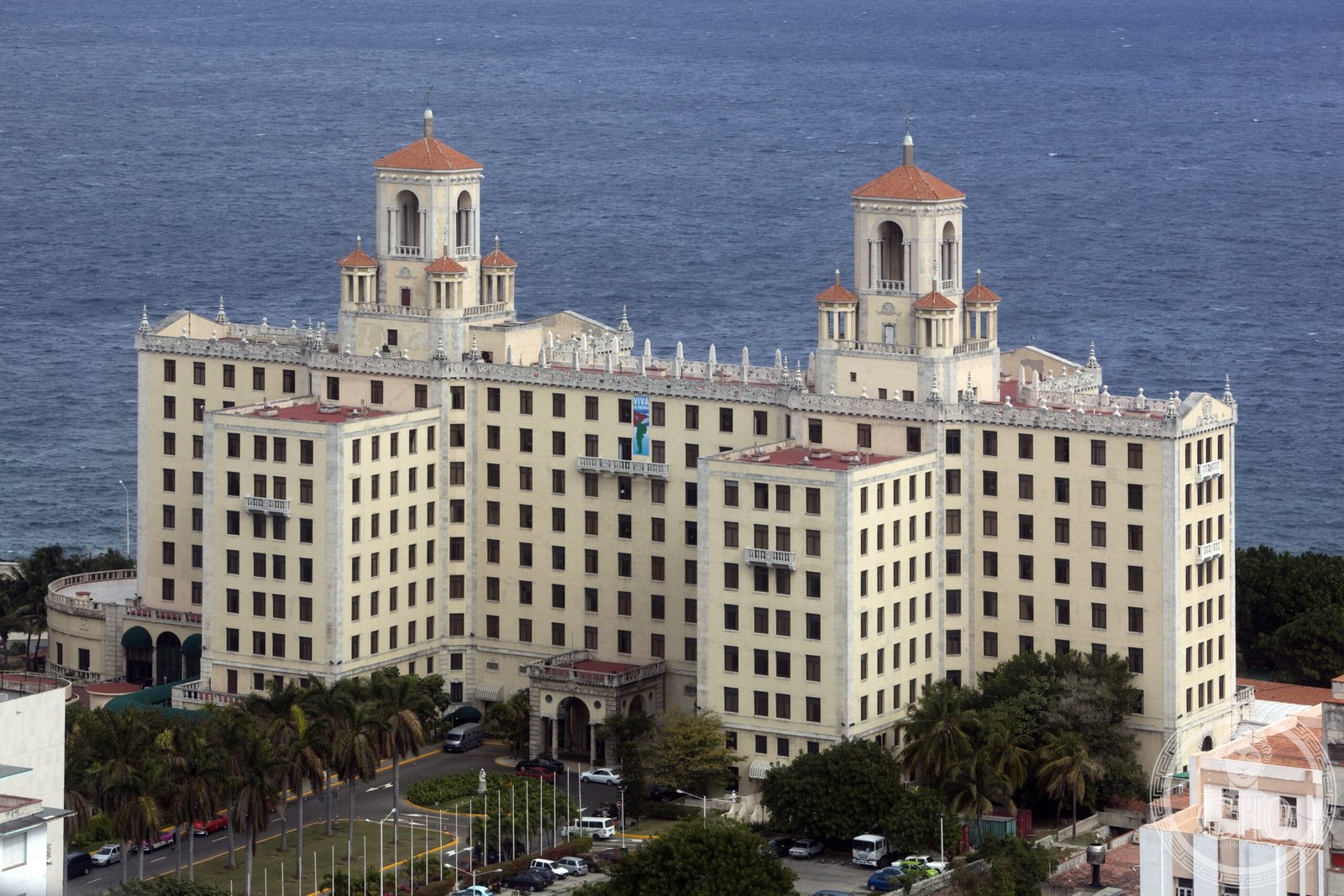
The Hotel Nacional de Cuba stands on Taganana Hill above the Malecón in Havana’s Vedado district — a building that has witnessed more of the twentieth century’s convulsions than almost any other hotel on earth. Designed by the New York firm McKim, Mead & White and opened in December 1930, it fuses Spanish Colonial Revival twin towers with Art Deco ballrooms and public rooms in an architectural tension that mirrors Cuba’s own history of competing influences. The Nacional was where American power, organised crime, Cuban politics, and Caribbean glamour intersected for three extraordinary decades: Buster Keaton, Marlene Dietrich, Frank Sinatra, and Winston Churchill all stayed here. In October 1933 deposed Cuban army officers barricaded inside were shelled by Batista’s forces. In December 1946 the hotel hosted the Havana Conference — the full leadership of American organised crime, convened by Lucky Luciano. And in October 1962, during the Cuban Missile Crisis, Che Guevara commanded an anti-aircraft battery from its grounds. Declared a National Monument of Cuba, the Nacional remains one of the iconic hotel buildings of the Americas.
At a glance
- Type
- Grand Hotel · National Monument
- Period
- Opened December 1930
- Style
- Spanish Colonial Revival · Art Deco
- Location
- Calle 21 y O, Vedado, Havana, Cuba
- Coordinates
- 23.140° N, 82.357° W
- Architect(s)
- McKim, Mead & White (New York)
Overview
The Hotel Nacional occupies a prime hilltop site overlooking the Straits of Florida, commanding views from the Morro Castle to the west of Havana Bay. McKim, Mead & White — the firm responsible for the original Pennsylvania Station and the Boston Public Library — brought their command of historical eclecticism to the commission, producing a building whose Moorish-arched arcades, terracotta tile roofs, and twin Spanish Colonial bell towers anchor the Havana skyline. The interior public rooms deploy Art Deco detailing: gilded coffered ceilings, geometric ironwork, and a sweeping staircase descending to the garden terrace facing the sea.
History
The Nacional was built by the Cuban government under President Gerardo Machado using the American firm favoured by the Havana power elite, and opened in 1930 as Cuba’s first world-class international hotel. In 1933, during the turbulent post-Machado period, some 300 deposed army officers occupied the hotel; Batista’s troops shelled and stormed it after a siege lasting several days. The hotel then became the unofficial headquarters of American organised crime’s Cuban operations in the 1940s and early 1950s, culminating in the December 1946 Havana Conference presided over by Meyer Lansky and Lucky Luciano. After the 1959 Revolution the hotel was nationalised; in 1962 Che Guevara set up anti-aircraft defences on its grounds during the Missile Crisis. Today it operates under Gaviota, the Cuban state tourism authority.
Architecture & Design
The Nacional’s exterior is dominated by its twin Moorish-inflected towers, terracotta tile roofs, and a long arcaded facade whose arches frame views of the Caribbean. The main entrance leads through a barrel-vaulted lobby decorated with geometric tilework and painted beams to the Hall of Fame corridor, lined with photographs of the hotel’s famous guests. The garden descends in terraced lawns to a sea-wall, with a swimming pool terrace on the middle level. A network of tunnels built during the Missile Crisis connects the hotel basement to defensive positions and can be visited today. The casino ballroom, closed since 1959, preserves its original Art Deco fittings intact.
Cultural significance
The Hotel Nacional is a National Monument of Cuba and a UNESCO candidate site. It is one of the few buildings in the Americas that can legitimately be called a witness to twentieth-century world history: the 1933 siege, the 1946 Havana Conference of organised crime, the 1962 Missile Crisis, and the glamour of pre-revolutionary Havana all happened within or immediately around this building. The Hall of Fame corridor — with its photographs of Hemingway, Sinatra, Churchill, and scores of others — is an inadvertent archive of a vanished world. The hotel also represents a rare surviving example of McKim, Mead & White’s Caribbean work.
Visiting today
The Hotel Nacional operates as a working hotel open to international visitors. Non-guests may visit the public areas — lobby, garden terraces, Hall of Fame corridor, and the Missile Crisis tunnels — during daylight hours. The Bar de los Famosos and outdoor terrace bar are open for drinks. The tunnels beneath the garden are accessible on a self-guided basis. The hotel hosts regular cabaret and live music evenings. Booking directly through the hotel or a specialist Cuba travel agency is recommended.
Getting there
The hotel is on Calle 21 y O in Vedado, approximately 4 kilometres from Old Havana. Taxis from Old Havana take 10 to 15 minutes. The P2 bus route connects Vedado to central Havana. Bicycle taxis operate along the Malecón. The hotel’s hilltop position makes it a useful orientation point: the Malecón seafront promenade is a short walk downhill and Revolution Square is within a 20-minute walk.
Sources & resources
Find it on the map
See this place and what’s around it →Record researched and written by Luigi De Marchi for Cultural Heritage Online, 2026.
📷 Become a Cultural Heritage Online photographer
Share your photos of places: they stay published under your name as the author. The more they're seen, the more you get noticed — and soon a contest will reward the most appreciated photos.
Log in or sign up free to add a photoIs this page about you?
This page is read by travellers and heritage enthusiasts who find it on Google. Tell us how you are connected to this place and we will take it from there.