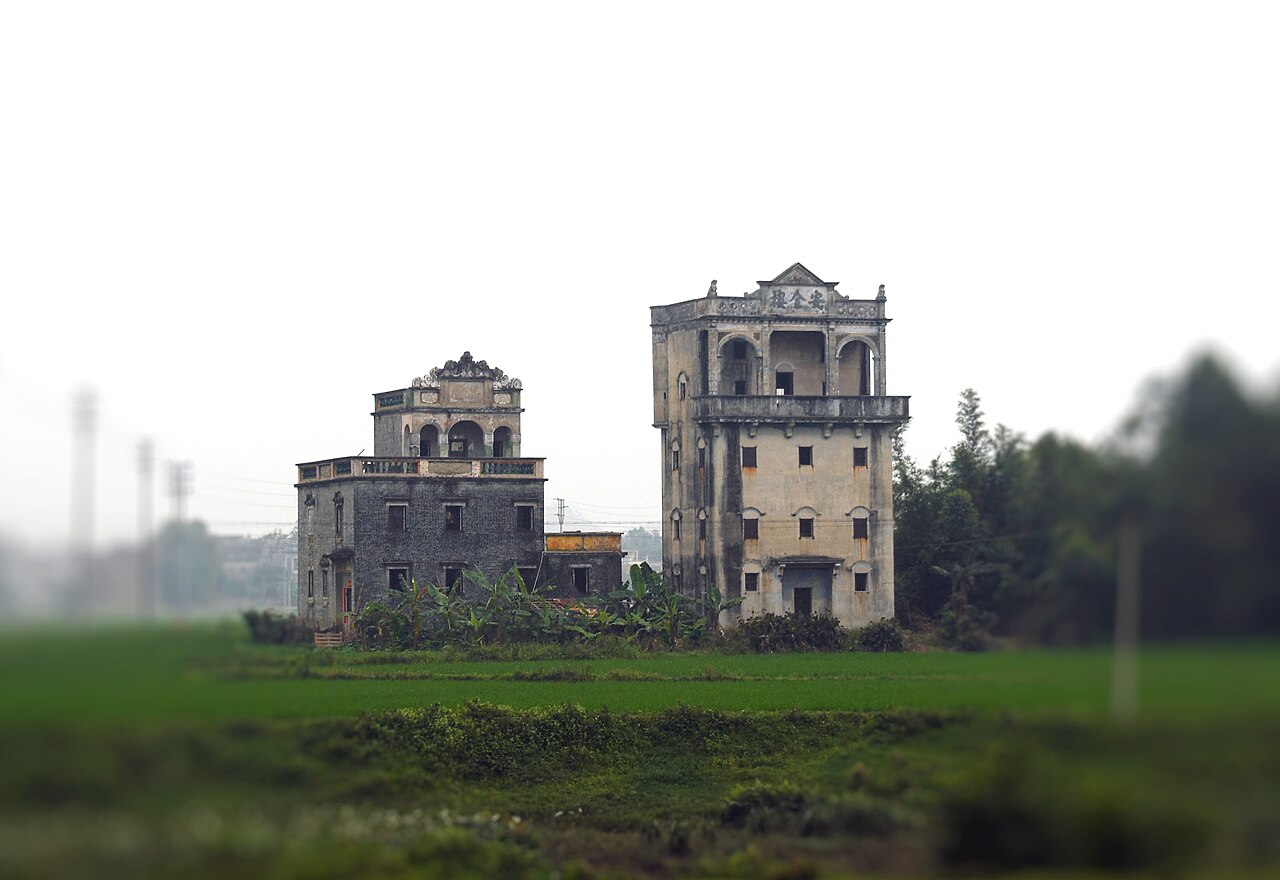
The Kaiping Diaolou and Villages, inscribed by UNESCO in 2007, comprise 1,833 distinctive multi-storey defensive towers (diaolou, literally “watchtower buildings”) in the Kaiping County area of the Pearl River Delta’s western hinterland in Guangdong Province — the largest surviving complex of hybrid Chinese-Western village architecture in the world, built between approximately the 16th century and the 1930s by emigrant Cantonese families from Kaiping, Taishan, Enping, and Heshan counties (the “Sze Yup” or Four Counties region, the primary source of 19th- and early 20th-century Chinese emigration to Southeast Asia, Australia, and North America) who returned with overseas earnings to build fortified residential towers in their home villages. The diaolou’s Outstanding Universal Value rests on their unique architectural hybridity: each tower combines a Chinese vernacular residential plan (courtyard orientation, ancestor hall, clan organisation of internal spaces) with an upper-storey decorative skin borrowed from Western architectural traditions — Baroque, Venetian, Italian Renaissance, Moorish, Byzantine, classical Greek, Romanesque, and Art Deco vocabularies appear simultaneously on different towers within a single village cluster, reflecting the variety of overseas Chinese settlement zones (Southeast Asia, Europe, North America) from which the individual families’ architectural references were drawn. The four primary inscribed village clusters (Zili, Majianglong, Jinjiangli, and Sanmenli) each contain 10–15 diaolou towers in village settings of paddy fields, banana groves, and pond fish farms that have preserved the agricultural landscape context for which the towers were originally built as protective structures against bandits and flooding.
The Pearl River Delta and the Cantonese emigrant network Historic Centre of Macao · Canton Guangzhou · South China Karst Guilin — 100 to 370 km
One Hundred and Forty Kilometres southeast of the Kaiping Diaolou by road (approximately 2 hours from Kaiping City to the Macao Outer Harbour ferry terminal via the Guangdong coastal expressway and the Zhuhai Gongbei land crossing, or approximately 2.5 hours via Guangzhou coach connections), the Historic Centre of Macao (inscribed 2005) is the most directly related UNESCO companion to the Kaiping Diaolou in terms of the cultural history of Sino-Western architectural exchange on China’s southern coast. Where the Kaiping Diaolou represent the Chinese emigrant community’s vernacular reception of Western architectural forms — family-level choices about which Western decorative vocabularies to apply to the upper storeys of their defensive towers — the Macao Historic Centre represents the official colonial Portuguese administration’s imposition of European Baroque and Renaissance architectural standards on a Chinese urban setting. Both are physical evidence of the same phenomenon (the encounter between Chinese and Western built environment cultures on the South China coast), but from opposite ends of the power dynamic: the Macao evidence is the product of the Western colonial authority; the Kaiping evidence is the product of the Chinese emigrant community’s autonomous reception of Western architectural forms on their own terms, in their own villages, for their own families. The Kaiping to Macao connection is also biographical: Kaiping County was one of the Four Counties (Sze Yup) that provided the majority of the 19th-century Cantonese emigrant workers who built the American and Australian railroad networks, mines, and agricultural systems — the same emigrant capital that funded the diaolou. From Kaiping, Macao is reached by coach to Zhuhai Gongbei (approximately 1.5 hours) and then bus/taxi across the border to Macao’s historic core (30 minutes).
One Hundred Kilometres northeast of the Kaiping Diaolou by road (approximately 1.5 hours from Kaiping City to Guangzhou South on the Guangdong provincial expressway network, or approximately 1 hour 15 minutes by intercity coach from Kaiping Bus Station to Guangzhou Shiqiao Coach Station), Guangzhou (Canton) is the historic capital of Guangdong Province and the commercial and cultural centre of the Cantonese emigrant world from which the Kaiping Diaolou builders came. The Canton System (the Guangzhou trading restriction that limited Western commercial access to China to a single port — Guangzhou — between 1757 and 1842) created the economic conditions that pushed Cantonese emigrants toward overseas trade and labour migration: when the Opium Wars (1839–1842, 1856–1860) forced China to open additional treaty ports and sign the Convention of Peking (1860, which legalised Chinese emigration for the first time under Qing law), Cantonese from the Pearl River Delta’s Four Counties were already positioned with overseas community networks to respond to the demand for Chinese labour in the gold rush economies of California (1848), Australia (1851), and British Columbia (1858). Guangzhou’s monuments most relevant to the Kaiping Diaolou story are the Shamian Island concession area (the 19th-century British and French concession district on the Pearl River, with its colonial European architecture preserved as a heritage precinct), the Chen Clan Ancestral Hall (1894 Guangzhou, the largest Qing-period clan-temple complex in Guangdong, whose carved brick and wood decorative programme documents the same Cantonese vernacular aesthetic sensibility that the Kaiping diaolou builders applied to their home-village towers), and the Guangzhou Museum of Art. From Kaiping, Guangzhou is reached by express coach (approximately 1.5 hours) or by the Guangzhou-Zhuhai Intercity Railway (from Zhongshan Station, approximately 1.5 hours by feeder bus from Kaiping to Zhongshan).
Three Hundred and Seventy Kilometres north of the Kaiping Diaolou by high-speed rail (approximately 2 hours from Guangzhou South to Guilin North on the Guiyang-Guangzhou HSR, with a Guangzhou-South connection from Kaiping of approximately 1.5 hours by coach), the South China Karst (inscribed 2007, extended 2014) represents the other 2007 UNESCO inscription from southern China, physically connecting the Pearl River Delta’s heritage sites to the Guangxi karst landscape zone. The Guilin karst (Li River section) is the most visited component of the South China Karst inscription and the archetypal “mountains-and-water” (shanshui) landscape of traditional Chinese painting — an association reinforced by 20th-century Chinese banknote design (the 20-yuan note depicts the Xingping section of the Li River karst). The same Pearl River system that drains the Kaiping agricultural landscape also drains the Guilin karst: the West River (Xijiang), which passes through Kaiping and joins the Pearl River at Guangzhou, is the downstream extension of the Gui River (which flows south through the Guilin karst to join the West River at Wuzhou). The hydrological connection — the water that flows past the Kaiping Diaolou paddy fields passed through the Guilin karst limestone formations upstream — provides a natural geographic framework for combining the two 2007 inscriptions in a single Cantonese-Guangxi heritage circuit. From Kaiping, Guilin is reached by coach to Guangzhou (1.5 hours) and then HSR Guangzhou South to Guilin North (approximately 2 hours).
Within the Kaiping Diaolou inscribed area, the four primary village clusters are distributed across Kaiping County in a zone approximately 40 kilometres east-west and 30 kilometres north-south. The Zili Village cluster (Zili Cun, approximately 15 km south of Kaiping City) is the most visited and the most photogenic — 15 diaolou towers in a remarkably intact village setting of paddy fields and fish ponds, including the Ruishi Lou (Ruishi Diaolou, 9-storey, 1925, the most architecturally elaborate diaolou in the inscribed area, with a Roman colonnaded loggia at the top, a Byzantine dome corner towers, and a Chinese-tiled lower storey) and the Mingshi Cun ancestral hall and communal buildings that demonstrate the social organisation of the Cantonese clan village. The Majianglong cluster (approximately 10 km southeast of Zili) contains a lower-density distribution of diaolou in a banana-plantation landscape that emphasises the towers’ vertical contrast with the surrounding flat agricultural ground. The Jinjiangli and Sanmenli clusters (approximately 20–30 km west of Kaiping City) are less visited and offer a quieter experience of the village landscape. Admission to the Kaiping Diaolou covers all four clusters; a hired car or minibus is the most practical way to visit multiple clusters in a single day. From Guangzhou, the Kaiping Diaolou is reached by coach from Guangzhou Liwan Coach Station (approximately 2 hours) or by Foshan-Kaiping Intercity Railway (under construction, expected 2026) with connection from Guangzhou.
Guangdong’s heritage landscape: emigrant capital and Lingnan culture Fujian Tulou · South China Sea trade routes · Chaozhou ancestral halls — 200 to 400 km
Two Hundred and Fifty Kilometres northeast of the Kaiping Diaolou by road (approximately 3.5 hours from Kaiping to Chaozhou via the coastal expressway through Shantou, or approximately 3 hours by HSR from Guangzhou South to Chaozhou North Station — not yet operational as of 2024; currently by conventional rail approximately 4 hours), Chaozhou City in eastern Guangdong is the historical capital of the Chaoshan (Chaozhou-Shantou) cultural zone and the starting point for understanding the other major Cantonese emigrant culture — the Teochew (Chaozhou dialect) community — whose overseas network extended through Southeast Asia (Thailand, Malaysia, Vietnam, Cambodia) rather than to the Americas and Australia as the Four Counties Cantonese (Sze Yup) network did. The Chaozhou ancestral halls complex (Chaozhou Kaiyuan Temple, 738 CE, and the Chaozhou Memorial Archways and Ancestral Halls cluster along Paifang Street, Ming-Qing period) demonstrates the same social function as the Kaiping Diaolou — the investment of overseas emigrant capital in built heritage in the home community — but in the form of civic and religious architecture (memorial archways, ancestral halls, temple complexes) rather than defensive residential towers. The Chaozhou wood-carving and Chaozhou cuisine traditions are the most internationally recognised material culture exports of the Teochew emigrant community, paralleling the Kaiping-area’s association with the Cantonese emigrant community’s contributions to the American and Australian built environment. From Kaiping, Chaozhou is reached by HSR from Guangzhou South (approximately 2 hours) or by conventional rail via Guangzhou (approximately 4.5 hours total).
Two Hundred Kilometres north of the Kaiping Diaolou by road (approximately 3.5 hours from Kaiping to Zhaoqing, and then the Danxia Mountain, or from Guangzhou South by HSR to Shaoguan and then local bus to Danxia Mountain, approximately 1.5 hours HSR + 1.5 hours bus), the Mount Danxia Scenic Area (part of the China Danxia (South China Karst) extension nomination in progress, or Danxiashan National Geopark, Shaoguan Prefecture) represents the Guangdong provincial landscape heritage complement to the Pearl River Delta urban and architectural heritage zone. Danxia Mountain’s characteristic red sandstone (Danxiaite) formations — red-coloured Cretaceous conglomerate eroded into spectacular towers, buttresses, and gorges — define a distinctly southern Chinese landscape type that contrasts with the limestone karst of Guilin and the granite peaks of the Yellow Mountain. From Kaiping, Danxia Mountain is accessible by road via Guangzhou and Shaoguan (approximately 4 hours) or by HSR to Shaoguan Station and then local bus.
Practical information
The Kaiping Diaolou and Villages UNESCO site is located in Kaiping County (Kaiping Shi, county-level city), Jiangmen Prefecture, Guangdong Province. Kaiping is approximately 130 kilometres southwest of Guangzhou City and approximately 100 kilometres north of the Macao-Zhuhai border crossing. Transportation to Kaiping from Guangzhou is primarily by express coach (approximately 1.5–2 hours from Guangzhou Liwan Coach Station or Foshan Coach Station); from Macao by coach via Zhongshan or via the Guangdong coastal expressway (approximately 2–2.5 hours). The Kaiping UNESCO site admission covers all four village clusters (Zili, Majianglong, Jinjiangli, Sanmenli) and the Kaiping Diaolou Museum (in Kaiping City). Individual cluster tickets are not available; a combined full-site ticket covers all monuments. The Zili Village cluster (Zili Cun Scenic Area, approximately 15 km south of Kaiping City, accessible by local bus No. 6 or tourist bus from the Kaiping Diaolou Museum) is the recommended starting point for first-time visitors. Allow a full day for Zili and Majianglong (the two most visited clusters) or two days if visiting all four clusters. The site is open year-round; the best visiting seasons are October–January (cooler, clear weather) and March–April (paddy fields in early growth). Summer months (June–September) bring high humidity and frequent typhoon rains. Accommodation in Kaiping City (mid-range hotels near the coach station) or in Chikan Old Town (Chikan, approximately 10 km east of Kaiping City, a preserved Qing-period commercial riverside quarter with guesthouse accommodation) is standard; no on-site accommodation within the inscribed village areas.
Frequently Asked Questions
Who built the Kaiping Diaolou and why did they choose such eclectic Western architectural styles?
The Kaiping Diaolou were built primarily by Cantonese emigrants from the Kaiping, Taishan, Enping, and Heshan county area — the Four Counties (Sze Yup) region of the western Pearl River Delta — who migrated to Southeast Asia, Australia, and North America from the 1840s through the 1930s. The migration was driven by a combination of local factors (political instability during the Taiping Rebellion, 1850–1864; population pressure in the Pearl River Delta’s densely settled agricultural landscape; clan conflicts and banditry in the Four Counties area) and the overseas demand for Chinese labour in the gold rush economies of California (1848), Victoria, Australia (1851), and British Columbia (1858). Successful overseas workers remitted earnings back to their home villages and eventually returned with their savings to marry, raise families, and invest in the construction of defensive residential towers that would protect their families and property from the banditry that had intensified during their absence. The Western architectural decorative elements on the diaolou upper storeys reflect the specific overseas communities where each family had lived and worked: a tower built by a family from the California railroad construction community might incorporate Baroque or Neo-classical elements seen in San Francisco’s Nob Hill mansions; a tower built by a family from Malaysia might incorporate Moorish arched windows seen in Kuala Lumpur’s colonial administrative buildings; a tower from a Thai-based Teochew family might show Siamese temple roof elements. The eclecticism is not the result of a single architectural design tradition but of hundreds of individual families independently applying the architectural memories of their specific overseas experience to the upper decorative levels of otherwise standard Cantonese vernacular tower structures. The resulting visual diversity — where each diaolou in a single village is visually distinct from its neighbours — is considered one of the inscription’s primary Outstanding Universal Value characteristics: it is a material index of the geographic diversity of the Cantonese emigrant diaspora.
What is the difference between a diaolou, a wulou, and a juslou, and how are they distinguished in the Kaiping landscape?
The 1,833 surviving diaolou in the Kaiping area are divided by function and ownership into three main types, each with a distinct relationship to the village social structure. The zhai lou (寨樓, “village tower”) or communal diaolou is the earliest and most basic type — a defensive structure built and owned collectively by a clan or village group, serving as a refuge tower for the entire community during bandit raids or flooding; these early towers (typically Ming period, 16th–17th century, built from rammed earth or river stone) have minimal ornamentation and prioritise structural defensibility (thick walls, metal-shuttered windows, rooftop watchtower) over residential comfort. The zhong lou (衆樓, “communal tower”) is a transitional type, collectively owned but with individual family floors assigned to specific households who stored valuables and retreated to their assigned floor during emergencies — the communal ownership requires that each family contribute to construction and maintenance, but internal organisation mirrors residential family units. The jushi diaolou (居仕碉樓, “resident diaolou”) is the privately owned residential tower — the type most responsible for the Kaiping Diaolou’s UNESCO inscription and its Western architectural eclectic character. Built from the late 19th century through the 1930s by individual families of returned overseas emigrants (Huaqiao), the resident diaolou functions as both a primary family residence and a defensive structure: the lower storeys contain living quarters, the upper floors contain storage and family quarters, and the top floor is the watchtower with fortified parapet and loopholes. The decorative eclecticism is concentrated on the resident diaolou type — communal village towers are architecturally conservative, while the resident towers reflect individual family investment and architectural ambition. The most architecturally celebrated diaolou — including the Ruishi Lou in Zili Village (1925, 9 storeys, Byzantine-Roman-Baroque hybrid) and the Yinglong Lou in Jinjiangli (1921, 5 storeys, Baroque parapet with Art Nouveau floral details) — are all resident diaolou commissioned by individual Huaqiao families.
What happened to the Kaiping diaolou-building communities after 1949 and why did construction stop?
The construction of diaolou in Kaiping County ended abruptly after the establishment of the People’s Republic of China in October 1949, for multiple converging reasons. The primary drivers were political and economic: the new government’s land reform (1950–1953) redistributed the agricultural landholdings that the diaolou-building families had accumulated with their overseas earnings, removing the economic basis for the towers’ function as symbols and storage facilities for family wealth. Simultaneously, the overseas Chinese communities whose remittances had funded diaolou construction were cut off from contact with their home villages by the PRC government’s restrictions on overseas Chinese remittances and communication (partially lifted in the 1980s Reform era). The banditry and clan conflict that had made the diaolou’s defensive function necessary was suppressed by the new government’s rural security apparatus, removing the security rationale. The result was a complete cessation of new diaolou construction after 1949, followed by a period of significant neglect and demolition (approximately 400–500 diaolou were demolished during the Cultural Revolution period, 1966–1976, when their overseas Chinese associations made them politically suspect) that reduced the surviving stock from an estimated 2,300+ towers in 1949 to the 1,833 documented before the UNESCO nomination. The cultural reassessment of the diaolou as heritage rather than as symbols of overseas Chinese capitalism began in the 1980s, parallel to the broader reassessment of Huaqiao culture as evidence of Chinese entrepreneurial capacity rather than of collaboration with capitalism. The 2007 UNESCO inscription completed the rehabilitation of the diaolou as the primary physical evidence of the Cantonese emigrant diaspora’s cultural achievement — the buildings that an earlier generation had viewed as ideologically problematic are now the most internationally recognised heritage of Guangdong Province.
Sources
- S1 — UNESCO World Heritage Centre — Kaiping Diaolou and Villages (Ref. 1112) — https://web.archive.org/web/20230601000000/https://whc.unesco.org/en/list/1112/
- S2 — UNESCO World Heritage Centre — Statement of Outstanding Universal Value (Ref. 1112) — https://whc.unesco.org/en/list/1112/
Spotted an error? Write to editorial@culturalheritageonline.com and we correct it the same day.