Xidi and Hongcun, two villages in Yi County, southern Anhui province, received UNESCO World Heritage status in 2000 as the best-preserved examples of traditional Huizhou rural settlement in China. Together they contain approximately 330 residential buildings constructed during the Ming (1368–1644) and Qing (1644–1912) dynasties. Hongcun’s central water management system — designed in the Ming period to move water through the entire village via channels connecting every household — still functions today. Fifty kilometres north, the Huangshan mountain range offers the second UNESCO inscription within reach of a single journey through southern Anhui.
The Huizhou House and the Merchant Culture That Built It Yi County, Anhui Province
The residential architecture preserved in Xidi and Hongcun is the physical expression of a merchant class that dominated long-distance trade in China for seven centuries. Huizhou merchants (Huishang) operated across eastern China from approximately the 12th to the 19th century, dealing primarily in salt, tea, timber, and ink. Salt distribution rights — allocated by the imperial government and enormously profitable — funded the construction of elaborate private residences back in their home villages in southern Anhui, which the merchants built as displays of wealth and status while remaining embedded in a Confucian culture that officially ranked merchants below farmers and scholars. The contradiction produced a distinctive architecture: visually modest on the exterior, built to exacting standards within.
The characteristic Huizhou building type is the baitang, or white hall house. The exterior walls are faced with lime plaster in white, the roof tiles are black clay, and the gable ends terminate in the stepped mabu qiang — horse-head walls — which rise above the roofline in successive horizontal tiers. The horse-head walls served originally as fire barriers: in densely packed villages, they interrupted the spread of fire between adjacent buildings. Over time they became a stylistic signature, varied in profile across different family compounds. The entrance gate of a substantial house carries carved stone lintels with symbolic decoration — bats for prosperity, deer for longevity, magpies for good fortune. Inside, the central feature is the tianjing, the skywell: a small open-air courtyard within the house envelope that brings daylight and ventilation to the surrounding rooms. Water collected in a stone basin at the skywell’s base; this indoor water source had both practical and symbolic functions, the basin referred to in Feng Shui terms as a container of wealth accumulating within the household.
Xidi, the smaller and more formally preserved of the two villages, contains 124 residential buildings and two ancestral halls. It was founded by a descendant of the Tang dynasty’s last emperor who fled south after the dynasty’s collapse in 907 CE, and the village maintained continuous habitation through the subsequent dynasties. Walking its central lane takes approximately 20 minutes; the carved wooden screens visible through open courtyards represent the finest decorative work in the village, produced by craftsmen specialising in the three Huizhou carving arts: wood, stone, and brick.
Hongcun’s Buffalo-Shaped Water System and the Film That Brought It Global Attention Yi County, Anhui Province
Hongcun was designed in the Ming dynasty around an artificial water management system conceived by a Feng Shui master to mimic the form of a buffalo when seen from above. The hills behind the village represent the buffalo’s body; a central pond represents its stomach; the network of channels carrying water through the village corresponds to the animal’s internal organs; and a larger lake at the village’s southern edge, constructed in 1607, represents the buffalo’s belly. The system is not merely symbolic: it delivers flowing water to the interior of the village in a regulated sequence, moving from a spring source in the hills through the central Moon Pond (Yuezhao, constructed in the 1400s), into a branching network of channels that pass through or alongside every household in the settlement, and out into the South Lake (Nanhu). Households upstream were historically required to stop drawing water each morning until downstream households had completed their cooking; the sequence then reversed for washing. This allocation system, maintained through community agreement rather than infrastructure, governed daily water use across the village for centuries and is documented in village records.
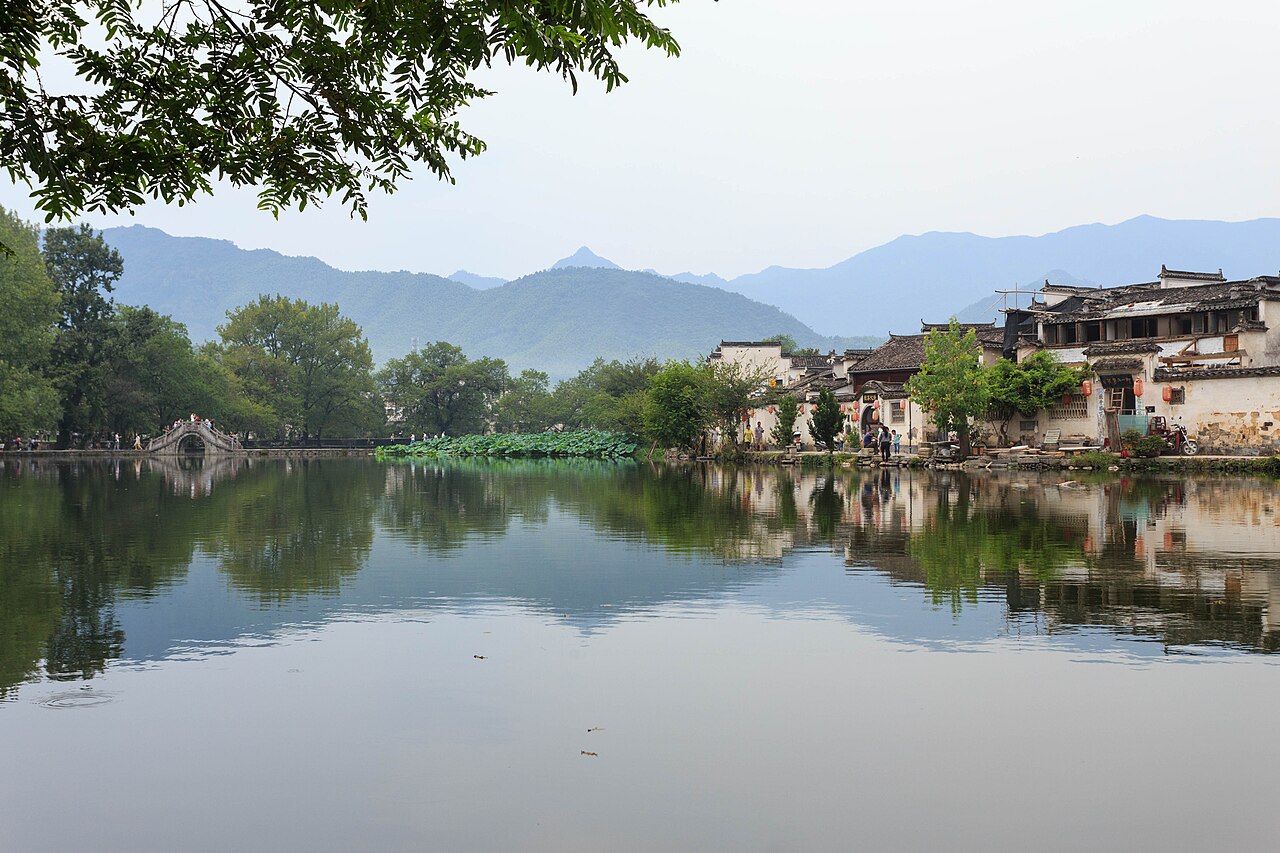
The Moon Pond remains the visual centre of Hongcun. Its still surface reflects the whitewashed walls and horse-head gables of the surrounding houses, and the composition it creates is among the most photographed traditional village views in China. That visual is one reason Ang Lee selected Hongcun as a principal filming location for “Crouching Tiger, Hidden Dragon” in 2000, the same year the village received its UNESCO designation. The film’s international success — it won four Academy Awards and was China’s highest-grossing foreign-language film in the United States at the time of release — brought Hongcun to the attention of a global audience that had not previously encountered Huizhou architecture. Visitor numbers rose sharply in the years after the film’s release.
Fifty kilometres north, the Huangshan mountain range — inscribed as a UNESCO World Heritage site in 1990 — extends the itinerary for visitors with additional time. Huangshan is known for its granite peaks, ancient pine trees deformed by wind into distinctive silhouettes, and the sea-of-clouds phenomenon that appears when low cloud fills the valleys between peaks at dawn. The two sites are connected by road through the Huizhou landscape and by historical logic: many of the merchants whose wealth built the Xidi and Hongcun houses came from families whose ancestral seat was in the mountain counties that Huangshan now occupies.
Practical information
Yi County is most easily reached from Huangshan City (formerly Tunxi), the regional transport hub with an airport serving Shanghai and Hangzhou, and a high-speed rail station on the Hangzhou–Huangshan line (approximately 2 hours from Hangzhou, 4 hours from Shanghai). From Huangshan City, buses and taxis connect to Xidi (approximately 40 minutes) and Hongcun (approximately 60 minutes). Both villages charge separate entrance fees; a combined ticket covering both is available through some tour operators. Hongcun is the larger and more commercially developed of the two, with cafés, tea houses, and accommodation inside the village perimeter; Xidi has fewer facilities and is generally quieter, particularly on weekday mornings. The Moon Pond is best photographed at dawn before visitor volume increases. Interior access to individual private houses requires separate payment to the family owners; many households in both villages display carved elements publicly through open gates. Accommodation is available in traditional courtyard guesthouses within both villages, booked in advance for peak periods (April–May, September–October, and Chinese public holidays). Huangshan is accessible by cable car and walking trails; the peak-season visitor management system requires advance booking for accommodation on the mountain.
Frequently Asked Questions
How does Hongcun’s water system work, and is it still functional today?
Hongcun’s water management system was designed in the Ming dynasty, with the Moon Pond constructed in the 1400s and the South Lake added in 1607. The system draws water from a natural spring source in the hills behind the village and moves it through the settlement via a network of stone-lined channels running alongside and through the spaces between residential buildings. The Moon Pond (Yuezhao), a crescent-shaped pool at the village’s centre, functions as the primary distribution point: water flows into it from the hills, settles and clarifies, and then moves outward through the channel network to reach individual households. The South Lake (Nanhu) at the village’s southern perimeter receives the outflow and serves as a reservoir. The entire system was conceived by a Feng Shui practitioner to create a settlement that, in plan view, resembled the body of a buffalo — the hills forming the animal’s back, the pond its stomach, the channels its veins, and the lake its abdomen. This organisational principle is documented in village genealogical records. A historic schedule governed water use: households were allocated morning drawing rights in a fixed upstream-to-downstream sequence, ensuring that cooking water was drawn before washing began. This customary regulation was enforced through community agreement rather than physical infrastructure. The system is still functional today. Water moves through the channels and the Moon Pond actively, though modern municipal water supply has reduced its role in daily household use. The South Lake remains clear and is used by residents for tasks including laundry, as it has been for centuries.
What defines Huizhou architecture and where else can it be seen in China?
Huizhou architecture (Huipai jianzhu) is the building tradition associated with the historic Huizhou prefecture in southern Anhui — a region that covers the present-day districts of Shexian, Xiuning, Yixian, Qimen, Wuyuan, and Jixi. Its defining formal characteristics are: lime-plastered white exterior walls, grey-black clay roof tiles, and the mabu qiang (horse-head walls) — stepped parapets that rise above the roofline at the gable ends in three to five horizontal tiers of varying heights. Inside, the central tianjing (skywell) provides natural light and ventilation to the surrounding rooms. The decorative programme of a substantial Huizhou house involves three distinct craft specialisations known as Hui San Diao (the three Huizhou carvings): wood carving on screens, panels, and beams; stone carving on door lintels, threshold stones, and columns; and brick carving on entrance gate surrounds and decorative panels. The style spread across eastern China via merchant migration: Huizhou merchants who settled in commercial centres such as Hangzhou, Yangzhou, Suzhou, and Shanghai built in variants of the home-province style, and the Huizhou building tradition influenced vernacular residential architecture across the Yangtze Delta region. Wuyuan County in Jiangxi province — culturally part of historic Huizhou though administratively in a different province — has the highest concentration of surviving Huizhou villages outside Anhui, with particularly well-preserved examples at Likeng and Wangkou. Xidi and Hongcun in Yi County, Anhui, are the only two Huizhou villages with UNESCO World Heritage status.
What role did Huizhou merchants play in Chinese economic history?
Huizhou merchants (Huishang) were one of the dominant merchant groups in Chinese long-distance trade from the 12th through the 19th century. Operating from a mountainous home region with limited agricultural land and abundant surplus labour, Huizhou men entered trade early and developed a reputation for disciplined commercial networks based on family and surname-group connections. Their most lucrative early business was salt distribution: the Ming and Qing imperial governments allocated salt trading rights (yan yin) to licensed merchants, and Huizhou families obtained large shares of these rights in the Lianghuai salt distribution region (covering the Yangtze Delta and southeastern China). Salt licensing created immense concentrations of merchant capital. Huizhou merchants diversified into tea (particularly from the mountains of southern Anhui and Fujian), timber (floated down the Xin River network), ink (Huizhou was the primary production centre for Chinese writing ink), and printed books and art supplies. Their trading networks extended across China, with commercial colonies in Yangzhou, Hangzhou, Suzhou, and Beijing. In cultural and intellectual life, Huizhou merchant wealth funded Neo-Confucian academies, the collection and printing of classical texts, and the patronage of painters and calligraphers — particularly the Xin’an school of painting, which influenced the development of Chinese literati landscape painting in the 17th and 18th centuries. The decline of the Huishang came after 1850, as the Taiping Rebellion (1850–1864) disrupted trade networks and destroyed many Huizhou villages, and as the imperial salt licensing system was gradually dismantled in the late 19th and early 20th centuries.
Sources
- S1 — Ronald G. Knapp — China's Living Houses: Folk Beliefs, Symbols, and Household Ornamentation, University of Hawai'i Press, Honolulu, 1999, ISBN 978-0824819989
- S2 — Nancy Shatzman Steinhardt — Chinese Architecture: A History, Princeton University Press, 2019, ISBN 978-0691169989
Spotted an error? Write to editorial@culturalheritageonline.com and we correct it the same day.