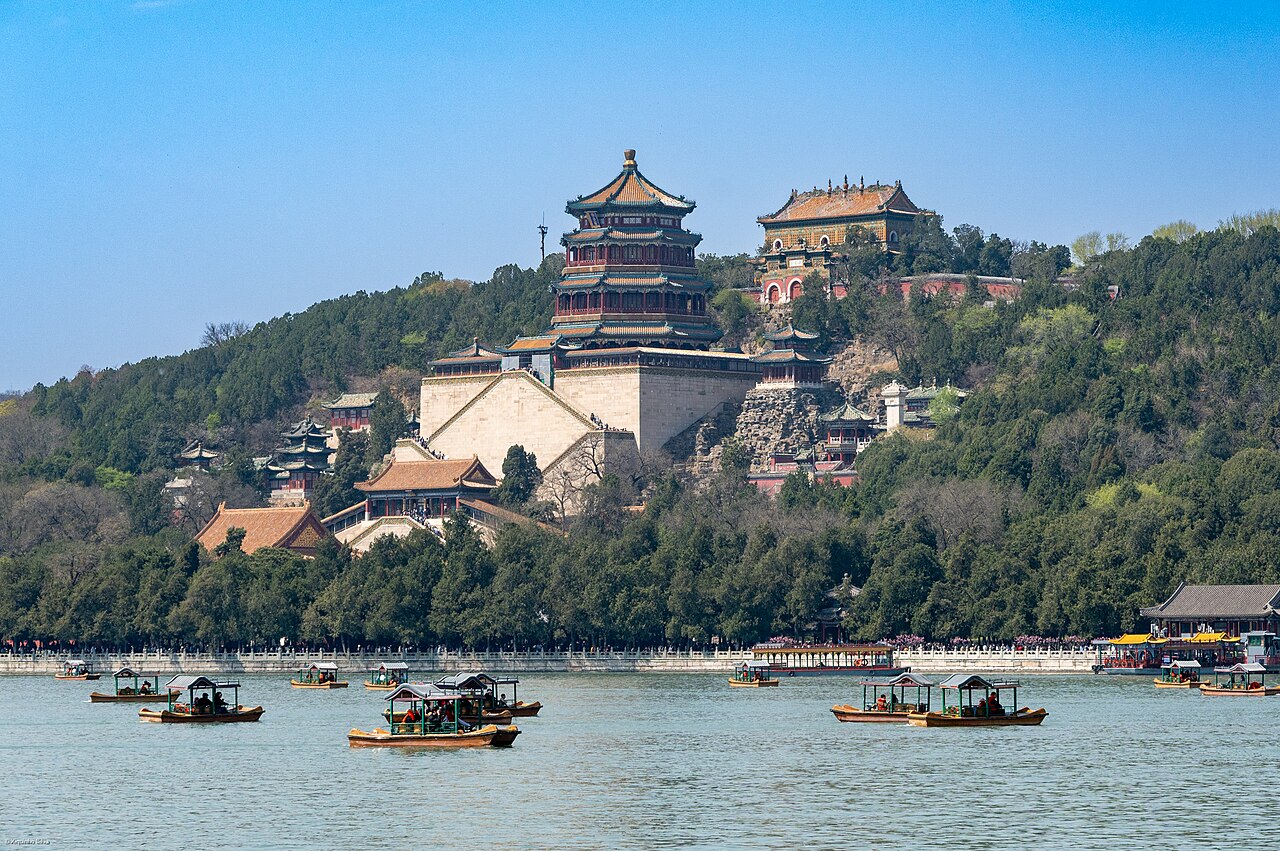
The Summer Palace (Yiheyuan) is a 294-hectare imperial garden complex 12 kilometres northwest of central Beijing, where 75% of the total area is water — Kunming Lake, excavated by an estimated 50,000 workers whose displaced earth formed Longevity Hill. UNESCO inscribed it in 1998 as an exceptional example of Chinese landscape garden design. The current structures date largely from 1886–1895, rebuilt by Empress Dowager Cixi after Anglo-French forces looted and burned the original complex in 1860. The Forbidden City lies 12 kilometres east and the Great Wall sections begin 80 kilometres north at Badaling.
A birthday gift burned by foreign armies and rebuilt on naval funds Haidian District, Beijing; metro Line 4 Xiyuan station
The origins of the Summer Palace site lie in 1750, when the Qianlong Emperor ordered construction of an elaborate garden complex as a birthday gift for his mother on her 60th birthday. The project, called the Qingyi Yuan (Clear Rippling Garden), was the largest garden construction project of the Qing Dynasty to that point. Kunming Lake was excavated to its current dimensions — roughly 2.2 kilometres long and 1.4 kilometres wide — by an estimated 50,000 workers over several years; the earth removed from the lake bed was piled to the north to create and extend Longevity Hill, which now rises approximately 60 metres above the water’s surface. The scale of the engineering was entirely intentional: Qianlong wanted a landscape that would evoke the scenic hills and lakes of Hangzhou in Zhejiang Province, specifically the West Lake (Xihu) — a reference he encoded in the name Kunming Lake, which echoes the name of a Han Dynasty training reservoir that was itself designed to evoke a famous landscape.
The Qingyi Yuan survived intact for approximately 110 years. In October 1860, during the Second Opium War, a joint British and French expeditionary force under Lord Elgin and General Montauban reached Beijing after defeating Qing forces at the Battle of Palikao. The troops first looted the adjacent Yuanmingyuan (Old Summer Palace) and the Qingyi Yuan over two to three days, taking jade, gold, silk, porcelain and clocks. Lord Elgin then ordered the systematic burning of the Yuanmingyuan — a deliberate act of collective punishment intended to signal to the Qing court that there were consequences for executing British and French envoys who had been sent under flag of truce. The Qingyi Yuan was partly burned in the same action. The French writer Victor Hugo wrote a public letter in November 1861 condemning the destruction, comparing the two nations to “two bandits” who had ransacked “one of the wonders of the world.” The letter is frequently quoted in Chinese official accounts of the event.
The Qing court lacked the funds to rebuild immediately. The Xianfeng Emperor, who had fled Beijing before the armies arrived, died in 1861. His son, the Tongzhi Emperor, died in 1875 without completing a planned restoration. The project fell to the Empress Dowager Cixi, who ruled as regent through two emperors from 1861 to 1908. Cixi began the reconstruction in 1886 under the name Yiheyuan (Garden of Nurtured Harmony), which is still the formal name of the complex today. The cost was approximately 30 million taels of silver — a figure that later became politically significant when China’s Northern Beiyang Fleet suffered a catastrophic defeat by Japan’s Imperial Navy at the Battle of the Yellow Sea in September 1894 and the Battle of Weihaiwei in 1895. Critics accused Cixi of diverting naval appropriations intended for new warships to the Summer Palace reconstruction; historical scholarship broadly confirms that appropriations designated for fleet modernisation were redirected to the garden project, though the extent of the diversion and its direct causal relationship to the naval defeat remain subjects of academic debate. Cixi’s reconstruction was completed in 1895, the same year as China’s defeat in the First Sino-Japanese War.
The Summer Palace was looted and partially damaged a second time in 1900, when forces of the Eight-Nation Alliance (Britain, France, Germany, Russia, Japan, the United States, Austria-Hungary and Italy) occupied Beijing during the Boxer Rebellion. Cixi again fled, this time to Xi’an. She returned to Beijing in 1902 after the signing of the Boxer Protocol, under which China agreed to pay 450 million taels in war indemnities — a sum equivalent to roughly twelve times the annual tax revenue of the Chinese government at the time. Further repairs to the Summer Palace were made between 1902 and 1908. Cixi died at the Summer Palace in November 1908, one day after the Guangxu Emperor (her nephew, whom she had effectively imprisoned since 1898) also died. The circumstances of both deaths, occurring on consecutive days, have never been fully explained; analysis of the Guangxu Emperor’s hair samples conducted in 2008 found elevated arsenic levels consistent with poisoning.
The Long Corridor, Longevity Hill and two more World Heritage Sites Forbidden City 12 km east; Great Wall at Badaling 80 km north
The Long Corridor (Changlang) is the structure most immediately striking to first-time visitors: a covered walkway running 728 metres along the north shore of Kunming Lake between the East Gate and the Cloud Dispelling Gate on the slope of Longevity Hill. The walkway is divided into 273 bays, each roofed and supported on painted pillars. Every beam and bracket is decorated with polychrome paintings — a total of 14,000 individual scenes, none of which is repeated. The subjects include landscapes (particularly West Lake scenes referenced by Qianlong’s original design), flowers, birds, fish, and scenes from Chinese literary works including the Dream of the Red Chamber, Romance of the Three Kingdoms, Journey to the West and Stories of the Water Margin. The paintings have been restored multiple times and represent both original Qing work and later restorations; the pictorial programme is continuous and encyclopaedic in scope. The corridor has been recognised by the Guinness World Records as the world’s longest painted corridor.
Longevity Hill rises at the midpoint of the Long Corridor and is the compositional centre of the landscape. The Tower of Buddhist Incense (Foxiangge), an octagonal four-storey pavilion on a 21-metre stone base, dominates the hill’s south face and is visible from Kunming Lake across a distance of several kilometres — its reflection in the water on calm mornings is the image most consistently associated with the Summer Palace in photography. The tower was built in 1891 during the Cixi reconstruction as a replacement for an earlier nine-storey pagoda that was burned in 1860. The climb from the lakeside to the tower base takes approximately 20 minutes via the monumental staircase on the south face; the view from the tower terrace extends across Kunming Lake to the Jade Spring Hill and Fragrant Hills beyond the city’s western suburbs.
The Seventeen-Arch Bridge (Shiqikong Qiao) spans 150 metres from the east shore of Kunming Lake to Nanhu Island. The bridge has 17 arches — the central arch being the largest and the arches diminishing symmetrically to either side — and is lined with 544 stone lions, each carved in a different posture. The bridge is the longest stone bridge in any classical Chinese garden. On Nanhu Island, the Dragon King Temple (Lonwangmiao) was used by emperors to pray for rain — a function parallel to the Heaven sacrifice at the Temple of Heaven, addressing specific meteorological needs rather than the general mandate of the harvest.
The Forbidden City, 12 kilometres east, is the logical companion to the Summer Palace: the two complexes served complementary functions in the Qing court’s annual cycle. From roughly May to October, the court resided at the Summer Palace; the Forbidden City was the seat of government during the colder months. The contrast in atmosphere between the two sites is pronounced. The Forbidden City is formal, axial, enclosed and ceremonial in character; the Summer Palace is asymmetric, open to the sky, oriented to water and landscape. Understanding both is necessary to understand how the Qing Dynasty organised imperial life. The Great Wall sections at Badaling, 80 kilometres north, require a separate full day; Badaling is accessible by direct high-speed rail from Beijing Qinghe station in approximately 20 minutes, making it the most efficient Great Wall option for visitors combining it with the Summer Palace in a two-day Beijing itinerary.
Practical information
Summer Palace: Open daily year-round. Entry: ¥30 (November–March), ¥60 (April–October) for the park. An additional ticket is required for Suzhou Street (¥10) and some interior halls. The combined ticket covering park and all buildings is approximately ¥50–70 depending on season. Allow 4–5 hours minimum for a thorough visit including Longevity Hill and the Long Corridor; a full day if including the back lakes and Suzhou Street area.
Getting there: Metro Line 4 to Xiyuan station; the Summer Palace East Gate (Dongong Men) is a 15-minute walk or short taxi ride. Bus routes 331, 332, 346, 394 and 817 also serve the palace gates. The North Palace Gate (Beigong Men) is served by buses from the Zhongguancun technology district. No parking facilities inside the complex.
Best timing: Early morning (07:30–09:00) for the Longevity Hill reflection on Kunming Lake and minimal crowds on the Long Corridor. Autumn (October–November) for foliage colour around the back lakes. Winter visits are possible; the lake occasionally freezes and has historically been used for ice skating, though current ice access is regulated.
Great Wall at Badaling: 80 km north; direct rail from Beijing Qinghe station approximately 20 minutes, then shuttle to the wall entrance. Open daily; tickets approximately ¥40, timed entry required. Advance online booking mandatory during peak season.
Frequently Asked Questions
Why did Empress Dowager Cixi rebuild the Summer Palace instead of the Old Summer Palace (Yuanmingyuan), which was also destroyed in 1860?
The Old Summer Palace (Yuanmingyuan) was a separate complex roughly 2 kilometres northeast of the current Summer Palace site. Built primarily under the Kangxi and Qianlong Emperors during the 18th century, the Yuanmingyuan was in many respects grander than the Qingyi Yuan: it included a series of European-style Baroque buildings designed by Jesuit missionaries, extensive artificial landscapes, and collections of art gathered over 150 years. The 1860 destruction by British and French forces was more thorough at the Yuanmingyuan than at the Qingyi Yuan — Lord Elgin’s order to burn specifically targeted the Yuanmingyuan as a deliberate and symbolic act, while the Qingyi Yuan suffered collateral damage. The ruins of the Yuanmingyuan’s European-style stone structures remain standing today as a memorial site and are protected as a park; China has not rebuilt the complex, and the ruins have become a symbol of the “Century of Humiliation” in Chinese national historiography. Cixi chose to rebuild the adjacent Qingyi Yuan rather than the Yuanmingyuan for practical reasons: the Qingyi Yuan’s basic infrastructure — the lake, the hill, the surviving structural foundations — was more intact and therefore less costly to restore to a usable condition. The Yuanmingyuan would have required reconstruction from bare ruins at a cost the court could not absorb. There was also likely a political dimension: rebuilding the more heavily destroyed site would have been a more conspicuous and politically vulnerable act given the circumstances. The Yuanmingyuan ruins were formally protected as a heritage site in 1988; periodic debates about full reconstruction have not resulted in any serious rebuilding programme.
Was the Summer Palace actually built using funds diverted from China’s naval modernisation, and did this directly cause the 1895 defeat by Japan?
The relationship between the Summer Palace reconstruction and China’s naval defeat in 1894–1895 is documented but requires careful framing. The Northern Beiyang Fleet, which bore the brunt of the fighting against Japan’s Imperial Navy, was the strongest of China’s four regional naval forces but was seriously underequipped by 1894. Its two most powerful ships — the battleships Dingyuan and Zhenyuan — were acquired in 1885 and were technologically comparable to Japanese vessels at the time of their purchase. The problem was that the fleet received almost no significant new ships or ammunition supplies from 1888 onward. Internal Qing court documents and the memorials of naval officials including Li Hongzhang record repeated requests for additional naval funding that were denied or reduced. An 1891 imperial edict suspended all naval construction and equipment purchases for three years — a decision made at a time when funds were being allocated to the Summer Palace reconstruction. The edict directly prevented the fleet from purchasing ammunition and replacement guns. The causal link between Cixi’s diversion of appropriations and the naval defeat is therefore supported by the historical record: the fleet that fought Japan in 1894 was the fleet of 1885, without meaningful reinforcement or resupply in the intervening nine years. Whether a well-funded fleet would have defeated Japan’s Imperial Navy is a separate counterfactual question — Japan’s navy was rapidly modernising with European technical assistance and might have prevailed regardless. But the evidentiary basis for the diversion criticism is solid.
What happened to the art and objects looted from the Summer Palace in 1860, and where are they now?
The looting of the Summer Palace and Old Summer Palace in October 1860 produced one of the largest documented dispersals of imperial art objects in history. British and French soldiers systematically removed jade carvings, gold and silver ornaments, silk textiles, porcelain, cloisonné enamelwork, bronze vessels, mechanical clocks and watches, and furniture over two to three days before the burning. Lord Elgin subsequently organised a public sale of the accumulated loot in Beijing; the proceeds were distributed among officers and men according to rank. Individual pieces reached London and Paris through multiple channels: some were acquired by officers as personal trophies, others were purchased by diplomatic personnel, and some entered the antiques market immediately. Victor Hugo identified the two “bandits” responsible in his 1861 letter, and named specific objects that had reached European collections. The most traceable class of objects is the twelve bronze zodiac animal heads (shoushou) from the Yuanmingyuan fountain — a set of twelve bronze heads of animals representing the Chinese zodiac cycle, each designed to spout water at the corresponding two-hour period of the day. As of 2024, seven of the twelve heads have been returned to China through donation or purchase: the rat, ox, tiger, rabbit, monkey, and pig heads were bought by a Chinese businessman in 2009 and donated to the Chinese government; the horse head was donated in 2007. Five heads — the dragon, snake, rooster, dog and sheep — remain unaccounted for. Objects from the 1860 looting continue to appear at European and American auction houses; the Chinese government regularly requests repatriation, and several institutions have negotiated voluntary returns, but no binding international legal framework compels the return of objects looted before the major international cultural property conventions of the 1970s.
Sources
- S1 — UNESCO World Heritage Centre — Summer Palace, an Imperial Garden in Beijing (listed 1998). https://whc.unesco.org/en/list/880/
- S2 — UNESCO World Heritage Centre — Imperial Palaces of the Ming and Qing Dynasties in Beijing and Shenyang (listed 1987). https://whc.unesco.org/en/list/439/
Spotted an error? Write to editorial@culturalheritageonline.com and we correct it the same day.