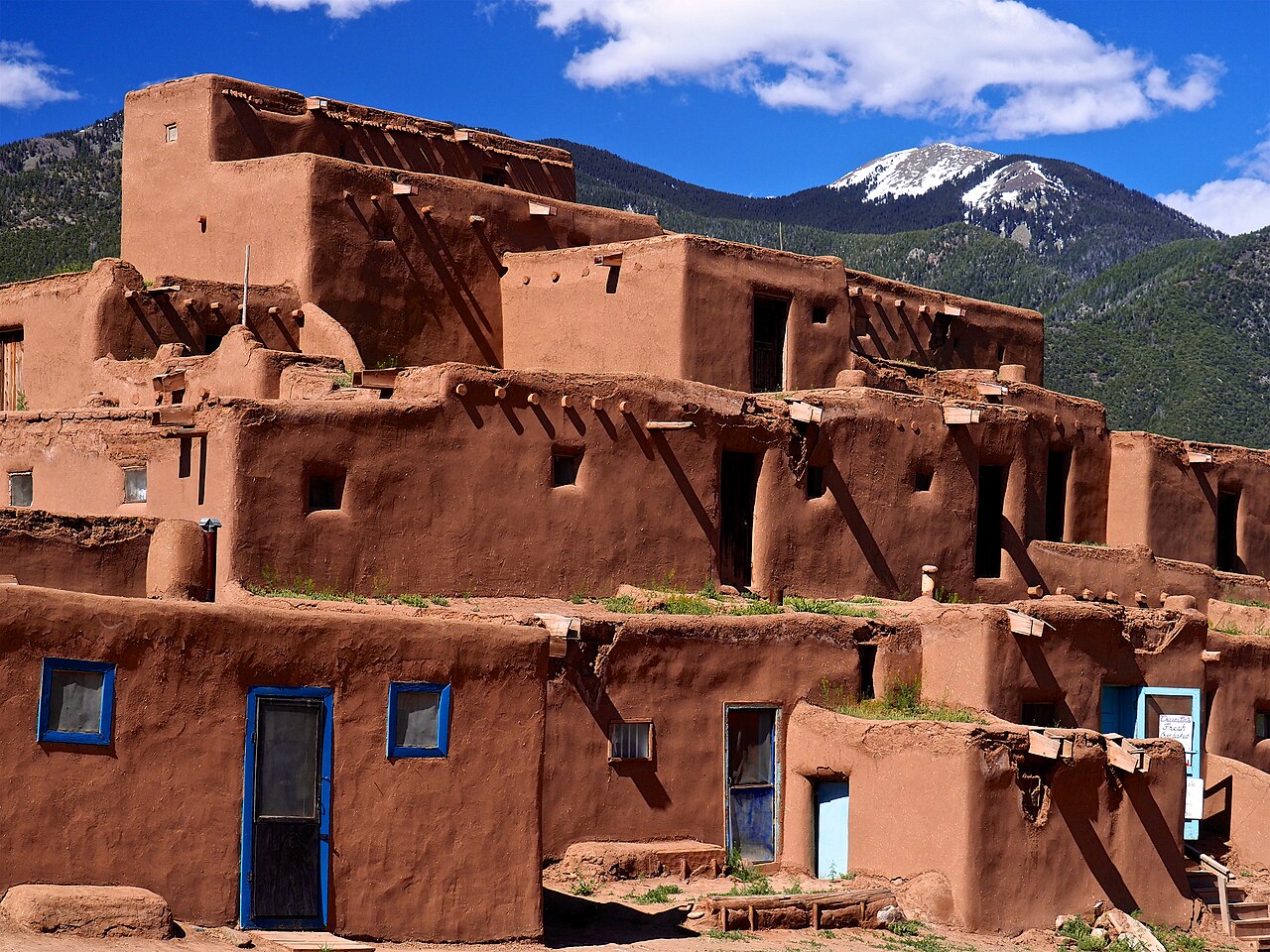
Taos Pueblo in northern New Mexico is the oldest continuously inhabited community in North America, with people living in its distinctive multi-story adobe buildings for at least a thousand years. Inscribed by UNESCO in 1992, the Pueblo is simultaneously a functioning village, a sacred ceremonial site, and an irreplaceable record of Puebloan architecture and resistance. Roughly 150 tribal members live within the Pueblo today without running water or electricity — by deliberate choice.
Architecture and daily life inside the Pueblo Taos, New Mexico, USA
The two great house complexes that define Taos Pueblo — North House (Hlauuma) and South House (Hlaukwima) — rise on opposite banks of the Rio Pueblo de Taos, a stream fed by the sacred Blue Lake high in the Sangre de Cristo Mountains. Both structures are built from adobe brick: a mixture of earth, water, straw, and sand shaped into blocks, dried in the sun, and stacked into walls that can reach five stories. No nails, no metal hardware, and no concrete appear anywhere in the fabric of the buildings. Timber beams — ponderosa pine and cottonwood — span the interiors, projecting slightly through the exterior walls in the characteristic Puebloan manner.
Construction at Taos dates the current standing buildings to between approximately 1000 and 1450 CE, though archaeological evidence confirms continuous human occupation in the broader area for considerably longer. The layout was not accidental: the two house blocks face each other across the stream, forming a defensible enclosure around the central plaza where ceremonies take place. Historically, the upper stories could only be reached by wooden ladders placed against the exterior walls. In times of danger, residents pulled the ladders up behind them, transforming the building into a vertical fortress with no ground-floor entry points.
The Taos people speak Tiwa, one of the Tanoan languages shared among several Rio Grande Pueblos. Unlike many indigenous languages in the American Southwest, Tiwa at Taos has not been written down by the community — knowledge is transmitted orally, and the tribe has actively resisted linguistic documentation by outsiders. This extends to a broader cultural practice of maintaining certain ceremonial knowledge as strictly private. Visitors to the Pueblo may walk through the central plaza and enter certain ground-floor spaces that residents make available, but photography in the vicinity of kivas (ceremonial chambers) is prohibited, and some feast-day ceremonies are closed to non-tribal members entirely.
Taos Pueblo functioned for centuries as a major node in the trading networks connecting the Great Plains, the Rio Grande valley, and Mesoamerica. Buffalo hides and dried meat moved south from Plains hunters; turquoise, pottery, and corn moved north and east. The Pueblo’s position at the base of the mountains, controlling access to passes into the high country, made it both a commercial hub and a strategic strongpoint — a dual role that would define its history through the centuries of Spanish colonization.
The 1680 Pueblo Revolt and the return of Blue Lake Taos, New Mexico, USA
On 10 August 1680, coordinated uprisings erupted simultaneously across the Rio Grande Pueblos from Taos in the north to Isleta in the south. The operation had been planned in secret over months by Popé, a Tewa religious leader from Ohkay Owingeh who used Taos Pueblo as his base after Spanish authorities had flogged him for practicing traditional ceremonies. The revolt killed approximately 400 Spanish settlers and 21 of the 33 Franciscan missionaries in New Mexico in a single day, and drove the surviving Spanish population — some 2,000 people — entirely out of the territory. It was the most successful coordinated Indigenous resistance against European colonization in the history of North America, and Spanish authority would not return to New Mexico for twelve years.
When Diego de Vargas reconquered New Mexico in 1692, Taos Pueblo resisted longer than most, finally capitulating in 1694. Relations with Spanish and later American colonial authorities remained tense across the following centuries, shaped largely by disputes over land, water rights, and the suppression of traditional religion. The most consequential of these disputes concerned Blue Lake — Ta’us in Tiwa — a high mountain lake above the Pueblo in the Sangre de Cristo range, the most sacred site in Taos religious life. The lake and the surrounding watershed were seized by the United States government in 1906 and incorporated into the Carson National Forest. For sixty-four years the Taos people sought its return, offering testimony before Congress that the lake was not a scenic recreation area but an active ceremonial site inseparable from their religious practice.
In December 1970, President Richard Nixon signed legislation returning 48,000 acres of forest land, including Blue Lake, to the Taos Pueblo tribe. It was the first time in United States history that federal land was returned to a Native American nation for religious purposes, and it remains a landmark in indigenous rights law. The event is commemorated annually at the Pueblo and occupies a central place in how tribal members understand their own history. Today, access to the Blue Lake watershed is restricted to tribal members, and non-tribal visitors may not enter the area under any circumstances.
Approximately 1,900 tribal members live in houses and settlements outside the old Pueblo walls. Those who live inside the original Pueblo buildings — around 150 people at any given time — maintain homes without electricity or indoor plumbing by community agreement. Water is drawn from the Rio Pueblo de Taos, which exits the protected Blue Lake watershed and flows through the Pueblo before joining the Rio Grande. This arrangement is considered integral to maintaining the sacred character of the water and, by extension, the entire community.
Practical information
Taos Pueblo is located approximately 2.5 kilometres north of the historic Taos Plaza, in Taos, New Mexico. It is open to visitors most days of the year, but the Pueblo closes entirely for tribal feast days, ceremonies, and a winter tribal closure period that typically runs from late February through late March — confirm current closure dates on the official tribal website before visiting. Admission fees apply; as of 2024 these are approximately $25 per adult, with additional fees for parking and photography permits (photography is permitted in designated areas only and prohibited near the kivas and during ceremonies). Guided tours led by tribal members depart regularly from the entrance plaza and are the recommended way to understand the buildings and their history. The nearest commercial airport is Santa Fe Regional (SAF), about 100 kilometres south; Albuquerque International (ABQ) is approximately 230 kilometres south and offers more frequent connections. Car rental is strongly recommended — public transport between Albuquerque or Santa Fe and Taos is limited. The town of Taos itself has a good range of accommodation at all price points. Allow a minimum of two hours for the Pueblo visit; combining it with the Taos Historic Museums and the Millicent Rogers Museum makes for a full day.
Frequently Asked Questions
Is Taos Pueblo still a living community, or is it a preserved historic site?
Taos Pueblo is a functioning, inhabited community — not a museum or an archaeological preserve. Approximately 150 tribal members of the Taos Pueblo tribe live year-round inside the original multi-story adobe buildings, while roughly 1,900 additional tribal members live in surrounding areas but maintain strong ties to the Pueblo through ceremonial life and governance. The buildings have been continuously occupied for at least a thousand years, making Taos Pueblo the oldest continuously inhabited community in North America. The distinction between a living settlement and a heritage site matters enormously to the Taos people: they have resisted several attempts over the decades to have their home treated as a museum property, and the tribal council exercises direct control over visitor access, photography rules, and the conduct of tours. Residents maintain their homes without electricity or indoor plumbing by deliberate community choice, a decision rooted in the Pueblo’s spiritual relationship with the Rio Pueblo de Taos and its source at the sacred Blue Lake. Visitors are guests in an active community, and the behavioral expectations — quiet conduct, respect for restricted areas, no photography of residents without explicit permission — reflect that status rather than the conventions of a conventional tourist attraction.
What was the Pueblo Revolt of 1680, and why is it significant?
The Pueblo Revolt of 10 August 1680 was the most successful coordinated Indigenous uprising against European colonization in North American history. Organized in secret by Popé, a Tewa religious leader who used Taos Pueblo as his organizing base after being punished by Spanish authorities for practicing traditional ceremonies, the revolt united at least 17 Pueblo nations — communities that spoke mutually unintelligible languages and had no prior tradition of coordinated political action — in a single-day uprising. The result was the death of approximately 400 Spanish colonists and 21 of 33 Franciscan missionaries in New Mexico, and the complete expulsion of the surviving Spanish population (roughly 2,000 people) from the territory. Spanish authority did not return for twelve years. The revolt has deep significance for contemporary Pueblo peoples as a demonstration of political agency and cultural self-defense, and it is studied by historians as a rare case in which European colonization was successfully reversed for an extended period. Popé’s memory is honored by a bronze statue in the United States Capitol, placed there by the State of New Mexico in 2005 — the first Indigenous leader to be represented in the National Statuary Hall Collection.
How did the Taos Pueblo tribe regain Blue Lake, and what is its significance?
Blue Lake (Ta’us in Tiwa) is a high-altitude lake in the Sangre de Cristo Mountains above Taos Pueblo and the most sacred site in Taos religious life. The lake serves as the origin point in Taos cosmology — the place from which the people emerged — and the watershed that flows from it feeds the Rio Pueblo de Taos, the stream running through the Pueblo itself, which tribal members consider sacred. In 1906, the United States Forest Service incorporated Blue Lake and the surrounding 48,000 acres into the Carson National Forest, cutting off tribal access and subjecting the site to recreational use by non-tribal visitors. The Taos Pueblo tribe sought the land’s return for sixty-four years, presenting testimony to Congress that the lake was an active ceremonial site whose character was being irreparably harmed. In December 1970, after years of sustained advocacy and support from environmental and religious-freedom organizations, President Richard Nixon signed the Taos Land Bill into law. The legislation returned the lake and surrounding watershed to the exclusive ownership and control of the Taos Pueblo tribe — the first instance in United States history of federal land being returned to a Native American nation for religious purposes. The event transformed federal Indian policy and opened legal pathways for subsequent land-return claims by other tribal nations.
Sources
- S1 — Kantor, David. Taos Pueblo: Its History and Culture. Sunstone Press, 1984. ISBN 978-0-86534-037-4.
- S2 — Sando, Joe S. Pueblo Nations: Eight Centuries of Pueblo Indian History. Clear Light, 1992. ISBN 978-0-940666-17-7.
Spotted an error? Write to editorial@culturalheritageonline.com and we correct it the same day.