
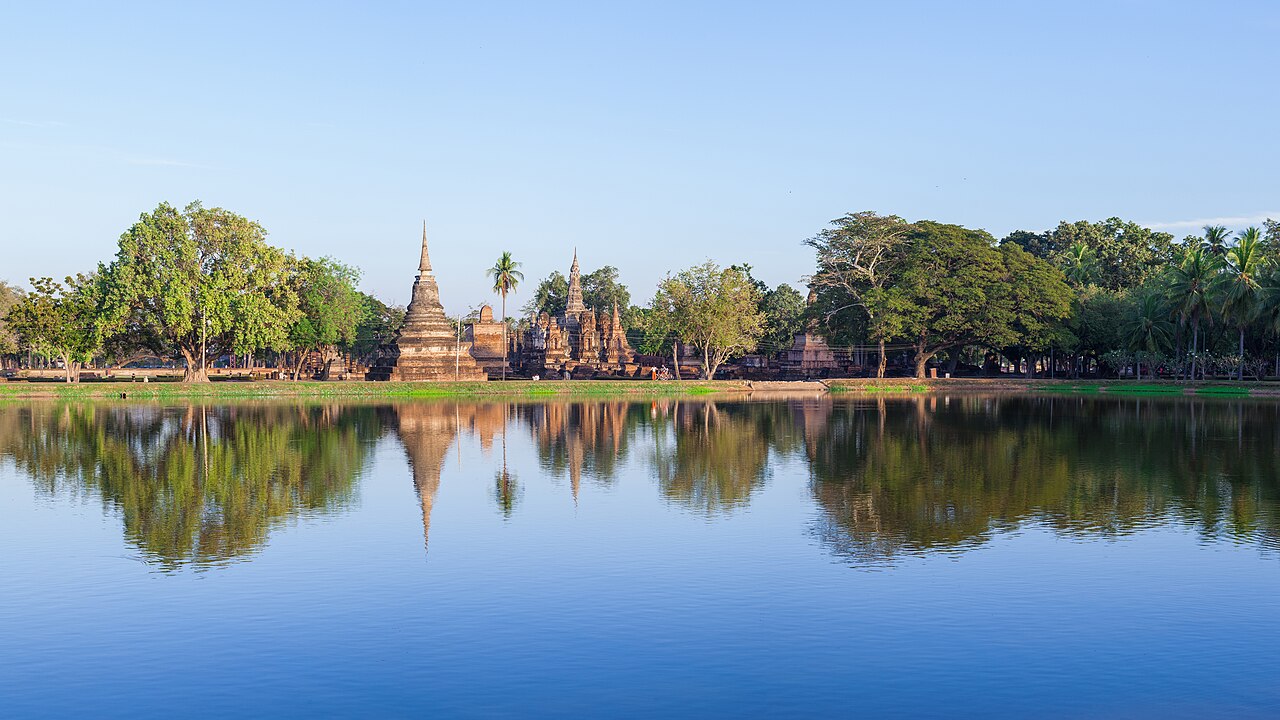
Sukhothai, founded in 1238 as the first independent Thai kingdom, covers 70 square kilometres of forested lowland in Northern Thailand and preserves 193 identified monuments from its period as the Siamese capital. King Ramkhamhaeng (r. 1279–1298) invented the Thai script here in 1283 — the primary evidence being a stele found in 1833 that is now displayed in the Bangkok National Museum. The Sukhothai Historical Park and two associated cities, Si Satchanalai-Chaliang and Kamphaeng Phet, were jointly inscribed as a UNESCO World Heritage Site in 1991.
Wat Mahathat and the Architecture of the Sukhothai Kingdom Central Sukhothai Historical Park: 12 km west of New Sukhothai town, 430 km north of Bangkok
Wat Mahathat is the central and largest monument of Sukhothai Historical Park, occupying the nucleus of the ancient walled city. The royal temple of the Sukhothai kingdom, its principal feature is a lotus-bud chedi (called mahadhatu) rising from a tiered square base — an architectural form that appears to have originated in the Sukhothai period and does not appear in earlier Thai or Khmer architecture. The central stupa is enclosed by a moat and fronted by a pillared hall whose laterite columns, now roofless, still stand to a height of several metres. Within the compound, over 200 auxiliary chedis, mondops (square reliquary towers), and wihans (assembly halls) are distributed across the grounds, making Wat Mahathat effectively a city within the walled city.
The Sukhothai walled city itself is rectangular, measuring approximately 2 km east to west and 1.6 km north to south, enclosed by three concentric earthen ramparts and moats. Within this area, the Fine Arts Department of Thailand has mapped 21 major monument sites. A further 70 sites lie in the immediate zone surrounding the walls, and the UNESCO-listed buffer zone extends to encompass related sites across the broader landscape. The infrastructure of the Sukhothai kingdom included a network of reservoirs and canals for irrigation — a water management system that, at a smaller scale, mirrors the hydraulic urbanism of Angkor in Cambodia.
King Ramkhamhaeng’s stele, the most important inscription from the Sukhothai period, records a political and legal system in which the king maintained an open-door policy: a bell hung at the palace gate that any subject could ring to bring a grievance directly to the king. The stele also describes a prosperous agricultural economy, free trade, and the introduction of Theravada Buddhism from Sri Lanka as the state religion. It was composed in the newly invented Thai script — distinguishable from earlier Khmer and Mon scripts used in the region by its rounded letterforms and its representation of tonal distinctions in spoken Thai.
Sukhothai’s peak period lasted approximately one century. After King Ramkhamhaeng’s death in 1298, the kingdom contracted under successive rulers who lacked his political and military range. By 1378, Sukhothai had become a vassal state of the rising Ayutthayan kingdom to the south, and in 1438 the last Sukhothai king formally submitted to Ayutthayan sovereignty. The city continued to function as a regional administrative centre for some time after, but gradually declined in population and was largely abandoned by the late 15th century. What survives at the historical park is therefore a remarkably intact snapshot of an urban and religious landscape frozen at the moment of political decline — with no subsequent rebuilding obscuring the original form.
Conservation at Sukhothai has involved contentious decisions. Between the 1950s and 1980s, the Fine Arts Department undertook extensive clearance of vegetation and partial reconstruction of collapsed structures using new brick and concrete to stabilise ruins. Some of these reconstructions are now considered over-interventionist by current conservation standards, as they altered the appearance of structures whose original form was speculative. The UNESCO inscription in 1991 catalysed a shift toward more conservative approaches.
Si Satchanalai, Kamphaeng Phet and Ayutthaya: The Other Cities of the Thai Heritage Corridor Si Satchanalai 57 km north; Kamphaeng Phet 70 km south; Ayutthaya 340 km south
Si Satchanalai-Chaliang, inscribed as part of the same 1991 UNESCO nomination, lies 57 kilometres north of Sukhothai along the Yom River. It served as a secondary royal city and the centre of the Sukhothai kingdom’s ceramic industry. The Sawankhalok kilns concentrated around Si Satchanalai produced celadon and brown-glazed wares from the 13th through early 16th centuries; over 200 kiln sites have been mapped in the surrounding area. Archaeological finds of Sawankhalok ceramics have been documented in the Philippines, peninsular Malaysia, Borneo, eastern Indonesia, Japan, and the Maldives, demonstrating the integration of the Sukhothai kingdom into long-distance maritime trade networks.
Si Satchanalai preserves, by many assessments, a less altered version of Sukhothai-period architecture than the central park at Sukhothai itself. Its distance from major roads and its smaller volume of visitors mean that vegetation clearance and structural reconstruction have been less aggressive. The site of Chaliang, adjacent to Si Satchanalai on the same riverbank, preserves ruins from an earlier, pre-Sukhothai period including a large Khmer-period temple (Wat Chao Chan) with a laterite prang, demonstrating the overlap between Khmer and early Thai cultural zones in this region during the 12th–13th centuries.
Kamphaeng Phet, 70 kilometres south of Sukhothai, was the Sukhothai kingdom’s principal military outpost on its southern frontier. Its name translates as “Diamond Wall,” reflecting its role as a fortification. The walled city contains approximately 40 ruins, of which Wat Phra Kaeo and Wat Phra That are the most substantial. Kamphaeng Phet is inscribed as part of the Sukhothai UNESCO site and shares the same architectural vocabulary — laterite construction, lotus-bud chedis — but its urban plan is less well preserved than either Sukhothai or Si Satchanalai, partly due to continued habitation of parts of the historic area through the modern period.
Ayutthaya, 340 kilometres south of Sukhothai and separately inscribed as a UNESCO World Heritage Site in 1991, represents the successor polity that absorbed Sukhothai. Founded in 1351, Ayutthaya’s architectural tradition diverged from Sukhothai’s: where Sukhothai built in laterite with lotus-bud chedis, Ayutthaya used brick and developed the bell-shaped chedi alongside the prang tower form inherited from Khmer tradition via Lopburi. The stylistic differences are visible enough that archaeologists can date recovered ceramic sherds and architectural fragments to either the Sukhothai or Ayutthayan cultural sphere with reasonable confidence.
Chiang Mai, 340 kilometres north of Sukhothai (founded 1296, roughly contemporary with Sukhothai’s peak), is not itself a UNESCO World Heritage Site but is associated with heritage of significance. The ancient city of Wiang Kum Kam, submerged by the Ping River flood in the 15th century and now a partially excavated site on the outskirts of Chiang Mai, preserves ruins of a Hariphunchai-period city that predates Chiang Mai’s founding. Wiang Kum Kam has been under excavation since the 1980s; some 21 monuments have been exposed, though much of the site remains below alluvial deposits up to 4 metres deep.
Practical information New Sukhothai town: served by Sukhothai Airport (THS) and intercity buses from Bangkok, Chiang Mai, and Phitsanulok
Sukhothai Airport (THS) serves daily flights from Bangkok (Don Mueang Airport, approximately 1 hour 20 minutes). Intercity buses from Bangkok’s Mo Chit terminal reach New Sukhothai in approximately 7 hours; services from Chiang Mai take approximately 5 hours. The historical park is 12 kilometres west of New Sukhothai town; songthaew (shared pick-up trucks) depart from the town centre market area. Bicycles can be rented at the park entrance for approximately 50 THB per day and are the standard way to move between monument clusters within the park.
Admission to the Sukhothai Historical Park central zone costs 100 THB for international visitors; separate fees apply to the north and west zones (each 100 THB). An all-zone ticket is available. The park is open daily from 06:00 to 18:00. For Si Satchanalai, a songthaew or private vehicle is required from New Sukhothai; the journey takes approximately 1 hour 30 minutes on Route 101. Si Satchanalai charges 100 THB for the main site. Kamphaeng Phet is accessible by bus from Sukhothai (approximately 1 hour 30 minutes); its historical park charges a separate entrance fee.
The cool season (November–February) is the most comfortable period for visiting. March and April bring temperatures above 38°C across the northern plain; the monuments offer little shade outside the forested sections of the park. The Loy Krathong Festival, celebrated across Thailand in November (exact date varies with the lunar calendar), is commemorated with particular scale at Sukhothai Historical Park, where light and sound performances are held among the ruins — the festival is believed to have originated here during the Sukhothai period. Accommodation in New Sukhothai ranges from budget guesthouses near the bus station to mid-range hotels; the historical park area has a small number of resort-style properties adjacent to the entrance. Thai baht (THB) is the only accepted currency; ATMs are available in New Sukhothai town.
Frequently Asked Questions
What is the Ramkhamhaeng Inscription, and why is it historically important?
The Ramkhamhaeng Inscription (Stele 1) is a stone tablet found in 1833 at the ruins of Sukhothai by future Thai king Mongkut (then a Buddhist monk). It is dated by its own text to 1283 CE and is attributed to King Ramkhamhaeng of Sukhothai. The inscription is the oldest surviving document written in the Thai script and one of the primary sources for the history of the Sukhothai kingdom. It describes the political and economic organisation of the kingdom, identifies the king as a Buddhist ruler who received a relic of the Buddha directly from Sri Lanka, and — most significantly — states that Ramkhamhaeng invented a new writing system by adapting and modifying existing Khmer and Mon scripts to represent the sounds of the Thai language, including its tonal distinctions. The stele is displayed in the Bangkok National Museum. Its authenticity has been contested: in 1989, Thai historian Piriya Krairiksh argued that the inscription was a 19th-century forgery, possibly created under Mongkut’s direction to establish historical precedents for Siamese territorial claims. The forgery hypothesis has been rejected by the majority of epigraphers and archaeologists who have examined the stone, based on analysis of the script forms, the composition of the stone, and comparisons with contemporaneous inscriptions at other Sukhothai-period sites. The debate nonetheless continues as a live question in Thai historiography.
What made the Sawankhalok ceramics from Si Satchanalai significant enough to be found across maritime Southeast Asia?
Sawankhalok ceramics — named after the old name for Si Satchanalai — occupied a specific commercial niche in the 14th–16th century maritime trade of Southeast Asia. Chinese export ceramics were the dominant product across regional trade routes, but the Sawankhalok kilns developed two categories of ware that competed successfully: a grey-green celadon similar in appearance to Chinese Longquan ware, and a dark-glazed brown ware used for storage vessels, particularly for fish paste and other preserved foods. The kilns at Si Satchanalai used a climbing-kiln design (Thai: tao prathun) capable of reaching temperatures above 1200°C, enabling stoneware production with a vitrified body unlike the earthenware produced elsewhere in mainland Southeast Asia at the time. Sawankhalok ceramics reached the Philippines — where they are found in burial contexts at pre-Hispanic sites in Luzon and the Visayas — as well as Borneo, eastern Indonesia, the Malay Peninsula, and Japan, where they are documented in tea ceremony contexts as “Sawankhalok-yaki.” The trade was conducted largely by Chinese and Malay merchant intermediaries operating out of ports in the Gulf of Thailand. The decline of the Si Satchanalai kilns in the early 16th century corresponds roughly with the political collapse of the Sukhothai administrative zone under Ayutthayan pressure and the disruption of northern trade routes; Chinese and Vietnamese ceramics subsequently filled the demand that Sawankhalok had supplied.
How does the Loy Krathong Festival at Sukhothai differ from how it is celebrated elsewhere in Thailand, and is it worth timing a visit around it?
Loy Krathong is observed nationally on the full moon of the 12th lunar month, typically falling in November. The festival involves the floating of small decorated baskets (krathong) on waterways as an act of reverence and a release of grievances. The connection to Sukhothai specifically rests on a historical claim: a verse attributed to the 13th century and known as the “Nang Nopphamat poem” credits a court lady of King Ramkhamhaeng with inventing the krathong tradition at Sukhothai. Historians are sceptical of this attribution — the poem’s manuscript dates are disputed and it may be a later composition — but the association has made Sukhothai the reference celebration for the festival. At Sukhothai Historical Park, the Loy Krathong Festival (locally branded “Loy Krathong and Candle Festival”) runs for six evenings centred on the full moon and includes illumination of the ruins, sound-and-light performances projected onto Wat Mahathat, traditional dance performances, and a market within the historical park grounds. Attendance in recent years has been approximately 50,000–100,000 over the festival period. The result is significantly higher than typical visitor density. Accommodation in New Sukhothai and the surrounding area books out months in advance; prices rise substantially. The visual spectacle of the lit ruins reflected in the moat of Wat Mahathat is undeniably distinctive. Visitors who prefer to see the ruins in daylight with low crowds and who can visit in November without the festival dates should consider arriving two to three days before or after the peak event — the ruins are accessible normally during the festival period and the park is not closed.

.jpg)