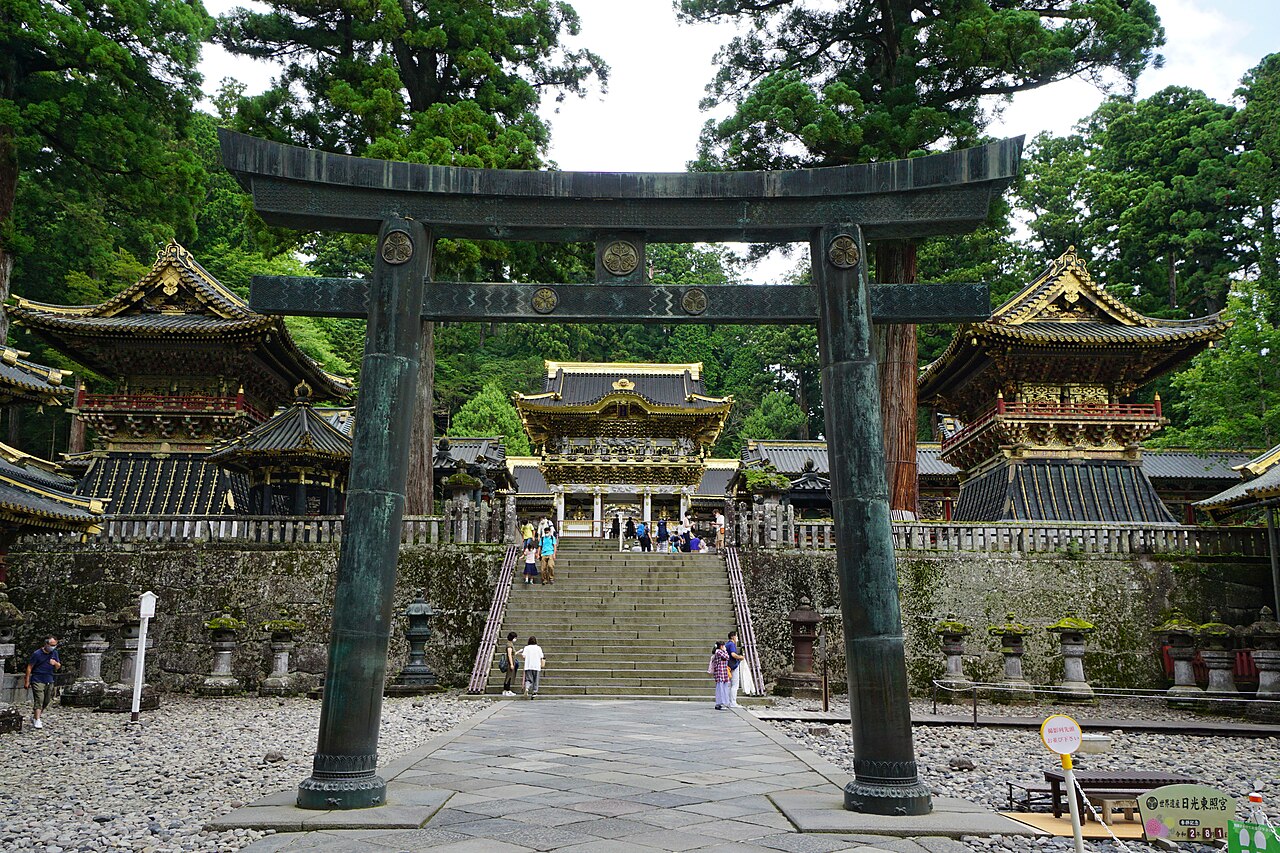
The Shrines and Temples of Nikkō is an ensemble of 103 buildings in the mountain forests of Nikkō, Tochigi prefecture, constructed between 1634 and 1636 as the mausoleum of Tokugawa Ieyasu — the warlord who unified Japan after the Battle of Sekigahara in 1600 and founded the shogunate that ruled the country until 1868. UNESCO inscribed the site in 1999. The construction programme reportedly cost 2.4 million ryō in gold and mobilised approximately 15,000 craftsmen over two years; the result is the most ornate example of Edo-period shrine architecture in Japan.
Tokugawa Ieyasu, Posthumous Deification, and the Mausoleum That Cost 2.4 Million Gold Coins Sannai, Nikkō city, Tochigi prefecture
Tokugawa Ieyasu was born in 1543 into a minor domain in the Mikawa Province (present-day Aichi Prefecture) and spent his childhood as a political hostage — first of the Imagawa clan and then of the Oda clan — before establishing his own military authority in the turbulent decades of the Sengoku period. His alliance with Oda Nobunaga and then with Toyotomi Hideyoshi positioned him as the most powerful daimyo in eastern Japan by the time of Hideyoshi’s death in 1598. The Battle of Sekigahara in October 1600 was the decisive confrontation between Ieyasu’s eastern coalition and the western lords loyal to Hideyoshi’s heir: it lasted a single day and ended in a comprehensive victory for Ieyasu that settled the question of Japanese political supremacy for more than two and a half centuries. Ieyasu established his shogunate in Edo (present-day Tokyo) in 1603 and arranged for the succession to pass to his son Hidetada in 1605, demonstrating that the Tokugawa family intended to hold the shogunal office permanently — a pointed contrast to Hideyoshi, who had held supreme power without transmitting it hereditarily. Ieyasu died in 1616.
After his death, Ieyasu was posthumously deified by imperial decree under the title Tōshō Daigongen — Great Incarnation Illuminating the East. The original mausoleum at Nikkō was a relatively modest structure built shortly after his death. The transformation into the current elaborate complex was ordered by the third shogun, Tokugawa Iemitsu, who was Ieyasu’s grandson. Iemitsu launched a rebuilding programme in 1634 that lasted two years, completing in 1636. The scale of the undertaking was intended as a statement of Tokugawa political legitimacy and permanence: the shogunate had survived internal challenges, the suppression of Christian communities, and the closing of Japan’s borders (the sakoku policy), and the mausoleum was designed to anchor Ieyasu’s memory as a divine founder equivalent in prestige to the imperial ancestors enshrined at Ise. The reported expenditure of 2.4 million ryō in gold coins and the mobilisation of approximately 15,000 craftsmen over two years are cited in Japanese historical records of the period, though exact verification is difficult — they represent a deliberate tradition of communicating extraordinary expenditure as evidence of piety and power.
The ensemble covers 103 buildings across a mountain valley connected by stone-paved paths, cedar avenues, and a sequence of gates that progressively restrict access. The buildings use a technique called gongen-zukuri, a hybrid architectural form connecting a shrine and a Buddha hall with a covered passage (ishi-no-ma), reflecting the pre-Meiji integration of Shinto and Buddhist practices at the site. The complex also includes Rinnō-ji, a Buddhist temple with origins in the eighth century attributed to the monk Shōdō Shōnin, who established a hermitage on Mount Nikkō in 766 CE. The juxtaposition of the medieval Buddhist foundation and the Edo-period Tokugawa mausoleum reflects the layered religious history of the site.
The Gate That Takes a Day to See and the Pillar Installed Upside Down Nikkō Tōshō-gū shrine complex
The Yōmeimon Gate — Gate of Sunlight — is the most celebrated individual element of the Nikkō complex. It stands at the principal axis of the shrine and marks the boundary between the outer precincts and the inner sanctuary. The gate is approximately 11 metres tall and covered in 508 individual sculptural decorations: cranes, dragons, lions, Chinese sages, mythological animals, peonies, chrysanthemums, phoenixes, and scenes from Chinese classical literature and court life. The carvings were executed in a combination of painted lacquer, gilding, and natural wood tones that creates an extraordinary density of visual information across every surface of the structure. The gate is known colloquially as Higurashi-no-mon — the Gate of the Day Ending — because the tradition holds that a visitor who begins examining its carvings in the morning will still be occupied at dusk. This is an aesthetic claim, not an instruction, but it accurately reflects the compression of detail involved.
Among the gate’s 12 decorative pillars, one is installed in an inverted orientation: the grain of the carved decoration runs upward on eleven pillars and downward on one. The traditional explanation for this deliberate imperfection is theological: in the belief system that pervaded Edo-period Japan — a syncretism of Shinto, Buddhist, and Chinese cosmological thought — a perfect completed work could attract divine punishment or jealousy. By intentionally leaving one element incorrect, the builders signalled that the work was unfinished, and therefore not subject to the wrath that perfection would invite. Whether this explanation was the actual motivation of the craftsmen who built the gate in 1636, or whether it is a later rationalisation applied to a pragmatic building decision, is impossible to determine from surviving records. It has become one of the most repeated stories attached to the Nikkō complex and is consistently cited in Japanese guides to the site.
The Sleeping Cat — Nemuri Neko — is a small lacquered wood carving installed above the lintel of the Sakashitamon Gate, which marks the entrance to the path leading to Ieyasu’s actual tomb (okusha) at the rear of the complex. The carving depicts a cat sleeping in sunlight, eyes closed, paws tucked. On the reverse of the same gate are carved two sparrows. The traditional interpretation is that the cat’s sleep is so profound and peaceful that even birds are unafraid — an allegory for the peace achieved under Tokugawa rule. The carving is attributed in popular tradition to the master sculptor Hidari Jingorō, a legendary figure from the early Edo period whose name translates roughly as “left-handed Jingorō.” The biographical account holds that Jingorō deliberately cut off his own right hand to force himself to develop his left hand as his working instrument, achieving a purity of dedication through self-mutilation. Historians consider this biography apocryphal — there is no contemporary documentary evidence for it — but the legend has been attached to exceptional left-handed craftsmanship attributed to the Edo period for several centuries and is deeply embedded in the popular culture surrounding Nikkō.
The avenue of cedars leading from the town of Nikkō to the shrine complex was planted in the early seventeenth century by the daimyo Matsudaira Masatsuna, reportedly because he could not afford to donate the gold and lacquerwork that other lords were contributing to the mausoleum’s construction. The cedar avenue — some of the trees planted in the 1630s survive — is now itself a nationally protected natural monument.
Practical information
The Shrines and Temples of Nikkō are located in Nikkō city, Tochigi prefecture, approximately 140 kilometres north of Tokyo. The most direct connection from Tokyo is the Tōbu Nikkō Line from Asakusa Station to Nikkō Station (approximately 2 hours on the Revaty Kegon limited express, or 1 hour 50 minutes on the Spacia limited express). JR Shinkansen from Tokyo to Utsunomiya Station followed by the JR Nikkō Line to Nikkō Station (total approximately 2 hours) is an alternative. From Nikkō Station, bus services connect to the shrine complex (approximately 10 minutes). The main shrine precinct charges a combined admission fee covering Tōshō-gū, Rinnō-ji, and the path to the okusha. The Yōmeimon Gate is visible without separate admission; the okusha path requires an additional ticket. Nikkō is typically visited as a day trip from Tokyo. There are no additional UNESCO World Heritage Sites immediately adjacent: the nearest inscribed sites are in Tokyo (no UNESCO city inscription) and the next closest is in the direction of Nikkō’s regional neighbours, which do not include further inscribed properties. The site is most visited during the annual Hyakumonin Gyoretsu festival (May and October), when samurai processions in full Edo-period costume recreate the original 1617 transport of Ieyasu’s remains to Nikkō.
Frequently Asked Questions
Why is one of the pillars on the Yōmeimon Gate installed upside down?
One of the twelve decorative pillars of the Yōmeimon Gate at Nikkō Tōshō-gū is installed with an inverted grain direction — its carved decorative motif runs in the opposite direction to the other eleven pillars, which is visible to a careful observer standing close to the structure. The traditional and most widely cited explanation is that this imperfection was deliberate, introduced to avoid divine retribution for creating a perfect work. The theological framework underlying this practice is broadly attested across Edo-period Japanese religious architecture and craftsmanship: the idea that a perfect, completed work could attract the jealousy or anger of supernatural forces, and that by leaving a recognisable flaw the builders could signal that the work was not truly finished and therefore not subject to that risk. The practice has parallels in other cultural traditions — the deliberate introduction of a flaw or “humility stitch” in Islamic geometric tilework or in Navajo weaving is often cited in comparative discussions. Whether the Nikkō pillar was truly placed with this theological intent in 1636, or whether the story developed after the fact as an explanation for what may have been a practical error or a last-minute reversal of a pillar that arrived oriented incorrectly, cannot be determined from surviving construction records. The story has been attached to the gate for several centuries and is now inseparable from the cultural narrative of the site.
Who was Tokugawa Ieyasu, and why was he deified after his death?
Tokugawa Ieyasu (1543–1616) was the founder of the Edo shogunate, the military government that ruled Japan from 1603 to 1868. He rose through the Sengoku period as a daimyo allied successively with Oda Nobunaga and Toyotomi Hideyoshi, accumulating power in eastern Japan. His decisive victory at the Battle of Sekigahara in 1600 gave him military supremacy over the country. He was appointed shogun by the emperor in 1603 and arranged the succession of the office to his son in 1605 to establish the hereditary principle of Tokugawa governance. His deification after death in 1616 under the title Tōshō Daigongen — Great Incarnation Illuminating the East — was arranged through a combination of Buddhist memorial rites and Shinto apotheosis practices. The deification served explicit political purposes: by establishing Ieyasu as a divine protector of Japan, the Tokugawa shogunate positioned itself as the guardian of a divinely ordered realm, and the mausoleum at Nikkō became a site of national pilgrimage that symbolically unified Japan’s daimyo lords in a shared act of reverence toward the Tokugawa founder. The elaborate reconstruction of the mausoleum by Ieyasu’s grandson Iemitsu in 1634–1636 was itself a political act: an assertion of Tokugawa permanence and divine legitimacy directed at any remaining doubts about the dynasty’s right to rule.
What is the Sleeping Cat (Nemuri Neko) at Nikkō, and who carved it?
The Nemuri Neko — Sleeping Cat — is a small lacquered wood carving, approximately 20 centimetres wide, installed above the lintel of the Sakashitamon Gate at Nikkō Tōshō-gū. It depicts a cat sleeping in a relaxed posture, eyes closed, in an attitude of complete ease. On the reverse of the same gate, carved in relief, are two sparrows. The traditional reading of the pair is allegorical: a cat at rest and birds that are unafraid represent the perfect peace that had descended upon Japan under Tokugawa governance — the long wars of the Sengoku period were over, and even the natural predator-prey relationship between cats and birds had been suspended. The carving is attributed in popular tradition to Hidari Jingorō, a semi-legendary sculptor of the early Edo period. “Hidari Jingorō” means approximately “left-handed Jingorō,” and the associated biography — that the sculptor cut off his own right hand to dedicate himself entirely to developing his left-hand skill — has the structure of hagiographic legend rather than verifiable history. Contemporary documentation of a sculptor named Jingorō working at Nikkō exists, but the details of the biography, including the amputation, are not corroborated by any surviving period source. The attribution and the story have been transmitted in Japanese popular culture since at least the Edo period and are now embedded in how the carving is presented at the site itself, making them part of the monument’s cultural meaning regardless of their biographical accuracy.
Sources
- S1 — Agency for Cultural Affairs, Government of Japan (Bunkacho) — Shrines and Temples of Nikko — https://www.bunka.go.jp/english/
- S2 — Neil Fiore — The Architecture of Nikko, Weatherhill, New York, 1980, ISBN 978-0834801554
Spotted an error? Write to editorial@culturalheritageonline.com and we correct it the same day.