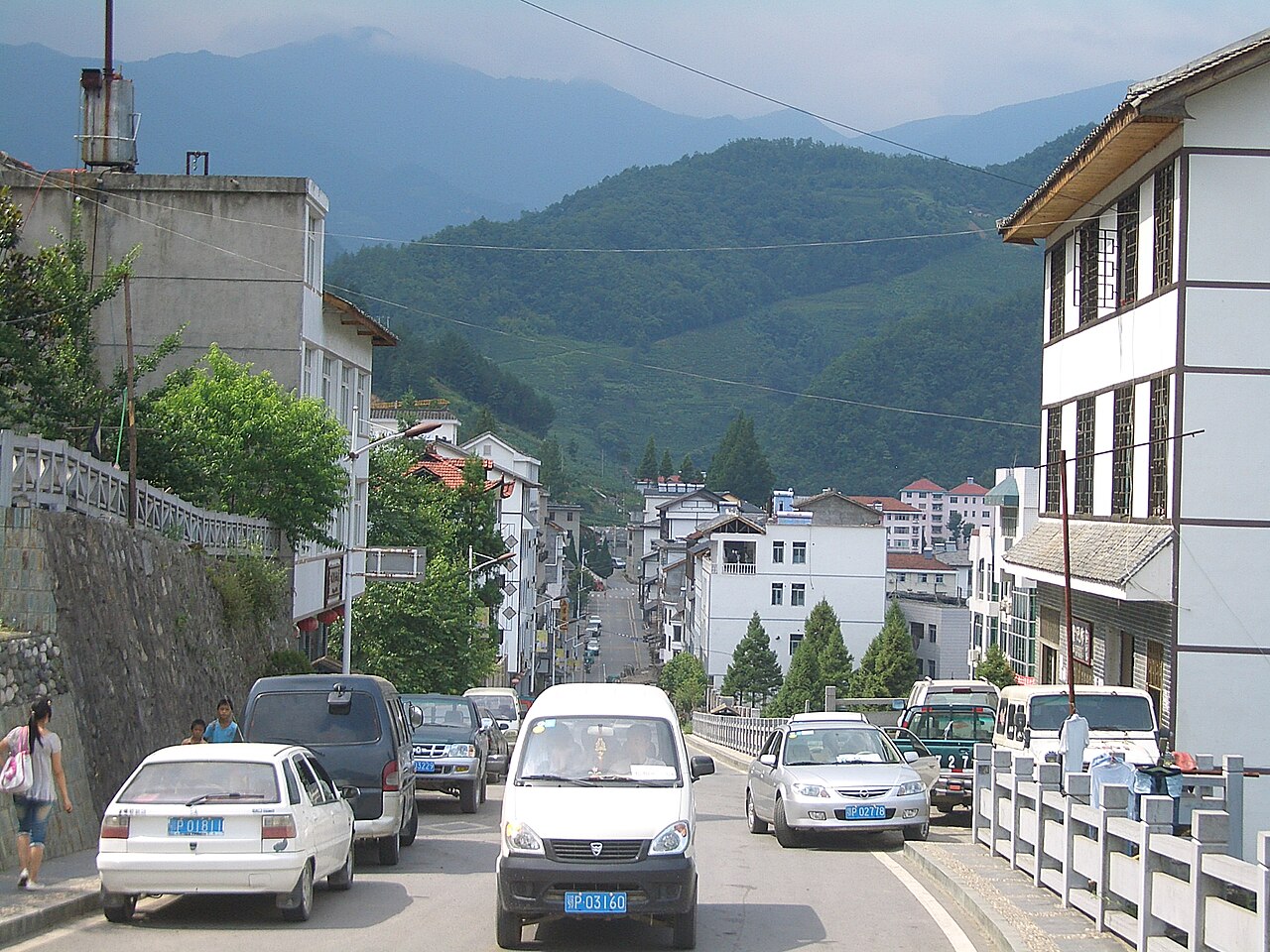
The Hubei Shennongjia was inscribed as UNESCO World Heritage in 2016, covering 73,318 hectares of primary temperate forest in the Shennongjia Forest District of western Hubei Province, with a buffer zone of a further 41,536 hectares. The inscription documents 3,767 species of higher plants across an elevational range from 420 to 3,105 metres, including 205 species listed on the IUCN Red List; at least 31 vertebrate species found in the area are considered endemic or near-endemic to the Shennongjia massif. The site is accessible from Yichang (210 km east, 4 hours by road or 30 minutes by flight to Shennongjia Airport) or from Wuhan (400 km east, 5 hours by road), and it is ringed by four UNESCO inscriptions within a radius of 600 kilometres that together cover the cultural, geological and religious landscape of the central Yangtze basin.
Immediate surroundings: Wudang Mountains and Tusi Sites at Tangya Wudang Mountains 250 km south, 3h by road; Tusi Sites/Tangya in Enshi 200 km west, 3h by road
The Ancient Building Complex in the Wudang Mountains, inscribed as UNESCO World Heritage in 1994, is approximately 250 kilometres south of the Shennongjia core zone, reachable in approximately 3 hours by road south from the Shennongjia Forest District administrative centre (Muyu Town) via the S252 and S209 provincial roads to Shiyan, the city in Hubei Province at the base of the Wudang massif. There is no direct high-speed rail connection between Shennongjia and Wudang; travel between the two sites requires road transport or a combination of road to Yichang followed by train toward Wuhan and then toward Shiyan (a significantly longer route). The Wudang Mountains inscription covers a complex of Taoist religious buildings constructed between the seventh and nineteenth centuries on the Wudang massif in Shiyan, comprising 72 cliffs and peaks integrated with temple compounds, palaces, bridges and curtain walls built across successive dynasties. The most significant building programme was the one ordered by the Yongle Emperor of the Ming dynasty (r. 1402–1424 CE), who mobilised 300,000 labourers over 12 years (1413–1424 CE) to construct 8 palaces, 72 Taoist temples and 39 bridge-gate structures on the mountain. The Golden Hall at the summit of Tianzhu Peak (1,612 metres), cast entirely in gilded bronze and prefabricated in Beijing before being transported and assembled on the mountain top in 1416 CE, weighs approximately 80 tonnes and has survived without corrosion or structural deterioration for over 600 years; the gilt surface retains its original appearance. The connection between the Wudang Mountains and Shennongjia is both geographic and mythological: both sites are located in the Daba Mountain system of western Hubei, and both are associated with the legend of Shennong, the mythical Divine Farmer emperor credited in Chinese tradition with the invention of herbal medicine and agriculture. The Shennongjia name itself (“Shennong’s ladders” or “Shennong’s terrace”) refers to the legend that Shennong climbed tree-ladders here to harvest medicinal plants from the forest canopy; Wudang’s Taoist associations overlap with the same mythological landscape of the western Hubei highlands as a domain of transcendent practice and extraordinary botanical knowledge. The documented flora of Shennongjia, which includes 1,793 species of medicinal plants recorded in the Chinese Materia Medica (Bencao Gangmu) system, gives a factual basis to the botanical mythology shared between the two sites.
The Tusi Sites at Tangya in Enshi, Hubei Province, inscribed as UNESCO World Heritage in 2015, are approximately 200 kilometres west of the Shennongjia core zone, reachable in approximately 3 hours by road west from Muyu Town via the G209 national road and the Enshi Expressway, or by road south from Shennongjia to Badong on the Yangtze (approximately 2 hours), then by rail or road from Badong to Enshi (approximately 1.5 hours). Enshi is connected to Wuhan by high-speed rail (approximately 2.5 hours). The Tangya component of the Tusi Sites covers the seat of the Tian family chieftaincy, administered as a tusi from the Song dynasty (eleventh century CE) through the Qing dynasty’s gaitu guiliu reforms of the eighteenth century. Tangya preserves a more extensive surviving built fabric than the Hailongtun (Guizhou) component of the Tusi inscription: above-ground architecture including a performance stage, ancestral hall, official reception hall, family residences and tomb complex survives within the inscribed area. The Tian family tusi administered a predominantly Tujia ethnic population in the Enshi basin, the same ethnic group that dominated the Laosicheng tusi administration in Yongshun, Hunan; the Enshi Tujia are today identified as one of the most intact Tujia cultural communities in western Hubei, with documented oral literature, textile traditions and musical forms that have been used as ethnographic comparanda for interpreting the built fabric of the tusi period. The connection between Tangya and Shennongjia is a shared western Hubei mountain ecology: the Qingjiang River, which drains the Enshi basin where Tangya is located, rises in the Shennongjia massif before flowing eastward to join the Yangtze, making the two sites part of the same watershed and the same upland forest ecological zone that the tusi administration governed.
Southeast and southwest: Three Gorges at Yichang and Mount Emei with Leshan Giant Buddha Three Gorges/Yichang 210 km southeast, 4h by road or 30 min flight; Mount Emei and Leshan 600 km southwest, 5h HSR from Wuhan
The Three Gorges area of the Yangtze River, while not itself a UNESCO World Heritage inscription, is the primary ecological and geographic corridor connecting Shennongjia to the wider Yangtze basin, and Yichang (the city at the eastern end of the Three Gorges, 210 kilometres southeast of Shennongjia by road) is the principal gateway to the reserve. The Three Gorges Dam at Sandouping, 40 kilometres upstream of Yichang, was completed in 2006 and created a reservoir 600 kilometres long that permanently altered the hydrology and ecology of the Yangtze from Chongqing to Yichang; the Shennongjia massif drains eastward into the Han River (Hanjiang), which joins the Yangtze at Wuhan, and southward into the Qingjiang tributary of the Yangtze at Yichang, giving Shennongjia a direct hydrological connection to both the Three Gorges corridor and the middle Yangtze wetlands. From Yichang (Yichang East High-Speed Railway Station), high-speed rail connects to Wuhan (approximately 1.5 hours), to Chongqing (approximately 2.5 hours via the Yichang–Wanzhou Railway, a conventional speed line through the Three Gorges), and to the national HSR network. Yichang serves as the practical access base for Shennongjia: the 4-hour road journey from Yichang to Muyu Town via the G42 expressway and the Xingshan Expressway traverses the Yangzi gorge landscape before ascending into the montane forest of the reserve. The Yangtze river dolphin (baiji, Lipotes vexillifer), a freshwater cetacean endemic to the middle Yangtze, was declared functionally extinct in 2007 following a survey that failed to locate any surviving individuals in the 1,600-kilometre survey stretch; its loss represents the most recent megafaunal extinction in China and provides context for the conservation significance of the Shennongjia inscription’s documented intact vertebrate fauna, which includes the Chinese giant salamander (Andrias davidianus), the world’s largest living amphibian, in rivers within the reserve.
Mount Emei and the Leshan Giant Buddha, inscribed as UNESCO World Heritage in 1996, are approximately 600 kilometres southwest of Shennongjia, reachable most efficiently by road south from Shennongjia to Yichang (approximately 4 hours), then high-speed rail from Yichang East to Wuhan (approximately 1.5 hours), then high-speed rail from Wuhan to Leshan or Emeishan (approximately 3.5 to 4 hours via Chengdu), giving a total journey of approximately 9 to 10 hours. Alternatively, a flight from Shennongjia Airport to Chengdu Tianfu International Airport (approximately 1.5 hours) followed by road or rail to Leshan (approximately 1.5 hours) reduces the journey to approximately 4 hours in total. The UNESCO inscription covers two components: Mount Emei (Emeishan), one of the four sacred mountains of Chinese Buddhism, whose summit at Wanfo Ding (3,099 metres) is crowned by the Golden Summit Monastery and a steel observation structure from which the “Buddha’s halo” (a circular rainbow phenomenon caused by sunlight diffracting through cloud droplets) is documented meteorologically; and the Leshan Giant Buddha (Dafo), a seated stone sculpture of Maitreya (the future Buddha) carved into the cliff face at the confluence of the Minjiang, Dadu and Qingyi rivers, measuring 71 metres from the carved hair crown to the sole, constructed between 713 and 803 CE under the direction of the monk Hai Tong and subsequently two Tang-dynasty governors. The Leshan Buddha’s head alone (14.7 metres) is larger than the entire Sphinx of Giza’s head; the toenails of the seated figure each measure approximately 1.6 metres in length. The connection between Mount Emei and Shennongjia lies in the continuity of the temperate broadleaf and mixed forest ecosystem: both sites are located within the Hengduan-Daba mountain ecological transition zone identified in the UNESCO citation for Shennongjia as a key refugium for Tertiary plant species during the Pleistocene glaciations, and Mount Emei is documented with 3,000 plant species including many of the same Tertiary relict taxa found in Shennongjia.
Practical information
Shennongjia Forest District has limited public transport within the reserve; most visitors use private vehicles or organised tours. From Yichang, tour buses to Shennongjia depart from the Yichang coach station at approximately 07:00 daily during peak season (April to October) and take approximately 4 hours to Muyu Town, the main settlement within the scenic area (approximately 100 CNY per person one-way). The scenic area ticket covers access to the Shennong Stream (a 3-hour boat journey through a 15-kilometre canyon), the Dalongtan wildlife observation zone (where captive and semi-wild golden snub-nosed monkeys, Rhinopithecus roxellana, are regularly observed), the Shennong Summit hiking area (ascending to approximately 3,000 metres above sea level) and the Tianyan Peak viewing platform. The combined scenic area ticket costs approximately 290 CNY in peak season. White bears (albino or leucistic black bears, Ursus thibetanus) documented in the reserve since the 1970s are one of several white-coloured animals observed in Shennongjia, including white deer, white snakes and white gibbons; the population genetics of these animals have not been definitively studied. The yeti-like “Wild Man” (yeren) sightings reported in Shennongjia from 1976 onward have attracted both public attention and periodic scientific survey expeditions, none of which has produced confirmatory physical evidence. The best season for Shennongjia is May to October (road access may be restricted by snow from November to March at higher elevations). Wuhan (5 hours by road) is the primary international gateway, with direct flights to major European, East Asian and Southeast Asian cities and HSR connections across China.
Frequently Asked Questions
What makes the Shennongjia forest scientifically significant compared with other temperate forests in China?
The Shennongjia UNESCO inscription cites three distinct categories of scientific significance that differentiate the site from other protected temperate forests in China. First, species richness and endemism: the 3,767 species of higher plants documented in the reserve include 205 species on the IUCN Red List and at least 205 species whose global range is restricted to the Shennongjia massif or its immediate environs. The vertebrate fauna includes 59 mammal species, 399 bird species, 55 reptile species and 37 amphibian species within the reserve boundary, with documentation rates of new species still active in the 21st century. Second, Tertiary relict flora: Shennongjia lies at the intersection of three major biogeographic regions — the Sino-Japanese floristic region, the Sino-Himalayan region and the East Asian broadleaf forest zone — and the relative absence of Pleistocene glacial coverage of the Shennongjia massif (which was too far south and at too low an elevation for ice sheets to develop) allowed plant species that went extinct across most of East Asia during the Pleistocene glaciations to survive here as relict populations. The ginkgo (Ginkgo biloba), the dawn redwood (Metasequoia glyptostroboides, first described in 1941 from a Shennongjia fossil record and then found living in the Lichuan area of Hubei in 1944), and the dove tree (Davidia involucrata) are the three most celebrated examples of Tertiary relict species with Shennongjia populations. Third, connectivity: the reserve functions as an ecological corridor between the Qinling-Daba mountain system to the north and west and the Wuling mountain system to the south and east, providing a continuous forest pathway used by migrating species including the golden snub-nosed monkey (Rhinopithecus roxellana) whose Shennongjia population of approximately 1,282 individuals (2018 survey) is the most consistently monitored in the species’ range.
What evidence exists for the “Wild Man” (yeren) of Shennongjia, and how have scientists responded to the reports?
Sightings of an unidentified large bipedal primate in the Shennongjia Forest District have been reported continuously since the 1950s, with the most concentrated series of reports occurring between 1974 and 1980, during which local government records document 31 separate eyewitness accounts from residents, forestry workers and military personnel in the Fangxian and Xingshan county areas adjacent to the reserve. The 1976 incident that attracted national attention involved a group of local Communist Party cadres who reported an encounter with five large reddish-haired bipedal creatures on a mountain road near Chunshuya; this account was reported in the People’s Daily and prompted the formation of the first official scientific expedition to investigate the yeren reports. Between 1977 and 1984, the Chinese Academy of Sciences organised or co-sponsored four expeditions to Shennongjia specifically to investigate the yeren phenomenon, deploying teams of zoologists, anthropologists and primatologists with camera traps, plaster casting equipment for footprints and collection protocols for hair and other physical evidence. The expeditions collected hair samples, footprint casts (the largest measuring 48 centimetres in length, compared to 28 to 30 centimetres for large adult male humans), faecal samples and a small number of photographs described as inconclusive. Hair sample analysis by the Institute of Vertebrate Palaeontology and Palaeoanthropology consistently identified the samples as matching Macaca thibetana (the Tibetan macaque, a large Old World monkey present in Shennongjia) or Ursus thibetanus (Asiatic black bear), with no samples identifiable as a primate outside known species. The scientific consensus, as stated in the final 1984 expedition report, was that no conclusive physical evidence for an unknown large primate had been found, and that the sighting reports were most consistent with misidentification of known species (particularly of the Asiatic black bear, which occasionally stands bipedally) combined with the region’s extreme low light conditions and dense forest cover.
How did the Shennongjia Forest District come to be administratively separate from the surrounding Hubei counties, and what does this mean for visitors?
The Shennongjia Forest District (Shennongjia Linqu) is an administrative unit at the same level as a county but directly administered by the Hubei Provincial Government rather than by any prefecture, a status it has held since 1970. The district was established in its current form in 1970 following a State Council decision to place the forested highland area under direct provincial management to protect both the timber resources (logging operations continued in Shennongjia until 1998, when China imposed a nationwide ban on natural forest logging following the 1998 Yangtze floods) and the area’s ecological significance. Before 1970, the territory was divided among several counties of Hubei and Chongqing (then part of Sichuan Province); the unification under a single administrative unit allowed coordinated management of the forest across what had previously been fragmented jurisdictions. The UNESCO inscription in 2016 combined the Shennongjia Nature Reserve (established 1982, 70,467 hectares) and the Shennongjia National Park (established 2016 at the time of the inscription) into the dual-inscribed World Heritage and MAB Biosphere Reserve property. For visitors, the direct provincial administration means that entry procedures, scenic area ticketing and accommodation are all managed centrally by the Shennongjia Forest District tourism bureau rather than by a municipal government; there is no major city within the Forest District, with Muyu Town (population approximately 30,000) being the largest settlement and the base for most visitor accommodation. The district has its own small airport (Shennongjia Airport, IATA: HPG) at an elevation of 2,580 metres, one of the highest civil airports in China, served by flights from Wuhan and a small number of other Chinese cities, with runway weather restrictions that limit operations to clear-sky conditions.
Sources
- S1 — UNESCO World Heritage Centre — Hubei Shennongjia (Ref. 1509) — https://web.archive.org/web/20230601000000/https://whc.unesco.org/en/list/1509/
- S2 — Shennongjia National Park Administration — https://whc.unesco.org/en/list/1509/
- S3 — Seidensticker, John. <em>Riding the Tiger: Tiger Conservation in Human-Dominated Landscapes</em>. Cambridge University Press, 1999. ISBN: 978-0-521-64835-6.
Spotted an error? Write to editorial@culturalheritageonline.com and we correct it the same day.