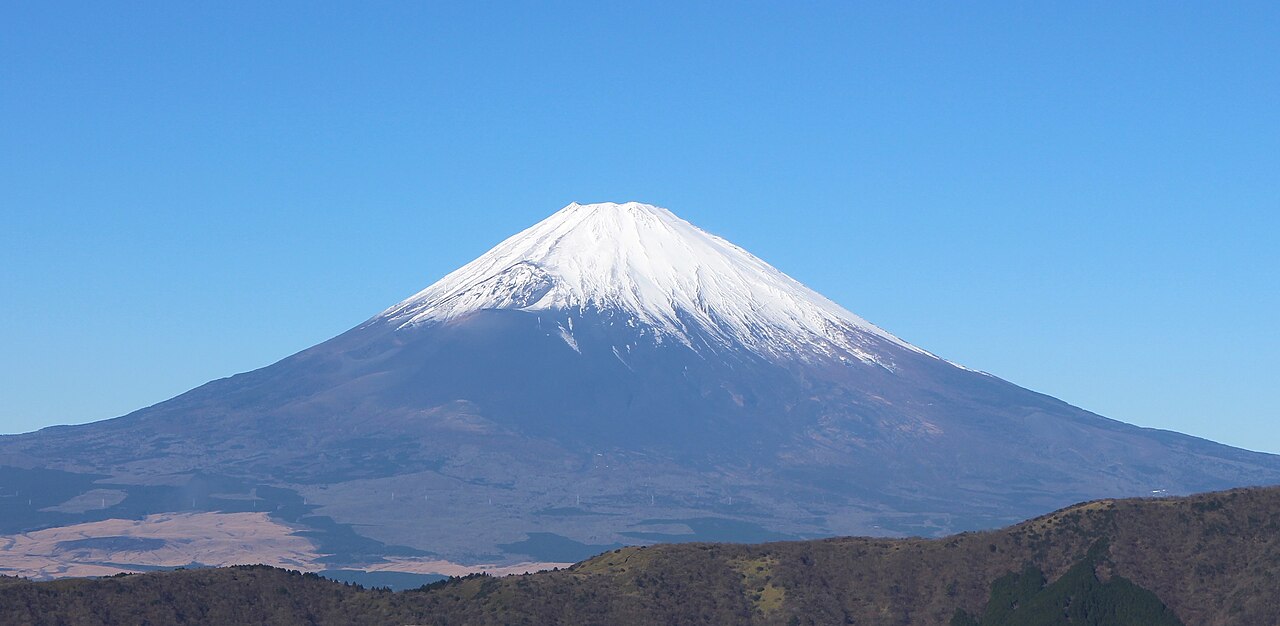
Fujisan, Sacred Place and Source of Artistic Inspiration, inscribed by UNESCO in 2013 as a Cultural Site, protects a serial cultural heritage property comprising 25 component sites on and around Mount Fuji (富士山, Fujisan, 3,776 metres) in Shizuoka and Yamanashi Prefectures — the inscription of Japan’s highest and most universally recognised mountain as a cultural site rather than a natural site reflecting the UNESCO Committee’s determination that Fuji’s Outstanding Universal Value lies not in its geology but in its role as a sacred Shinto peak, a Buddhist pilgrimage mountain, and the single most influential visual subject in the Japanese artistic tradition, reproduced in an estimated 30,000+ individual artworks from the Heian period (794–1185 CE) to the present, including the 36 Views of Mount Fuji by Katsushika Hokusai (1831–1833) and the 36 Views of Fuji by Hiroshige Utagawa (1858) that are the most internationally recognised works of Japanese art. The 25 component sites include: the mountain itself (Fuji’s summit crater and the approach trails used by the approximately 200,000 annual summit climbers); the Fuji Sengen Jinja network (the 1,300 Sengen shrines at the base and on the slopes of the mountain, dedicated to the goddess Konohanasakuya-hime, whose mythological narrative frames the mountain’s sacred status in Shinto cosmology); the Oshino Hakkai (the eight spring ponds fed by snowmelt from Fuji’s summit aquifer, in Oshino Village, Yamanashi, whose crystal-clear blue water fed by the mountain’s filtered spring flow has been a sacred pilgrimage site since the Heian period); and the Fujigoko (the Fuji Five Lakes — Kawaguchiko, Yamanakako, Saiko, Shojiko, and Motosuko — on the northern flank of the mountain, the viewpoints that produced the most widely reproduced photographic images of Fuji with its cone reflected in lake water).
Fuji’s five-lake viewshed and the Hakone-Fuji heritage corridor Hakone volcanic landscape · Kamakura Great Buddha · Oshino Hakkai springs — 30 to 100 km
Thirty Kilometres east of Mount Fuji (from the Kawaguchiko lake viewpoint on the northern flank) by road (approximately 1 hour from Kawaguchiko to Hakone-Yumoto via the Fuji-Hakone road through the Yamanaka Pass), or approximately 40 minutes from Mishima Station on the Tokaido HSR to Odawara Station and then the Hakone Tozan Railway to Hakone-Yumoto, the Hakone volcanic area (箱根, open-sky volcanic landscape, not individually UNESCO-inscribed but on Japan’s Tentative List) is the most visited natural landscape companion to Mount Fuji, and the viewpoint from Owakudani (大涌谷, the active volcanic valley on the Hakone caldera rim at 1,044 metres elevation, produced by the Kanagawa Earthquake of 1703 CE and continuously active with steam vents and sulfur deposits) is one of the most frequently photographed viewpoints of Fuji’s northern cone from a lateral angle. The Owakudani Ropeway (the 4-kilometre aerial cable car from Sounzan Station to Togendai Station on Lake Ashi, crossing the Owakudani volcanic crater zone) provides the most dramatic access to the Hakone caldera landscape with Fuji in the background. Lake Ashi (芦ノ湖, Ashinoko, a caldera lake at 725 metres elevation formed approximately 3,000 years ago by a phreatic eruption, the southernmost of the Hakone volcanic lakes) offers the classic frontal view of Fuji’s southern cone across the lake from the Motohakone or Hakone-machi piers — the view that appears in the Tokugawa period woodblock prints of the Tokaido Road and that has been the standard composition for the Fuji-over-Hakone lake image for 300 years. From Kawaguchiko, Hakone is reached via the Tomei-Odan Expressway (approximately 1 hour) or by the more scenic Fuji-Hakone-Izu National Park road through Ashinoko.
One Hundred Kilometres east of Mount Fuji by road (approximately 1.5 hours from Kawaguchiko to Kamakura via the Tomei Expressway and the Yokohama-Yokosuka road) or by rail (from Kawaguchiko by direct express train to Shin-Yokohama, approximately 1.5 hours, then Yokosuka Line to Kamakura, approximately 20 minutes), Kamakura (鎌倉市, Kanagawa Prefecture, the seat of Japan’s first military government under Minamoto no Yoritomo, 1192–1333 CE) is the most historically significant cultural site in the Fuji proximity zone, containing the Kotoku-in Great Buddha (高徳院大仏, cast 1252 CE, height 13.35 metres, the second-largest bronze Buddha in Japan and the most-photographed Buddhist sculpture in the Kanto region), the Tsurugaoka Hachimangu Shrine (the principal Shinto shrine of the Kamakura shogunate, the ceremonial and ritual centre of Japanese warrior culture in the Kamakura period), and approximately 65 temples and shrines within the historic Kamakura urban area. Kamakura was on Japan’s UNESCO Tentative List since 1992 (listed as “Ancient Kamakura: Its Shrines, Temples and Nature”) but was declined by the UNESCO Committee in 2013 (the same year as Fujisan’s inscription) on the grounds that its Outstanding Universal Value had not been sufficiently demonstrated against comparable sites. From Shinjuku Station (central Tokyo), Kamakura is accessible by the Shonan-Shinjuku Line (direct train, approximately 55 minutes). From Kawaguchiko, Kamakura is a 2-hour transit (bus/train combination via Yokohama).
Practical information
The Fujisan UNESCO inscription covers 25 component sites in Yamanashi and Shizuoka Prefectures; the most visitor-accessible are: the Fujigoko (Fuji Five Lakes — Kawaguchiko is the most developed, with the Kachi Kachi Mountain Ropeway and the Chureito Pagoda/Arakurayama Sengen Park viewpoint, the most photographed composition of Fuji with a five-storey pagoda in the foreground and the mountain behind); the Oshino Hakkai (the eight sacred spring ponds in Oshino Village, 10 km east of Kawaguchiko, free to enter, best light in morning); and the Fujisan World Heritage Centre in Fujinomiya (opened 2017, the primary interpretive facility for the cultural heritage aspects of the inscription). Mount Fuji is open for summit climbing from approximately July 1 to September 10 (the official climbing season); outside this window, the summit trails above the 5th Station are dangerous and often closed due to ice and snowfall. The 5th Station (Subashiri, Gotemba, Kawaguchiko, or Fujinomiya, at approximately 2,000–2,400 metres elevation) is accessible year-round by tourist bus and provides the most convenient access to the mountain’s mid-elevation volcanic landscape for non-summit visitors. The most evocative access to the sacred mountain character of the inscription is the Fujisan Hongu Sengen Taisha (富士山本宮浅間大社, Fujinomiya, Shizuoka, the head shrine of the 1,300-shrine Sengen network, whose grounds encompass the mountain from the shrine’s Oku-no-miya sanctuary at the summit crater), reachable by the Fujinomiya Trail from the Fujinomiya 5th Station. From Tokyo, Kawaguchiko is accessible by direct express bus from Shinjuku Bus Terminal (approximately 1.5–2 hours) or by the Fuji Excursion limited express train from Shinjuku (approximately 1.5 hours to Kawaguchiko) — from 2023, direct JR limited express service from Shinjuku is available on the Chuo Line to Otsuki then the Fujikyu Line to Kawaguchiko.
Frequently Asked Questions
Why was Mount Fuji inscribed as a cultural site rather than a natural site?
The distinction between UNESCO natural heritage and cultural heritage inscriptions is significant, and Japan’s decision to apply for Fujisan’s inscription as a cultural site rather than a natural site reflects both the specific nature of the mountain’s heritage value and a pragmatic calculation about the inscription’s prospects. Fujisan’s geological characteristics — a stratovolcano that last erupted in 1707 CE, with a symmetrical cone profile produced by successive lava flows — are not sufficiently exceptional by UNESCO natural heritage standards (the criteria for natural inscription require natural phenomena of “outstanding universal value”, exceptional natural beauty or aesthetic importance, major geological processes, or exceptional biodiversity and ecosystem value that Fuji, while visually spectacular, cannot claim against the world’s most geologically active volcanic systems). By contrast, Fuji’s cultural value — as the most frequently depicted natural subject in Japanese art history, the central sacred mountain of Japanese Shinto practice, and the destination of one of Japan’s largest religious pilgrimages for over 1,000 years — is demonstrably of outstanding universal value against comparable artistic and religious mountains worldwide. The inscription’s 25 component sites were chosen to document the mountain’s cultural significance rather than its natural features: the Sengen shrine network documents its sacred status, the Oshino Hakkai springs document its sacred water significance, the Fujigoko lakes document its role as a viewshed for artistic representation, and the historical climbing routes document the pilgrimage tradition. The UNESCO Committee was also influenced by the fact that Japan had submitted and withdrawn a natural heritage application for Fuji in 1992 (dropped because the Committee signalled it would not meet natural criteria without stronger conservation management for the summit zone, which was then heavily polluted by tourist waste), and the cultural application circumvented this obstacle by focusing on the mountain’s undeniable cultural rather than geological significance.
What is the Fuji pilgrimage tradition and how did it develop historically?
The Fuji pilgrimage tradition (Fuji-ko, 富士講, the confraternity-based group pilgrimage system that became Japan’s most popular religious pilgrimage movement in the Edo period) is one of the most socially distinctive pilgrimage traditions in world religious history — a mountain pilgrimage that was primarily organised not by Buddhist temples or Shinto shrines but by urban lay confraternities (ko, 講) of merchants, craftsmen, and townspeople who pooled resources to send a rotating cohort of members to the summit annually as collective representatives of the group. The origins of Fuji pilgrimage are attributed to the Buddhist monk En no Gyoja (634–706 CE), who is credited in Japanese religious tradition with first ascending Fuji as an ascetic practice — but systematic pilgrimage to the summit began with the Sengoku-period ascetic Hasegawa Kakugyo (1541–1646 CE), a wandering practitioner of Shugendo (mountain asceticism) who established a retreat on the Fuji slopes and taught that ritual purification at the summit of Fuji would produce worldly blessings. Kakugyo’s followers established the first Fuji-ko confraternities in Edo (Tokyo) in the mid-17th century, and by the mid-18th century the Fuji-ko movement had become the most popular form of religious confraternity organisation in Edo’s urban merchant and craft communities: estimated numbers of Edo-period Fuji-ko confraternities range from 700 to 2,000, with a combined membership of several hundred thousand. The social innovation of the Fuji-ko system was its democratisation of the pilgrimage: rather than requiring each member to make the expensive and physically demanding summit ascent personally, the confraternity system sent a rotating annual delegation to the summit on behalf of the entire group (approximately 3–5 members per year per confraternity), distributing the spiritual merit of the ascent across all members through the collective ritual. The annual delegation would carry the confraternity’s talismans to the summit, collect sacred water from the crater snowfields, and bring back talismans and spring water as material evidence of the summit contact — objects circulated among all members as shareable spiritual goods. By the early Meiji period, the Fuji-ko movement had produced the highest single-year summit climbing record in Japanese pre-modern history (over 40,000 climbers at the summit in 1860 CE, a figure not exceeded until the late 20th century), a remarkable testament to the motivating power of the confraternity pilgrimage system in organising mass voluntary religious movement.
How did Mount Fuji influence Japanese art and what is the significance of Hokusai’s 36 Views?
Katsushika Hokusai’s Thirty-six Views of Mount Fuji (富嶽三十六景, Fugaku Sanjūrokkei, published 1831–1833 CE, in fact comprising 46 prints due to ten supplementary additions after commercial success) is the single most influential series in the history of Japanese printmaking and one of the most widely reproduced series of visual artworks in world history — the 46 prints’ extraordinary compositional variety (Fuji seen from rice fields, harbours, mountain passes, tea houses, breaking waves, beneath waves, in rain, in clear weather, in summer, in winter) established the principle that a single visual subject could sustain an entire visual enterprise of formal variation, influencing not only subsequent Japanese printmakers (Hiroshige’s Thirty-six Views of Fuji, 1858) but profoundly affecting European Impressionist and Post-Impressionist painters who discovered the series after Japanese woodblock prints began circulating in Europe following Japan’s opening to trade in the 1850s. The specific print that most impacted European modernism is Kanagawa oki nami-ura (神奈川沖浪裏, “Under a Wave off Kanagawa”, commonly known as “The Great Wave”), in which a towering foreground wave with foam crests shaped like grasping claws frames a diminutive Fuji in the background middle distance — a compositional revolution against European perspectival convention that substituted a dynamic foreground subject for the conventional hierarchical arrangement of landscape elements from foreground (small, close) to background (distant, reduced). The influence of Hokusai’s wave composition is directly traceable in the work of Vincent van Gogh (who owned a copy of the Great Wave and wrote about it in letters to his brother Theo), Claude Monet (whose Impressionist seascapes explicitly reference the Japanese wave composition), and Gustav Klimt (whose ornamental patterning in works like “The Kiss” reflects the Japanese woodblock tradition). The Fujisan UNESCO inscription explicitly recognises this artistic legacy as a primary component of the mountain’s Outstanding Universal Value — the only UNESCO natural site whose primary inscribed value is as a visual subject rather than a physical environment.
Sources
- S1 — UNESCO World Heritage Centre — Fujisan, sacred place and source of artistic inspiration (Ref. 1331) — https://web.archive.org/web/20230601000000/https://whc.unesco.org/en/list/1331/
- S2 — UNESCO World Heritage Centre — Statement of Outstanding Universal Value (Ref. 1331) — https://whc.unesco.org/en/list/1331/
Spotted an error? Write to editorial@culturalheritageonline.com and we correct it the same day.