Wikimedia Commons,
CC BY 2.0.
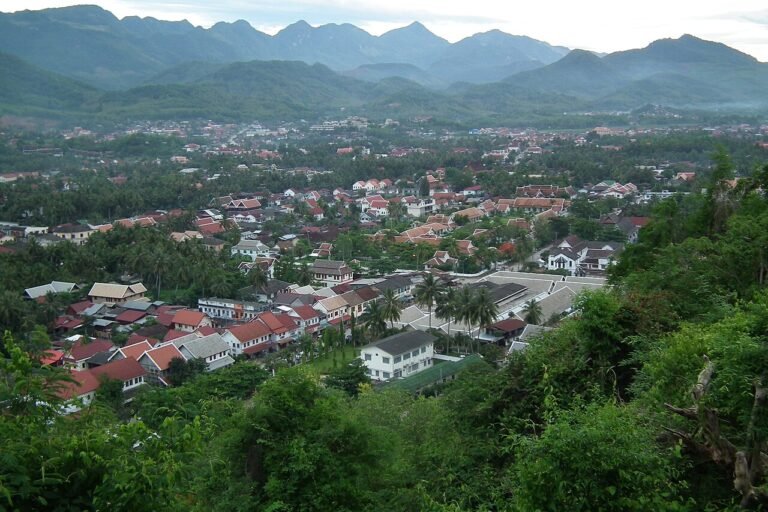
Olinda rises on a series of low hills overlooking the Atlantic, 6 kilometres north of Recife in Pernambuco state, its Baroque churches and convents visible from the sea as they were when the Portuguese founded the town in 1535. Burned by the Dutch West India Company in 1630 and rebuilt in the Baroque manner, the town retains a remarkably intact colonial urban fabric of whitewashed churches, cobbled streets, and mango trees. Its Frevo carnival and its colossal papier-mâché puppet figures are UNESCO Intangible Heritage; the historic centre has been on the World Heritage List since 1982.
Pernambuco’s Baroque hilltop town: Franciscan convents, Dutch occupation and the oldest carnival in Brazil Pernambuco state · north-east Brazil · 6 km from Recife; 2.5 hr flight from São Paulo
Olinda (the name derives from the Portuguese exclamation “Oh Linda!” — “Oh, beautiful!” — which tradition attributes to the first Portuguese governor looking down from the hill, though this etymology is almost certainly apocryphal) was founded on 12 March 1535 by Duarte Coelho Pereira, the first donatário-captain of the captaincy of Pernambuco. The site on the hills above a natural harbour was well chosen: the elevation provided defence, the view gave early warning of approaching ships, and the proximity to what would become Recife (then simply the port district below Olinda) gave access to the Atlantic trade routes.
The town that Duarte Coelho built rapidly became one of the wealthiest in colonial Brazil. Pernambuco was the heart of the Brazilian sugar industry in the late 16th century, producing more sugar than any other region in the Americas; the wealth that sugar generated flowed through Olinda. The Franciscan Convent of São Francisco, founded 1585, was the first Franciscan house in Brazil; its cloister, decorated with blue-and-white azulejo tile panels depicting the life of Francis of Assisi — an unexpectedly lyrical programme for a colonial convent — survives largely intact. The Convent of Nossa Senhora das Neves (Our Lady of the Snows, 1585) and the Benedictine Monastery of São Bento (1596) followed; within fifty years of foundation, Olinda had more ecclesiastical architecture per capita than almost any city in Portugal itself.
The Dutch West India Company invaded Pernambuco in January 1630. Olinda was taken, sacked, and burned by the Dutch; the destruction was thorough enough that only a handful of structures survived. The Dutch rebuilt Recife (which they renamed Mauritsstad, after Count Johan Maurits van Nassau-Siegen, the enlightened Dutch governor from 1637-1644) as a planned Renaissance city on the island between the Capibaribe and Beberibe rivers, leaving Olinda as a burned shell that they never fully rebuilt. The Brazilians, Portuguese, and allied indigenous forces expelled the Dutch in 1654, and the rebuilding of Olinda began in the 1660s.
What makes Olinda’s colonial architecture distinctive from this second phase onward is the Baroque manner in which it was reconstructed. The rebuilding occurred during the high period of Portuguese Baroque — the style that reached its apogee in Braga, Porto, and the great pilgrimage churches of northern Portugal — and the churches, convents, and chapels of Olinda reflect this national fashion in a colonial idiom. The Igreja da Misericórdia (c. 1540, rebuilt late 17th c.), the Sé Cathedral (rebuilt after the Dutch burning), and the smaller neighbourhood chapels scattered across the hills all share the characteristic Portuguese Baroque vocabulary of deeply moulded doorways, whitewashed lime render, and azulejo tile panels used as narrative rather than merely decorative elements.
The UNESCO inscription of 1982 was among the earliest in Latin America and one of the first on the World Heritage List overall. The citation notes the “exceptional nature of the urban fabric, which has remained almost intact” and the “remarkable setting” of the town’s hilltop position. UNESCO also noted, even in 1982, the threat from uncontrolled urban expansion: the historic centre is surrounded by the continuous urban fabric of metropolitan Recife, and pressure on the buffer zone has been a permanent concern since inscription.
Olinda’s carnival, which predates the more famous Rio carnival by several decades, is built around the Frevo — a frenetic brass-band musical style with acrobatic dance characterised by the use of small coloured parasols (sombrinhas) as a substitute for the weapons of the capoeira martial art from which it is said to derive. UNESCO proclaimed the Frevo of Olinda Intangible Cultural Heritage of Humanity in 2012. The giant puppet figures (bonecos gigantes) — papier-mâché effigies up to 4 metres tall, carried by groups of people dancing through the carnival crowds — are the visual signature of Olinda’s street carnival and have been copied by carnivals across Brazil.
Recife’s heritage: the Dutch city, Capibaribe River and the Pernambuco museum circuit 6 km south of Olinda · metro and bus connection
Recife, the capital of Pernambuco and a city of approximately 1.6 million in the urban centre (4 million in the metropolitan area), was built by the Dutch on the flat delta islands at the mouth of the Capibaribe River and expanded by the Portuguese after 1654. The historic neighbourhood of Recife Antigo (Old Recife), on the island of Recife, retains a substantial number of 17th-century Dutch and later Portuguese colonial buildings, concentrated around Rua do Bom Jesus, where the oldest synagogue in the Americas — Synagogue Kahal Zur Israel, founded by Sephardic Jews who arrived with the Dutch West India Company in 1630 — has been restored and opened as a museum.
The Instituto Ricardo Brennand, located in a neo-Gothic castle constructed in the early 20th century in the western suburbs of Recife, houses the most important collection of objects related to Dutch Brazil anywhere in the world: paintings, maps, weapons, and documents from the Nassau period, including major works by Frans Post and Albert Eckhout — the two Dutch painters who accompanied Count Johan Maurits and produced the first systematic pictorial record of Brazil’s landscape and people. The collection is exceptional by any international standard and largely unknown outside Brazil.
Practical information
Getting there: Recife/Guararapes International Airport (REC) is served from São Paulo, Rio de Janeiro, Brasília, Fortaleza, and Lisbon (TAP Air Portugal, direct); the flight from São Paulo takes approximately 2 h 30 min. From the airport, the Recife Metro connects to the city centre, and buses and taxis reach Olinda in about 30 minutes (6 km). Olinda itself has no railway station but is well served by urban buses from central Recife.
Getting around: Olinda’s historic centre is entirely walkable; the hills are moderate in gradient and the cobbled streets are well maintained. The Franciscan Convent, the Sé Cathedral, the Benedictine Monastery, and the six or seven principal churches are all within a 30-minute walking circuit of the main square (Praça do Carmo). The town’s best viewpoint — over Recife and the sea — is from the terrace in front of the Igreja da Sé.
Best time to visit: Carnival (late February or March, depending on the lunar calendar) is the peak event; Olinda’s street carnival is considered by many Brazilians to be the most authentic in the country. Outside carnival, the town is calm year-round. June brings the Festas Juninas (João Pessoa celebrations), a second major popular festival. The dry season (September-February) is the most comfortable for sightseeing.
Practical tips: Olinda has a working artists’ community; the studios and galleries scattered through the historic centre sell original work in painting, ceramics, and the papier-mâché puppet tradition. Most are open during daylight hours with no appointment necessary. The town’s restaurants, clustered near Praça do Carmo and on the Alto da Sé viewpoint, specialise in Pernambuco cuisine — moqueca, caldo de sururu, and tapioca crepes.
Frequently Asked Questions
What makes Olinda’s carnival different from Rio de Janeiro’s?
Rio de Janeiro’s carnival is a stadium event: the Sambódromo parades, where the samba schools compete, are ticketed, seated, and adjudicated. The street blocks (blocos) outside the Sambódromo are large and often commercially sponsored. Olinda’s carnival is entirely a street event: there are no bleachers, no judges, no admission fees for the main street festivities. The bonecos gigantes — the giant puppets that are Olinda’s signature — move through the historic streets accompanied by brass bands playing Frevo, and the crowd dances around them without barriers or organisation. The Frevo itself is musically distinct from samba: played at extreme speed by brass and percussion ensembles, it requires a specific athletic dance style that involves jumps, spins, and parasol manipulation that has no equivalent in other Brazilian carnival traditions. Many Brazilians who find the commercialisation of Rio carnival alienating prefer Olinda’s populist, neighbourhood-centred model.
Why is the Convent of São Francisco in Olinda significant for Brazil’s history?
The Convent of São Francisco, founded 1585, is the oldest Franciscan house in Brazil and predates the famous Franciscan complexes of São Paulo, Rio de Janeiro, and Salvador by several decades. Its significance is both institutional and artistic. Institutionally, it was the first centre of Franciscan evangelisation in north-eastern Brazil, and its friars accompanied the Portuguese expansion into the Pernambuco interior and beyond. Artistically, its church and cloister contain one of the most complete programmes of colonial azulejo tile panels in the country: the cloister’s arcaded walkway is lined with blue-and-white Portuguese tiles, probably imported from Lisbon in the late 17th or early 18th century, depicting scenes from the life of Francis of Assisi and from the Old Testament. The panels were produced by anonymous Lisbon tile workshops but are considered among the finest examples of the azulejo narrative tradition outside Portugal. The convent’s carved wooden altar in the church interior, in the gilded Baroque manner, is also an important work of colonial sacred art.
What happened to Olinda during the Dutch occupation of Pernambuco (1630-1654)?
The Dutch West India Company (VOC’s counterpart for the Atlantic, the WIC) invaded Pernambuco on 14 February 1630 with a fleet of 67 ships and 7,000 soldiers. Olinda was taken quickly; its wealthy Portuguese residents evacuated when possible, taking valuables but leaving the buildings. The Dutch burned the town systematically in November 1631 to deny shelter to the Brazilian guerrilla forces (the guerra da palha, or “straw war”) who were harassing Dutch supply lines from the surrounding countryside. The burning was thorough: most of Olinda’s 16th-century buildings were destroyed. The Dutch did not rebuild Olinda; they concentrated their urban investment in Recife (Mauritsstad), which under Count Johan Maurits became a planned city with canals, bridges, a botanical garden, a zoo, and a scientific observatory — the most progressive urban development anywhere in the Americas at the time. After the Portuguese-Brazilian reconquest in 1654, the reconstruction of Olinda began in the late 1650s-1660s, producing the Baroque urban fabric that survives today.
Sources
- S1 — Boxer, Charles R. The Dutch in Brazil: 1624-1654. Clarendon Press, 1957. ISBN 978-0-19-821458-8.
- S2 — Freyre, Gilberto. The Masters and the Slaves: A Study in the Development of Brazilian Civilization. University of California Press, 1986. ISBN 978-0-520-05665-7.
Spotted an error? Write to editorial@culturalheritageonline.com and we correct it the same day.