Lahore Fort, inscribed on the UNESCO World Heritage List in 1981 alongside the Shalimar Gardens, contains 21 notable monuments built by successive Mughal emperors from Akbar (1556–1605) to Aurangzeb (1658–1707), each ruler adding at least one major structure to the complex. The Shalimar Gardens, commissioned in 1641 by Shah Jahan and designed across three terraced levels with 410 fountains fed by 12 water channels, are now on UNESCO’s List of World Heritage in Danger due to road-widening works that encroached on the garden perimeter. Within a 100-kilometre radius, two further UNESCO sites — Rohtas Fort (1997) and Taxila (1980) — define one of South Asia’s densest concentrations of heritage protected at international level.
Lahore Fort and Shalimar Gardens: The Dual UNESCO Inscription City centre, 5 km apart
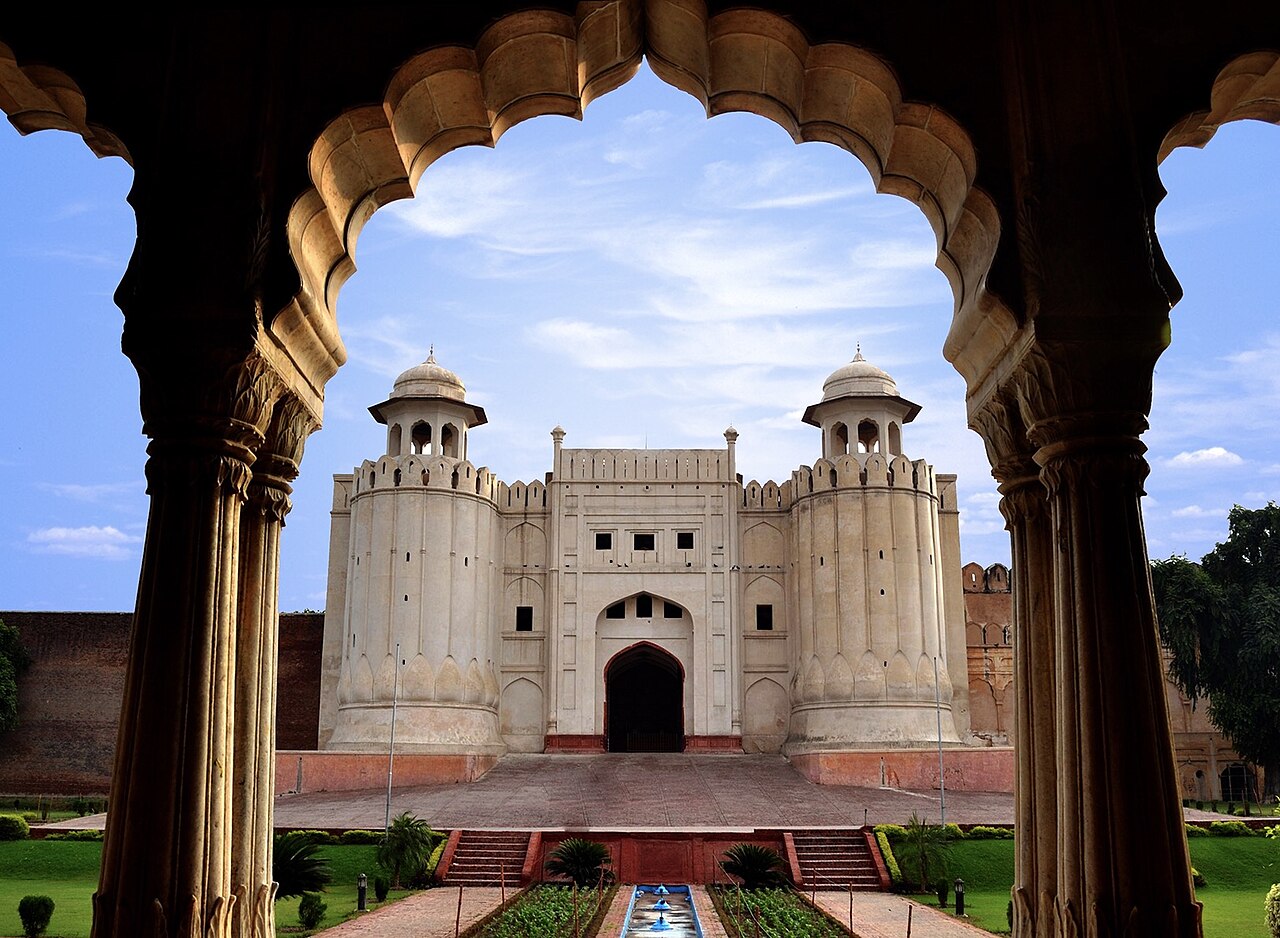
The Lahore Fort stands on a mound at the northern edge of the Walled City, its present form largely the result of building campaigns spanning 1556 to 1707. Akbar erected the first substantial stone structures on a site that had been a royal enclosure since at least the 11th century. Each subsequent emperor modified and extended the compound: Jahangir added the Picture Wall, a continuous facade of glazed tile mosaics covering the north and west faces; Shah Jahan built the Shish Mahal (Palace of Mirrors) around 1632, a set of audience chambers whose interior surfaces are covered with approximately 50,000 mirror fragments set into white plaster using a technique called ayna-kari; Aurangzeb constructed the Alamgiri Gate in 1674, the ceremonial entrance that still faces the Badshahi Mosque across the large open forecourt.
The Naulakha Pavilion, a small white marble structure with a characteristic curved Bengali roof, takes its name from the figure of 900,000 rupees (nau lakh) that Shah Jahan spent on its construction. It stands adjacent to the Shish Mahal, its exterior inlaid with pietra dura work in semi-precious stones, a technique refined at the Taj Mahal in Agra during the same reign. The fort complex as a whole measures roughly 20 hectares enclosed within massive brick ramparts, and the 21 principal monuments within it represent an almost unbroken record of Mughal imperial architecture from mid-16th to early 18th century.
The Shalimar Gardens lie 5 kilometres east of the fort, connected historically by the grand avenue that Shah Jahan laid out from the city walls. Built in 1641, the gardens were designed for the emperor’s court and named in honour of the empress Mumtaz Mahal, who had died a decade earlier during the construction of the Taj Mahal in Agra. The three terraced levels descend from north to south, each terrace separated by a water cascade. The 410 fountains were fed by a canal drawn from the Ravi River; 12 distinct water channels cross the garden. At full operation under Mughal management the fountains were set in white marble basins. The garden follows a formal char-bagh (four-part garden) plan, though at a scale and hydraulic complexity exceeding most examples of the genre.
In 2000, the Lahore Ring Road project widened a road along the northern boundary of the Shalimar Gardens from a two-lane track to a 12-lane artery, removing part of the outer perimeter wall and disrupting the original enclosed character of the site. This development, combined with encroachment by residential and commercial construction along other boundaries, led UNESCO to place the gardens on its List of World Heritage in Danger — a designation it shares globally with sites threatened by armed conflict, natural disaster, or neglect. The fort itself has experienced periodic deterioration of its plasterwork and tile surfaces, accelerated by humidity and the vibration of heavy traffic.
Directly across from the Alamgiri Gate of the fort stands the Badshahi Mosque, built by Aurangzeb and completed in 1673. Not separately listed by UNESCO, it nonetheless forms the visual counterpart to the fort in the urban landscape of Lahore. With a capacity of 55,000 worshippers in its courtyard and prayer hall combined, it held the title of the world’s largest mosque from its completion until 1986, when the Faisal Mosque in Islamabad surpassed it. Its red sandstone construction mirrors the palette of Mughal monuments in Agra and Delhi. The three domed minarets at each corner reach 53 metres.
Rohtas Fort and Taxila: Two Further UNESCO Sites Within 100 Kilometres 100 km south and 40 km east by road
Rohtas Fort, inscribed in 1997, stands approximately 100 kilometres south of Lahore, near the town of Jhelum in Punjab province. Sher Shah Suri, the Afghan ruler who displaced the Mughal emperor Humayun in 1540, ordered its construction to suppress the Gakhhar tribe of the Potohar Plateau and to establish a defensive base against Humayun’s anticipated return from exile in Persia. The fort was built between 1541 and 1543, a remarkably short period for a structure with a perimeter wall extending 4 kilometres, 12 gates, and 68 bastions. Sher Shah Suri died in 1545 before the project reached completion. Humayun recaptured Lahore in 1555 without fighting a battle for Rohtas Fort — the stronghold that had been constructed partly in anticipation of stopping him.
The Kabuli Gate at Rohtas, which faces northwest toward Kabul, is the most elaborate of the 12 gates: a 15-metre arch flanked by round towers and decorated with Quranic calligraphy in sandstone relief. The Shahi Masjid (Royal Mosque) inside the fort walls dates to the Suri period. Unusually for a military fortification of its era, Rohtas was built using paid local labour rather than conscripted or enslaved workers — a fact noted in contemporary Persian chronicles and confirmed by the fort’s relatively uniform construction quality throughout.
Taxila, 40 kilometres east of Lahore, was inscribed in 1980 and represents a layered archaeological site of extraordinary historical range. Three distinct urban settlements were built on and near the site across roughly 800 years: Bhir Mound (600–200 BCE), the oldest city; Sirkap (200 BCE–100 CE), rebuilt on a Hellenistic grid plan following the arrival of Indo-Greek rulers; and Sirsukh (from approximately 100 CE onward), associated with the Kushan dynasty that dominated the region after the Greeks. Alexander the Great arrived at Taxila in 326 BCE, received by King Ambhi as an ally rather than a conquest target — one of the few cities in Alexander’s eastern campaigns that opened its gates without resistance.
Taxila’s significance in the history of Buddhist art is distinct from its political history. Between the 1st and 5th centuries CE, Gandharan sculptors working in the region developed the first figurative representations of the Buddha in human form. Earlier Buddhist iconography had avoided depicting the Buddha directly, using instead symbolic surrogates: his footprints, an empty throne, the Bodhi tree, or a parasol. Gandharan sculpture introduced recognisable facial features and garment folds derived from Hellenistic stone-carving traditions, fusing them with Indian iconographic conventions. The Taxila Museum holds one of the world’s most comprehensive collections of Gandharan artefacts. The Dharmarajika stupa, the largest Buddhist monument at the site, was originally built by Emperor Ashoka in the 3rd century BCE to enshrine relics of the Buddha, then rebuilt and enlarged multiple times over the following centuries.
Lahore’s Position in the Mughal Empire and the Grand Trunk Road Regional context — Lahore to Agra: 600 km
Lahore served as the second capital of the Mughal Empire, after Agra, through much of the 16th and early 17th centuries. Akbar maintained his court here for extended periods; Jahangir and his empress Nur Jahan are both buried in Lahore, at the Tomb of Jahangir (Shahdara, across the Ravi) and the Tomb of Nur Jahan respectively. This concentration of imperial patronage over 150 years produced the density of Mughal architecture that distinguishes Lahore from any other city in the subcontinent outside of Agra and Delhi.
The Grand Trunk Road, one of Asia’s oldest and longest major roads, passes through Lahore. Originally conceived in Maurya-era India and substantially rebuilt by Sher Shah Suri in the 16th century, it connected Dhaka in the east to Kabul in the west. For Mughal emperors, Lahore was the gateway to Central Asia: campaigns into Afghanistan and Persia launched from here; diplomatic embassies from the Safavid court in Isfahan arrived here first. The road also carried trade in both directions, and Lahore’s bazaars in the Walled City developed in direct response to this transit commerce. The Walled City, largely intact, contains the Delhi Gate, Lahori Gate, and Mochi Gate among its 13 original entrances, all accessible by foot from the fort.
Practical information
The best months to visit Lahore are October through March, when temperatures remain between 5°C and 25°C. Summer (May–July) brings extreme heat regularly exceeding 40°C. The monsoon (July–September) brings high humidity and occasional flooding in older parts of the city. Lahore is served by Allama Iqbal International Airport with direct connections to Dubai, Abu Dhabi, Doha, Istanbul, and several Chinese cities. Visa on arrival is available for citizens of a number of countries; the Pakistan e-visa portal handles most nationalities with processing typically completed in three to five days. The currency is the Pakistani rupee (PKR). Entry to Lahore Fort requires a fee (nominal for Pakistani nationals, higher for foreign visitors); Shalimar Gardens is separately ticketed. Rohtas Fort is accessed by road from Jhelum (approximately 1.5 hours from Lahore by car); limited public transport serves the site, so hiring a driver in Lahore for the day is more practical. Taxila is accessible in 45 minutes from Lahore on the Grand Trunk Road; the Taxila Museum near the Dharmarajika stupa requires a separate entry fee and is closed on Mondays. Photography inside the Shish Mahal at Lahore Fort may require a permit from the Archaeology Department.
Frequently Asked Questions
What exactly is on UNESCO’s World Heritage in Danger list about the Shalimar Gardens?
The Shalimar Gardens were placed on UNESCO’s List of World Heritage in Danger due to a road-widening project that began in 2000 and expanded a road along the northern perimeter of the garden from a two-lane road to a 12-lane artery. This construction removed a section of the outer boundary wall that had enclosed the garden since Shah Jahan’s time, breaking the spatial integrity of the original design. The char-bagh (four-part garden) concept depends on enclosure: the high boundary walls were not merely decorative but functional, creating a controlled microclimate and a visual separation from the city outside. Once breached, the noise, dust, and vibration of a 12-lane urban road fundamentally alter the character of the garden as it was inscribed. Additional encroachment from residential construction along other boundaries has compounded the issue. UNESCO has been in discussions with the Pakistani government for over two decades regarding remediation. The State of Conservation reports submitted to the World Heritage Committee have noted some positive steps — a Heritage Conservation and Management Plan was drafted — but physical restoration of the boundary has remained incomplete. The fountains, though partially restored in recent years, do not operate at the scale or pressure of the Mughal originals, as the canal system from the Ravi River was long ago redirected.
How does the Shish Mahal (Palace of Mirrors) compare to similar structures in Mughal architecture?
The Shish Mahal at Lahore Fort, built by Shah Jahan around 1632, is one of several “mirror palaces” in Mughal and Rajput architecture, but it is among the earliest examples of the fully developed ayna-kari technique in which small pieces of convex mirror — originally imported Belgian tiles — are set into plaster ceilings and walls to create an effect of starlight when a single lamp or candle is introduced into the room. The Amer Fort near Jaipur has a comparable Sheesh Mahal from approximately the same period, and the Musamman Burj at Agra Fort contains mirror inlay work as well. Shah Jahan’s obsession with reflective surfaces extended to water: the Taj Mahal’s reflecting pool and the marble channels at Shalimar Gardens both play on the same aesthetic principle of doubled images. At Lahore’s Shish Mahal, approximately 50,000 mirror fragments are embedded across the ceiling and upper walls of the two main chambers. The rooms were used as private royal apartments rather than public audience halls. During Sikh rule in the 19th century, the rooms were partially adapted for Ranjit Singh’s court and some surfaces were altered; the Archaeology Department has since carried out conservation work, though the exact scale of original versus restored mirror surface is difficult to quantify precisely.
Can you visit Rohtas Fort and Taxila as day trips from Lahore, and what is the sequence that makes most historical sense?
Both Rohtas Fort and Taxila are manageable as day trips from Lahore if you hire a private driver, though combining both in a single day would be rushed and is not advisable given the 140 kilometres separating them. Taxila lies 40 kilometres east of Lahore along the Grand Trunk Road and takes 45 minutes to an hour by car, making it the easier excursion; allow at least four hours to cover the Dharmarajika stupa, Sirkap city ruins, and the Taxila Museum, which closes Mondays. Rohtas Fort is 100 kilometres south of Lahore via the motorway toward Islamabad and then south from Dina on the Grand Trunk Road; allow five to six hours in total including travel. There is no meaningful public bus service that connects Rohtas with Lahore conveniently. Historically, the sequence that makes cultural sense is: begin with Taxila (the oldest site, with roots in the 6th century BCE), then Rohtas Fort (16th century Suri-era military architecture), then Lahore Fort and Shalimar Gardens (Mughal imperial architecture 1556–1707). This order moves from ancient to Mughal chronologically. Practically, the opposite order works just as well if you are basing yourself in Lahore, since Lahore Fort requires little travel time. Note that the Taxila Museum and Lahore Fort both have separate ticketing from their surrounding archaeological zones.