Within and around Kazan, three UNESCO World Heritage Sites span ten centuries of Tatar, Bulgar, and Russian history: the Kremlin with its coexisting mosque and cathedral, the medieval Islamic heartland of Bolgar, and the fortified island-town of Sviyazhsk. From Cultural Heritage Online.
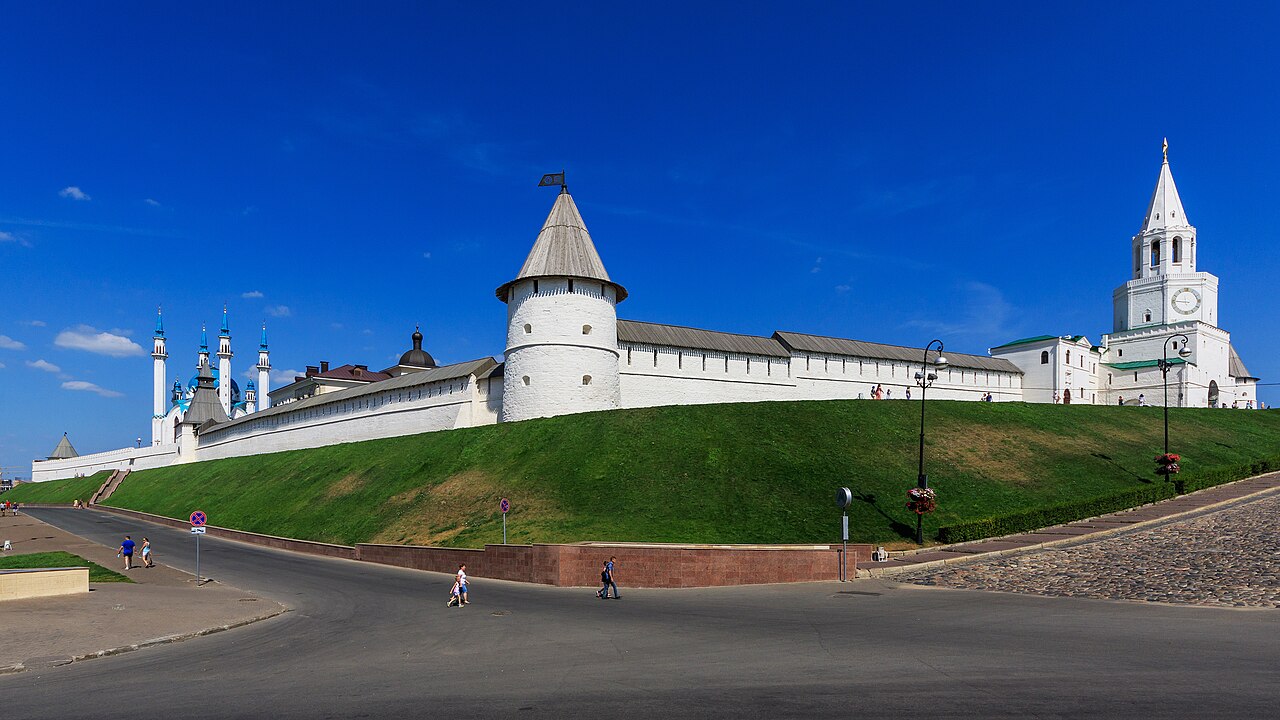
Kazan Kremlin within the city centre
The Kazan Kremlin stands on a limestone hill at the confluence of the Volga and Kazanka rivers, its whitewashed walls enclosing a compound that is unique in Russia: a Russian Orthodox cathedral and a major Islamic mosque occupy the same walled enclosure. That combination earned it a place on the UNESCO World Heritage List in 2000 as an outstanding example of the synthesis of Tatar and Russian cultures.
The site traces its foundations to the 10th century, when Volga Bulgars built the first fortification here. After Ivan IV took the city by siege in 1552, Russian craftsmen rebuilt the kremlin in stone and raised the Annunciation Cathedral, completed in 1561–62. The Söyembikä Tower, a distinctive seven-tiered brick structure from the late 17th century, leans visibly to the northeast — Kazan’s answer to Pisa, though on a smaller scale. The Kul Sharif Mosque, reconstructed and opened in 2005, rises on the site of a 16th-century mosque destroyed during the conquest; its four minarets reach 57 metres and it is the largest mosque in European Russia.
Walking the kremlin takes under two hours, but the juxtaposition of gilded Orthodox domes and white-marble Islamic minarets within a single fortified perimeter rewards a slower pace. The Governor’s Palace adds a 19th-century imperial layer to the ensemble.
Getting there: The kremlin is a 15-minute walk from Kazan Kremlin metro station. Allow: 2–3 hours for the grounds and key interiors. Best for: Travellers interested in the interplay of Islamic and Orthodox heritage, and in Tatar history.
Bolgar Archaeological Complex 170 km south — 2 hr by hydrofoil, 2.5 hr by road
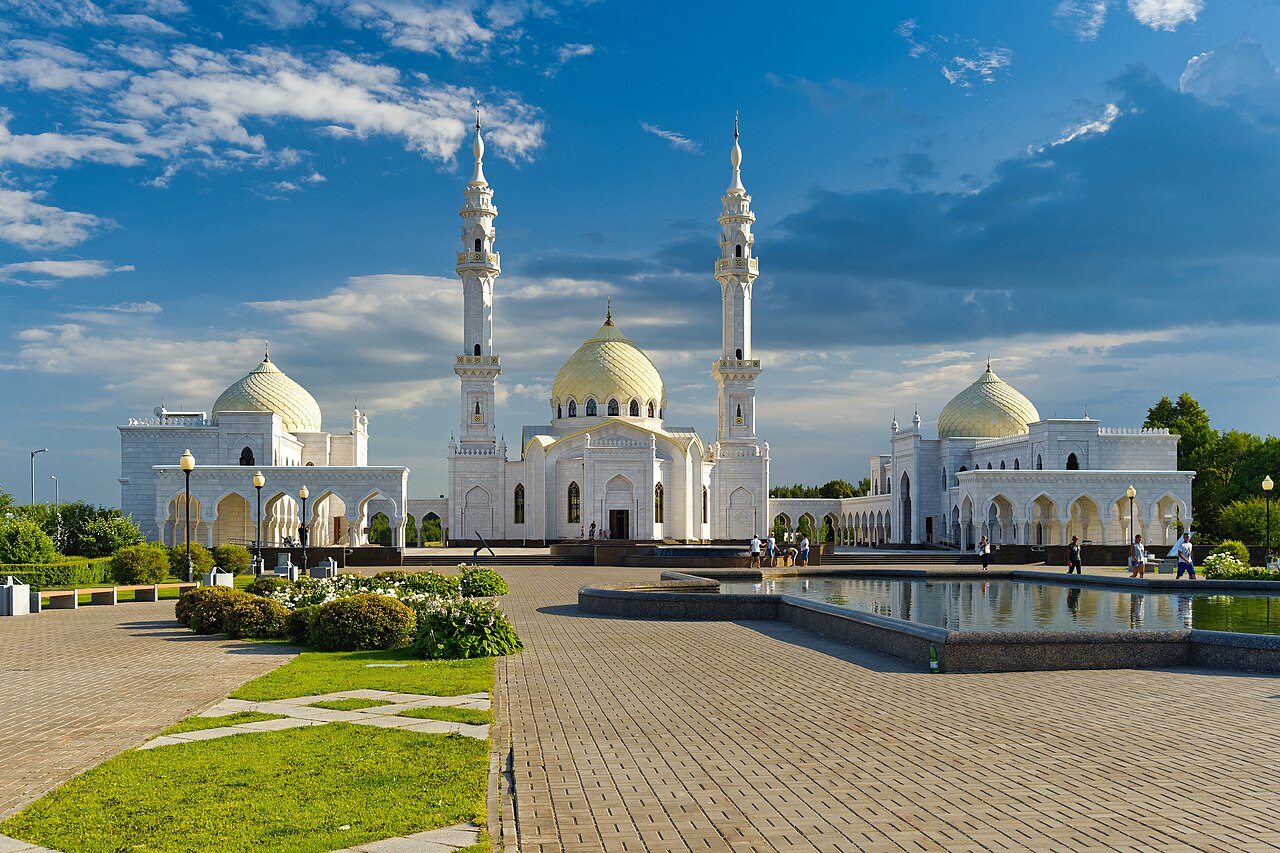
Bolgar was the capital of Volga Bulgaria, the first Muslim state to establish itself in the middle Volga region. In 922 AD, the Arab traveller Ibn Fadlan documented the formal adoption of Islam by the Bulgar khan — an event that makes this site the oldest documented Islamic centre in the lands that would become Russia. UNESCO inscribed the Bolgar Archaeological Complex in 2014 for its outstanding testimony to the convergence of nomadic, sedentary, and Islamic civilisations on the Eurasian steppe.
The ruins of the Cathedral Mosque, built in the 13th century, are the most substantial survivals of the medieval city. The Black Chamber, whose dark stone vaulting has resisted eight centuries of weathering, served as either a bath house or a judicial hall — scholars still debate which. Two mausoleums, Eastern and Northern, stand alongside Khan’s Tomb in various states of preservation. The White Mosque, opened in 2012 as a modern reconstruction, gives contemporary Muslim pilgrims a functioning place of worship within the archaeological landscape. In summer, the White Mosque’s marble dome and minaret reflect in the adjacent lake, the kind of composition that explains why the site draws pilgrims as much as historians.
The island location — the site sits on a promontory above the Volga — adds a quality of remove. Arriving by hydrofoil from Kazan heightens the sense of approaching a place that history set apart from ordinary geography.
Getting there: Hydrofoil from Kazan river station (summer season, approximately 2 hours); by road via M-7 highway, approximately 2.5 hours. Allow: 3–4 hours on site. Best for: Travellers drawn to Islamic heritage, steppe civilisations, and sites that carry living pilgrimage significance.
Island-Town of Sviyazhsk 30 km west — 45 min by road or boat
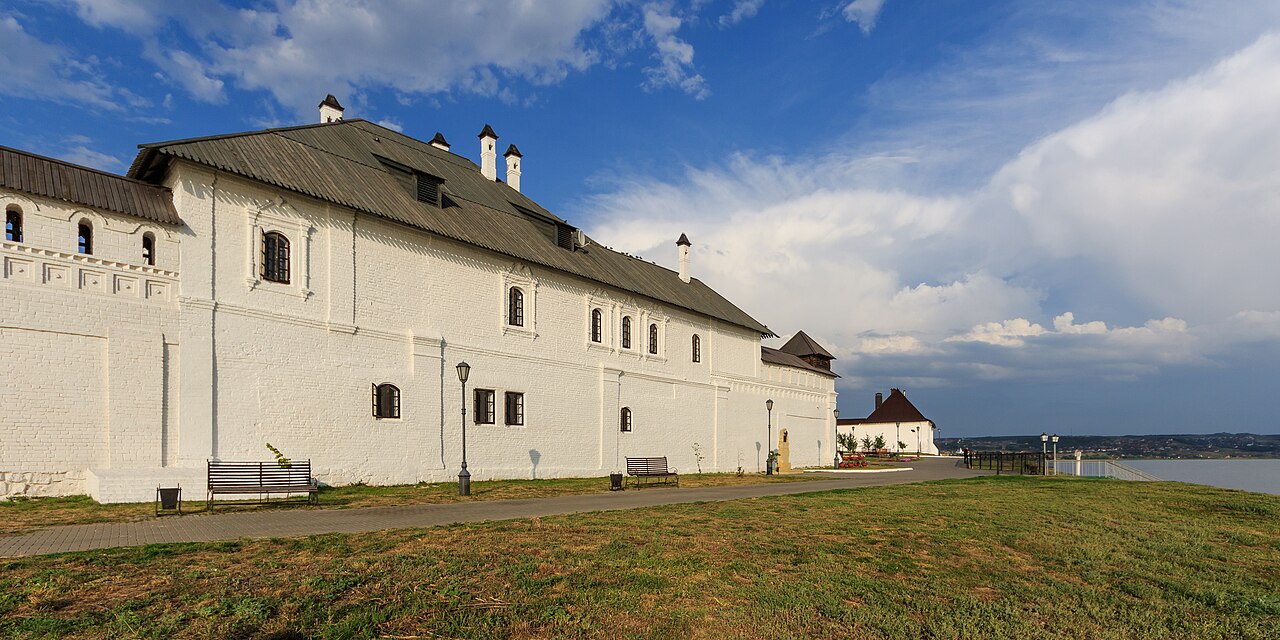
Ivan IV founded Sviyazhsk in 1551 as a military staging post for the siege of Kazan, prefabricating the entire timber fortification in the forests of Uglich and floating it down the Volga on rafts — an engineering operation on a scale that contemporary observers found barely credible. Once Kazan fell in 1552, Sviyazhsk lost its military purpose and became a monastic centre. The island’s ensemble of 16th- and 17th-century churches and monasteries, remarkably intact, earned it UNESCO inscription in 2017.
The Assumption Cathedral, completed in the 1560s, holds the most significant interior: frescoes attributed to painters from the workshop of Dionysius, the leading Russian iconographer of the era. The murals cover almost every surface of the cathedral’s interior — a dense theological programme of saints, apostles, and Last Judgement scenes executed when the paint was still wet, in the true fresco technique. The Assumption Monastery encircling the cathedral and the John the Baptist Monastery on the island’s northern edge complete an ensemble where little from the intervening centuries has intruded.
The island was connected to the mainland by causeway in the Soviet era, which makes access straightforward by road; a boat from Kazan covers the same route more slowly but with better views of the town rising above the confluence of the Sviyaga and Volga rivers.
Getting there: By road from Kazan, 45 minutes (take the M-7 west, then signposted turn to Sviyazhsk). Seasonal boat from Kazan river station. Allow: 2–3 hours. Best for: Travellers interested in medieval Russian Orthodox art, military history, and well-preserved monastic architecture.
Frequently Asked Questions
How many UNESCO World Heritage Sites are near Kazan?
There are three UNESCO World Heritage Sites in and around Kazan: the Kazan Kremlin (inscribed 2000), the Bolgar Archaeological Complex (inscribed 2014), and the Island-Town of Sviyazhsk (inscribed 2017). The Kremlin is within the city itself; Sviyazhsk is 30 km to the west; Bolgar is 170 km to the south.
How do you get from Kazan to Sviyazhsk?
The quickest option is by road: Sviyazhsk is approximately 30 km west of Kazan, reached in around 45 minutes by car or taxi via the M-7 highway. In the summer season, a passenger boat also runs from Kazan’s river station, offering views of the town approaching from the water. The island is connected to the mainland by a causeway, so no ferry crossing is required on arrival.
When is the best time to visit all three sites in one trip?
Late May through September gives the most flexibility. The Bolgar hydrofoil runs only in summer, roughly May to October depending on river conditions, so combining all three sites by public transport is easiest then. A dedicated two-day itinerary works well: the Kremlin and Sviyazhsk on day one (both reachable by road within an hour of Kazan), and Bolgar by hydrofoil on day two. Outside summer, Bolgar is still accessible by road year-round, but the river crossing atmosphere is lost.
What makes the Kazan Kremlin historically distinctive within Russia?
The Kazan Kremlin is the only kremlin in Russia where a Russian Orthodox cathedral and a major Islamic mosque stand within the same walled enclosure. This coexistence reflects Kazan’s position at the boundary of two civilisations: a Tatar Muslim city conquered and partly rebuilt by Ivan IV in 1552, then inhabited by both communities for the following centuries. The Kul Sharif Mosque, reconstructed in 2005 on the site of the mosque destroyed in the conquest, and the Annunciation Cathedral of 1561–62 face each other across the same courtyard — an arrangement with no close parallel in the Russian architectural tradition.