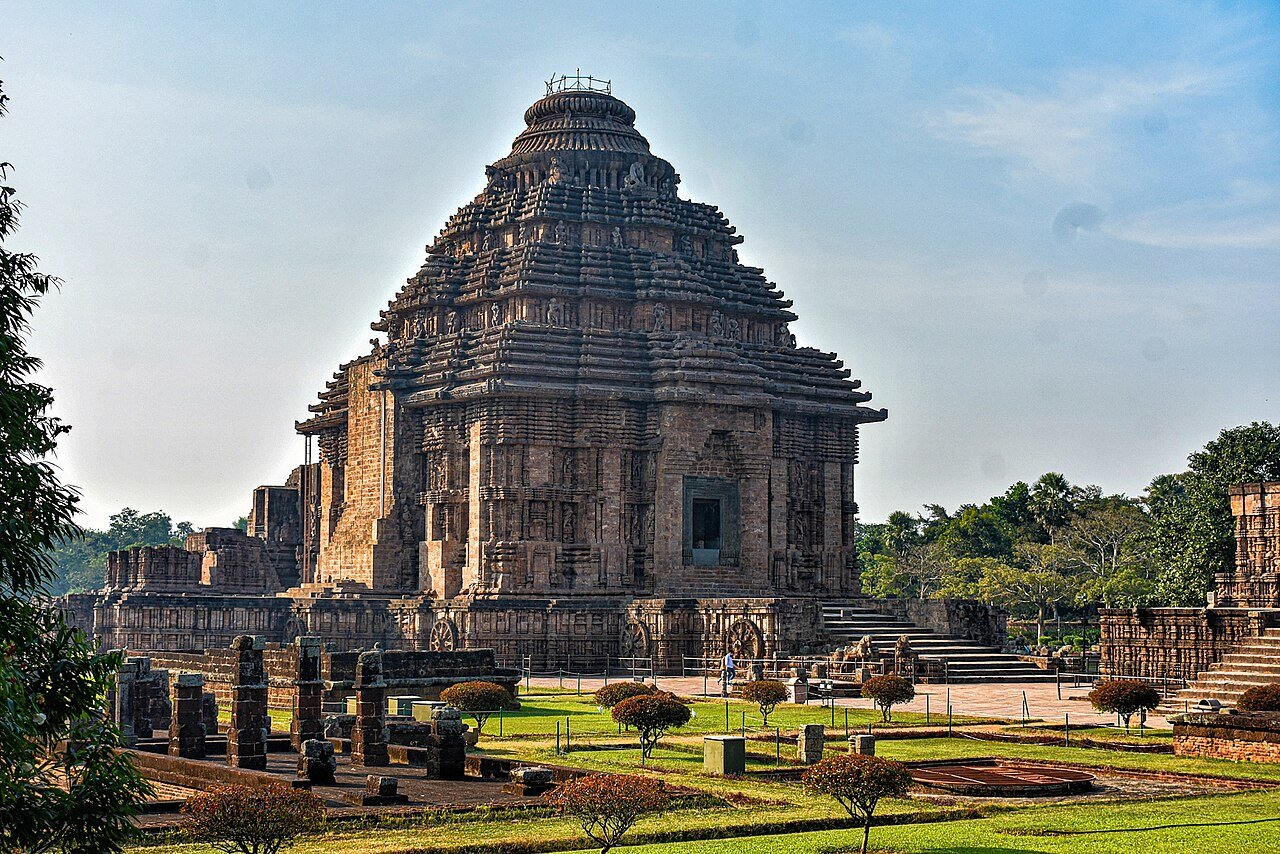
On the Bay of Bengal coast of Odisha, the Konark Sun Temple stands as one of the most ambitious acts of sacred architecture in the medieval world — a 13th-century stone chariot built to carry the sun god Surya across the sky. Constructed around 1250 CE under King Narasimhadeva I of the Eastern Ganga dynasty, it was inscribed as a UNESCO World Heritage Site in 1984. The temple’s symbolic programme, its engineering scale and the richness of its sculptural decoration make it an essential reference point for anyone studying Indian art and religion.
A chariot in stone Konark, Odisha — 64 km from Bhubaneswar
The conception behind the Konark Sun Temple is unlike anything else in the subcontinent’s architectural tradition. The entire base platform was designed as a colossal chariot — 100 metres wide — on which the sun god Surya rides across the heavens each day. Twenty-four wheels are carved into the plinth in two rows of twelve, each wheel measuring roughly three metres in diameter and fitted with eight spokes. The number is not incidental: 24 corresponds to the hours in a day, while the eight spokes within each wheel represent the eight praharas, the traditional Hindu divisions of the day and night cycle. Seven stone horses were intended to pull the chariot westward — reflecting Surya’s conventional iconography — though only one survives today, positioned on the south side of the approach.
At its height the temple complex comprised three structures arranged along an east-west axis. The main sanctum, the deul or shikhara, originally rose approximately 70 metres and was topped with a metal disc called the amalaka. It collapsed at some point between the late 18th and early 19th century — the exact cause remains debated, though the removal of a central magnetic lodestone during a Portuguese naval expedition is one persistent but unconfirmed theory. What survives is the jagamohana, the audience hall or porch, standing at 39 metres, and the nata mandir, the dance hall in front of it where temple dancers performed.
Three large statues of Surya — carved in green chlorite rather than the local khondalite stone — were positioned at the eastern, northern and southern entries to the main sanctum. Each was angled with precision: the eastern Surya receives the light of dawn, the northern image catches the midday sun, and the southern receives the late afternoon rays. This solar alignment was functional as much as symbolic — the temple was, among other things, a monumental sundial.
The interior of the collapsed shikhara was filled with packed sand at some point before the British-era Archaeological Survey took over management of the site. The entrances were sealed to preserve the jagamohana, which was at risk of following the main tower into collapse. The sand filling remains in place today and continues to stabilise the structure against the salt air of the nearby coast.
Sculpture, cosmology and the “Black Pagoda” Part of Odisha’s Golden Triangle with Bhubaneswar and Puri
The sculptural programme at Konark is one of the most comprehensive in South Asian art and extends across every surface of the surviving structures. A visitor circling the base platform encounters successive registers of carvings that move from the terrestrial to the celestial: elephants at the lowest level (symbolising the earth), horses above them (representing speed and time), then human figures in scenes of everyday life, court scenes, hunting, processions and warfare, and above those the maithuna — the celebrated erotic sculptures that occupy the middle tier of the platform walls.
The maithuna figures at Konark are often discussed in isolation, but they form part of a deliberate cosmological hierarchy. In the Shaiva and Shakta traditions that influenced the temple’s design, erotic union represented the creative energy of the universe at the human level. The figures are explicitly sensual but they are also compositionally integrated with apsaras (celestial dancers), gandharvas (divine musicians) and sura-sundaris (heavenly beauties) in the registers above and below. Taken together, the sculptural programme reads as a complete map of existence — from the physical world at the base to the divine realm at the top.
European sailors gave the temple its most enduring nickname. From the 18th century onward, Portuguese and later British navigators along the Odisha coast used the dark stone mass of Konark as a navigational landmark, calling it the “Black Pagoda.” The contrast was with the Jagannath Temple in Puri, 35 kilometres to the southwest, whose whitewashed exterior made it the “White Pagoda.” The pairing of the two landmarks — one dark, one light, one solar, one Vaishnavite — became a standard reference in European maritime charts of the Bay of Bengal.
Today Konark sits within the broader cultural landscape of Odisha’s so-called Golden Triangle: Bhubaneswar to the west with its concentration of medieval Shaiva temples, Puri to the southwest with the Jagannath complex and its famous Rath Yatra chariot festival, and Konark on the coast. The three sites represent complementary facets of Odishan religious and architectural history across roughly a millennium.
Practical information
Konark is 64 kilometres from Bhubaneswar and 35 kilometres from Puri; the most comfortable approach is by taxi or auto-rickshaw from either city. State-run buses operate but are slower and less frequent. The nearest airport is Biju Patnaik International Airport in Bhubaneswar. The ideal months to visit are October through February, when temperatures are moderate and humidity is lower; the monsoon (June–September) brings heavy rain and the post-monsoon coast can be hot and sticky through September. Avoid the Konark Dance Festival in late November if crowds are a concern — though the festival itself, held in the open-air theatre beside the temple, is worth attending if dance is an interest. Entry fees for foreign visitors are currently in the range of ₹600 (check the Archaeological Survey of India website before visiting as fees are periodically revised). The site opens at sunrise and closes at sunset. Wear comfortable walking shoes; the stone platforms can be uneven. There is a site museum on the grounds covering the architectural history and displaying sculptures recovered during excavations. A half-day is sufficient for the temple and museum; combining Konark with Puri in a single day is feasible from Bhubaneswar.
Frequently Asked Questions
Why did the main tower of the Konark Sun Temple collapse?
The precise cause of the shikhara’s collapse remains one of the enduring puzzles of Indian architectural history, and no consensus has been reached among historians and engineers. The most widely accepted view is that the tower was structurally compromised from an early stage, possibly because the original builders underestimated the weight of the superstructure relative to the bearing capacity of the sandy coastal soil. The main sanctum may never have been fully completed: some scholars argue that the tower was only partially built and was already unstable within a few decades of its construction around 1250 CE. Other proposed causes include earthquake damage, lightning strikes, and the effects of salt-laden sea air on the chlorite and khondalite stone. A popular but unverified story attributes the collapse to Portuguese sailors who removed a powerful lodestone from the top of the temple — the magnet was said to hold the building in equilibrium and to interfere with ship compasses, so they extracted it, destabilising the structure. This account appears in several colonial-era travel narratives but has no archaeological corroboration. What is documented is that by the 18th century the tower had fallen, and British-era surveys found the jagamohana (audience hall) also at risk. The interior was deliberately packed with sand and the entrances sealed to prevent further collapse — a conservation measure that remains in place today.
What do the 24 wheels of the Konark chariot represent?
The 24 wheels carved into the base platform of the Sun Temple operate on several simultaneous levels of meaning, which is characteristic of medieval Hindu iconographic programmes. At the most immediate level they represent the hours of the day — 24 wheels for 24 hours — reflecting the temple’s function as a monument to Surya and to the passage of solar time. Within each wheel, the eight spokes divide the day into the eight praharas, the traditional Indian time divisions of roughly three hours each. Some scholars read the wheels as a further reference to the Hindu cosmic calendar, with the 12 months of the year represented by 12 wheels on each side of the platform. The wheels are also functional sundials. The spokes cast precise shadows on the wheel’s rim, and a person standing close to the wheel can read the approximate time of day from the position of the shadow — an interpretation demonstrated by guides at the site and confirmed by archaeoastronomical studies. Finally, the chariot as a whole reflects the Vedic image of Surya riding his seven-horse chariot across the sky, a motif present in the Rigveda and elaborated in the Puranas. The number seven for the horses corresponds to the seven days of the week, each associated with a planetary deity in the Hindu calendar system.
How do the erotic sculptures at Konark relate to the temple’s religious purpose?
The maithuna (erotic union) sculptures at Konark have attracted both admiration and controversy since the temple’s rediscovery by Western scholarship in the 19th century. Early colonial accounts sometimes treated them as evidence of moral degeneracy or as a curiosity, but this misreads their function within the temple’s iconographic logic. In the Shaiva and Tantric traditions that shaped the temple’s design, kama — desire and erotic love — is one of the four legitimate aims of human life (the purusharthas), and its visual representation in sacred architecture is a recognised tradition in Indian temple building, well attested at sites including Khajuraho, Modhera and numerous temples in Karnataka and Tamil Nadu. At Konark specifically, the maithuna figures occupy the middle register of the base platform — above the earthly animals (elephants, horses) and below the celestial beings (apsaras, gandharvas) — placing human erotic experience in the middle of a cosmological hierarchy that ascends from the material to the divine. Some scholars also propose an apotropaic function: the sculptures are thought to have power to ward off evil and protect the structure. Others suggest they represent the moment of creative cosmic energy that the devotee must pass through (and mentally transcend) before entering the sacred space of the sanctum. Whatever the theological framing, the sculptural quality is extremely high — the figures are rendered with great formal elegance and their integration into the overall decorative programme is sophisticated.
Sources
- S1 — Behera, K. S. Konark: The Heritage of Mankind. Aryan Books International, 1996. ISBN 978-81-7305-076-3.
- S2 — Donaldson, Thomas E. Hindu Temple Art of Orissa. Brill, 1985. ISBN 978-90-04-07174-2.
Spotted an error? Write to editorial@culturalheritageonline.com and we correct it the same day.