Samarkand — Crossroads of Cultures has been inscribed since 2001 for its Timurid and Sogdian monuments, which document the city’s role as the meeting point of four civilisations — Greek, Persian, Indian, and Chinese — across more than two millennia of the Silk Road. Shahrisabz, Timur’s birthplace, and the Khanate of Khiva extend a Central Asian heritage itinerary of architectural magnificence.
Samarkand: Timur’s Capital on the Silk Road City centre
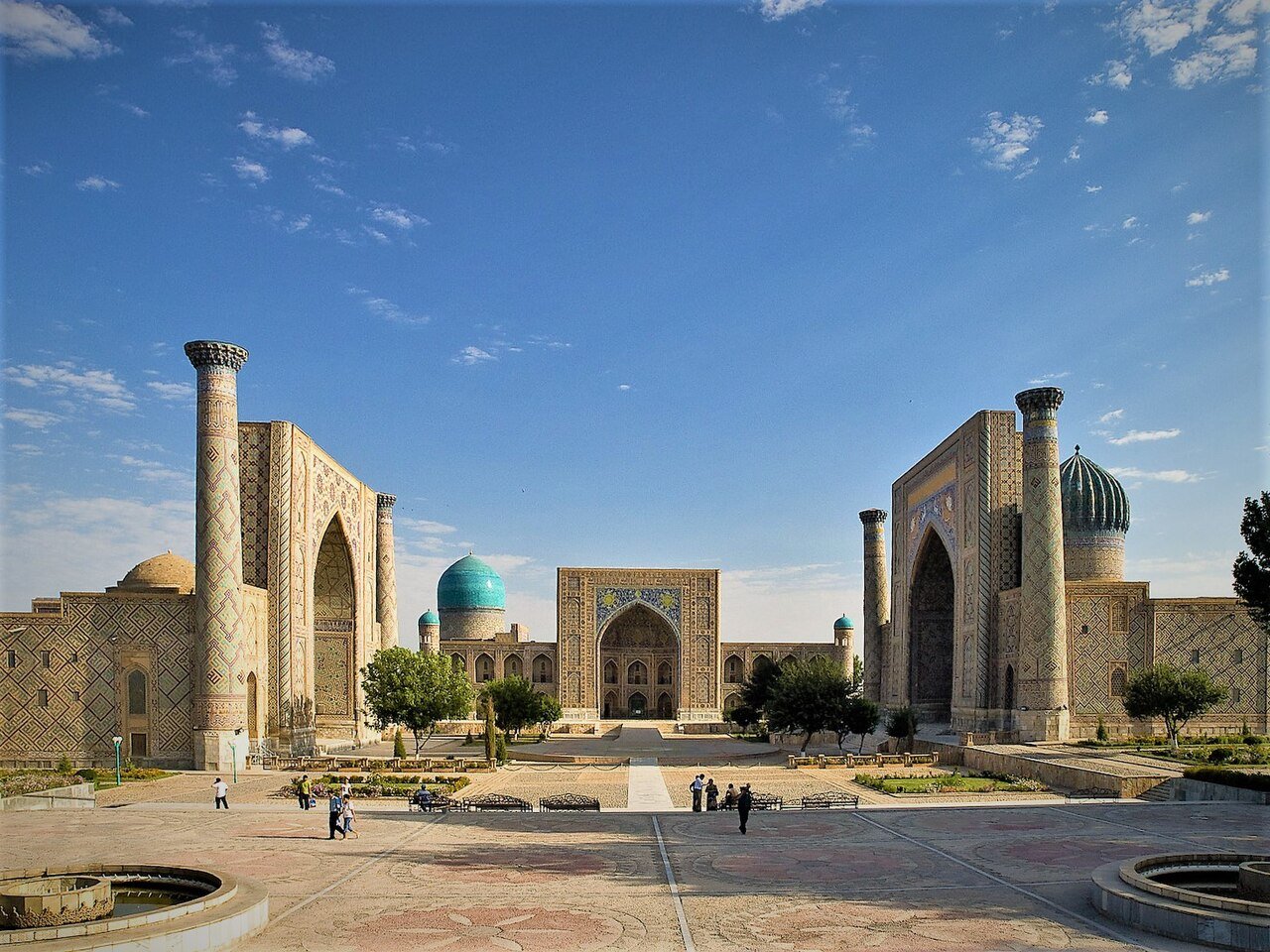
Samarkand — Crossroads of Cultures, inscribed in 2001 under criteria (i), (ii), and (iv), preserves the monuments of one of the world’s oldest continuously inhabited cities — documented from the fifth century BCE (as the Sogdian city of Maracanda, conquered by Alexander in 329 BCE) through its role as the capital of Timur (Tamerlane) in the fourteenth and fifteenth centuries. The Registan — three madrasas arranged around a central square, a composition unique in Islamic urban planning — is the architectural centrepiece: the Ulugh Beg Madrasa (1420), built by Timur’s astronomer grandson, with its deep-set iwan portal and mosaic tile facade; the Sher-Dor (“Lion-bearing”) Madrasa (1636), with its heretical animated-figure tilework (lions, sunfaces); and the Tilya-Kori (“Gold-covered”) Madrasa (1660), whose prayer hall ceiling is gilded in the technique of Persian lacquer painting. The Shah-i-Zinda necropolis (tenth to fifteenth centuries CE) — a funerary alley of eleven mausolea roofed in turquoise tilework, including the tomb of Timur’s niece — is the most intimate and technically refined of the city’s monuments.
Historic Centre of Bukhara: The Most Complete Islamic City in Central Asia 🚅 2 hrs west by high-speed train
The Historic Centre of Bukhara, inscribed in 1993 under criteria (ii), (iv), and (vi), is the most completely preserved Islamic city in Central Asia — a trading centre whose bazaars, madrasas, and caravanserais were built continuously between the tenth and seventeenth centuries. The Kalon Minaret (1127 CE), built by the Qarakhanid ruler Arslan Khan, is 47 metres high and the only building that Genghis Khan ordered preserved when he sacked and burned the rest of Bukhara in 1220 (according to tradition, because he was so impressed by its height that he removed his helmet in inadvertent reverence). The Samanid Mausoleum (c. 905–943 CE) is the oldest intact Islamic mausoleum in the world, built in fired brick with decorative bonding patterns that anticipate the entire subsequent tradition of Timurid tile ornament. Bukhara is connected to Samarkand by Afrosiyob high-speed train in two hours.
Itchan Kala, Khiva: The Last Intact Khanate Capital 🚗 ~6 hrs northwest or ✈ 45 mins
Itchan Kala, inscribed in 1990 under criteria (iii), (iv), and (v), is the inner walled city of Khiva — a concentrated ensemble of mud-brick palaces, madrasas, and minarets that was the capital of the Khiva Khanate from the seventeenth century until 1920. The city is unique among Central Asian heritage sites in that its urban fabric is largely intact — a city within walls where most buildings visible above the street level date from the eighteenth and nineteenth centuries, creating a coherent pre-industrial urban environment uninterrupted by twentieth-century redevelopment. The unfinished Kalta Minor minaret (begun 1855, abandoned at the death of the Khan who ordered it) — a truncated blue-tiled cylinder of extraordinary girth — is Khiva’s signature monument. Khiva is reachable by charter flight from Tashkent (45 minutes) or by sleeper train from Samarkand (14 hours).
Historic Centre of Shahrisabz: Timur’s Birthplace 🚗 ~1.5 hrs south via Tashkent road
The Historic Centre of Shahrisabz, inscribed in 2000 under criteria (iii) and (iv), preserves the remnants of the palace and mausoleum complex that Timur (Tamerlane, 1336–1405) built in his birthplace — a programme of construction intended to rival and surpass Samarkand’s Registan. The Ak-Saray Palace (begun 1380) survives in two massive portal piers, each 50 metres tall; the original entrance iwan, of which these are the flanking towers, would have been 70 metres high — the largest iwan portal ever built. The Kok-Gumbaz Mosque (1435–1437), built by Ulugh Beg, and the underground Dorus-Saodat mausoleum complex (where Timur had planned to be buried, before dying en route to China in 1405) complete the historic centre. The site was placed on the Danger List in 2016 due to urban redevelopment pressure that removed historic fabric to create a monumental park.
Practical information
Samarkand’s international airport (SKD) connects to Tashkent (45 mins), Moscow, and Istanbul; Tashkent’s international hub connects globally. The Afrosiyob high-speed train connects Tashkent–Samarkand (2 hrs) and Samarkand–Bukhara (1.5 hrs) daily. Khiva requires a charter flight from Tashkent or an overnight train; the journey from Samarkand is most efficiently done as a 2–3 day extension. Shahrisabz is reached by shared taxi (grand taxi) from Samarkand over the Takhta-Karacha pass (80 km, 1.5 hrs). The best visiting season is April–May and September–October; summer temperatures in the Ferghana Valley regularly exceed 40°C. Uzbekistan’s e-visa system is efficient and covers most nationalities.
Frequently Asked Questions
Is Samarkand a UNESCO World Heritage Site?
Yes. Samarkand — Crossroads of Cultures was inscribed in 2001 under criteria (i), (ii), and (iv). The inscription covers the city’s principal Timurid and post-Timurid monuments, including the Registan complex, the Shah-i-Zinda necropolis, the Bibi-Khanym Mosque, the Gur-e-Amir mausoleum (Timur’s actual tomb), and the observatory site of Ulugh Beg.
What is the Registan?
The Registan (“Sandy Place”) is a square in central Samarkand enclosed on three sides by madrasas — the Ulugh Beg (1420), Sher-Dor (1636), and Tilya-Kori (1660). No other city in the Islamic world has three monumental madrasas arranged around a single plaza; the composition is unique in Islamic urban planning and was recognised as a supreme achievement by European travellers from the seventeenth century onward.
What is the best route to see all three UNESCO Silk Road cities in Uzbekistan?
Fly into Tashkent → Samarkand by Afrosiyob high-speed train (2 hrs) → Bukhara by Afrosiyob (1.5 hrs) → Khiva by charter flight or overnight sleeper. Allow 2 full days in Samarkand, 2 days in Bukhara, 2 days in Khiva. Shahrisabz can be added as a half-day side trip from Samarkand.
Sources
- S1 — Knobloch, Edgar. Monuments of Central Asia. I.B. Tauris, 2001. ISBN 978-1-86064-590-7.
- S2 — MacLeod, Calum, and Bradley Mayhew. Uzbekistan: The Golden Road to Samarkand. Odyssey, 2008. ISBN 978-962-217-795-6.
Spotted an error? Write to editorial@culturalheritageonline.com and we correct it the same day.