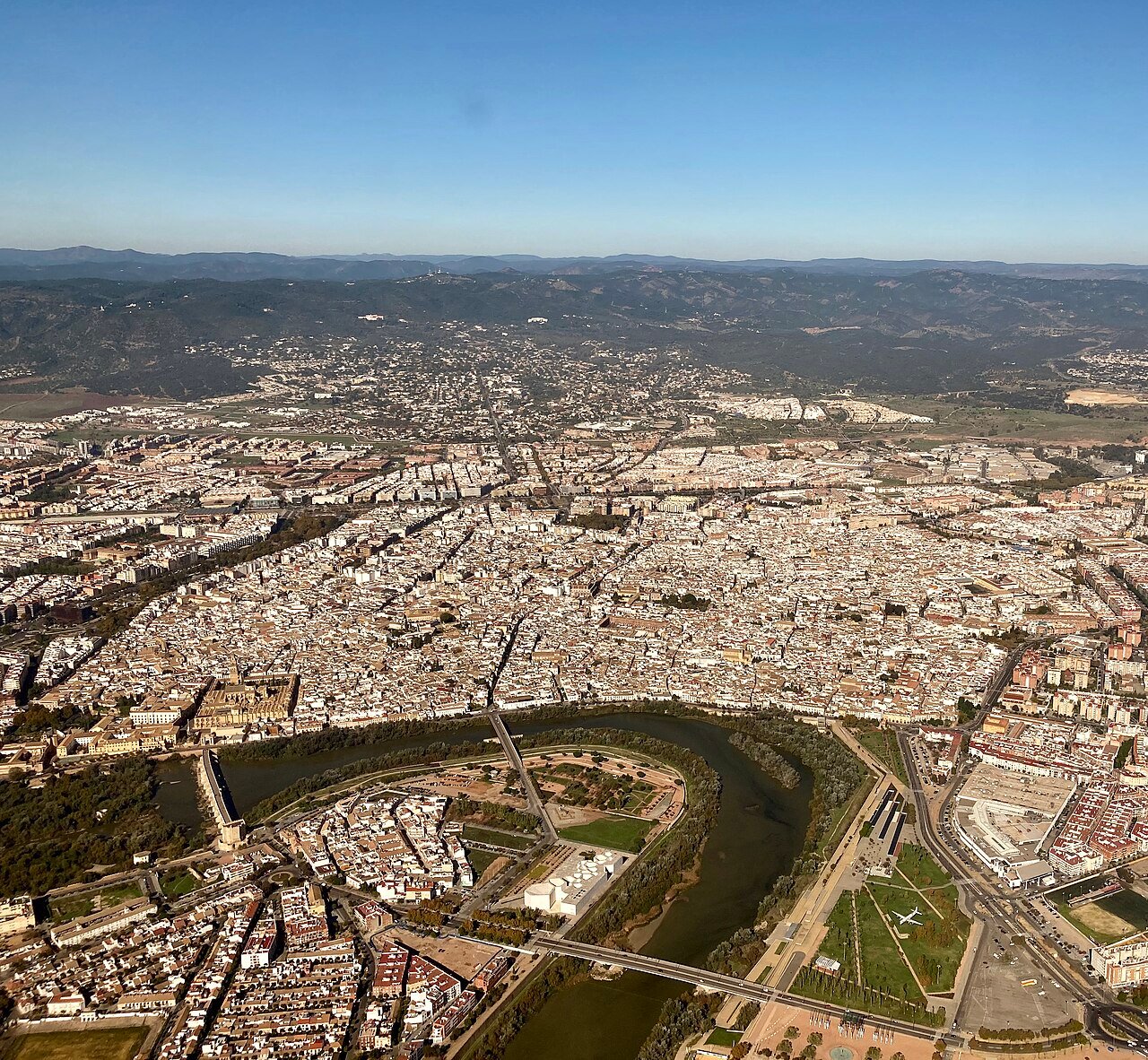
Córdoba’s Historic Centre has been inscribed since 1984, and the Caliphate City of Medina Azahara was added in 2018 — together documenting the capital of the Western Caliphate at its tenth-century height, when Córdoba was the largest city in Europe and its Mosque-Cathedral was the greatest religious building in the Islamic west. Granada’s Alhambra and Seville’s Cathedral extend an Andalusian heritage circuit of unparalleled depth.
Historic Centre of Córdoba: The Mezquita and Moorish Legacy City centre
The Historic Centre of Córdoba, inscribed in 1984 (extended 1994) under criteria (i), (ii), (iii), and (iv), centres on the Mosque-Cathedral of Córdoba (La Mezquita) — the greatest monument of Moorish civilisation in Europe. Abd al-Rahman I began the mosque in 785 CE on the site of a Visigothic church; his successors expanded it three times over two centuries, covering 1.7 hectares with a forest of 856 columns in alternating red-and-white striped arches. Abd al-Rahman III added the Mihrab (961–966 CE), its mosaic programme laid by Byzantine craftsmen sent by the Emperor Constantine VII as a diplomatic gift, with gold tesserae that still catch the morning light. After the Christian reconquest of 1236, a Gothic cathedral was inserted into the mosque’s centre — a collision of two architectural civilisations still visible and still generating disagreement. The Roman bridge over the Guadalquivir, the Alcázar de los Reyes Cristianos (1328), and the Jewish quarter with the Córdoba synagogue (1315, one of three surviving medieval synagogues in Spain) compose the rest of the inscribed historic centre.
Caliphate City of Medina Azahara: The Tenth-Century Palace-City 🚌 ~20 mins west
The Caliphate City of Medina Azahara, inscribed in 2018 under criteria (iii) and (iv), preserves the archaeological remains of the palace-city built by Abd al-Rahman III between 936 and 976 CE as the administrative capital of the Caliphate of Córdoba — the political centre of a state that controlled the Iberian Peninsula and North Africa at the height of Umayyad power. The city was built on three terraces of a hillside overlooking the Guadalquivir valley: the palace and administrative complex at the top, the residential quarter in the middle, the mosque and market at the base. The Salon Rico (Throne Room) of Abd al-Rahman III, with its geometric carved marble panels of exceptional delicacy, was designed to overwhelm ambassadors with the wealth of the caliphate; it was excavated and partially restored in the twentieth century and is the finest surviving example of Umayyad palatial decoration outside Damascus. The city was sacked and burned in 1009 during the civil war that destroyed the caliphate; it lay buried under farmland until excavations began in 1911.
Alhambra and Albaicín, Granada: The Last Moorish Kingdom 🚌 ~2 hrs east
The Alhambra, Generalife and Albayzín (Granada), inscribed in 1984 (Albayzín added 1994) under criteria (i), (iii), and (iv), is the palace complex of the Nasrid kingdom of Granada — the last Islamic state in the Iberian Peninsula, surviving until 1492. The Nasrid Palaces (fourteenth and early fifteenth centuries) represent the culmination of Andalusian Islamic decoration: muqarnas stalactite vaults, geometric tilework dadoes, calligraphic friezes, and the Court of the Lions (1370s) with its fountain of twelve marble lions at the centre of a twelve-sided pool reflect a decorative programme of extraordinary refinement. The Generalife gardens above the palace, with their water channels and pavilions, are the finest surviving example of Andalusian garden design. The Albayzín hill opposite, the former Moorish quarter of the city, retains its street pattern, whitewashed wall topography, and view of the Alhambra silhouetted against the Sierra Nevada.
Seville Cathedral and Alcázar: The Capital of the Reconquista 🚅 ~1.5 hrs west
The Cathedral of Seville, Alcázar and Archivo de Indias, inscribed in 1987 under criteria (i), (ii), (iii), and (vi), includes the Gothic Cathedral of Seville (1402–1519) — the largest Gothic cathedral in the world by interior volume, built on the site of the Almohad Great Mosque of Seville. The Giralda, the 97.5-metre minaret of the Almohad mosque (completed 1198), was converted into the cathedral’s bell tower in 1560–68 by adding a Renaissance lantern of 24 bells; the minaret itself, with its interlaced geometry of sebka panels, is the model from which all subsequent Moroccan minarets descend. The Royal Alcázar of Seville, begun by Pedro I of Castile in 1364 using Mudéjar craftsmen trained in the Moorish tradition, is the oldest royal palace in continuous use in Europe and a masterwork of Christian-Islamic synthesis. The Archivo de Indias holds 80 million pages of documentation on the Spanish colonial empire in the Americas.
Practical information
Córdoba is served by high-speed AVE trains from Madrid (1 hr 45 mins), Seville (40 mins), and Málaga (50 mins). The historic centre is walkable; the Mezquita, the Roman bridge, the Alcázar, and the Jewish quarter are within 15 minutes’ walk of each other. Medina Azahara is 8 km from the city centre and best reached by the dedicated tourist bus (Saltos tour from Glorieta de Ibn Rushd, Tuesday–Sunday). Entry to the Mezquita-Cathedral requires advance booking online (timed entry, including for free visits early morning). Granada is served by AVE from Antequera-Santa Ana (2.5 hours from Córdoba) or by direct bus (3 hours). The best season for Córdoba is spring (May, during the Festival of the Patios) and autumn (September–October); summer temperatures regularly exceed 40°C.
Frequently Asked Questions
Is the Mosque-Cathedral of Córdoba a UNESCO World Heritage Site?
Yes. The Mosque-Cathedral (La Mezquita) is the centrepiece of the Historic Centre of Córdoba, inscribed in 1984 under criteria (i), (ii), (iii), and (iv). The inscription covers the entire historic centre, including the Roman bridge, the Alcázar de los Reyes Cristianos, and the Jewish quarter with its medieval synagogue.
What is Medina Azahara and why was it inscribed separately?
Medina Azahara is the tenth-century Umayyad palace-city built by Abd al-Rahman III outside Córdoba. It was inscribed separately in 2018 because it was not yet fully excavated at the time of the original 1984 inscription, and its archaeological significance — as the best-preserved early Islamic palatial complex in the western world — merited independent recognition under criteria (iii) and (iv).
How far is it from Córdoba to the Alhambra in Granada?
By AVE high-speed train from Córdoba to Antequera-Santa Ana (50 minutes) and then Avant to Granada (45 minutes) — total approximately 2 hours. By direct express bus (Alsa): 2.5 hours. By car via the A-45: 2 hours. Granada is the most natural extension of a Córdoba visit within an Andalusian heritage itinerary.
Sources
- S1 — Dodds, Jerrilynn D., ed. Al-Andalus: The Art of Islamic Spain. Metropolitan Museum of Art, 1992. ISBN 978-0-87099-636-8.
- S2 — Kennedy, Hugh. Muslim Spain and Portugal: A Political History of al-Andalus. Longman, 1996. ISBN 978-0-582-49515-9.
Spotted an error? Write to editorial@culturalheritageonline.com and we correct it the same day.