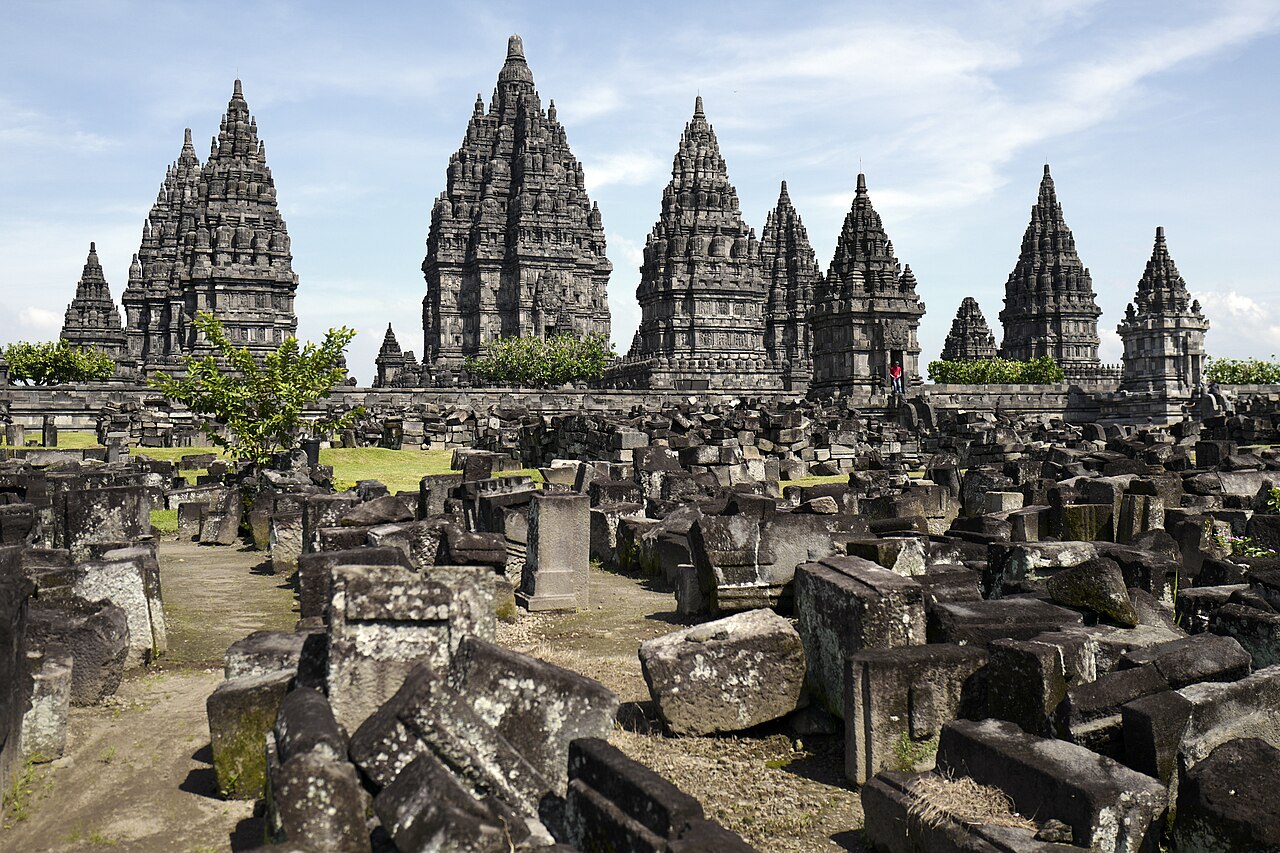
The Prambanan Temple Compounds, inscribed in 1991, are the largest Hindu temple complex in Indonesia and one of the greatest Hindu monuments in Southeast Asia — a ninth-century complex of over 200 temples dedicated to the Trimurti (Shiva, Vishnu, and Brahma) near Yogyakarta in Java, built by the Sanjaya dynasty of the Mataram Kingdom at the height of Hindu civilization in Java, with the 47-metre Shiva temple as the most impressive individual structure.
Prambanan: The Trimurti in Stone on the Javanese Plain Sleman Regency, Special Region of Yogyakarta, Java, Indonesia, 17 km east of Yogyakarta
The Prambanan Temple Compounds (inscribed in 1991 under criteria (i), (iv)) is a Hindu temple compound built c. 850 CE by King Rakai Pikatan of the Sanjaya dynasty of the Mataram Kingdom — a Javanese Hindu kingdom that controlled central Java from approximately 716 to 930 CE. The compound consists of a central zone of three principal temples (Trimurti — Candi Shiva at 47 metres, Candi Brahma at 33 metres, and Candi Vishnu at 33 metres) flanked by three “vahana” temples (the vehicles of each god: Nandi the bull for Shiva, Hamsa the goose for Brahma, and Garuda the eagle for Vishnu) and surrounded by 224 smaller shrine temples in concentric rows. The Shiva temple (the tallest, at 47 metres, decorated with 432 reliefs of the Ramayana carved on the exterior balustrade of the lowest level — the narrative runs continuously around the temple and continues on the adjacent Brahma temple, making it the most extensive Ramayana relief programme in Southeast Asia) is architecturally the finest tenth-century Hindu temple outside India. The compound was largely destroyed by a major earthquake, likely in the early sixteenth century CE (possibly the eruption of Mount Merapi, 40 km north, combined with tectonic activity); the ruins were documented by colonial archaeologists in the nineteenth century and restoration (using the anastylosis method — reassembling fallen stones in their original positions) has been ongoing since the 1930s. The 2006 Yogyakarta earthquake (magnitude 6.3) damaged approximately 300 of the restored stones and set back restoration work significantly.
The Ramayana Ballet: The Full Moon Performance Trimurti Open Air Theatre, Prambanan, May–October annually
The Ramayana Ballet of Prambanan (Sendratari Ramayana) is an outdoor performance held on the nights of the full moon from May to October against the illuminated backdrop of the Prambanan temple complex — one of the most spectacular cultural performances in Southeast Asia. The ballet presents the entire Ramayana narrative (the ancient Hindu epic of Prince Rama’s quest to rescue his wife Sita from the demon king Ravana) in Javanese traditional dance style (a form of classical Javanese dance, the bedhaya and srimpi traditions, combined with the male warrior-dance legong), with elaborate costumes, a gamelan (Javanese xylophone-gong orchestra) live score, and the illuminated Prambanan temples as the backdrop. The performance was established in 1961 CE as part of the post-independence Indonesian cultural programme; it has since become one of the most internationally famous Javanese cultural events, attracting both domestic and international visitors. The full-moon performances (which take place outdoors with the audience facing the temples) are the most atmospheric; indoor performances in a covered theatre are available year-round regardless of the moon cycle.
Practical information
Prambanan is 17 km east of Yogyakarta (Adisutjipto International Airport, JOG, or the newer Yogyakarta International Airport, YIA, 45 km west); local buses and tourist shuttle services connect the city to the temple compound. The Trans Jogja bus route 1A and 2A reach Prambanan from Yogyakarta. The compound is open daily 6 a.m.–5:30 p.m.; entry fee approximately IDR 350,000 (foreigners). The Borobudur Buddhist temple complex (UNESCO 1991, the other component of the Prambanan-Borobudur pair) is approximately 40 km northwest of Prambanan and 45 km from Yogyakarta (best visited as a separate day from Prambanan). The best season is May–October (dry season); April–November Ramayana ballet full-moon performances. The compound requires comfortable walking shoes and sun protection; temperatures reach 35°C in the middle of the day.
Frequently Asked Questions
Is Prambanan a UNESCO World Heritage Site?
Yes. The Prambanan Temple Compounds were inscribed in 1991 under criteria (i) and (iv). Indonesia has 9 UNESCO World Heritage Sites (as of 2024): Komodo National Park (1991, natural), Ujung Kulon National Park (1991, natural), Borobudur Temple Compounds (1991), Prambanan Temple Compounds (1991), Sangiran Early Man Site (1996), Lorentz National Park (1999, natural), Tropical Rainforest Heritage of Sumatra (2004, natural, In Danger), Cultural Landscape of Bali (2012), and Ombilin Coal Mining Heritage of Sawahlunto (2019).
What is the Ramayana and why is it carved on the Prambanan temples?
The Ramayana (Sanskrit: “The Journey of Rama”) is one of the two great Hindu epics of ancient India (the other is the Mahabharata) — a narrative poem of approximately 24,000 verses attributed to the sage Valmiki, composed c. 500–100 BCE. The Ramayana tells the story of Rama (an avatar of Vishnu), his wife Sita, his companion Hanuman (the monkey god), and the demon king Ravana of Lanka (Sri Lanka): Ravana abducts Sita; Rama assembles an army of monkeys and bears, builds a causeway to Lanka, defeats Ravana, and rescues Sita. The story is the most influential narrative in the cultural traditions of South and Southeast Asia — versions of the Ramayana exist in every major Southeast Asian literary tradition (Khmer, Thai, Javanese, Balinese, Malaysian, and others) and the narrative is the source of some of the most important dance and theatrical traditions of the region (the Ramayana Ballet of Prambanan, the Kecak fire dance of Bali, the Khon masked dance of Thailand). The carving of the Ramayana on the Prambanan temple balustrades (432 panels in sequence on the Shiva temple and the Brahma temple) was a statement of the Sanjaya dynasty’s identity as devotees of Shiva and Vishnu — the Ramayana, as the story of Vishnu’s avatar Rama, was particularly appropriate for a Shaivite temple complex because Rama’s victory over Ravana is also interpreted as the victory of dharma (cosmic order) over adharma (chaos), which is Shiva’s cosmic role.
What happened to Prambanan in the 16th century?
The abandonment and partial destruction of Prambanan in the sixteenth century CE is not precisely documented; the most likely explanation is a combination of the eruption of Mount Merapi (approximately 40 km north, an active stratovolcano that has had multiple major eruptions in historical time) and the political and religious shift from Hinduism to Islam in the Javanese coastal kingdoms. The Mataram Kingdom (both its Sanjaya Hindu phase and its later Buddhist Sailendra phase) had declined by the tenth century; from the thirteenth century onward, coastal Javanese kingdoms (beginning with the Sultanate of Mataram in the seventeenth century, based at Yogyakarta) gradually converted to Islam, and the Hindu temple complexes of central Java fell into disuse and eventually into ruin. The temples at Prambanan were known to the Javanese population as “Roro Jonggrang” (The Slender Virgin — after a local legend about a princess turned to stone), but were not systematically documented until the Dutch colonial archaeological surveys of 1807. Restoration began under Dutch colonial authorities in 1918 and was taken over by the Indonesian government after independence in 1945; the complex today is approximately 75% restored.
Sources
- S1 — Jordaan, Roy E., ed. In Praise of Prambanan: Dutch Essays on the Loro Jonggrang Temple Complex. KITLV Press, 1996. ISBN 978-90-6718-105-1.
- S2 — Miksic, John N. Ancient History: Indonesian Heritage. Archipelago Press, 1996. ISBN 978-981-3018-26-6.
Spotted an error? Write to editorial@culturalheritageonline.com and we correct it the same day.