
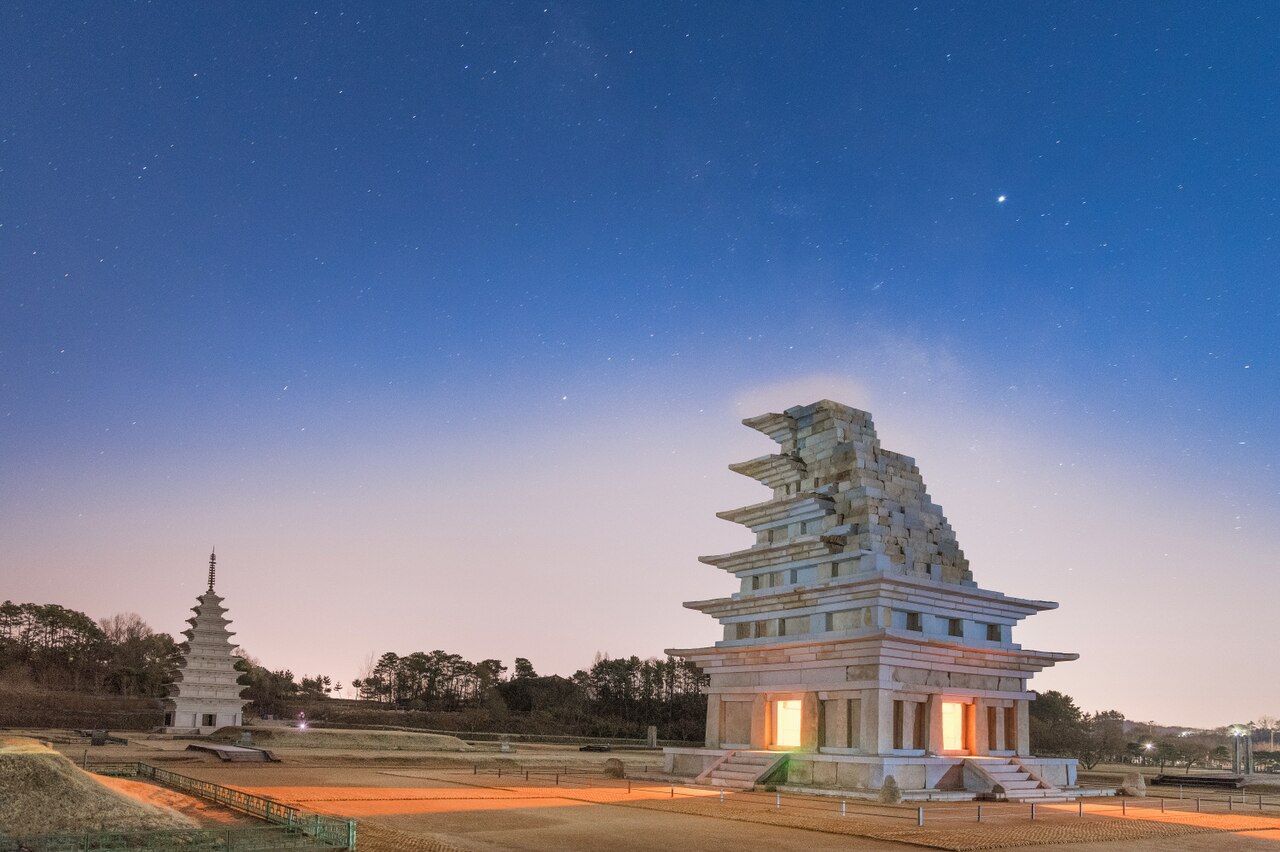
The Baekje Historic Areas were inscribed by UNESCO in 2015 as a serial property spanning eight component sites across three cities in South Korea—Gongju, Buyeo and Iksan—representing the final two centuries of the Baekje kingdom (18 BCE–660 CE), when it held the capital at Ungjin (Gongju, 475–538 CE) and then at Sabi (Buyeo, 538–660 CE). In 552 CE, according to the Nihon Shoki, the Baekje king sent Buddhist sutras, a gilt bronze statue and a monk named Nori Sachiko to the Yamato court in Japan, marking the documented transmission of Buddhism to the Japanese archipelago. The stone pagoda at Mireuksa in Iksan, built in the early 7th century, is the oldest surviving stone pagoda in Korea at 14.5 metres and took 20 years of restoration work, completed in 2019, to stabilise.
The three Baekje cities and their inscribed components Gongju to Buyeo 40 km; Buyeo to Iksan 30 km
Gongju (ancient Ungjin) holds two of the eight inscribed components: Gongsanseong Fortress and the Songsan-ri Tumuli burial mounds. Gongsanseong is a 2.66-kilometre stone and earthen fortress wall on a hill above the Geum River, originally constructed in the early 5th century and substantially modified during the Joseon period; the circuit walk takes about 45 minutes and offers clear views over the river bend that made this location defensible. The Songsan-ri Tumuli holds seven royal tombs, of which Tomb 29—the Muryeong Royal Tomb—is the most significant: discovered intact in 1971, it contained 2,906 artefacts including gold ornaments and a stone epitaph that identifies the occupant by name as King Muryeong, who died in 523 CE. This was the first Baekje royal tomb to be identified with certainty. The original artefacts are in the National Museum in Seoul; the site displays replicas in situ with explanatory panels in English and Korean.
Buyeo (ancient Sabi) contains five inscribed components within a compact area of the city. The Busosanseong Fortress walls run along the north bank of the Geum River; Nakhwaam Rock, known in Korean as White Horse Rock, stands at the northwestern edge where, according to the Samguk Sagi chronicle, approximately 3,000 court ladies and palace women jumped to their deaths in 660 CE rather than surrender to the invading Tang-Silla coalition. The Neungsan-ri Royal Tombs hold seven tumuli of the late Sabi period, including the site where the Baekje Gilt Bronze Incense Burner was excavated in 1993—now considered one of the finest examples of Korean metalwork, displayed in the National Museum. Jeongnimsa Temple Site preserves the foundations of the main hall and the only surviving five-storey stone pagoda from the Baekje period, standing 8.33 metres on its original foundation stones. The Gwanbuk-ri Palace Site and Naseong City Wall complete the Buyeo inscribed components.
Iksan, 30 kilometres south of Buyeo by road, holds two components: Wanggung-ri Site (a royal palace complex excavated from the 1980s onward) and Mireuksa Temple Site, the largest Buddhist temple in Korean history. At its construction peak in the early 7th century, Mireuksa covered roughly 18 hectares and contained three distinct pagoda-hall complexes arranged on a single east-west axis. The western stone pagoda, surviving to 14.5 metres, was the tallest pagoda in Baekje; its eastern counterpart, a wooden pagoda, left only foundation stones. Inside the stone pagoda’s reliquary chamber, opened during restoration in 2009, conservators found a gold plate inscription dating the construction to 639 CE and identifying the donor as Queen Sataek, wife of King Mu.
Korean UNESCO sites reachable from the Baekje region 60 km–200 km from Buyeo by intercity bus and rail
The Gochang, Hwasun and Ganghwa Dolmen Sites (UNESCO 2000) form a serial inscription covering Korea’s prehistoric Bronze Age, roughly a millennium before the Baekje kingdom. The Gochang cluster, the most accessible of the three, lies 60 kilometres south of Buyeo by road (approximately 1 hour 20 minutes by intercity bus via Jeongeup or Jeonju). South Korea holds an estimated 30,000 of the world’s 36,000 known dolmens, and the Gochang concentration—approximately 1,665 dolmens in Doosan-ri and Maesan-ri—includes capstones weighing up to 280 tonnes, moved without wheels by Bronze Age communities whose social organisation can only be inferred from the physical evidence. The Hwasun cluster, 55 kilometres southeast of Gochang, adds quarry evidence: unfinished capstones still in their hillside cut show chisel channels and wedge marks, providing the clearest surviving evidence for Bronze Age Korean stone-working method. Taken together with the Baekje sites, a southern loop from Buyeo through Gochang and Hwasun spans approximately 2,500 years of Korean history in three days of travel.
The Gyeongju Historic Areas (UNESCO 2000), 150 kilometres east of Buyeo by intercity bus (2.5 to 3 hours, typically with a change at Daejeon or direct express via Okcheon), represent the Silla kingdom—the rival state that, allied with Tang China, defeated Baekje in 660 CE and went on to unify the peninsula. Gyeongju served as the Silla capital for nearly 1,000 years (57 BCE–935 CE), and its standing monuments include the Cheomseongdae observatory (built circa 634 CE, the oldest surviving astronomical observatory structure in East Asia), the Daereungwon burial mound complex in the city centre containing 23 royal tumuli, and the Anapji garden pond (formally Donggung and Wolji), constructed in 674 CE as part of the eastern palace complex. The gold crowns and belt ornaments excavated from Gyeongju tumuli, now in the Gyeongju National Museum, show a goldwork tradition distinct from but contemporaneous with Baekje metalwork; comparing the two at their respective national museums provides a concrete measure of the cultural divergence between the two kingdoms. Bulguksa Temple and Seokguram Grotto (a separate UNESCO inscription, 15 kilometres east of Gyeongju city) are logically added as a half-day extension.
Haeinsa Temple with the Tripitaka Koreana (UNESCO 1995) is the most directly thematically connected UNESCO site to the Baekje legacy. Baekje transmitted Buddhism to Japan in 552 CE; the Goryeo dynasty, which followed Silla, undertook the carving of 81,258 wooden printing blocks between 1237 and 1248 CE as a form of national prayer against Mongol invasion, producing the most complete and accurate surviving edition of the Buddhist Tripitaka canon. These blocks—each approximately 70 cm by 24 cm, carved on both sides to a consistent standard without a single error across the full set—are stored in the 15th-century Janggyeong Panjeon depositories at Haeinsa, in the Gayasan mountains. Haeinsa is approximately 200 kilometres east of Buyeo by road (intercity bus to Daegu, 2.5 hours, then local bus 1 hour). The depositories use no mechanical ventilation; their orientation, louvre design and mud-floor composition maintain stable humidity through passive airflow alone, and the blocks have survived intact since 1251.
The Historic Villages of Korea—Hahoe and Yangdong (UNESCO 2010)—lie 200 kilometres northeast of Buyeo, reachable by intercity bus via Daejeon to Andong (2.5 hours), then local transport 15 kilometres to Hahoe village. Both villages have been continuously occupied since the 14th and 15th centuries respectively, retaining clan-based settlement patterns, earthen-walled residential compounds and the spatial relationships between aristocratic yangban residences and commoner dwellings that characterise Joseon period planning. Hahoe also holds one of the nine Seowon (Neo-Confucian academies) inscribed by UNESCO in 2019. A Buyeo–Gyeongju–Andong itinerary connects Baekje, Silla and Joseon heritage in a single southeast-to-northeast arc, feasible by public transport in four to five days.
Practical information
Buyeo is the practical base for visiting the Baekje Historic Areas: it contains the largest concentration of inscribed components, the National Museum of Buyeo (free entry, with the Baekje Gilt Bronze Incense Burner and Sarira reliquary in dedicated galleries), and the best pedestrian access to Busosanseong Fortress and Nakhwaam Rock. From Seoul, the fastest connection is the express bus from Nambu Terminal (2 hours 20 minutes); trains go via Nonsan (KTX from Seoul to Nonsan 1 hour, then local bus 30 minutes to Buyeo). From Gongju (40 km north, 50 minutes by intercity bus), the Muryeong Royal Tomb and Gongsanseong are worth a half-day before continuing south.
The best season is spring (April–May) and autumn (September–October). Summer sees high humidity and occasional flooding of riverside sites; winter is passable but the outdoor fortress walks are less comfortable. Buyeo’s White Lotus Festival in late July/early August, centred on Gungnap Reservoir near the palace site, is the largest annual event. Gongju and Buyeo each have English-speaking guides at their main sites during weekends from April to October; guide services should be confirmed with the Baekje World Heritage Centre before arrival. Iksan is best reached from Buyeo by taxi (30 km, approximately 40 minutes) or by bus via Iksan city (connection at Iksan terminal); there is no direct bus from Buyeo to the Mireuksa site.
Frequently Asked Questions
How did Baekje transmit Buddhism to Japan in 552 CE, and what physical evidence survives?
The transmission date of 552 CE comes from the Nihon Shoki (Chronicles of Japan, compiled 720 CE), which records that King Seong of Baekje sent a gilt bronze statue of Shakyamuni Buddha, a set of sutras, and a letter recommending Buddhism to the Yamato court of Emperor Kinmei. A competing chronology in the Gangōji Engi gives 538 CE, and modern scholarship treats both dates as approximate records of a diplomatic-religious contact that almost certainly developed over several decades rather than occurring as a single event. What survives physically: in Korea, the Mireuksa Temple Site at Iksan represents the culmination of Baekje Buddhist architecture, with foundation stones, pagoda structures and the 2009 reliquary discovery demonstrating the sophistication of 7th-century Baekje temple design; the Jeongnimsa pagoda in Buyeo is the only complete Baekje-period pagoda still standing. In Japan, Hōryū-ji Temple in Nara Prefecture—founded in 607 CE by Prince Shōtoku, who was a patron of the Buddhism the Baekje mission introduced—contains wooden structures dating to around 670–711 CE that are the oldest surviving wooden buildings in the world. The architectural vocabulary of Hōryū-ji’s pagoda and main hall shows direct continuity with Baekje building methods, a connection confirmed by the discovery at Iksan and other Baekje sites of foundation stone arrangements that closely match Japanese 7th-century temple layouts. The cultural transmission is thus readable in comparative architectural evidence as well as in the textual record.
What happened at Nakhwaam Rock (White Horse Rock) in 660 CE, and how is it commemorated today?
In 660 CE, a joint Tang Chinese and Silla military force besieged Sabi (Buyeo), the Baekje capital since 538 CE. According to the Samguk Yusa (13th-century compilation of Korean historical legends) and related chronicles, as the city fell, approximately 3,000 women from the royal court and palace—described as court ladies, palace servants and royal consorts—threw themselves from the cliff at the northwestern corner of Busosanseong Fortress into the Geum River below, rather than be captured. The cliff is approximately 15 to 20 metres above the river. The Samguk Yusa calls them nakhwa (落花, “falling flowers”), giving the rock its Korean name Nakhwaam. The figure of 3,000 should be understood as a formulaic number in the classical Korean literary tradition—the same number appears in other accounts of collective acts—rather than a precise census count; the event itself is considered historically plausible though the death toll cannot be verified from the archaeological record. Today, the site is accessible via a path through Busosanseong Fortress; a small pavilion, Goransa, sits at the base of the cliff at river level and can be reached by a short boat crossing. The cliff face is marked with an inscription. The site is sombre in character; most visitors walk the fortress circuit and descend to the rock as part of the same 90-minute loop.
What is the significance of the Mireuksa reliquary discovered in 2009, and why did the restoration take 20 years?
During stabilisation work on the western stone pagoda at Mireuksa, conservators opened the first-storey reliquary chamber on January 14, 2009, and found a gilt bronze sarira (reliquary) vessel, a gold sheet with an inscription of 193 characters, and 567 additional artefacts including glass beads and small gold items. The gold inscription was the first contemporaneous text ever found inside a Baekje monument and provided data that the excavated archaeological record alone could not: it identifies the donor as Queen Sataek, wife of King Mu of Baekje, gives the date of construction as the “year of Gihae in the reign of King Mu”—corresponding to 639 CE—and states the intention that the king, queen and all living beings attain the wisdom of the Buddha. This inscription resolved a long-running scholarly dispute about the pagoda’s construction date, previously estimated anywhere from the late 6th to the mid-7th century, and confirmed that Mireuksa was still under active royal patronage in 639 CE, eight years before Baekje first came under attack from Silla. The restoration itself lasted from 1999 to 2019 because the pagoda, which had partially collapsed in an unknown past event (the eastern half missing entirely), required individual treatment of each of its roughly 1,600 individual stone members—cleaning, structural analysis and, for damaged stones, repair with matching local granite—before reassembly. The work is documented in a detailed conservation report issued by the National Research Institute of Cultural Heritage.
Sources
- S1 — UNESCO World Heritage Centre — Baekje Historic Areas (Ref. 1477) — https://web.archive.org/web/20230601000000/https://whc.unesco.org/en/list/1477/
- S2 — Baekje Historic Areas Conservation Foundation — https://whc.unesco.org/en/list/1477/
- S3 — Seth, Michael J. <em>A History of Korea: From Antiquity to the Present</em>. Rowman & Littlefield, 2010. ISBN: 978-0-8248-3563-7.
Spotted an error? Write to editorial@culturalheritageonline.com and we correct it the same day.

_%EC%95%BC%EA%B2%BD.jpg)