
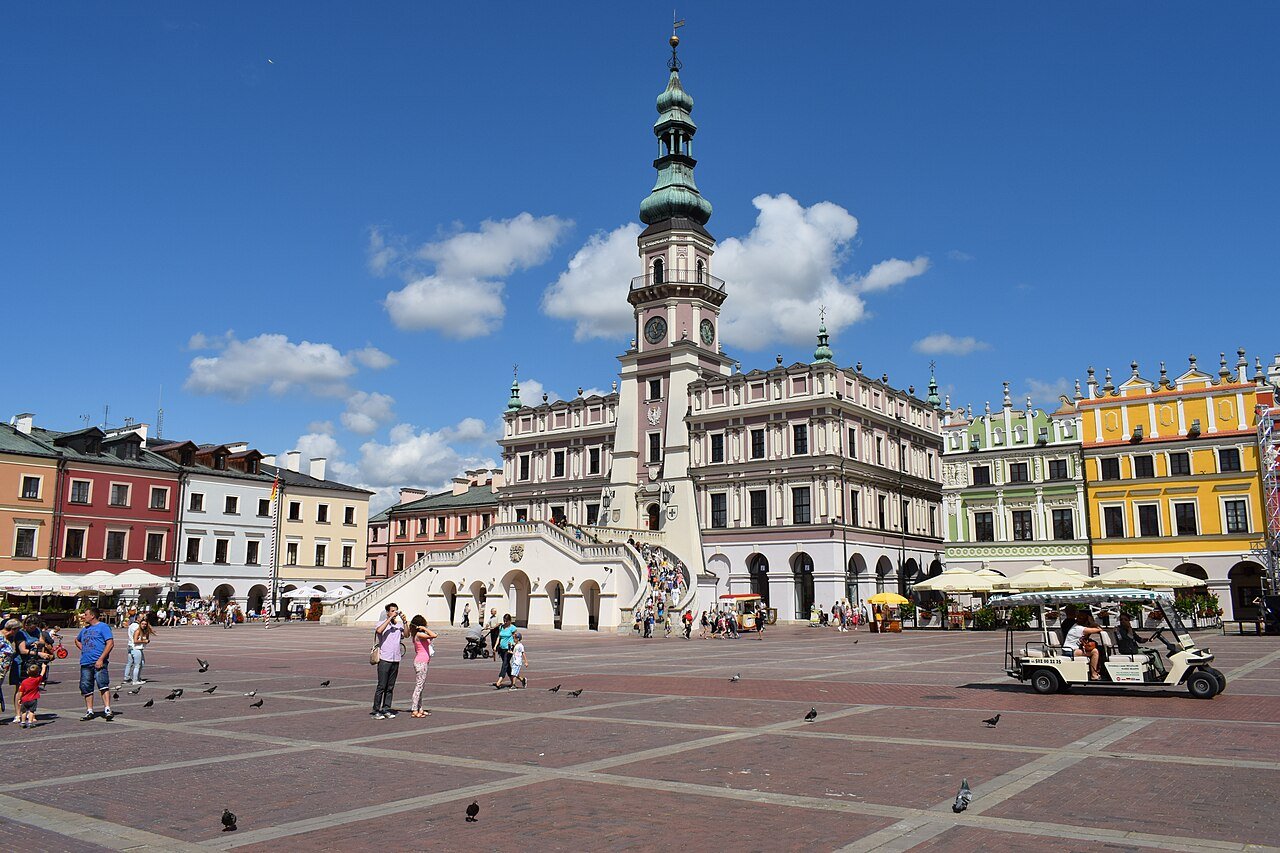
Zamość was built as a single act of intellectual ambition in 1580: a complete city planned by an Italian architect according to Renaissance urban theory, funded by the most powerful man in the Polish-Lithuanian Commonwealth. Its Great Market Square, its Armenian merchants’ arcades, and its Mannerist fortifications have survived four centuries of war, occupation, and ideological upheaval almost intact. UNESCO inscribed it in 1992 as an outstanding example of the Renaissance città ideale concept realised in Central Europe.
The Renaissance Ideal City at the Edge of Europe 270 km SE of Warsaw · accessible by bus or train via Lublin
The founding of Zamość was an act of deliberate urban philosophy. Jan Zamoyski, Grand Chancellor and Commander-in-Chief of the Polish-Lithuanian Commonwealth, commissioned the Padua-trained architect Bernardo Morando in 1578 to design a city from scratch on his private estate. The brief was explicit: Zamoyski wanted a città ideale — a perfect city in the Italian Renaissance sense, meaning a settlement whose physical form would embody rational governance, civic dignity, and the intellectual ideals of humanism. Morando, who had studied under the influence of architects working directly from Vitruvius and Alberti, delivered a design that is still legible on the ground today.
Construction began in 1580 and the core layout was complete within two decades. Morando’s plan placed the Great Market Square — 100 metres by 100 metres — at the centre, surrounded by arcaded townhouses whose ground floors were designed for commercial activity and whose upper floors provided residential accommodation for the merchant class Zamoyski intended to attract. The town hall stands at the northern end of the square, distinguished by an external spiral staircase — a Mannerist flourish that has no obvious practical advantage and was built purely as an architectural statement. The overall geometry of the city is a modified grid oriented to the cardinal points, with the main axes leading to fortified gates and bastions that were state of the art for the late 16th century.
Zamoyski did not merely build a city; he built an economic ecosystem to fill it. He recruited merchants, craftsmen, and scholars from across Central Europe and the Ottoman trade network. Greek merchants settled in one quarter. Sephardic Jews — expelled from Spain in 1492 and moving through the Mediterranean world for the following century — established a community here that grew to constitute a significant portion of the population by the mid-17th century. Most remarkably, Zamoyski invited Armenian traders from the eastern reaches of the trade routes connecting Poland to the Black Sea and beyond.
The Armenians brought with them not only commercial capital but also an architectural tradition that reshaped part of the old town’s character. Ormiańska Street, in the northeast quadrant, is lined with two-storey arcaded houses whose proportions and decorative programmes reflect the fusion of Italian Renaissance structure with Armenian merchant sensibility. These are not Italianate buildings with cosmetic ornament: they represent a genuine Central European architectural hybrid that has few equivalents elsewhere on the continent. The Armenian community maintained a church, schools, and community institutions until the 19th century; their descendants remained in Zamość until the catastrophic upheavals of the Second World War.
The Zamoyska Academy, founded in 1594 by Zamoyski himself, was the third institution of higher learning in the Polish-Lithuanian Commonwealth, after the Jagiellonian University in Kraków and the Vilnius Academy. It produced scholars in theology, law, medicine, and philosophy until its closure in 1784 under Habsburg administrative reforms. The building still stands on the northern edge of the old town, its courtyard largely intact — evidence that Zamoyski conceived his city as an intellectual centre, not merely a commercial one.
The Town That Was Never Taken — and the Town Renamed Himmlerstadt Old Town perimeter · 15-minute walk from central bus station
One of Zamość’s more extraordinary claims is military: the city was never successfully besieged. Its Mannerist fortifications — a system of bastions, ravelins, and dry moats designed according to the latest Italian military engineering — proved effective against every assault it faced. In 1648, Cossack forces under Bohdan Khmelnytsky besieged the city during the great Ukrainian uprising against the Polish-Lithuanian Commonwealth; the walls held. In 1656, during the Swedish invasion that devastated most of Poland in the conflict known as the Deluge, Zamość resisted the Swedish army and was never taken. The Habsburgs acquired the city during the partitions of the late 18th century, but by diplomatic agreement rather than by assault.
The 20th century brought violence on a scale the city’s founders could not have imagined. During the German occupation following September 1939, the Nazis selected the Zamość region for implementation of Generalplan Ost — the long-term programme to depopulate the east of its Slavic inhabitants and replace them with ethnic German settlers. Between November 1942 and August 1943, approximately 110,000 Poles were expelled from over 100 villages surrounding the city; many were sent to concentration camps, deported to forced labour in Germany, or killed outright. Children deemed sufficiently “Aryan” in appearance were abducted and sent to Germany for racial re-education. The city itself was renamed Himmlerstadt — Himmler’s city — in honour of the SS chief who directed the programme.
The Jewish community of Zamość, which had been one of the largest and most important in southeastern Poland since the city’s founding, was systematically murdered between 1942 and 1943. Approximately 12,000 Jews had lived in the town and surrounding district in 1939, constituting around a third of the total population. The majority were deported to the Bełżec extermination camp, where they were killed on arrival; smaller numbers went to Sobibor. A memorial now marks the former Jewish quarter. The physical fabric of the old town survived the war largely intact, which explains why UNESCO’s 1992 inscription found a Renaissance ensemble that remained coherent and readable rather than a partially reconstructed one.
After 1945, Zamość was reintegrated into Poland and systematic conservation of the historic centre began in the 1950s. The Great Market Square was restored to its 16th-century appearance, the Armenian houses were stabilised, and the fortifications — partially dismantled by the Habsburgs in the 19th century to ease city expansion — were documented and partially restored. The nearest comparable UNESCO cities are the Historic Centre of Kraków, approximately 270 kilometres northwest, and the Old City of Lviv in Ukraine, 170 kilometres to the east — two further expressions of the multicultural urban heritage of the former Polish-Lithuanian Commonwealth.
Practical information
Zamość is located in southeastern Poland, approximately 270 kilometres southeast of Warsaw and 95 kilometres southeast of Lublin. The most practical approach by public transport is by bus or train to Lublin, then onward by PKS or FlixBus coach to Zamość — approximately 1.5 to 2 hours from Lublin. Direct trains from Warsaw run several times daily; the journey takes around 3.5 hours. By car from Warsaw, the drive via the S17 motorway takes approximately 3 hours.
The old town is compact and walkable. A thorough circuit of the main monuments — Great Market Square, Town Hall, Armenian quarter on Ormiańska Street, the fortification bastions, and the Zamoyska Academy — takes between two and three hours on foot. The Regional Museum, housed in one of the arcaded buildings on the Great Market Square, provides historical context for the founding period and the wartime events. Entry to the old town is free; museum admission is approximately 20 PLN for adults.
The best time to visit is between May and September, when the outdoor spaces are fully accessible and the main market square hosts regular events. Zamość is considerably less visited than Kraków or Warsaw, meaning accommodation is readily available at all price points and the main monuments rarely crowded. Several hotels and guesthouses operate within or immediately adjacent to the UNESCO-protected zone, making an overnight stay practical and rewarding.
Frequently Asked Questions
What makes Zamość an example of the Renaissance “ideal city” concept?
The concept of the città ideale — the ideal city — was central to Italian Renaissance architecture and urban theory. Thinkers from Alberti in the 15th century through Filarete, Francesco di Giorgio Martini, and later Palladio developed the idea that a city could be designed from first principles according to rational geometry, with its physical form expressing the values of a well-ordered civic society. The ideal city was typically conceived as a regular polygon or grid, with a central public space for commercial and civic life, streets radiating outward to defensive perimeters, and zones assigned to different social and economic functions. Zamość realises this programme in practice: the 100-by-100-metre Great Market Square, the arcaded perimeter that standardised the commercial frontage, the fortification system designed according to the latest Italian military engineering, and the deliberate recruitment of diverse merchant communities all reflect the systematic application of these Renaissance ideals. What makes Zamość exceptional — and why it was chosen for UNESCO inscription rather than any number of other planned Renaissance towns — is the degree to which the original conception survives intact. The street grid, the major public buildings, the fortification outlines, and the general proportions of the ensemble are all still those laid down by Bernardo Morando in the 1580s and 1590s, allowing the logic of the original plan to be read directly from the built fabric today.
Why did Jan Zamoyski invite Armenian merchants to Zamość?
Zamoyski’s recruitment of Armenian merchants was a deliberate commercial strategy rooted in the economic geography of the late 16th century. Armenian trading communities had been established across Central Europe, the Ottoman Empire, and the Caucasus for centuries, operating as skilled intermediaries on the overland trade routes connecting the Black Sea and the Levant to Western European markets. They specialised in luxury goods — silk, spices, precious stones, and horses — and had developed networks of credit, trust, and information that made them economically invaluable. Zamoyski, who positioned his city as a stopover on the trade route between the Ottoman Empire and the markets of Western Europe, understood that attracting Armenian merchants would bring both commerce and capital. He granted them significant privileges, including the right to maintain their own church, community courts, and charitable institutions — a standard practice for merchant communities in the religiously pluralistic Polish-Lithuanian Commonwealth. The Armenian houses on Ormiańska Street represent the physical trace of that community’s presence; the architectural fusion visible in their design reflects several generations of settlement and the genuine synthesis of Italian Renaissance structure with Armenian building tradition. The community survived until the Second World War, when its members were caught in the violence that destroyed most of Zamość’s multicultural heritage population.
How did Zamość avoid being taken during the Swedish invasion of the 1650s?
The Swedish invasion of the Polish-Lithuanian Commonwealth between 1655 and 1660, known in Polish history as the Potop or Deluge, was one of the most devastating conflicts in early modern European history. Swedish armies swept through most of the country, sacking Kraków, Warsaw, Poznań, and dozens of other cities. The fortifications at Zamość proved an exception. The city’s Mannerist defensive system — designed by Bernardo Morando and refined over subsequent decades — included a sophisticated arrangement of angular bastions that eliminated blind spots and created overlapping fields of fire, making frontal assault extremely costly. The city also held sufficient provisions and a committed garrison to sustain a siege, and the Swedish commanders made the calculation — presumably correct — that the cost of taking Zamość by storm would be disproportionate to the strategic value of the city. The Swedes bypassed it and moved on to easier targets. The same logic applied in 1648 when Cossack forces under Khmelnytsky besieged the city: the fortifications held and the attackers eventually withdrew. The unbesiged record is a direct measure of Morando’s competence as a military engineer, as well as evidence of the sustained investment the Zamoyski family made in maintaining the defences over the generations following the city’s foundation.


