
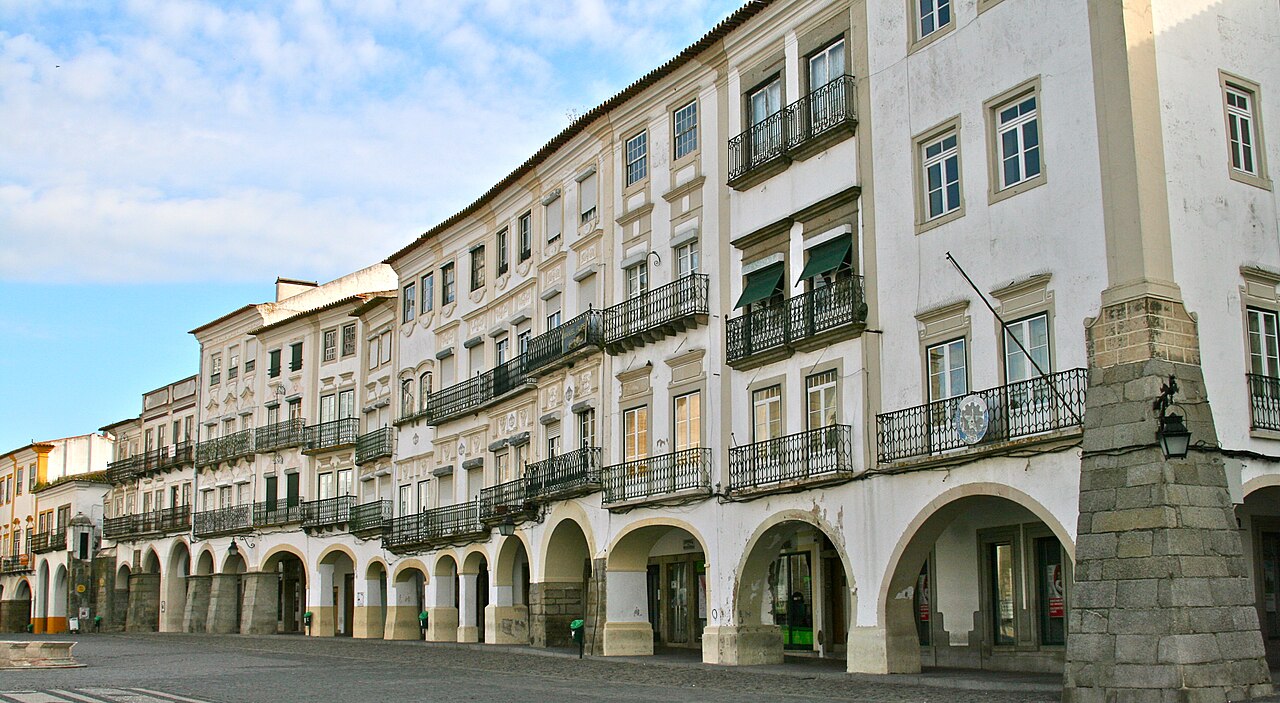
The Historic Centre of Évora, inscribed in 1986, is the finest Roman city in Portugal — a walled Roman provincial capital (Liberalitas Julia, 57 BCE) whose Roman temple (first century CE), Roman walls, and medieval urban fabric form one of the most layered and complete historic city centres in Iberia, with the added distinction of the Chapel of Bones (a seventeenth-century Franciscan ossuary lined with 5,000 human skulls) and the Almendres Cromlech (one of the largest stone circles in Europe, 7 km away).
Évora: Two Thousand Years of Roman, Moorish, and Portuguese History Évora district, Alentejo region, southern Portugal, 130 km east of Lisbon
The Historic Centre of Évora (inscribed in 1986 under criteria (ii), (iv)) is the capital of the Alentejo region of Portugal — a city of approximately 55,000 inhabitants in the interior of southern Portugal (the Alentejo plateau, the principal grain-growing region of Portugal, characterized by cork oak forests, wheat fields, olive groves, and a distinctly Mediterranean landscape). The city has been continuously inhabited for at least 2,000 years: the Romans established the colony of Liberalitas Julia at Évora in 57 BCE, and the city became a significant Roman provincial centre, with an amphitheatre, baths, forum, and temples — of which the Temple of Évora (incorrectly called the “Temple of Diana” in older guides; current scholarship identifies it as a temple dedicated to the Imperial cult, possibly to Augustus or to one of his successors) is the best-preserved Roman monument in Portugal, with fourteen of the original Corinthian columns of the temple’s portico standing to their full height. Évora subsequently became a Moorish city (Yabura, 715–1165 CE), then was reconquered by the Portuguese under Geraldo Sem Pavor (“Gerald the Fearless”) in 1165 CE; the Portuguese kings used Évora as a secondary capital from the thirteenth to the sixteenth century (the University of Évora, founded 1559, was the second university in Portugal after Coimbra), and the Jesuits built some of their most important Portuguese religious buildings here. The walled historic centre (the medieval and Renaissance city within the Roman circuit of walls, approximately 1 × 1 km) preserves an exceptional density of buildings from every period of Évora’s history: Roman temple, Moorish alleys, Gothic cathedral, Renaissance university, Baroque palaces, and Manueline doorways within a single compact heritage zone.
The Chapel of Bones: Memento Mori in the Alentejo Igreja de São Francisco / Casa dos Ossos, Évora
The Chapel of Bones (Casa dos Ossos or Ossuary of São Francisco, constructed in the late sixteenth to early seventeenth century CE and attached to the Igreja de São Francisco, a major fifteenth-century Gothic church near the central market) is one of the most remarkable and confrontational religious interiors in Europe — a small chapel (approximately 11 × 11 metres) whose walls and ceiling are entirely lined with the bones and skulls of approximately 5,000 human beings, exhumed from overcrowded Évora churchyards in the early seventeenth century and arranged by the Franciscan friars in decorative patterns: skulls forming geometric designs on the walls, long bones stacked in columns between the skulls, and two complete hanging mummified human bodies (a man and a child; their identities are unknown) suspended from the ceiling as a final shock. The entrance inscription (in Portuguese, carved above the door) reads: “Nós ossos que aqui estamos pelos vossos esperamos” (“We bones that are here await yours”) — a straightforward memento mori that makes no attempt to soften the message. The chapel was a deliberate Franciscan meditation on mortality and Christian salvation (the logic: if you see that these 5,000 people are already dead and their bones await you, you should direct your thoughts to spiritual rather than temporal concerns), and it continues to serve its original function as a devotional space — entry is charged (approximately EUR 4), and the chapel is one of the most visited monuments in Portugal. The Chapel of Bones belongs to the same tradition as the Sedlec Ossuary in the Czech Republic and the Capuchin Crypt in Rome, but it is distinguished by the scale of its collection and the directness of its theological message.
Practical information
Évora has no airport; the nearest airports are Lisbon (LIS, 130 km west, 1 hour 30 minutes by Rede Expressos coach or 1 hour 35 minutes by train from Lisbon Oriente/Entrecampos) and Faro (FAO, 150 km south). The historic centre is approximately 1 × 1 km within the Roman walls and entirely walkable in a full day. Principal sites: the Roman Temple, the Cathedral (Sé de Évora, 12th–14th century), the University courtyard, the Chapel of Bones, and the Almendres Cromlech (7 km west by car, one of the largest stone circles in Iberia, approximately 7,000–6,000 BCE). The Praça do Giraldo (the main square) has the best cafes for the local Alentejo cuisine (wild boar, black pork, coriander soup, excellent local wines). Best season: March–May (flowers, mild temperatures) or September–October (harvest season, fewer tourists). July–August can be extremely hot (35–40°C).
Frequently Asked Questions
Is Évora a UNESCO World Heritage Site?
Yes. The Historic Centre of Évora was inscribed in 1986 under criteria (ii) and (iv) — one of Portugal’s earliest UNESCO inscriptions, pre-dating the major Portuguese wave of nominations in the 1990s–2000s. Portugal has 17 UNESCO World Heritage Sites (as of 2024). The Évora inscription was explicitly recognized for the “outstanding example of a human settlement that illustrates significant stages of human history” (criterion iv) — specifically the Roman, Moorish, and Portuguese medieval periods all visible simultaneously within the same walled city. The UNESCO inscribed area covers approximately 1 km² within the Roman walls.
Why is the Roman temple in Évora called the “Temple of Diana”?
The “Temple of Diana” name is a nineteenth-century misnomer — a romantic attribution by early scholars who assumed that the temple was dedicated to the goddess Diana because of its association with a hunting legend (a local tradition that connected the temple ruins to a legend about a Diana-worshipping king of Lusitania). Current archaeological consensus (supported by analysis of the temple’s dimensions, orientation, and stylistic features, and by analogy with similar temples in other Roman provincial cities) identifies the temple as a temple of the Imperial cult — most likely dedicated to Augustus or to one of his successors, constructed in the first or second century CE, during the peak of the cult of the deified Roman emperors. The temple’s survival to the present day (unusually complete for a Roman temple in Iberia, with 14 of the original Corinthian columns standing to their full height) is due to its conversion to a medieval use: after the fall of the Roman Empire, the temple was incorporated into the medieval butchers’ market (the Açougue, a municipal slaughterhouse) whose walls were attached to the Roman columns and which preserved them by embedding them in a functioning structure. The butchers’ market was demolished in the nineteenth century, revealing the columns in their current freestanding form.
What is the Almendres Cromlech and why is it near Évora?
The Almendres Cromlech (Cromeleque dos Almendres, approximately 7 km west of Évora near the village of Nossa Senhora de Guadalupe) is one of the largest stone circle complexes in the Iberian Peninsula and one of the oldest known in Europe — a double oval of approximately 95 standing granite stones (menhirs) originally arranged in two concentric ellipses, probably used as a ritual site between approximately 6,000 and 3,000 BCE (the Neolithic and Chalcolithic periods). The site is the most important megalithic complex in Portugal and is part of the broader “Alentejo megalithic landscape” — a concentration of dolmens, menhirs, and stone circles in the Évora district that is unequalled in the Iberian Peninsula. The proximity of the Almendres Cromlech to Évora is a coincidence of geography rather than cultural continuity: the megalithic monuments (3,000–6,000 BCE) predate the Roman city (57 BCE) by thousands of years and were already ancient ruins when the Romans founded Liberalitas Julia. The cromlech is unexcavated except for a small test trench; no burials have been found within the stone circle, suggesting it was a ceremonial rather than a funerary site. The standing stones are decorated with carved cupmarks and abstract symbols (rare among Iberian megaliths); some stones have been moved from their original positions.
Sources
- S1 — Espanca, Túlio. Évora: Encontro com a História e a Arte. Livraria Bertrand, 1975. ISBN 978-972-25-0120-0.
- S2 — Smith, Robert C. The Art of Portugal: 1500-1800. Weidenfeld & Nicolson, 1968. ISBN 978-0-297-76412-0.
Spotted an error? Write to editorial@culturalheritageonline.com and we correct it the same day.


_(cropped).jpg)