
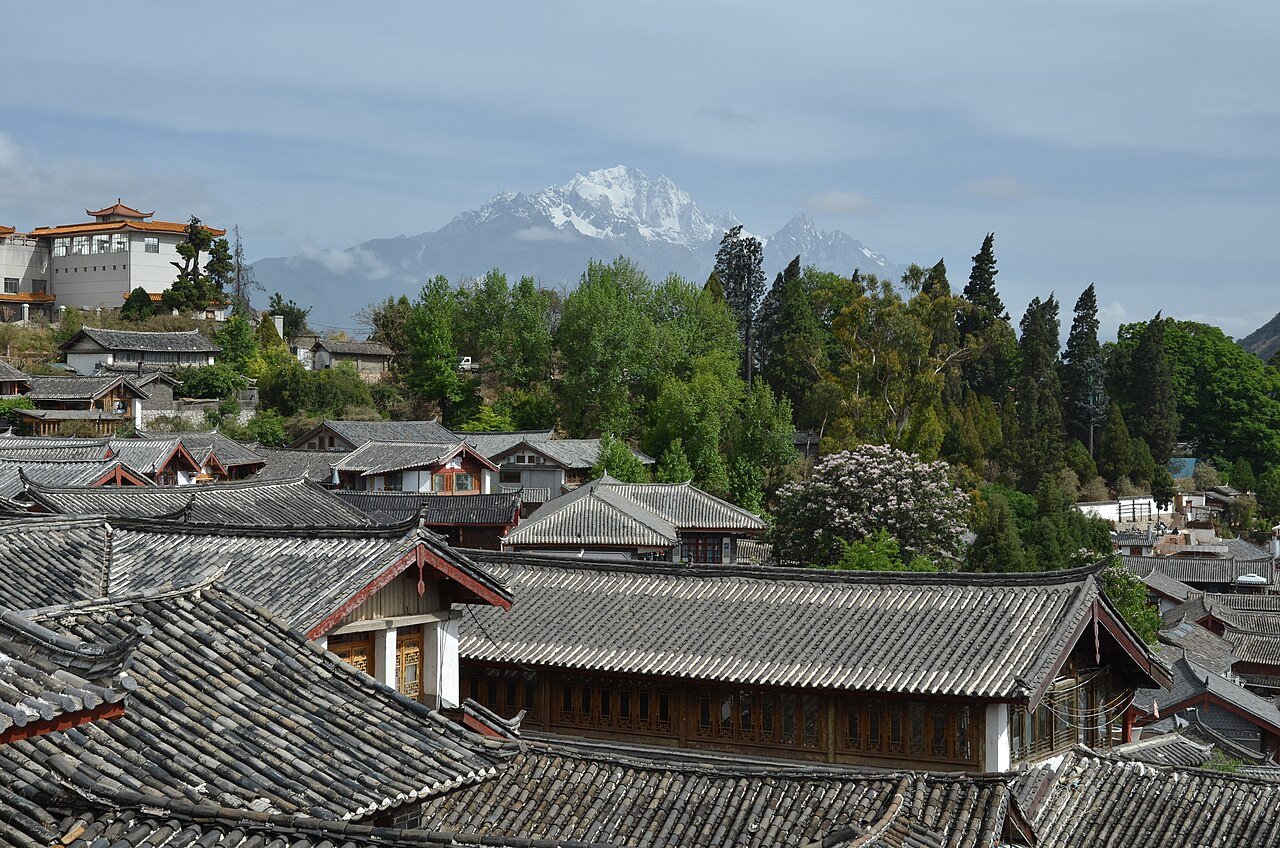
The Old Town of Lijiang sits at 2,400 metres on the plateau of northwestern Yunnan, a compact grid of cobblestone alleys, wooden-fronted houses and canal channels fed by springs at the foot of Lion Hill — the ancient capital of the Naxi people, a Tibeto-Burman ethnic group whose pictographic writing system is the only hieroglyphic script still in ceremonial use anywhere in the world. Inscribed on the UNESCO World Heritage List in 1997, Lijiang’s Dayan district fuses Han, Tibetan and Bai architectural traditions in a townscape that survived a magnitude-7.0 earthquake in 1996 only to be rebuilt with careful attention to its pre-existing form. Behind the town, the 14 glacial peaks of Jade Dragon Snow Mountain rise to 5,596 metres and provide the snowmelt that feeds the canals below.
The Naxi and the Mu lords of Dayan Northwestern Yunnan, 3–4 hours from Kunming by high-speed rail
The Naxi people — whose name is transliterated variously as Nakhi, Na-khi or Mosuo depending on regional branch — are a Tibeto-Burman ethnic group believed to have migrated to the Yunnan plateau from the Tibetan highlands between 1,000 and 2,000 years ago. They settled in the Lijiang basin, a fertile highland valley ringed by mountains and drained by the upper Yangtze River’s tributaries, where the altitude (around 2,400 metres) and rich pastureland supported both agriculture and animal husbandry. The Naxi developed a sophisticated culture that absorbed influences from multiple neighbouring traditions: Tibetan Buddhism, Han Chinese Confucianism and Taoism, and the indigenous Bai culture of Yunnan all left marks on Naxi religion, architecture and music without displacing a distinctly Naxi identity.
Political power in the Lijiang basin was held for centuries by the hereditary Naxi chiefs of the Mu family, who bore the Chinese title of tusi — indigenous chieftains who acknowledged the suzerainty of the Ming and Qing emperors while retaining effective local authority. The Mu family’s palace, the Mu Fu (Wooden Mansion), was the political and ceremonial centre of Lijiang and is now one of its most visited monuments. The palace complex originally rivalled the grandeur of the Forbidden City in miniature, a claim supported by the Ming Yongle Emperor’s reported admiration for the Mu tusi’s loyalty and cultural sophistication. The absence of city walls around Lijiang is explained by a famous geomantic reasoning: the Mu family’s surname (木, mù, meaning “wood”) combined with a wall character (围, wéi) would create the character 困 (kùn), meaning “trapped” or “in difficulty” — an inauspicious construction that no prudent ruler would commission. The town therefore expanded without enclosure, its organic street plan shaped by the terrain and the canal network rather than by defensive geometry.
The canal system is one of Lijiang’s defining technical achievements. Three springs emerge at the foot of Lion Hill (Shi Zi Shan) at the town’s western edge, and the engineers of the Mu lords divided the flow into a network of channels that thread through the town’s streets, providing drinking water, irrigation and waste management. Stone bridges — over 300 by some counts — cross the channels at every junction. The water was managed by a rotational cleaning system: on specific days, the channels were released at full flow to flush debris, a practice still observed. The cobblestones of the streets are local porphyritic rock, patterned in a herringbone design that reflects light and resists slipping in rain — a practical choice that gives the town its distinctive visual texture.
Dongba script, ancient music, and the Jade Dragon Snow Mountain Jade Dragon peak 25 km north of town
The Dongba script is among the most remarkable surviving writing systems on Earth. A pictographic script used by the Naxi Dongba priests — religious specialists who conduct rituals, maintain oral literature and mediate between human communities and the spirit world — the Dongba writing system employs over 2,000 individual pictographs to represent a combination of logograms, phonetic indicators and ideographic compounds. Unlike most ancient pictographic systems, which evolved into abstract phonetic alphabets over centuries, Dongba script has remained pictographic across its documented history of over 1,000 years. It is the only hieroglyphic script still in daily use for religious ceremonial purposes anywhere in the world: Dongba priests write ritual texts, almanacs and religious poetry in the script, though the number of fully literate Dongba practitioners has declined sharply over the 20th century. UNESCO has recognised the Dongba archives — tens of thousands of manuscripts held in collections worldwide, including at the Library of Congress — as part of the Memory of the World programme.
Naxi ancient music (Dongjing and Baisha Xiyue) is a second cultural treasure of comparable rarity. The Baisha Xiyue repertoire, believed to date to the Ming dynasty (14th–17th centuries) and possibly earlier, comprises a set of musical suites performed on traditional Chinese instruments — erhu, dizi, pipa, guqin — in a style that preserves compositional forms and tonal modes that disappeared from mainstream Han Chinese music centuries ago. The Lijiang Naxi Ancient Music Orchestra, founded in 1981 and led until his death in 2015 by Xuan Ke, performed nightly concerts for decades and attracted ethnomusicologists from across the world. The musicians are elderly: preserving the transmission of these pieces to younger performers is an active cultural policy concern.
Jade Dragon Snow Mountain (Yulong Xue Shan) provides the backdrop for the town and the literal source of its water. The massif’s highest peak reaches 5,596 metres and remains unclimbed — it was attempted by an American expedition in 1987 but the summit was never reached, and it has since been declared sacred by the Naxi and closed to climbing. A cable car ascends to approximately 4,500 metres, providing access to glacier viewpoints and alpine meadows. The Black Dragon Pool Park at the town’s northern edge offers the most photographed angle in Lijiang: a pavilion reflected in the pool with the snow mountain behind — a composition that appears on virtually every piece of Lijiang tourism material and is accurate to the actual view on clear days, which are most common from October to April.
Practical information
Lijiang is located in northwestern Yunnan Province, People’s Republic of China. Lijiang Sanyi International Airport receives flights from Kunming, Chengdu, Chongqing, Beijing and several other Chinese cities; the journey from the airport to the old town takes approximately 30 minutes by taxi. High-speed rail from Kunming takes 3–4 hours. The old town core (Dayan) is pedestrianised; electric carts serve the main routes but are not permitted in all alleys. Altitude awareness is advisable for visitors arriving from lower elevations: at 2,400 metres, mild acclimatisation symptoms (headache, fatigue) are common in the first 24 hours. Descend if symptoms are severe.
The best season is October to April, when the sky is clear and Jade Dragon Snow Mountain is visible from the town. May to September brings the summer rains and frequent cloud cover, though the surrounding countryside is at its greenest. The 1996 earthquake destroyed approximately 70% of the old town’s structures, which were rebuilt in the traditional Naxi style — a reconstruction that preserved the architectural character while renewing much of the physical fabric. Winter (December–February) is cold at night (below freezing) but often brilliantly sunny. Entry to the old town itself is free; a heritage maintenance fee (currently around RMB 80) is collected at the main access points. The Mu Fu palace charges a separate admission. Comfortable walking shoes with grip are strongly recommended for the cobblestone streets.
Frequently Asked Questions
What is Dongba script and why is it considered unique among the world’s writing systems?
Dongba script is the pictographic writing system of the Naxi Dongba priests of northwestern Yunnan. It is unique because it is the only hieroglyphic — fully pictographic — writing system that remains in active ritual use anywhere in the world. Most ancient pictographic scripts evolved over centuries into phonetic systems (as Egyptian hieroglyphs became Coptic, or Sumerian pictograms became cuneiform), but Dongba script has remained pictographic across more than a thousand years of documented use. The script employs over 2,000 individual pictographs that can represent objects, actions, sounds and abstract concepts through a flexible combination of logographic and rebus principles. Dongba priests — male religious specialists whose role combines shamanic, literary and liturgical functions — use the script to record ritual manuals, cosmological narratives, almanacs, funeral rites and love poetry in the Naxi language. The world’s largest collections of Dongba manuscripts are held outside China, at institutions including the Library of Congress in Washington (which holds approximately 4,000 volumes acquired in the early 20th century by the explorer Joseph Rock) and the Nationalities Library in Beijing. UNESCO inscribed the Dongba archives on the Memory of the World register in 2003. The number of Naxi people who can read and write the script fluently has declined sharply, and cultural preservation programmes now train young Naxi in Dongba literacy alongside the traditional oral transmission through apprenticeship to practising priests.
Why did Lijiang have no city walls, and what is the geomantic explanation?
The absence of city walls around Lijiang’s Dayan old town is a well-documented historical anomaly for a settlement of its importance and is explained by a geomantic reasoning specific to the Mu family, Lijiang’s hereditary Naxi rulers. The Mu family’s surname is written with the Chinese character 木 (mù), meaning “wood.” In Chinese geomancy (fengshui) and character analysis (a practice called 拆字, chāi zì, or character disassembly), combining the character 木 with the character for enclosure or wall — specifically the character 囗 (a square enclosure) — produces the character 困 (kùn), meaning “trapped,” “困難” (kùnnán, difficulty), or “困境” (kùnjìng, a predicament). Building a walled enclosure around a city governed by a family whose name meant “wood” would therefore literally write “trapped” over their domain — an inauspicious fate no ruler would willingly invite. The Mu lords therefore declined to wall Lijiang, a decision that also reflected their considerable confidence in their military position: the Naxi tusi were effective military commanders who had little need for defensive walls. The result was an organically planned town whose streets, canals and buildings followed the landscape rather than a defensive perimeter, giving Dayan the irregular but coherent urban texture that UNESCO recognised in its 1997 inscription. The story is taught in every Lijiang school and repeated by every guide, making it one of the most effectively transmitted pieces of urban history in China.
What was the impact of the 1996 Lijiang earthquake on the old town, and how was it rebuilt?
On February 3, 1996, a magnitude-7.0 earthquake struck Lijiang and the surrounding region, killing over 300 people, injuring more than 16,000 and destroying or severely damaging hundreds of thousands of buildings. The old town of Dayan was significantly damaged, with estimates of 60–70% of structures requiring reconstruction. The Chinese government and international organisations including UNESCO funded an extensive rebuilding programme that was largely completed within three years. The rebuilding was guided by documentation of the traditional Naxi architectural system: timber-framed structures with curved tiled roofs, carved wooden facades and internal courtyards arranged around a central well. The rebuilt old town closely replicates the pre-earthquake character in materials, scale and street pattern, though critics note that the reconstruction was inevitably a standardisation — some of the organic variation of centuries-old construction was lost in favour of a regularised version of traditional style. The 1997 UNESCO inscription, awarded just one year after the earthquake, recognised both the surviving historic fabric and the quality of the reconstruction effort, a relatively unusual acknowledgment of rebuilding work in a World Heritage context. The earthquake and reconstruction together accelerated the transformation of Lijiang into a major tourism destination: the reconstruction funds brought infrastructure improvements, and the international attention attracted by UNESCO status drove visitor numbers from tens of thousands annually in the 1990s to millions by the 2010s.
Sources
- S1 — Rock, Joseph F. The Ancient Na-khi Kingdom of Southwest China. Harvard University Press, 1947. ISBN 978-0-674-03700-7.
- S2 — McKhann, Charles F., et al., eds. Icon and Poetry: The Visual Language of Naxi Pictographs. University of Washington Press, 2011. ISBN 978-0-295-99119-1.
Spotted an error? Write to editorial@culturalheritageonline.com and we correct it the same day.


.jpg)