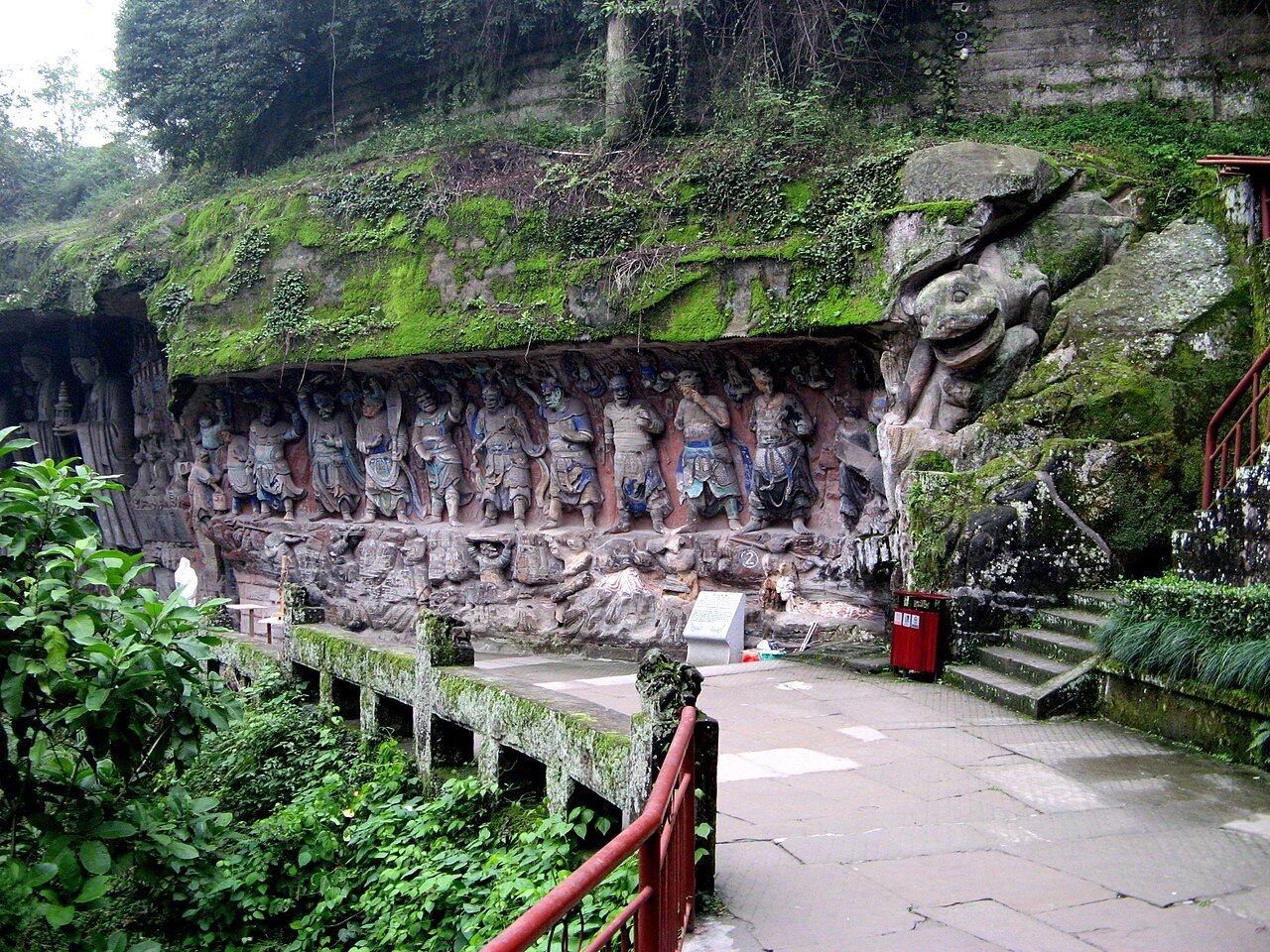
The Dazu Rock Carvings in Chongqing municipality are among the most ambitious sacred art projects in Chinese history: 50,000 stone statues and 100,000 characters of inscription carved into cliff faces across 75 sites in Dazu County between the late Tang dynasty (late 9th century CE) and the Southern Song (13th century CE), narrating Buddhist, Taoist and Confucian moral teaching in visual programmes of extraordinary detail and inventiveness. Inscribed on the UNESCO World Heritage List in 1999, the carvings combine the three major Chinese belief systems in a single integrated site — something achieved nowhere else in Chinese religious art. The centrepiece, Baodingshan, was conceived and personally supervised over 70 years by the monk Zhao Zhifeng, making it the largest individually directed sacred art project in Chinese history.
From military piety to monastic project: Beishan and its Song refinements 165 km west of Chongqing city, 2.5 hours by road
The earliest significant carvings at Dazu were commissioned not by a religious institution but by a military commander. In 892 CE, Wei Junjing, the prefectural military governor of Changzhou (the region that became Dazu County), began carving Buddhist images into the cliff at Beishan — the Northern Mountain — as an act of personal religious devotion during a period of late Tang military conflict. The Tang dynasty was in its final decades of collapse, and the creation of Buddhist merit through patronage of sacred art was a well-established practice for officials and generals seeking divine protection and posthumous salvation. Wei Junjing’s original commission was relatively modest, but the carvings attracted further patronage from successive officials, monks and laypersons over the following three centuries, filling Beishan’s cliffs with 264 separate niches containing over 10,000 statues.
The Beishan carvings are notable for the quality of their Song dynasty additions (10th–12th centuries), which represent the high point of refined Chinese Buddhist sculptural style. Where Tang Buddhist sculpture tends toward monumental scale and hieratic formality, the Song sculptors at Beishan worked with an almost porcelain-like attention to surface detail: the fabric of robes is carved with individual thread patterns, the jewellery of bodhisattvas shows filigree-level precision, and facial expressions carry individuated emotional nuance. The multi-armed and multi-headed Guanyin figures at Beishan — particularly Niche 136, the Thousand-Armed Guanyin — are among the finest examples of this genre in Chinese art. The polychrome painting that once covered many of the Beishan figures has mostly faded or been damaged by weathering and past restoration attempts, but the sculptural quality beneath the surface treatments remains intact.
The 264 niches at Beishan cover a cliff face approximately 500 metres long, arranged in a sequence that reflects the accretion of patronage over three centuries rather than any single iconographic programme. Buddhist deities predominate — Shakyamuni Buddha, Amitabha, Maitreya, Guanyin in multiple forms, the Eight Great Bodhisattvas — but Taoist and Confucian motifs appear in decorative borders and subsidiary figures, anticipating the full programmatic integration that Zhao Zhifeng would achieve at Baodingshan. The site also contains rare examples of illustrated sutras carved in relief — visual translations of Buddhist scripture texts — which provide documentary evidence of Song dynasty religious practice and the specific texts that were most widely studied in this region.
Baodingshan: the 70-year masterwork of Zhao Zhifeng 15 km northeast of Dazu county town
The monk Zhao Zhifeng was born in 1159 CE and began his work at Baodingshan — the Precious Summit Mountain — at some point in his early adulthood, conceiving an integrated programme of religious art that he would supervise and continuously develop until his death in 1249. The project lasted approximately 70 years. Zhao Zhifeng belonged to the esoteric Tantric Buddhist tradition and brought to Baodingshan a didactic ambition without precedent in Chinese religious art: he designed not a temple complex but an outdoor classroom, where carved tableaux would teach Buddhist doctrine, Confucian ethics and Taoist cosmology to an illiterate agricultural population through visual narrative.
The centrepiece is the Great Buddha Bay (Da Fo Wan), a horseshoe-shaped cliff approximately 500 metres long and up to 15 metres high, carved with 31 continuous niches that flow into each other without breaks — a single uninterrupted narrative rather than a sequence of discrete images. The programme begins and ends with Zhao Zhifeng himself: his portrait sculpture appears at the entrance, and he is depicted again in meditation at the conclusion, framing the entire programme as his personal spiritual transmission. Among the most remarkable individual compositions:
The Recumbent Buddha (Reclining Nirvana) stretches for 31 metres along the cliff base, carved as if the Buddha is entering parinirvana — the final liberation from the cycle of rebirth. Only the upper body and head are shown; the legs and feet disappear into the living rock of the cliff, a deliberate compositional choice that suggests the Buddha’s body merging with the earth at the moment of transcendence. This is the largest stone recumbent Buddha in China and one of the largest in the world. The Thousand-Hand Guanyin at Baodingshan — distinct from the Beishan figure — has been counted with 830 actual hands, each holding a different ritual implement, carved in a fan composition of extraordinary technical ambition. The Herding the Water Buffalo series illustrates, across ten sequential scenes, the stages of Zen Buddhist meditation practice using the metaphor of a cowherd taming a wild buffalo: the untamed mind (the buffalo resists), progressive domestication (the buffalo becomes docile), and final liberation (herdsman and buffalo dissolve into empty sky). These ten scenes are the Chinese adaptation of a Japanese Zen teaching sequence and represent the clearest surviving visual exposition of Chan (Zen) meditation theory in Chinese religious art.
Baodingshan is also unique in its explicit integration of all three Chinese belief systems. Taoist figures — including the jade emperor, celestial officials and cosmological diagrams — appear alongside Buddhist deities and Confucian scenes of filial piety (including a vivid tableau of a woman breastfeeding her elderly mother-in-law to sustain her through illness, illustrating the Confucian virtue of filial devotion). Zhao Zhifeng’s syncretic vision reflects the 12th-century Chinese Buddhist conviction that the three teachings (sanjiao) were ultimately expressions of a single truth, a position that would become mainstream in Chinese religious culture by the Ming dynasty (14th–17th centuries).
Practical information
The Dazu Rock Carvings are located in Dazu County, Chongqing municipality, approximately 165 kilometres west of Chongqing city. The journey from central Chongqing by road takes approximately 2.5 hours; there is no direct rail connection to the main carved sites. Tour buses from Chongqing operate daily. The two principal sites — Beishan and Baodingshan — are approximately 15 kilometres apart within Dazu County; most visitors cover both in a single day with the help of local minibuses or hired vehicles. Entry tickets for the main sites are purchased separately.
The best seasons to visit are spring (March–May) and autumn (September–November), when temperatures are moderate and rainfall is lower. Chongqing is famously humid and overcast; the Sichuan Basin climate means that clear-sky days are relatively rare — around 30–50 sunny days per year — but the diffuse light of overcast conditions is actually favourable for photographing the carved reliefs, which tend to bleach out in direct sunlight. Summer (June–August) is extremely hot and humid but manageable at the carved cliff sites, which are partially shaded. Comfortable shoes are needed; some paths between niches involve steep stone steps. The carvings are fully exposed to weather and cannot be photographed with flash inside protected alcoves.
Frequently Asked Questions
What makes the Dazu Rock Carvings different from other Buddhist cave temples in China, such as Yungang or Longmen?
The most significant difference is the combination of three belief systems — Buddhism, Taoism and Confucianism — within a single integrated programmatic site. The great Buddhist cave-temple complexes at Yungang (5th century CE, near Datong) and Longmen (5th–8th centuries CE, near Luoyang) are primarily Buddhist sites, commissioned by imperial patrons as acts of state Buddhist devotion; their iconographic programmes are almost exclusively Buddhist. Dazu, particularly Baodingshan, is the only major Chinese rock-carving site where Confucian ethical scenes and Taoist cosmological figures are treated as equal components of an integrated didactic programme alongside Buddhist teaching. A second important difference is chronology: Yungang and Longmen date to the Northern Wei and Tang periods, when Chinese Buddhism was still absorbing Indian influence; Dazu’s primary phase (late Tang through Southern Song, 9th–13th centuries) represents a mature, Sinicised Buddhism that had been domesticated and adapted over eight centuries. The iconographic forms, narrative conventions and doctrinal emphases at Dazu are distinctly Chinese rather than translations of Indian Buddhist art. A third difference is the commissioning context: Yungang and Longmen were imperial projects; Dazu was a regional initiative, funded by local officials, monks, merchants and farming families, which gives its iconographic programme a popular religious character absent from the court-sponsored complexes of north China.
Who was the monk Zhao Zhifeng and why did Baodingshan take 70 years to complete?
Zhao Zhifeng (1159–1249 CE) was a monk in the esoteric Tantric tradition of Chinese Buddhism who devoted his adult life to the creation of Baodingshan as a didactic religious site for the rural population of Dazu County. He received initiation in the Tantric tradition at Mount Emei — one of the four sacred Buddhist mountains of China, 200 kilometres southwest of Dazu — and returned to Dazu with a vision for an outdoor catechism in stone. The project took 70 years because Zhao Zhifeng designed it to be comprehensive: he was not creating a shrine or a temple, but a complete curriculum in visual form, covering the entire range of Buddhist, Confucian and Taoist teaching relevant to a 12th-century Chinese lay audience. The Great Buddha Bay’s 31 consecutive niches required sustained oversight to maintain the thematic and compositional coherence of a programme that grew to include hundreds of individual figures arranged in narrative sequences. Zhao Zhifeng supervised the carving, arranged the funding (primarily through the patronage of local officials and lay donors), designed the iconographic programme, and apparently adjusted the content over decades as his own religious understanding developed. He is depicted in the site itself — his portrait appears at the entrance to the Great Buddha Bay — making Baodingshan a uniquely self-referential monument in which the creator is present within the created work. No other Chinese sacred site of comparable scale was conceived and overseen by a single individual over such an extended period.
What are the Herding the Water Buffalo scenes at Baodingshan, and what do they represent?
The Herding the Water Buffalo series at Baodingshan is a sequence of ten carved relief panels depicting the stages of Buddhist meditation practice through the extended metaphor of a cowherd taming a wild water buffalo. The buffalo represents the untrained mind: wild, resistant, prone to escape. The cowherd represents the meditating practitioner. Across ten scenes, the relationship between herdsman and animal progresses from struggle (the buffalo strains against the rope, the herdsman strains to hold it) through progressive domestication (the buffalo becomes calmer, the rope gradually loosens) to complete liberation (herdsman and buffalo have both disappeared, replaced by an empty landscape). The sequence is the Chinese adaptation of a Japanese Zen (Chan) teaching narrative known as the Ten Ox-Herding Pictures, attributed to the 12th-century Song dynasty Chan master Kuoan Shiyuan. The Baodingshan version is the oldest surviving three-dimensional sculptural realisation of this teaching sequence and provides the most direct visual exposition of Chan meditation theory available in Chinese religious art. Each panel is accompanied by inscribed verse commentary explaining the stage it represents. The series is notable because it renders abstract meditational psychology — the stages of mental training described in Chan texts — in a form accessible to an audience with no textual literacy, translating doctrinal content into the language of everyday agricultural life in a region where water buffalo were the most important working animals. Zhao Zhifeng’s genius at Baodingshan was precisely this translation: taking the most sophisticated levels of Buddhist doctrine and rendering them legible to farmers.
Sources
- S1 — Howard, Angela Falco. Summit of Treasures: Buddhist Cave Art of Dazu, China. Weatherhill, 2001. ISBN 978-0-8348-0427-2.
- S2 — Chung, Anita. Drawing Boundaries: Architectural Images in Qing China. University of Hawaii Press, 2004. ISBN 978-0-8248-2663-5.
Spotted an error? Write to editorial@culturalheritageonline.com and we correct it the same day.