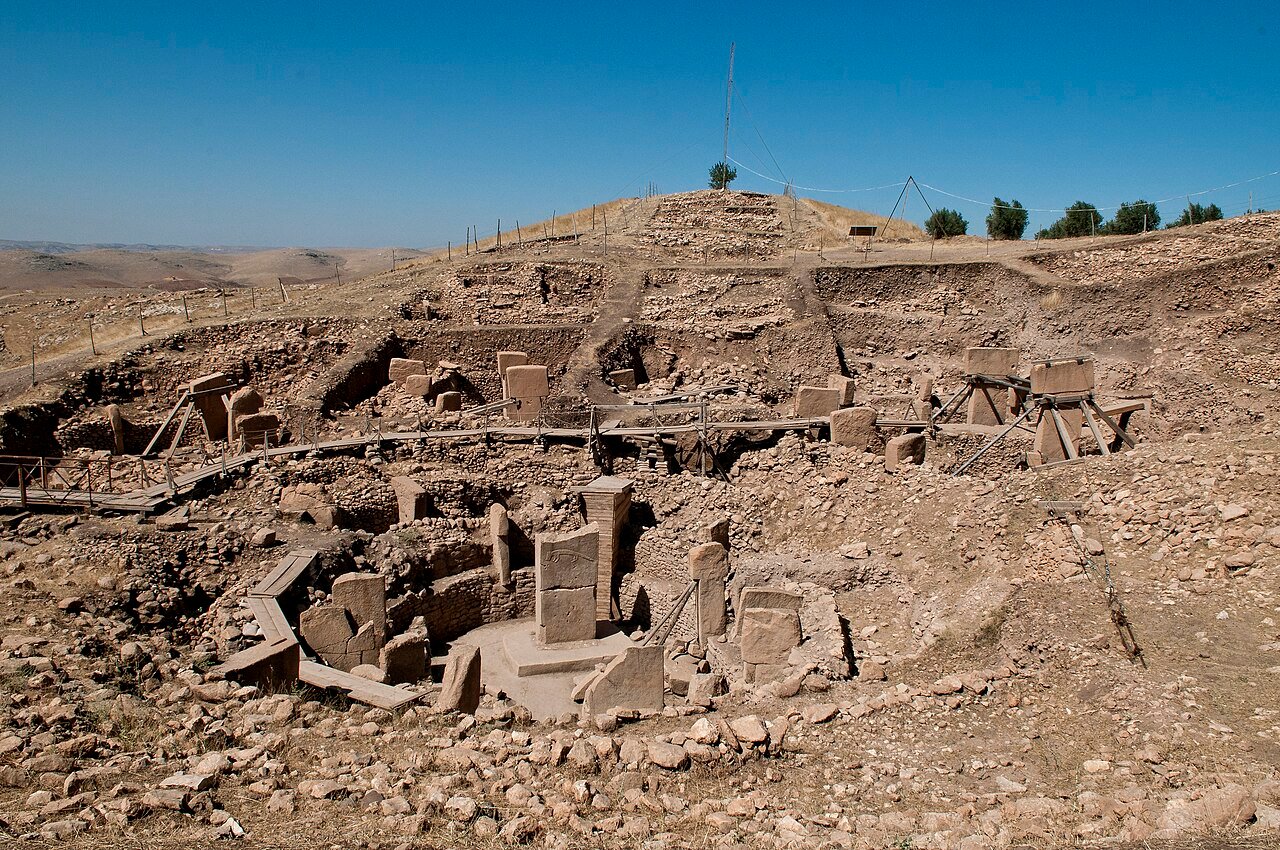
Göbekli Tepe, inscribed in 2018, is the world’s oldest known ritual building complex — a hilltop sanctuary in southeastern Turkey built by hunter-gatherers approximately 9,500 BCE, some 7,000 years before Stonehenge and 6,000 years before the pyramids of Egypt, whose T-shaped limestone megaliths with carved animal reliefs have overturned the established chronology of human civilization by demonstrating that monumental architecture and organized ritual precede settled agriculture.
Göbekli Tepe: The Zero Point of Human Civilization Şanlıurfa Province, southeastern Turkey, 760 m altitude
Göbekli Tepe (“Belly Hill” in Turkish, or “Potbelly Hill”) was inscribed in 2018 under criteria (i), (ii), and (iv) as the oldest known example of monumental architecture and the site that has most fundamentally revised the conventional understanding of early human cultural development. Located on a limestone ridge 760 metres above the Harran Plain of southeastern Turkey, 15 km northeast of Şanlıurfa, Göbekli Tepe consists of at least 20 circular and oval stone enclosures (of which only 4–6 have been fully excavated; the rest remain beneath the hilltop) containing T-shaped limestone pillars (the tallest approximately 5.5 metres tall, weighing 10–20 tonnes each) arranged in pairs at the centre and around the perimeter of each enclosure. The pillars are decorated with carved reliefs of animals — foxes, boars, cranes, vultures, aurochs, gazelles, snakes, spiders, and scorpions — and some central pillars have human arms in relief on their narrow sides, suggesting they represent anthropomorphic beings rather than purely abstract forms. The site was built, used, and then deliberately buried (the enclosures were filled with clean soil and rubble in a process clearly intentional rather than gradual accumulation) by Neolithic hunter-gatherers — people who had not yet adopted agriculture, pottery, metallurgy, or writing — overturning the conventional model in which monumental architecture is a product of agricultural surplus and hierarchical state organization. Radiocarbon dates from the site cluster between 9,500 and 8,000 BCE; the site appears to have gone out of use by approximately 8,000 BCE, roughly contemporaneous with the first evidence of agricultural domestication in the region.
Şanlıurfa: The City of Prophets Şanlıurfa city, 15 km southwest of Göbekli Tepe
Şanlıurfa (ancient Edessa, also Urfa or “the Blessed City”) is the nearest major city to Göbekli Tepe, 15 km southwest — a city of approximately 600,000 inhabitants that claims to be the birthplace of the prophet Abraham (Ibrahim in Arabic) and was one of the most important cities of early Christianity (the first city outside the Roman Empire to adopt Christianity as its official religion, under King Abgar V, c. 30 CE). The Balıklıgöl (Pool of Sacred Fish, also called Abraham’s Pool) is the most important pilgrimage site in Şanlıurfa: a spring-fed pool inside the Khalil ul Rahman Mosque complex containing hundreds of carp (fish that, according to Islamic tradition, were miraculously produced when Nimrod attempted to burn Abraham by catapulting him into a bonfire — God transformed the flames into water and the embers into fish). The pool and its gardens are the most visited attraction in southeastern Turkey after Göbekli Tepe. The Şanlıurfa Museum (Urfa Museum, opened 2015) is one of the finest archaeological museums in Turkey and contains the finds from Göbekli Tepe (including the “Urfa Man” — the earliest known life-sized human sculpture, 9,000 BCE, found at Göbekli Tepe) as well as exhibits on Harran, the Neolithic of southeastern Anatolia, and the Roman-Byzantine period of Edessa. Harran (44 km south of Şanlıurfa) is the site of the world’s oldest continuously operated university (the School of Harran, founded c. 800 CE, which transmitted Greek philosophical and scientific texts to the Arab world) and the ruins of the beehive-domed traditional houses still inhabited in the village.
Practical information
Şanlıurfa (GAP) Airport has direct flights from Istanbul and Ankara (Turkish Airlines, Pegasus, approximately 2 hours). Göbekli Tepe is 15 km northeast of Şanlıurfa by road; minibuses and taxis run from the city centre (taxi approximately TRY 200–300 one way). The site is open daily 8 a.m.–7 p.m. (summer) and 8 a.m.–5 p.m. (winter); entry fee approximately TRY 50 for foreign visitors. A protective shelter has been built over Enclosures A, B, C, and D (the four main excavated enclosures); the ongoing excavation is visible from the walkways. The Şanlıurfa Museum (also displaying Göbekli Tepe finds) is in the city centre, open Tuesday–Sunday 9 a.m.–5 p.m. A visit to Göbekli Tepe and the Şanlıurfa Museum together requires a full day. The best season is October–May (the spring wildflower season on the limestone plateau is spectacular in March–April); summers (July–August) are extremely hot (40°C+).
Frequently Asked Questions
Is Göbekli Tepe a UNESCO World Heritage Site?
Yes. Göbekli Tepe was inscribed in 2018 under criteria (i), (ii), and (iv) as the oldest known example of monumental architecture and the site that has fundamentally revised the understanding of early human cultural complexity. The inscription was controversial among some archaeologists who argued that the site’s significance warranted higher criteria (particularly criterion (vi), the “direct association with events or living traditions”), which the UNESCO World Heritage Committee did not apply. Turkey has 21 UNESCO World Heritage Sites (as of 2024); Göbekli Tepe is the most recent and the one with the most immediate impact on global archaeological understanding.
Who built Göbekli Tepe and why?
Göbekli Tepe was built by Neolithic hunter-gatherers approximately 9,500–8,000 BCE — people who had not yet adopted agriculture, lived in mobile or semi-mobile communities, and had no pottery or metallurgy. This finding was initially disbelieved when the site was first excavated by Klaus Schmidt (German Archaeological Institute, 1994–2014), because the conventional model of social evolution assumed that monumental architecture requires agricultural surplus, population density, and hierarchical state organization to mobilize the labour force. The current consensus is that the reverse was true at Göbekli Tepe: the ritual complex was the organizing force that drew hunter-gatherer communities together seasonally, and the social organization required for its construction may have been the catalyst for the development of agriculture in the region (the first evidence of wheat domestication is within 150 km of Göbekli Tepe). The purpose of the site remains debated: the animal reliefs (foxes, boars, vultures, snakes) suggest a symbolic vocabulary related to the wild animal world; the site’s position on a hilltop visible from a great distance suggests a landmark function; and the careful deliberate burial of each enclosure after use suggests a complex ritual lifecycle for each structure.
What is the Urfa Man and why is it the oldest human sculpture?
The “Urfa Man” (officially “Statue of a Man”) is a life-sized limestone sculpture of a standing human figure (1.88 metres tall) with a blank face (no carved nose, mouth, or ears — only obsidian eyes set in bitumen, the earliest known use of this combination in a human effigy) and hands clasped over an erect phallus. It was found at Göbekli Tepe in 1993 (before the main excavations began) and is dated to approximately 9,000 BCE. It is currently displayed at the Şanlıurfa Museum and is the oldest known life-sized anthropomorphic sculpture in the world, predating the next oldest examples (from the Levant and Anatolia) by approximately 1,000–2,000 years. The blank face with obsidian eyes is interpreted by scholars as representing an ancestor or supernatural being rather than a naturalistic portrait; the combination of the obsidian eyes (which would have caught and reflected light dramatically) and the featureless face suggests a deliberate contrast between visible “aliveness” (the glittering eyes) and the anonymity of the ancestral or divine.