
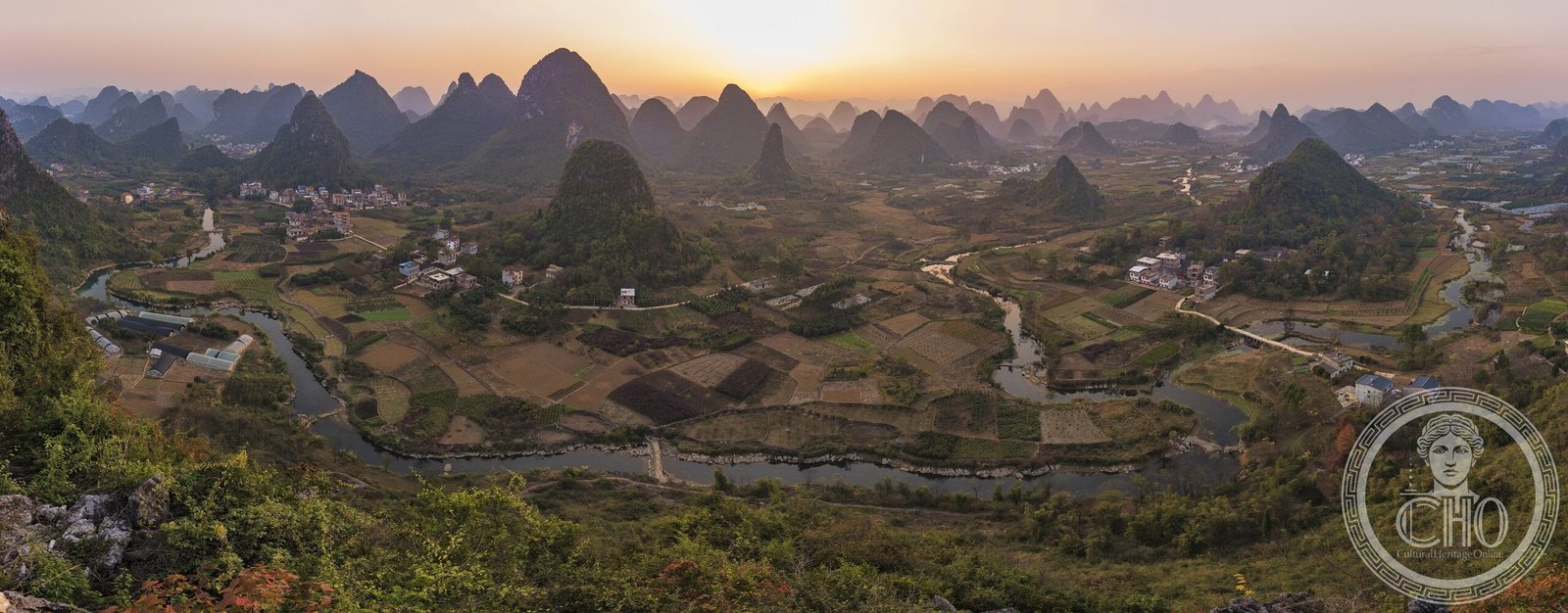
A vast UNESCO World Heritage landscape spanning four provinces, the South China Karst showcases Earth’s most diverse karst terrain—from tower formations and stone forests to giant sinkholes and underground cave systems.
At a glance
Covering approximately 550,000 square kilometres, the South China Karst is recognized as the world’s type area for humid tropical and subtropical karst development. UNESCO describes it as “unrivalled in terms of the diversity of its karst features and landscapes.” The property comprises 97,125 hectares across seven distinct clusters, inscribed in two phases: 2007 and 2014.
History
The site was inscribed as a UNESCO World Heritage property in June 2007, protecting three initial clusters: Libo, Shilin, and Wulong. A second phase of inscription in 2014 added four additional clusters: Guilin, Shibing, Jinfoshan, and Huanjiang. Together, these seven sites form a serial property representing the full spectrum of karst landscape development across South China.
What you see
The landscape exhibits three globally significant karst landform types: fenglin (tower karst), fengcong (cone karst), and shilin (pinnacle or stone forest karst). Visitors encounter dramatic vertical formations, massive dolines known as Tiankeng karst, table mountains, gorges, and extensive cave systems decorated with stalactites and stalagmites. The terrain descends approximately 2,000 metres over 700 kilometres, from the Yunnan-Guizhou Plateau in the west to the Guangxi Basin in the east—a geomorphic transition that displays karst development in its full spectrum. Seasonal vegetation changes enhance the landscape’s aesthetic impact.
Cultural significance
The South China Karst represents one of Earth’s great landscapes and serves as the global benchmark for understanding humid tropical karst formation. Scientists regard it as the world’s premier example of this geological phenomenon. The property’s scientific value lies not only in its landform diversity but in the intact natural vegetation that frames these formations, creating a landscape of exceptional scientific and aesthetic importance.
Key facts
- Country: China
- Provinces: Chongqing, Guangxi, Guizhou, Yunnan
- UNESCO World Heritage Site: inscribed June 2007 (Phase I) and 2014 (Phase II)
- Total protected area: 97,125 hectares with buffer zone of 176,228 hectares
- Seven clusters: Shilin, Libo, Wulong, Guilin, Shibing, Jinfoshan, Huanjiang
- Coordinates: 24.92°N, 110.35°E
Practical information & getting there
The South China Karst comprises multiple sites spread across four provinces. Each cluster has its own access points and visitor facilities. For travel, major gateways include Guilin in Guangxi and Kunming in Yunnan. Check local tourism boards for specific opening hours, entry fees, and guided tours, as regulations vary by cluster.
Sources & resources
Find it on the map
See this place and what’s around it →📷 Become a Cultural Heritage Online photographer
Share your photos of places: they stay published under your name as the author. The more they're seen, the more you get noticed — and soon a contest will reward the most appreciated photos.
Log in or sign up free to add a photo