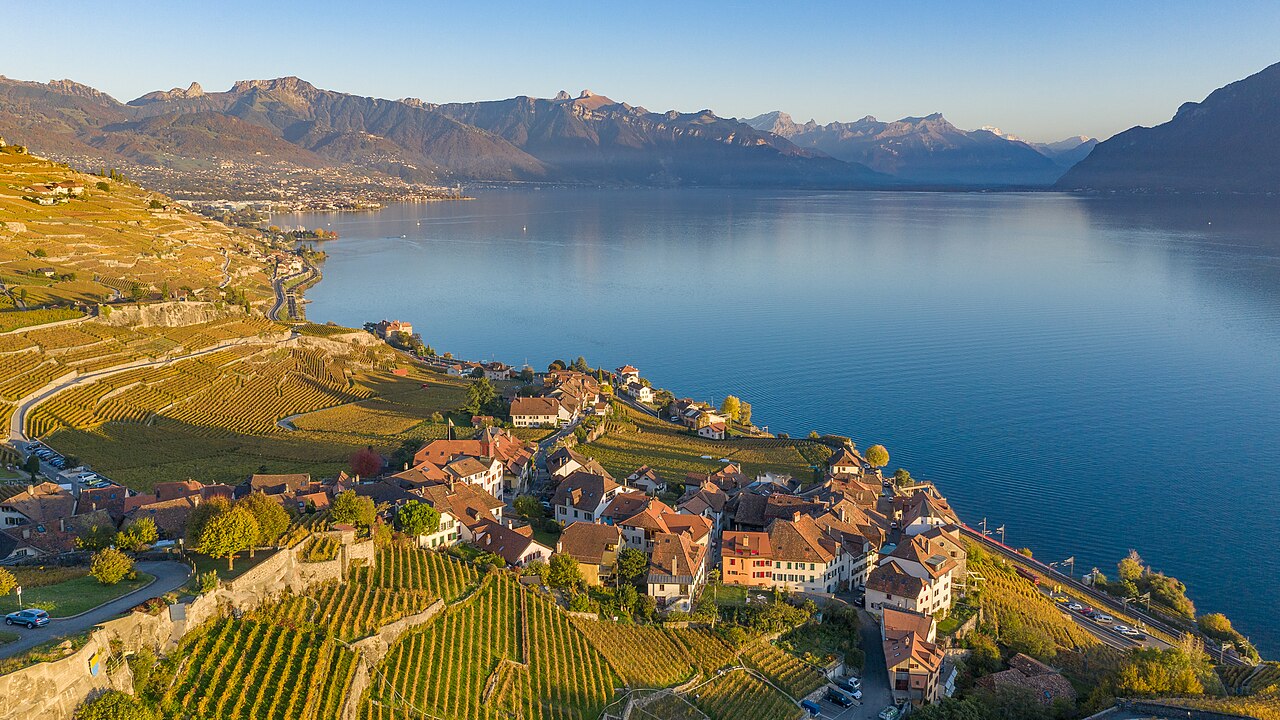
The Lavaux terraces on the north shore of Lake Geneva have been cultivated since the 11th century, when Benedictine and Cistercian monks cut the first steps into the hillside. Today 830 hectares of vines descend from the ridgeline to the lakeshore in an unbroken sequence of stone walls, narrow lanes, and wine villages that appear on the Swiss 200-franc note. UNESCO inscribed them in 2007.
Nine Centuries of Walls, Wine, and the Three-Sun Microclimate Canton of Vaud, between Lausanne and Montreux
The north shore of Lake Geneva between Lausanne and Montreux rises steeply from the water. The hills facing south and southeast catch direct sunlight from early morning until evening. The lake below reflects a second source of solar energy upward to the vines. The dry-stone terrace walls themselves absorb heat through the day and release it at night, creating a third warming effect that extends the growing season and promotes the even ripening that Chasselas — the principal white grape of the Lavaux — demands. The local winemakers have a name for these three energy sources: the three suns of Lavaux. The UNESCO inscription in 2007 recognised the landscape as a cultural property under criteria (iii) and (v), acknowledging both the long continuity of viticulture and the exceptional way in which human labour has modified and maintained the terrain to create a distinctive agricultural microclimate.
The terraces stretch 30 km from Lutry, east of Lausanne, to Saint-Saphorin, west of Vevey — a distance that can be walked in two days on the marked Lavaux vineyard trail, or traversed in 35 minutes on the regional train that follows the lake below the terraces. The railway line, opened in the 19th century, is itself part of the visual experience: viewed from a train window the terraces rise above the carriage roof, the stone walls running in parallel horizontal lines up the hillside, the individual vine rows precisely aligned between them.
Ten wine-growing villages are embedded in the terraced landscape: Lutry, Villette, Cully, Riex, Epesses, Saint-Saphorin, Rivaz, Chexbres, Dezaley, and Grandvaux. Each has its own appellation within the Lavaux AOC designation, and each produces wine from a slightly different combination of soil, aspect, and altitude. The Dezaley and Calamin appellations within the Lavaux zone are classified as Premier Cru under Swiss wine law — the country’s highest quality designation — and their wines command prices that reflect both the quality and the extraordinary cost of maintaining viticulture on steep terraces by hand.
The landscape achieved canonical status in Swiss culture well before its UNESCO inscription. It appears on the 200 CHF banknote — the most valuable Swiss denomination in general circulation — in a composition that frames the terraces, the lake, and the Alps beyond. This representation places the Lavaux in the same category as the Matterhorn and the Swiss federal cross as symbols of national identity, which helps explain the intensity of local resistance when, in the 1970s, proposals for new roads and housing development in the terraced zone prompted a popular referendum. The vote to protect the terraces from development passed with a large majority, establishing the legal basis that eventually made the UNESCO inscription possible.
The surrounding region holds three other UNESCO World Heritage Sites within two hours by train. The Old City of Berne, 80 km northeast, is the medieval capital of the Swiss Confederation, with 6 km of arcaded pedestrian streets and the astronomical clock that has measured Bernese hours since 1530. The Abbey of Saint Gall, 130 km northeast, preserves the most complete surviving Carolingian monastery plan in Europe alongside the library that holds some 160,000 manuscripts and early printed books. The Jungfrau-Aletsch area, 80 km southeast in the Bernese Oberland, is the Swiss Alps’ UNESCO natural heritage site: the largest glacier in the Alps, surrounded by the great peaks of the Eiger, Mönch, and Jungfrau.
The Monks Who Shaped the Slope, and the Chasselas That Made It Famous Wine villages and tasting rooms, Cully and Rivaz
The first terraces in the Lavaux were cut in the 11th and 12th centuries by Benedictine and Cistercian monks working estates granted by local bishops and nobles. The Cistercian Order, which spread rapidly through Europe after its founding in 1098, applied to viticulture the same systematic agricultural rationalism it brought to farming everywhere it established priories and abbeys. In the Lavaux the Cistercians worked from the Abbey of Hautcrêt and the Priory of Saint-Vivit among others, converting wooded slopes into terraced vineyards by clearing the scrub, building the dry-stone retaining walls, and establishing the drainage channels that prevent erosion on gradients that in some sections approach 30 degrees. Some of the terrace walls that survive today are directly continuous with walls constructed in this medieval period, maintained through nine centuries of repairs and replacements using the same technique — quarried local stone laid without mortar — that the monks first applied.
The grape most associated with Lavaux is Chasselas, a thin-skinned white variety of obscure origin that is difficult to grow well and virtually unknown as a serious wine grape outside Switzerland and a handful of French and German regions. In Lavaux it finds conditions that appear to suit it specifically: the combination of lake reflection, direct sun, and radiated wall heat produces a ripeness level that gives the wines their characteristic balance of mineral precision and mid-palate weight. Lavaux Chasselas at its best is not a fruity, aromatic white but a wine of texture and restraint, often with a faint perlance — a light spritz — that winemakers allow to remain as a signature of the appellation. The wines are drunk young in Switzerland and rarely exported in quantity; tasting them in situ, in one of the village cellars that sell direct to visitors, is the principal enological argument for a visit.
Pinot Noir is the secondary red grape of the Lavaux, producing lighter, early-drinking wines in the cooler upper sections of the terrace system. Small quantities of other varieties — Gamaret, Garanoir, and the local crossing Diolinoir — are also found, but Chasselas and Pinot Noir together account for the great majority of production. The Lavaux Vinorama in Rivaz provides an introduction to the appellation with a tasting room that covers the main wines of the region and offers guided visits to the terraces themselves; it is the most accessible entry point for visitors without prior knowledge of Swiss wine geography.
The physical experience of walking the terraces is distinct from most wine-landscape visits. The paths are narrow and at times steep, cut directly into the hillside between the vine rows. Below, the lake is a persistent presence — its colour shifting from grey to deep blue depending on cloud cover and time of day, the mountains of the Chablais region across the water providing a backdrop that changes with the seasons. In spring the vines are leafing out against the stone; in late September and October the harvest is underway and winery doors are open in the villages; in winter the bare vine rows reveal the full geometry of the terrace system. Each season gives the landscape a different character.
Practical information
Lavaux is accessible by rail from Lausanne in 10–35 minutes depending on the destination village. The intercity train from Geneva to Lausanne runs frequently and takes about 35 minutes; from Zurich, about 2 hours. The most scenic rail approach is the regional train (R) from Lausanne toward Vevey, which threads directly through the terrace zone along the lake. Cully is the most central base for visits: a small town with wine cellars, restaurants, and hotels, reachable in 20 minutes from Lausanne by rail.
The vineyard trail from Lutry to Saint-Saphorin can be walked in sections; the Cully-to-Rivaz stretch takes about 2 hours at a moderate pace and includes the steepest and most visually dramatic sections of the terrace system. Comfortable walking shoes and attention to sun exposure are advisable in summer; the south-facing slopes heat quickly. The Lavaux Vinorama in Rivaz is open Wednesday to Sunday and charges an admission fee that includes a guided tasting.
The region is most visited from April through October. The grape harvest, usually in late September and early October, brings the wine villages alive with cellar openings and local festivals. Accommodation in the villages is limited; Lausanne and Vevey provide the main hotel stock for the region. The winter months are quiet but the landscape is striking on clear days when the Alps across the lake are snow-covered.
Frequently Asked Questions
What makes the Lavaux terraces a UNESCO World Heritage Site rather than just a scenic wine region?
The UNESCO inscription in 2007 under criteria (iii) and (v) rests on two arguments. The first is continuity: viticulture has been practiced on these specific slopes continuously for approximately 900 years, with physical evidence — the dry-stone terrace walls themselves — that is directly traceable to the medieval Benedictine and Cistercian foundations that first cultivated the hillside. The walls that divide and retain the terraces are not architectural monuments in any traditional sense, but they are a form of material culture that embodies nine centuries of accumulated agricultural knowledge about drainage, slope management, microclimate exploitation, and vine cultivation on steep terrain. No equivalent density of this kind of knowledge survives anywhere else in the Swiss viticultural landscape. The second argument is landscape integrity: the Lavaux presents an unbroken sequence of terraced vines from the ridgeline to the lakeshore across 30 km of shoreline, with ten wine villages embedded in the working landscape, without the industrial winery infrastructure, highway interruptions, or housing development that have fragmented comparable wine landscapes in other European regions. The combination of historical depth and physical integrity — a working agricultural landscape that looks much as it did centuries ago, still producing wine from the same grape varieties by similar methods — meets the threshold for cultural landscape inscription.
What is Chasselas, and why is it associated with Lavaux in particular?
Chasselas is a white wine grape of uncertain origin — Swiss, French, and Egyptian theories all have their adherents — that is cultivated seriously as a wine variety in only a handful of regions: the Lavaux and the broader Vaud and Valais cantons in Switzerland, the Pouilly-sur-Loire region of France, the Baden region of Germany, and a few pockets of Alsace. Elsewhere it is treated primarily as a table grape, eaten fresh rather than pressed for wine. The reason it is taken seriously in Switzerland, and in the Lavaux specifically, is that the microclimate of the north shore of Lake Geneva — the three-sun effect of direct radiation, lake reflection, and wall radiation — produces the slow, even ripening that allows Chasselas to develop complexity rather than simply accumulating sugar and losing acidity. Lavaux Chasselas at its best has a mineral quality often described as stone or flint, a texture that is fuller than its light colour suggests, and a faint natural spritz that the best producers retain as a characteristic of the appellation. It is emphatically not a wine that travels well or is widely understood outside Switzerland, which contributes to its rarity and its local mystique. Tasting it in a Cully or Epesses cellar, with a view of the lake where it was grown, is the argument for visiting Lavaux rather than simply reading about it.
How are the Lavaux terraces maintained, and is this sustainable long-term?
The maintenance of the Lavaux terraces is one of the more challenging problems in Swiss agricultural heritage management. The dry-stone walls require constant inspection and periodic repair; storm events, freeze-thaw cycles, and the pressure of vine roots all cause movement and occasional collapse. Because the slopes are too steep for mechanical equipment in many sections, repair work is done by hand — at costs that make the economics of small terrace parcels difficult to sustain against the alternative of selling the land. Swiss wine prices have risen substantially in the last two decades partly as a response to these production costs, but the labour economics remain tight. The Canton of Vaud has introduced subsidy programmes for terrace maintenance and funds research into the structural condition of the wall network. The UNESCO inscription has raised the profile of these conservation challenges without fully resolving them. Succession is a related issue: many of the smaller domaines are operated by families who may not have the next generation in place to continue. Wine tourism — visits to village cellars, the Lavaux Vinorama, the vineyard trail — has become an important supplementary income source for smaller producers, and the heritage designation directly supports this. The long-term sustainability of the landscape depends on maintaining both the economic viability of the wine production and the cultural status of the terraces as a Swiss national symbol — a combination that the UNESCO inscription has, at least for now, helped to secure.