

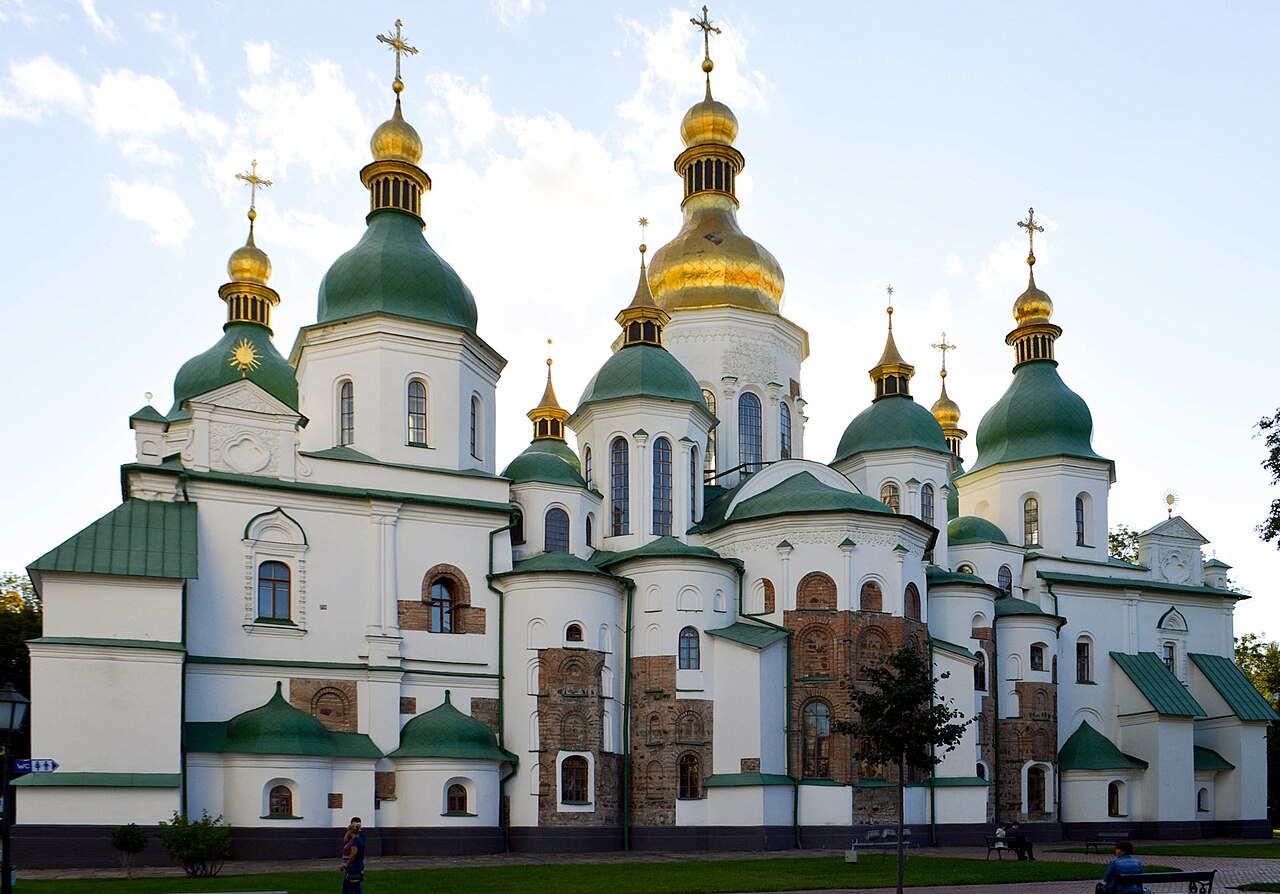
Kyiv holds two UNESCO World Heritage Sites within its city limits: the eleventh-century Saint-Sophia Cathedral, with the oldest surviving mosaics in Eastern Europe, and the Kyiv-Pechersk Lavra, a monastic complex whose golden domes have drawn Orthodox pilgrims for nearly a millennium. Both remain structurally intact, though UNESCO placed them on the List of World Heritage in Danger in 2023 due to the ongoing armed conflict; travellers should consult their government’s current travel advisory before planning a visit. From Cultural Heritage Online.
Saint-Sophia Cathedral city centre — walkable from Maidan Nezalezhnosti
Saint-Sophia Cathedral stands at the physical and symbolic heart of medieval Kyiv. Yaroslav the Wise commissioned it between 1011 and 1037 as the metropolitan cathedral of Kievan Rus, modelling it on the Hagia Sophia in Constantinople while adapting the form to local conditions — a single core structure crowned by thirteen domes, surrounded by open galleries that were later enclosed and extended. The exterior as it appears today reflects seventeenth- and eighteenth-century Baroque restorations, but step inside and the medieval interior survives largely intact.
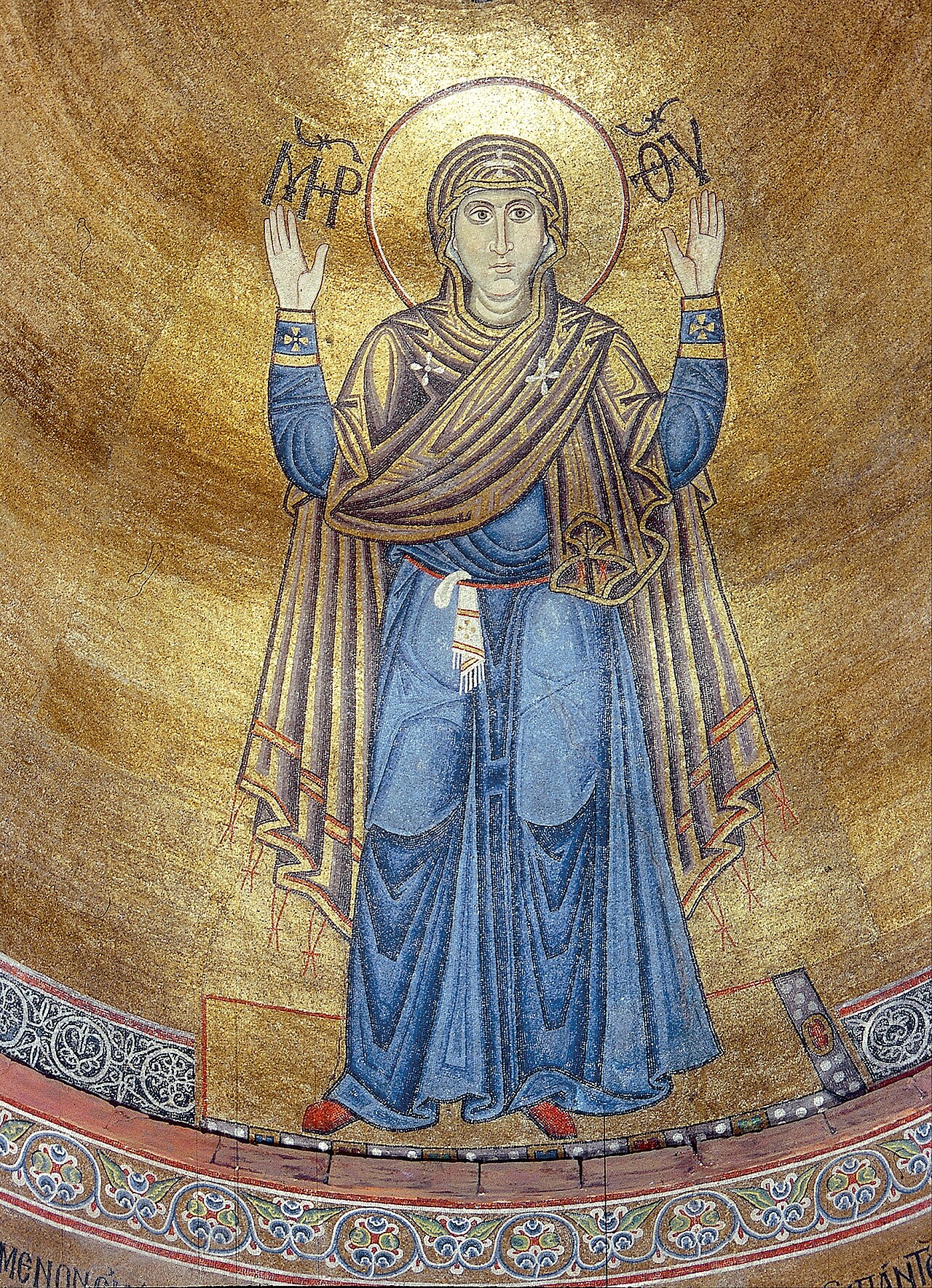
The mosaics in the central apse date to the 1040s and are among the finest examples of Byzantine art outside Istanbul. Dominant among them is the six-metre Orant, the Virgin Mary standing in prayer with her arms raised — a gold-ground image that has survived wars, Soviet anti-religious campaigns, and the passage of a thousand years. Below her, the Eucharist mosaic depicts Christ distributing bread and wine to the apostles. The walls and arches carry some 260 square metres of fresco alongside the mosaics, including secular portraits of Yaroslav’s family — an unusual survival that gives historians a rare look at Rus court life. UNESCO inscribed the cathedral in 1990, recognising this concentration of eleventh-century art as exceptional and irreplaceable.
The cathedral functions today as a museum, not an active church. The complex includes a tall Baroque bell tower visible across the surrounding district, a small monastic refectory, and the remains of the Golden Gate of Kyiv a short walk to the west. The acoustics inside the cathedral are worth noting: the stone vault produces a long, diffuse reverberation that makes even quiet speech sound ceremonial.
Getting there: Metro to Zoloti Vorota (Golden Gate) station, then 5 minutes on foot northeast along Volodymyrska Street. Allow: 1.5–2 hours for the cathedral and bell tower. Best for: Travellers interested in Byzantine art, early medieval history, and Orthodox ecclesiastical architecture.
Kyiv-Pechersk Lavra (Monastery of the Caves) 4 km southeast — Metro Arsenalna, then taxi or 25-min walk
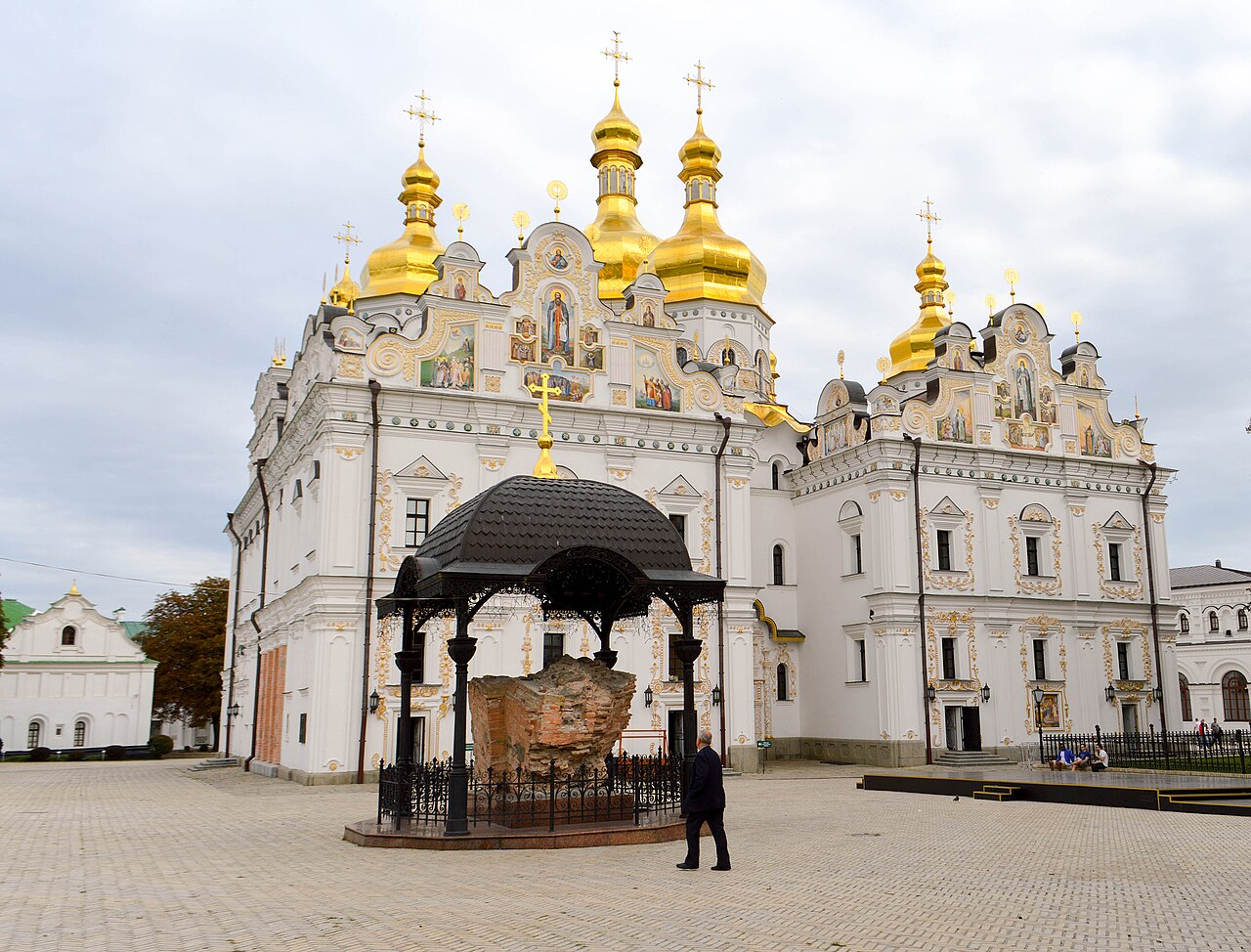
The Kyiv-Pechersk Lavra — literally the Monastery of the Caves — occupies a bluff above the Dnipro River and has been one of the most important centres of Eastern Orthodox Christianity since its founding in 1051. The monk Anthony, returning from Mount Athos, dug a hermitage into the soft sandstone; other monks gathered around him, and the community grew into a sprawling complex of churches, workshops, printing presses, and underground cave systems. By the twelfth century it ranked among the holiest sites in the Orthodox world.
The above-ground complex is defined by Baroque architecture introduced in the seventeenth and eighteenth centuries: white-and-green facades, gilt domes, and a Great Bell Tower that rises above the entire Dnipro escarpment. The Dormition Cathedral, the Lavra’s central church, was destroyed by the retreating Soviet forces or German troops in 1941 — the cause remains disputed — and rebuilt in 2000 on its original foundations. UNESCO inscribed the Lavra alongside Saint-Sophia in 1990, with the inscription extended in 2005 to include additional buildings; the citation recognised the site’s outstanding universal value as a living monument of Orthodox monastic tradition and Ukrainian Baroque art.
Below ground, the Near Caves and Far Caves extend for several hundred metres through the hillside. Narrow, low-ceilinged corridors — lit by candles that visitors carry — lead past glass-covered niches where the mummified or skeletal relics of saints and monks lie in embroidered vestments. The atmosphere is dense: incense, candlelight, and the presence of pilgrims who have come from across the Orthodox world. Visitors who do not wish to enter the caves can still spend hours among the above-ground churches, the Lavra museums, and the views of the Dnipro from the fortified walls.
Getting there: Metro to Arsenalna (the deepest metro station in the world at 105 metres), then a 25-minute walk downhill along Sichnevogo Povstannya, or a short taxi ride. Allow: 3–4 hours for the upper complex and caves. Best for: Visitors interested in Orthodox Christianity, monastic history, and Ukrainian Baroque architecture; also compelling for those interested in cave archaeology.
Frequently Asked Questions
How many UNESCO World Heritage Sites are near Kyiv?
Kyiv has one UNESCO inscription, designated in 1990 and extended in 2005, that covers two distinct sites: Saint-Sophia Cathedral and Related Monastic Buildings, and the Kyiv-Pechersk Lavra. Both were placed on the UNESCO List of World Heritage in Danger in 2023 as a precautionary measure following the Russian invasion of Ukraine, though the monuments themselves remained structurally intact as of late 2024.
How do you get from Saint-Sophia Cathedral to the Kyiv-Pechersk Lavra?
The two sites sit roughly four kilometres apart along a southeast axis. From Saint-Sophia, take the metro from Zoloti Vorota south one stop to Khreshchatyk, change to the Sviatoshynsko-Brovarska line, and ride one stop to Arsenalna. From Arsenalna it is a 20–25 minute walk downhill, or a short taxi ride, to the Lavra entrance. Allow a full day to visit both sites without rushing.
What is the best time of year to visit these sites?
Late spring (May–June) and early autumn (September–October) offer mild temperatures and manageable crowds. Summer months see peak visitor numbers, particularly at the Lavra, which draws Orthodox pilgrims year-round. The gold-domed churches photograph well under overcast light, which reduces glare on the gilt surfaces — a point worth noting for any season.
What makes the mosaics of Saint-Sophia Cathedral historically significant?
The mosaics in Saint-Sophia’s central apse were laid in the 1040s using Byzantine craftsmen and techniques, making them the oldest surviving in situ mosaics in Eastern Europe. Unlike paintings, mosaic tesserae are embedded in plaster and do not deteriorate in the same way pigments do; many retain their original gold grounds and vivid blues after nearly a thousand years. The Orant figure — the standing Virgin with raised arms — has become one of the defining images of Kyiv’s cultural identity and appears in the city’s visual culture across many centuries.
Sources
- S1 — Hewryk, Titus D. The Lost Architecture of Kiev. The Ukrainian Museum, 1982. ISBN 978-0-9602524-1-1.
- S2 — Plokhy, Serhii. The Gates of Europe: A History of Ukraine. Basic Books, 2015. ISBN 978-0-465-05091-8.
Spotted an error? Write to editorial@culturalheritageonline.com and we correct it the same day.



.jpeg)

.jpeg)