
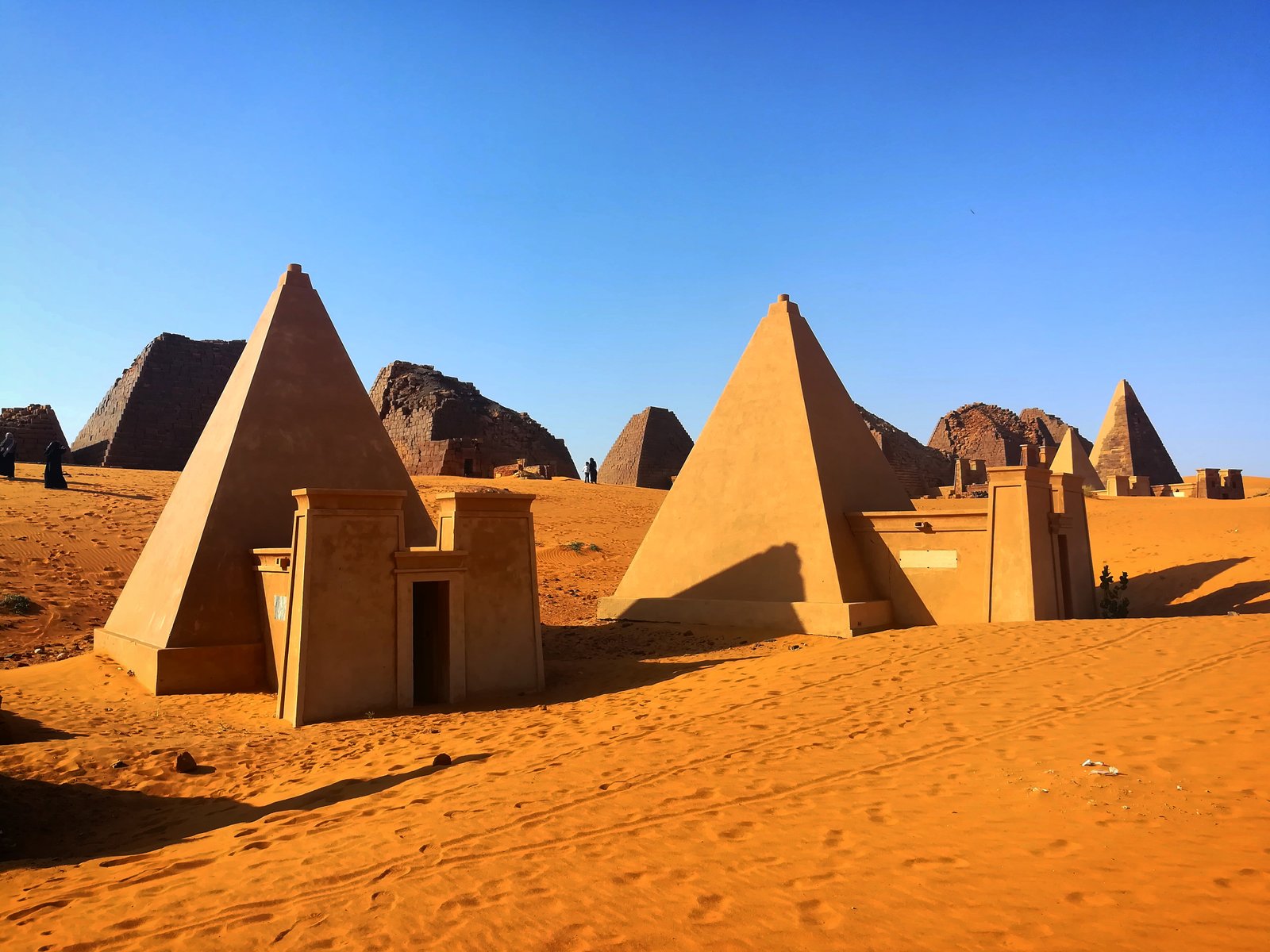
Sudan’s two overland UNESCO World Heritage Sites — the Meroe pyramid fields and the sacred mountain of Jebel Barkal — place Khartoum at the edge of one of antiquity’s least-visited royal landscapes. Both sites preserve millennia of Kushite civilisation, from iron-smelting workshops to cliff-cut temples that once crowned an empire stretching north into Egypt. From Cultural Heritage Online.
Island of Meroe — Archaeological Sites 200 km northeast · 2.5–3 hr by road

More than 200 pyramids stand on two ridges of ochre sand roughly four hours northeast of Khartoum. Sudan has more pyramids than Egypt — a fact that surprises almost every visitor — and the Meroe group is the largest concentration. The shafts are steeper and narrower than their Egyptian counterparts, rising from square bases to sharp points, and many still show carved reliefs on their chapel facades: processions of offering-bearers, gods in profile, queens with wings spread. In the slanted light of early morning the sandstone surfaces shift from deep red to pale gold as the sun climbs.
The Kushite rulers of the Meroitic kingdom buried their dead here between roughly 300 BC and AD 350, shifting the royal necropolis south from Napata after the centre of power moved upriver. The city of Meroe itself — a grid of palaces, temples, and iron-smelting furnaces — sprawls along the Nile bank below the pyramid ridge. Slag heaps from the furnaces remain visible; Meroe was probably the largest iron-production centre in sub-Saharan Africa during its height. UNESCO inscribed the entire Archaeological Sites of the Island of Meroe in 2011, recognising the pyramids, the urban remains, and two further Kushite sites within 50 km.
Naqa and Musawwarat es-Sufra lie roughly 30–50 km south of the pyramid fields and reward the extra driving time. Naqa’s Lion Temple, built in the first century BC, preserves reliefs of the lion-headed god Apedemak — a deity unique to Nubian religion — alongside images of the Roman emperor Augustus that reflect the diplomatic complexity of the era. Musawwarat es-Sufra’s Great Enclosure is a sprawling ceremonial complex whose function still divides archaeologists; elephant motifs carved into its walls suggest it may have served as a training ground for war elephants.
Getting there: Paved road north from Khartoum via Shendi; 4WD recommended for the final approach to the pyramid ridge. Organised day tours and private drivers available from Khartoum. Allow: Full day for pyramid fields alone; two days to include Naqa and Musawwarat. Best for: History travellers, photographers, and anyone drawn to ancient civilisations outside the standard Egypt itinerary.
Gebel Barkal and the Sites of the Napatan Region 370 km north · 4–5 hr by road or 1 hr by domestic flight
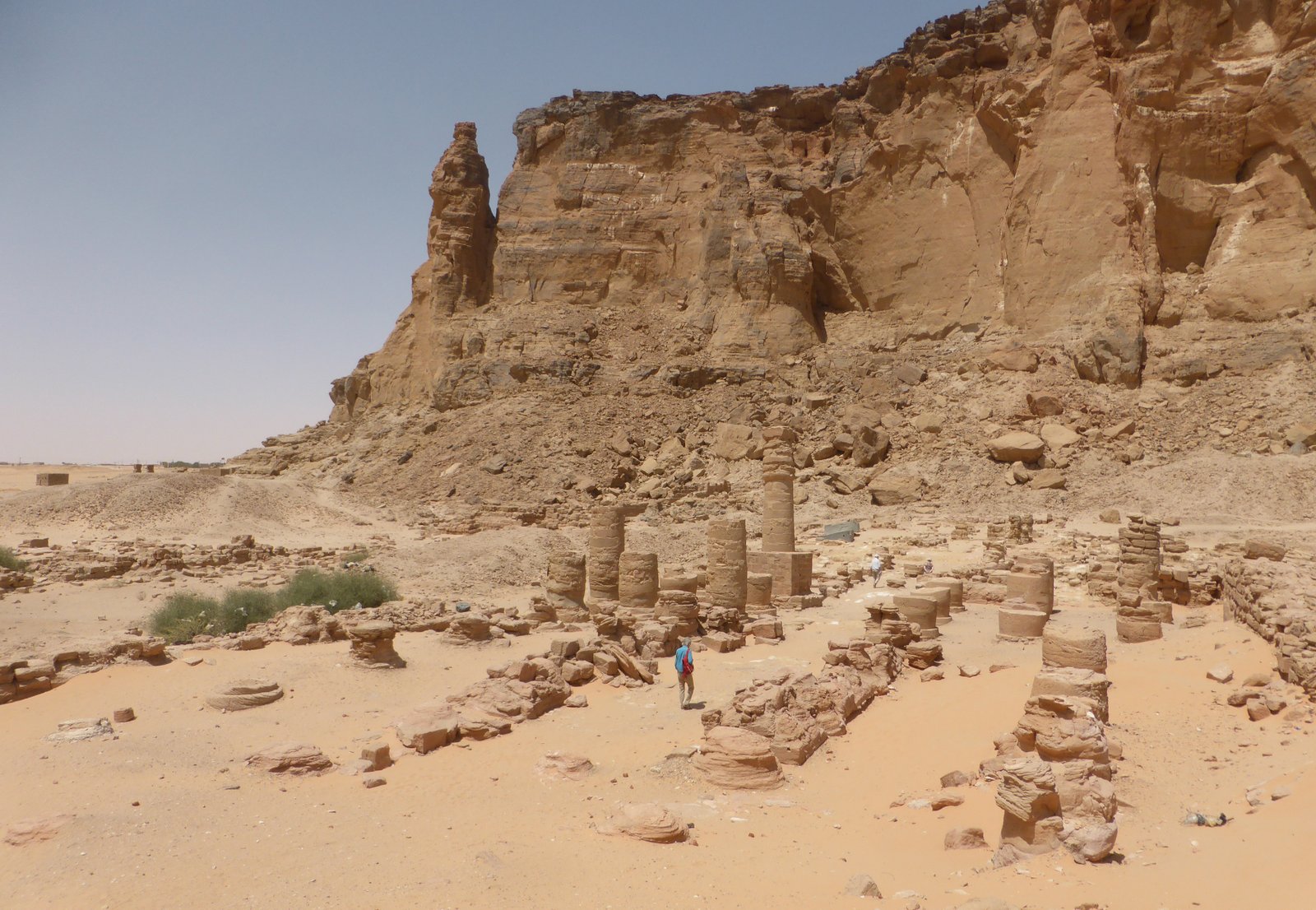
A flat-topped sandstone mesa rises abruptly from the Nile floodplain near the town of Karima, its vertical face streaked with dark desert varnish and broken only by a slender pinnacle at one end. This is Jebel Barkal — the Pure Mountain — which the ancient Kushites identified as the dwelling place of Amun. Temples cut into the cliff and built across the plain in front of it made this one of the most sacred sites in the ancient Nile world. The silence at the base of the rock face, broken only by wind and the occasional call of a bird, carries a weight that the ruins alone cannot account for.
The kingdom of Napata ruled from this location and, between 747 and 656 BC, pushed north to conquer Egypt, establishing the Twenty-Fifth Dynasty — a Kushite pharaonic line that left monuments from the Delta to the Fourth Cataract. The temples at Jebel Barkal include a sanctuary of Amun whose inner chambers were carved directly into the mountain; column bases, fallen lintels, and reconstructed ram-sphinx avenues mark the extent of what was once a major pilgrimage destination. UNESCO inscribed Gebel Barkal and the Sites of the Napatan Region in 2003, grouping it with four further archaeological zones — Napata, Nuri, el-Kurru, and Zuma — each of which holds royal pyramid fields and tomb complexes of the Napatan and later Meroitic periods.
The Nuri necropolis, a short drive from Jebel Barkal, contains the tomb of Taharqa, the most celebrated of the Kushite pharaohs, and dozens of smaller royal pyramids arranged on a hillside overlooking the river. El-Kurru holds some of the earliest Kushite royal burials, including painted burial chambers that rank among the finest surviving examples of Nubian funerary art. Spending a night in Karima rather than rushing back to Khartoum allows a second morning at the mountain, when the east face catches the light and the ruins read clearly against the pale desert floor.
Getting there: Road north via Khartoum–Merowe highway, approximately 4–5 hours. Domestic flights from Khartoum to Merowe Airport cut the journey to around 1 hour; Karima is 35 km further by road. Allow: Minimum one full day; overnight stay in Karima recommended to cover Nuri and el-Kurru. Best for: Travellers combining Sudan’s major heritage sites and those interested in the little-known African roots of Egyptian civilisation.
Frequently Asked Questions
How many UNESCO World Heritage Sites are near Khartoum?
Two UNESCO World Heritage Sites are reachable by road from Khartoum: the Archaeological Sites of the Island of Meroe (inscribed 2011), which includes the Meroe Pyramids, Naqa, and Musawwarat es-Sufra; and Gebel Barkal and the Sites of the Napatan Region (inscribed 2003), near the town of Karima. A third Sudanese site, Sanganeb Marine National Park and Dungonab Bay (2016), lies on the Red Sea coast near Port Sudan and requires a domestic flight.
How do you visit the Meroe Pyramids from Khartoum?
The Meroe pyramid fields are approximately 200 km northeast of Khartoum, reached by paved road via Shendi in roughly 2.5 to 3 hours. Most visitors hire a private driver or join an organised day tour from the capital. A 4WD vehicle is useful for the sandy tracks around the pyramid ridge itself. Arriving before 9 am means cooler temperatures and the low-angle light that brings out the carved reliefs on the chapel facades most clearly.
Can you combine Meroe and Jebel Barkal in one trip?
Yes, though the two sites are roughly 200 km apart and the trip works better over three or four days than as a single rush. A practical approach: drive north to Meroe on day one, continue to Naqa and Musawwarat es-Sufra on day two, then proceed north to Karima and Jebel Barkal for days three and four before returning to Khartoum. October to February offers the most comfortable temperatures; the Sudanese summer (May–September) is extremely hot, with midday temperatures regularly above 40°C.
Why does Sudan have more pyramids than Egypt?
The Kushite kingdoms of Napata and Meroe adopted the Egyptian practice of pyramid burial and sustained it for roughly a thousand years after Egypt had abandoned it, producing more than 255 royal pyramids across sites including Meroe, Nuri, el-Kurru, and Jebel Barkal. The Kushite structures are generally smaller and steeper than Egyptian pyramids — most stand between 10 and 30 metres high — but they were built continuously from around 700 BC to AD 350, a span that Egypt’s pyramid age never matched. Because Sudan’s archaeological heritage remains far less excavated and publicised than Egypt’s, the sheer number of surviving structures comes as a genuine surprise to most visitors.
Sources
- S1 — Welsby, Derek A. The Kingdom of Kush: The Napatan and Meroitic Empires. British Museum Press, 1996. ISBN 978-0-7141-0986-2.
- S2 — Adams, William Y. Nubia: Corridor to Africa. Princeton University Press, 1977. ISBN 978-0-691-09370-3.
Spotted an error? Write to editorial@culturalheritageonline.com and we correct it the same day.



_(34027366100).jpg)