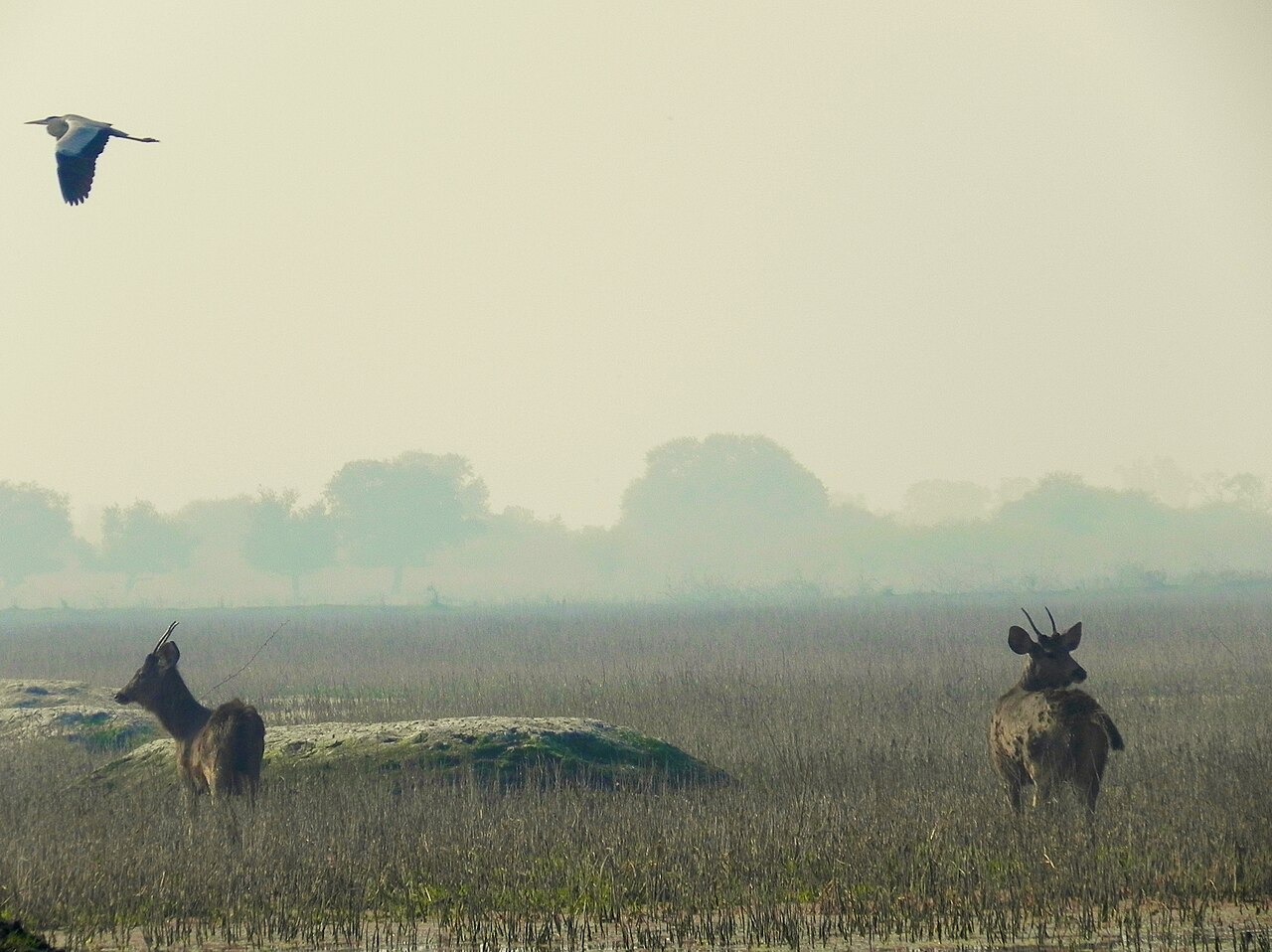
Keoladeo Ghana National Park covers 29 sq km of engineered wetland in Bharatpur, Rajasthan — a terrain that was deliberately flooded in the 1850s by the Maharaja of Bharatpur to create the most productive duck-shooting ground in the British Empire. UNESCO listed it in 1985 as a critical habitat for 370 bird species, including some that no longer come: the Siberian crane’s eastern migratory flock last visited the site in the winter of 1999–2000, two birds only, and has not returned. The wetland sits 55km southeast of the Taj Mahal and 40km east of the Mughal abandoned capital at Fatehpur Sikri, making it an anchor point for one of the highest concentrations of UNESCO sites anywhere in India.
From imperial duck shoot to national park: how a flood basin became a sanctuary Bharatpur, Rajasthan
In 1938, Lord Linlithgow — Viceroy of India — led a shooting party at Keoladeo Ghana that killed 4,273 birds in a single day. The figure appears in official Game Books kept by the Bharatpur state and is often cited as the most birds ever killed in a single organised shoot. It was not considered exceptional at the time: British viceroys had been conducting duck shoots here since the 1880s, and the wetland had been specifically engineered to maximise the target population. What made the count possible was the combination of an artificially flooded terrain, ideal for waterfowl, and a hunting infrastructure — beaters, boats, designated firing positions — that had been refined over decades.
The wetland’s origin is artificial. In the 1850s, the Maharaja of Bharatpur ordered a dam built across the Gambhir and Banganga rivers to flood a series of natural depressions. The resulting reservoir — shallow, reed-fringed, partitioned into manageable sections — proved immediately productive for ducks, geese, and migratory birds arriving from Central Asia and Siberia. The Keoladeo Hindu temple at the centre of the wetland (from which the park takes its name) was left on slightly raised ground and still stands within the park boundaries. Ghana means “dense” in Hindi, a reference to the thick reed beds that characterise the inner marsh.
The site was declared a protected wildlife sanctuary in 1956, eleven years after independence, and shooting was formally prohibited. It was upgraded to a national park in 1982, one year before UNESCO added it to the World Heritage List in 1985. This sequence — engineered hunting estate to protected zone to UNESCO listing — took about 130 years. During that transition, something fundamental changed in the ecological picture. Until 1991, the wetland received supplementary water from the Ajan Dam catchment via a Mughal-era canal system. A dispute between farmers and the park administration ended that supply, and since 1991 the marsh has depended entirely on monsoon rainfall and limited groundwater diversion. Ecologists note that water levels have been consistently lower since then, affecting the habitat quality for large waterbird colonies.
Those colonies — painted storks, pelicans, herons, cormorants — nest in stands of Acacia nilotica trees that rise from the marsh. The nesting aggregation can exceed 1,000 birds in a single tree cluster during peak season (October to February). The spectacle is the park’s principal draw for contemporary visitors: not the shooting record, but the density of large birds nesting, fishing, and roosting in conditions that approach what the natural Gangetic floodplain looked like before agricultural drainage changed the hydrology of the region permanently.
Visitors enter the park on foot, bicycle, or cycle-rickshaw; private vehicles are prohibited inside the boundary. The restriction, introduced in 1982, is one of the reasons the nesting colonies have remained stable despite the park’s small size. The 29 sq km is enough to sustain significant populations only because human disturbance inside is carefully limited.
The Siberian crane, the Taj Mahal, and the Mughal ghost city 40km west Agra 55km / Fatehpur Sikri 40km
The Siberian crane (Grus leucogeranus) is the bird most associated with Keoladeo Ghana in the ornithological literature, and its disappearance from the site is one of the most-discussed conservation failures in South Asian wildlife management. Until the late 1990s, a flock wintering at Keoladeo was reliably observed each year — counts in the 1980s reached as many as 41 birds. The numbers declined through the 1990s. In the winter of 1999–2000, two birds arrived and were the last confirmed sightings of the eastern migratory flock in India. None have returned since.
The eastern Siberian crane flock migrated from breeding grounds in Yakutia (Russia) south across Siberia, through Kazakhstan, Afghanistan, and Pakistan to winter at Keoladeo. The loss of the flock is attributed primarily to hunting along the migration route — particularly in Afghanistan and Iran, where cranes were shot during the period of conflict in the 1980s and 1990s — rather than to any change at Keoladeo itself. The western flock, which uses a different route to Fereydunkenar in Iran, remains extant. The eastern flock is believed functionally extinct. What this means practically for a visitor in 2026 is that Keoladeo Ghana will not deliver one of the spectacles that made it famous in the 20th century. The site remains outstanding — 370 species, massive nesting colonies — but the Siberian crane chapter is closed.
The proximity of two more UNESCO sites makes Keoladeo a logical base for a multi-day itinerary. The Taj Mahal complex in Agra, 55km northwest, was listed in 1983. The monument and its associated structures — the Agra Fort, also UNESCO-listed, and the Itimad-ud-Daulah — form a Mughal riverside ensemble from the 17th century. The drive from Bharatpur takes under 90 minutes on the Agra–Jaipur highway. Fatehpur Sikri, 40km west of Bharatpur, is a complete Mughal city built by Emperor Akbar between 1571 and 1585 and then abandoned within 14 years, most likely due to water scarcity. UNESCO listed it in 1983. Its abandonment makes it structurally analogous to Champaner — a complete capital that was never built over — though the Mughal stonework here is red sandstone and the abandonment was 50 years more recent.
Ranthambore National Park lies 130km south of Bharatpur, a 3-hour drive. It is not a UNESCO site but is one of India’s most reliable locations for Bengal tiger sightings, and many visitors combine a Keoladeo birding trip with a Ranthambore tiger safari. The Rajasthan tourism infrastructure between Jaipur, Bharatpur, Agra, and Ranthambore is well-developed, with regular rail connections and a high density of mid-range and luxury hotels.
Practical information
Bharatpur is on the Delhi–Mumbai and Delhi–Chennai railway main lines. Trains from Delhi take 2–3 hours (200km); from Agra, 45 minutes (55km). The park entrance is 2km from Bharatpur Junction station and easily reached by auto-rickshaw. The main gate is open daily from sunrise to sunset. Entry fees (2024): ₹75 for Indian nationals, ₹500 for foreign visitors, plus ₹50 for a cycle-rickshaw (mandatory for non-walkers — private vehicles are not permitted inside). Licensed guides are available at the gate and are strongly recommended: the 29 sq km of wetland has multiple tracks and a guide who knows current nesting locations significantly increases the number of species spotted.
Best season: October to February for migratory species and the main nesting colonies. March to May sees resident breeding activity but fewer migrants. Monsoon months (July–September) bring some water birds but mosquitoes are heavy. Accommodation in Bharatpur ranges from budget guesthouses to the government-run Forest Guest House inside the park (bookable in advance through Rajasthan Forest Department). Most visitors use Bharatpur as a day-trip from Agra or as a 1-night stop on a Jaipur–Agra circuit.
Frequently Asked Questions
Why did the Siberian cranes stop coming to Keoladeo Ghana?
The Siberian crane (Grus leucogeranus) that wintered at Keoladeo Ghana was the eastern migratory flock, which bred in the Yakutia region of Russia and flew south each autumn across Kazakhstan, Afghanistan, and Pakistan. The flock numbered up to 41 birds in the 1980s and declined steadily through the 1990s. The last confirmed sighting was in the winter of 1999–2000: two birds appeared at Keoladeo and were not seen again. The cause of the eastern flock’s disappearance is attributed primarily to hunting along the migration route, particularly through Afghanistan during the period of armed conflict from the late 1970s onward. Cranes are large, conspicuous, slow-moving targets and were shot both for food and as incidental casualties of the chaos that disrupted traditional conservation arrangements in the region. The loss of breeding adults faster than they could be replaced by young birds led to a progressive decline and ultimate collapse of the flock. The situation at Keoladeo itself — reduced water supply since 1991, changed reed-bed composition — is a secondary factor; the habitat deterioration would not have caused the extinction of the flock if the hunting pressure along the flyway had not already reduced it to critically low numbers. The western Siberian crane flock, which uses a route through Iran to Fereydunkenar, remains in existence with a managed population, but the genetic lineage that historically used Keoladeo is gone.
How was the Keoladeo wetland originally created, and how is it maintained today?
The wetland is entirely man-made. In the 1850s, the rulers of the Bharatpur princely state ordered construction of a dam across the Gambhir and Banganga rivers, upstream of a series of natural low-lying depressions. The dam captured seasonal river flow and directed it into these depressions, creating shallow lakes and reed-fringed marshes covering several square kilometres. The system was designed and operated specifically to attract waterfowl in large numbers for organised hunting. Depth management was important — too deep and ducks would not feed on the bottom vegetation, too shallow and the marsh would dry out mid-season. A network of dikes, sluices, and earthen channels allowed the Bharatpur state to regulate water levels through the shooting season from October to February. After the park’s creation, the same hydraulic infrastructure continued to supply water via an arrangement with the Ajan Dam reservoir. That arrangement broke down in 1991 when farmers objected to water being diverted from agricultural use to the sanctuary; a legal dispute followed, and the canal supply was never restored. Since 1991 the wetland is filled by monsoon rain only. The park authority supplements this with limited groundwater pumping, but hydrological surveys from the 2000s and 2010s indicate that average water levels are lower than they were in the mid-20th century, affecting both vegetation composition and the density of waterbird aggregations. The park’s 29 sq km is managed by the Rajasthan Forest Department under national park rules, with no human settlement inside the boundary.
Can Keoladeo Ghana be combined with the Taj Mahal and Fatehpur Sikri in one trip?
Yes, and this combination represents one of the most UNESCO-site-dense itineraries available in northern India. Bharatpur (Keoladeo Ghana) sits at the geographic intersection of Agra and Jaipur, making it a natural stop on either the Golden Triangle circuit (Delhi–Agra–Jaipur–Delhi) or a standalone heritage corridor. From Bharatpur, Agra is 55km northwest (90 minutes by road, 45 minutes by train); the Agra cluster includes the Taj Mahal (UNESCO 1983) and Agra Fort (UNESCO 1983). Fatehpur Sikri (UNESCO 1983) is 40km due west of Bharatpur — a 1-hour drive — and can be visited en route from Bharatpur to Agra, or as a separate excursion. A practical three-day structure: Day 1 at Keoladeo Ghana (morning and late afternoon are best for birds); Day 2 at Fatehpur Sikri followed by Agra Fort in the afternoon; Day 3 for the Taj Mahal at sunrise followed by train departure. This itinerary accesses four UNESCO World Heritage Sites (Keoladeo Ghana, Taj Mahal, Agra Fort, Fatehpur Sikri) within a 55km radius without any retracing of route. Bharatpur has direct train connections to both Agra and Jaipur Junction, making it straightforward to begin or end the circuit here.