Wikimedia Commons,
CC BY-SA 3.0 ro.
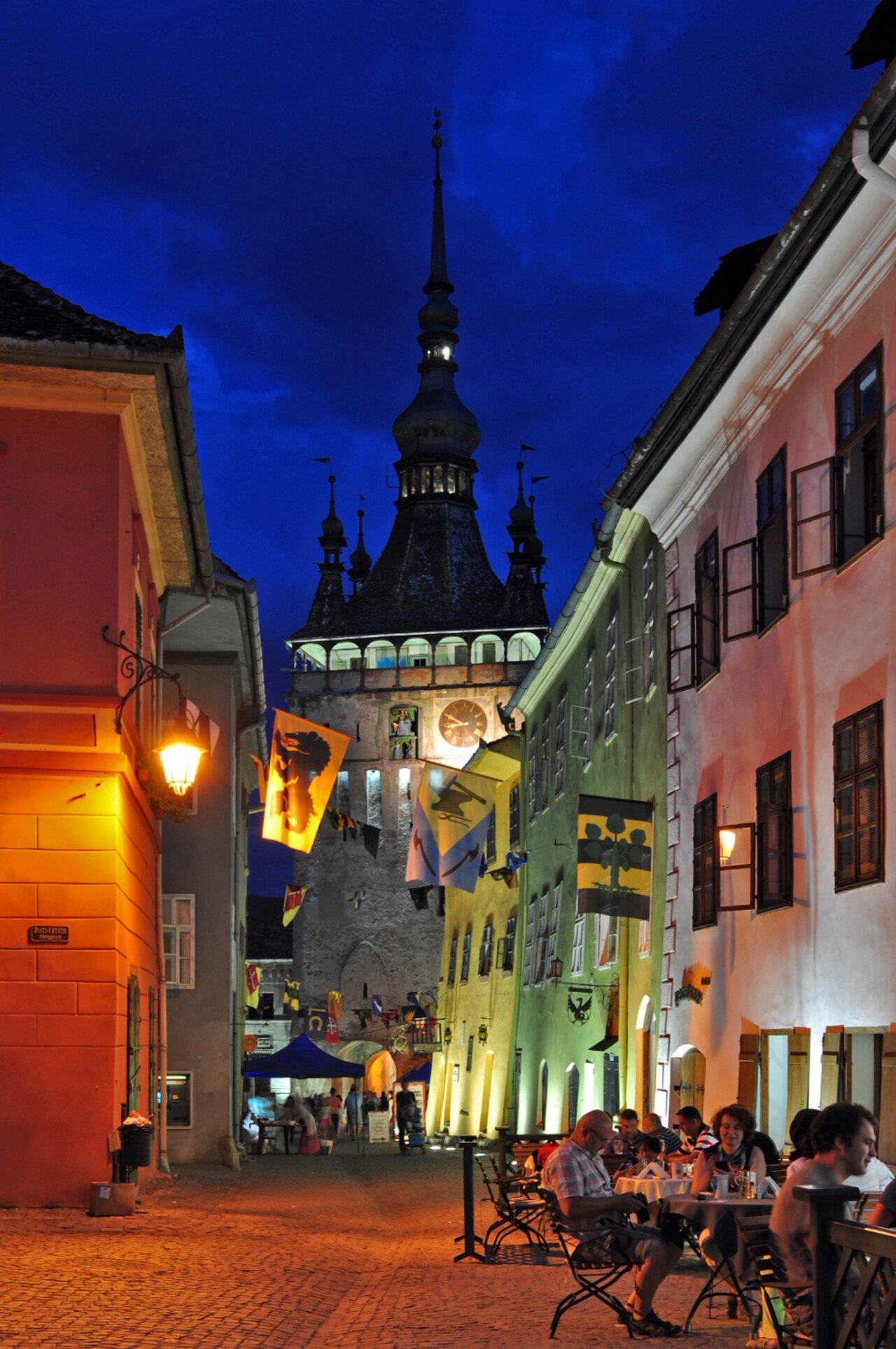
Sighișoara’s medieval citadel rises on a wooded hill above the Târnava Mare River in Transylvania, its clock tower visible for miles across the surrounding valleys. Founded by Transylvanian Saxons in the 12th century, the fortified hilltop town has never been abandoned and retains its medieval street plan, towers, and houses in active residential use — making it, by most accounts, the only inhabited medieval citadel in Europe. UNESCO inscribed the Historic Centre of Sighișoara in 1999.
Transylvania’s fortified Saxon citadel and the birthplace of Vlad III Central Transylvania · Romania · 3.5 hrs from Bucharest by train, 1.5 hrs from Cluj-Napoca
The Transylvanian Saxons were German-speaking colonists invited into the territory by the Hungarian crown in the 12th century as part of a deliberate policy to populate and defend the south-eastern frontier of the Kingdom of Hungary. Their settlements — Sibiu (Hermannstadt), Brașov (Kronstadt), Sighișoara (Schäßburg), Bistritz (Bistritz) — formed a chain of fortified market towns that controlled the mountain passes through the Carpathians. Each town developed its own guild system, fortified its centre, and maintained a distinct German-speaking civic identity that persisted, against considerable pressure, until the mass emigration to West Germany in the 1970s and 1980s.
Sighișoara was first mentioned in documents as Castrum Sex in 1280 and appears under its German name Schäßburg in 1298. The medieval citadel occupies a hill roughly 90 metres above the lower town, connected by cobbled lanes and staircases. Its current circuit of walls, dating primarily from the 14th and 15th centuries, was once reinforced by 14 towers, each built and maintained by a different guild — the Tailors’ Tower, the Shoemakers’ Tower, the Ropemakers’ Tower, the Butchers’ Tower among them. Nine towers survive in various states of preservation; the Clock Tower (Turnul cu Ceas) is the most complete and most imposing.
The Clock Tower (Turnul cu Ceas) was built in the 14th century as the main gateway to the citadel and served as the seat of the town council. In 1648 a mechanical clock with moving figurines was installed on its eastern face; the present figures — representing Justice, Law, Peace, and the days of the week — are replicas of the baroque originals. The tower now houses a history museum, and its terrace offers the most panoramic view across Sighișoara’s roofscape and the Târnava Mare valley beyond. Climbing the 175 steps inside the tower brings you out at a level from which the medieval layout of the citadel streets is immediately legible.
The Church on the Hill (Bergkirche / Biserica din Deal), reached from the citadel by a covered wooden stairway of 175 steps built in 1642, is the main Lutheran church of the Saxon community. Its Gothic nave dates from the 14th-15th century; the choir murals, restored in the late 19th century, give some sense of the original polychrome interior. The adjacent German Cemetery, still maintained by the surviving Saxon community, contains tombstones with inscriptions in German from the 18th to 20th centuries — a compressed history of the community in stone.
The house on Strada Cositorarilor 5 in the lower citadel is identified by local tradition as the birthplace of Vlad III Drăculea (1431-1476), known as Vlad the Impaler, voivode of Wallachia and the historical figure whose name Bram Stoker borrowed for his 1897 novel. The historical Vlad was not a vampire but was genuinely notorious: his method of execution by impalement on tall stakes was intended as a deliberate political demonstration, and the Ottoman Sultan Mehmed II reportedly withdrew his army from Wallachia in 1462 after encountering a forest of impaled bodies outside Târgoviște. Whether Vlad was actually born in Sighișoara or merely lived here briefly during his father’s political exile is debated by historians; the house is now a restaurant.
The citadel remains a living residential neighbourhood, which distinguishes it from most preserved medieval town centres in Europe. Approximately 800 people live within the fortified walls; their laundry dries on lines strung between Gothic windows, and the sounds of cooking and conversation come through open doors on summer evenings. This domesticity is part of the UNESCO site’s character: it is not a museum but a community.
Day trips: the Fortified Churches of Transylvania and Brașov Within 100 km · car recommended; some connections by bus
The Fortified Churches of the Transylvanian Saxons were inscribed by UNESCO as a group of seven in 1993 and 1999. Three of the most significant — Biertan, Saschiz, and Valea Viilor — are within 40 km of Sighișoara and accessible by car or, with patience, by local bus. Biertan (Birthälm), 27 km south-west, has the largest and most elaborately fortified church in the group: a three-aisled Gothic basilica surrounded by three concentric rings of walls and nine towers, built between 1490 and 1524. The church’s Renaissance polyptych altarpiece and the trilobite lock of its sacristy door (which requires three keys operated simultaneously) are among the most cited technical achievements of Saxon craftsmanship. Biertan was the seat of the Lutheran Bishop of Transylvania for 300 years.
Brașov (Kronstadt), 110 km south-east of Sighișoara, is the largest Saxon city and the gateway to the Prahova Valley ski resorts. The Black Church (Biserica Neagră), a Gothic hall church begun in 1383 and partially burned in the fire of 1689 that gave it its sooted-black walls, is the largest Gothic church in Romania. The old Saxon town square, Piața Sfatului, retains its Council House (1420) and is surrounded by Baroque buildings that replaced the originals after the 1689 fire. Brașov is connected to Sighișoara by a direct train taking approximately 1 hour 40 minutes.
Practical information
Getting there: Sighișoara is on the main Brașov-Cluj-Napoca railway line, with direct trains from Bucharest (approximately 5 hours via Brașov), Cluj-Napoca (1 h 30 min), and Brașov (1 h 40 min). The railway station is at the base of the hill, a 15-minute walk from the citadel entrance. Day tours from Brașov and Cluj-Napoca are widely available but allow insufficient time for the citadel; an overnight stay is strongly recommended.
Getting around: The citadel is compact — about 400 metres across — and explored entirely on foot. Shoes with grip are advisable: the cobblestones on Strada Turnului and the covered stairway to the Church on the Hill are steep and slippery when wet. The lower town has several decent restaurants and bakeries; most visitor facilities are in the citadel.
Best time to visit: June and early July coincide with the Medieval Festival (Festival Medieval), which fills the citadel with craft markets, jousting displays, and music. September and October are cooler and less crowded. Winter brings snow, which makes the citadel photogenic but the cobblestones treacherous.
Practical tips: Accommodation within the citadel — in restored Saxon burgher houses — books out weeks in advance in summer. The citadel museums (Clock Tower and Torturer’s House) charge modest entry fees payable in cash. The Church on the Hill is sometimes closed during services; check schedules at the Clock Tower museum desk.
Frequently Asked Questions
Is Sighișoara really the only inhabited medieval citadel in Europe?
The claim requires some qualification, as it depends on definitions. Several European cities — Carcassonne in France, Dubrovnik in Croatia, Tallinn in Estonia — have medieval fortified cores that are also inhabited. What distinguishes Sighișoara is that its entire fortified citadel hill, rather than just a portion of a larger walled city, has been continuously occupied since the Middle Ages without major rebuilding of the street pattern or the medieval house stock. UNESCO’s inscription notes the “outstanding universal value” of its “urban fabric that has remained largely intact.” The citadel’s relatively small size (about 12 hectares) has paradoxically aided its preservation: it was never large enough to be worth the expense of comprehensive modernisation, and it remained economically marginal enough that speculative development bypassed it.
What is the historical connection between Sighișoara and Vlad the Impaler?
Vlad II Dracul, voivode of Wallachia and member of the chivalric Order of the Dragon (Societas Draconistarum), spent part of his political exile in Sighișoara between approximately 1431 and 1435. His son Vlad III was born during this period, almost certainly in the house now identified as his birthplace on Strada Cositorarilor. The child’s name — Drăculea, “son of the Dragon” — derived from his father’s membership in the Order. Vlad III’s later career as voivode of Wallachia and his method of enforcing political control through mass impalement were well documented in German, Hungarian, and Ottoman sources of the 15th century. Bram Stoker, writing in 1897, encountered the name Dracul in a book on Transylvanian history and borrowed it for his vampire count — but Stoker placed his fictional Dracula’s castle in the Borgo Pass, far from Sighișoara, and made no direct claim about the voivode being a vampire.
What is the current situation of the Transylvanian Saxon community?
The Transylvanian Saxon community, which at its peak numbered over 700,000 people, has declined dramatically since the Second World War. The communist period brought forced collectivisation and cultural suppression; from the late 1960s onward, the Ceaușescu government allowed ethnic Germans to emigrate to West Germany for fees paid by the West German state, a policy that accelerated after 1989. The Saxon population of Sighișoara, which maintained the citadel’s German-language Lutheran community for over 800 years, is now counted in hundreds rather than thousands. The Lutheran Church of Sighișoara continues to hold services; the church on the hill is cared for by a small but dedicated congregation and by the German government, which funds heritage maintenance through the German Cultural Foundation. The Saxon heritage — architecture, crafts, church music, dialect — is increasingly documented and preserved by Romanian and German cultural organisations as an endangered cultural legacy.