The Royal Palaces of Abomey, inscribed by UNESCO in 1985, preserve the earthen palace complex of the Kingdom of Dahomey — one of the most powerful, wealthy and militarily sophisticated states in West Africa from the 17th to the late 19th century. Located in Abomey city in Benin’s Zou Department, 145 kilometres north of Cotonou, the 44-hectare royal enclosure contains the accumulated palaces of 12 successive kings, each of which added its own structures to the compound over nearly three centuries of dynastic rule. The site is inseparable from the history of the Atlantic slave trade, the culture of the Fon people, and one of the 21st century’s most significant acts of colonial repatriation.
The Kingdom of Dahomey: architecture, military power and Atlantic trade 44-hectare royal enclosure, Abomey city centre
The Kingdom of Dahomey was founded around 1625 CE when King Dako established rule over the Fon people on the Abomey plateau, a region of flat savannah that offered strategic advantages for both agriculture and military expansion. Unlike many West African kingdoms organised around trade routes or natural resources, Dahomey was first and foremost a military state: highly centralised, bureaucratically sophisticated, and focused on the systematic expansion of its territory through organised warfare. Each of the 12 kings who ruled from Abomey — from Dako to Agoli-agbo (deposed 1900) — built his own palace within the royal enclosure, and by convention each new palace had to physically touch the previous king’s structure, creating an interconnected architectural complex that grew organically over 275 years.
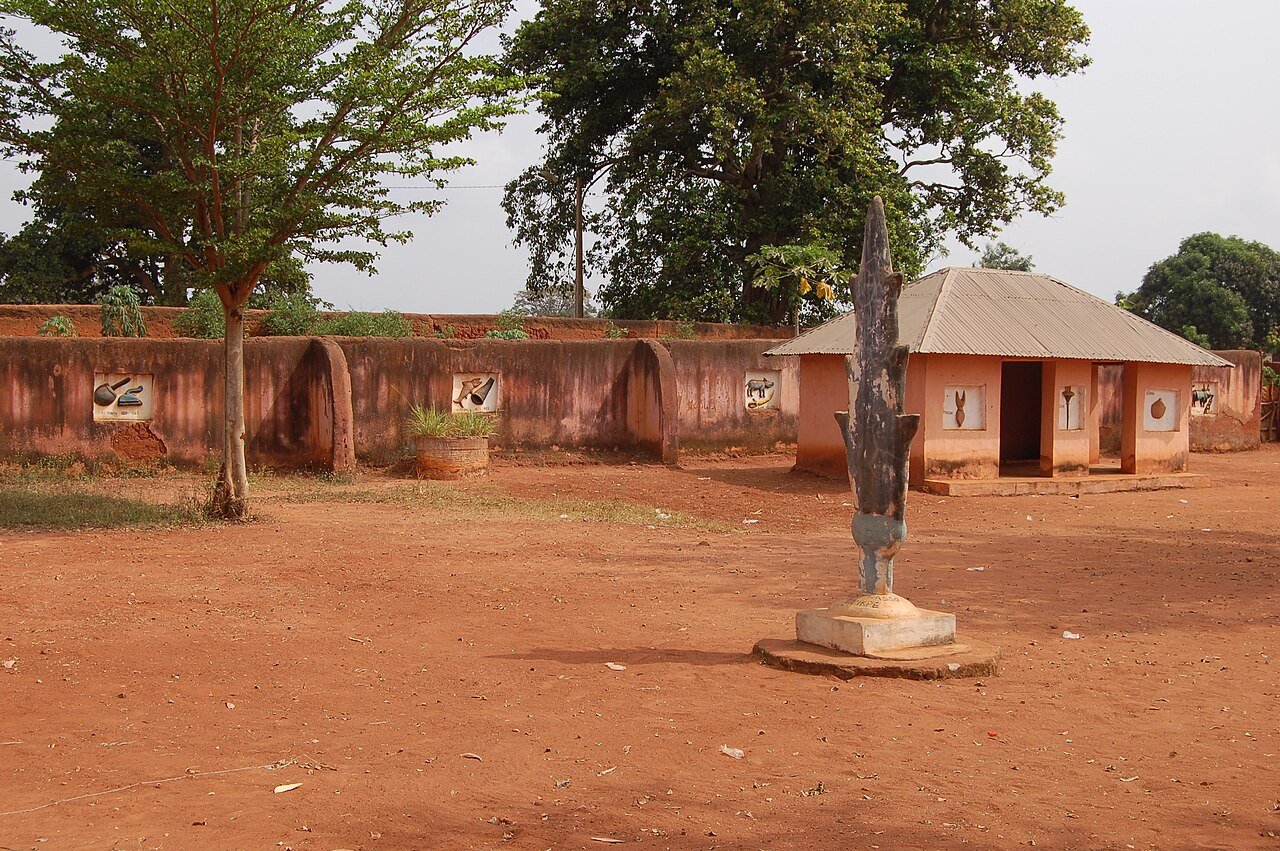
The palaces are built from compressed earth (adobe) in a technique that has proven remarkably durable in the West African climate. The outer walls — some sections still standing at 3-4 metres — enclose throne rooms, audience courts, ancestral shrines, storehouses and private quarters. The most distinctive artistic feature is the bas-relief panels that cover the exterior walls of major halls: these low-relief earthen sculptures depict the achievements, attributes and symbols of each king in a systematic visual programme that served as a history without writing. Each king had a personal symbol — King Agaja was represented by a ship (after his conquest of the slave-trading port of Ouidah in 1727), King Glele by a lion, King Behanzin by a shark and an egg. The tapestries (appliqué cloth panels) woven in Abomey used the same visual vocabulary and were displayed inside the palaces.
Abomey’s prosperity rested substantially on the Atlantic slave trade. From the mid-17th century through the 19th century, the Kingdom of Dahomey was the primary supplier of enslaved people to European traders at the port of Ouidah (Glexwe) on the Bight of Benin coast, 100 kilometres south of Abomey. Prisoners of war from raids on neighbouring peoples — the Mahi, the Yoruba and others — were marched to Ouidah and sold to Portuguese, British and Dutch slavers. Estimates suggest that at least one million enslaved people were shipped from the Bight of Benin during the era of the Atlantic slave trade. The wealth generated funded the royal palaces, the military apparatus and the sophisticated court culture of Abomey. The Ouidah Museum of History (a former Portuguese fort) and the Route des Esclaves (the road enslaved people walked to the coast) are now key memorial sites near Cotonou, forming an essential complement to any visit to Abomey.
Dahomey was also exceptional for the Agojie — the all-female royal military corps that served as both the king’s personal bodyguard and a front-line fighting force. Known in European sources as the “Dahomey Amazons,” the Agojie took a sacred oath of dedication to the king and were bound by strict celibacy during active service. At their peak under King Gezo (r. 1818-1858), the Agojie numbered approximately 6,000 women and constituted roughly a third of the entire Dahomey army. Trained in hand-to-hand combat and night raids, they were by multiple European and African accounts among the most disciplined and feared soldiers in the region. Their name in Fon — Agojie — translates approximately as “those who have taken the sacred oath.”
The fall of Dahomey, the Paris treasures and the 2021 repatriation Abomey Historical Museum, formerly the palace of King Glele
The last independent king of Dahomey, Behanzin (r. 1889-1894), came to power at precisely the moment France was extending its colonial reach into the interior of West Africa. Behanzin was a formidable opponent: he negotiated with Germany as a counter-pressure to French demands, reorganised and rearmed the Dahomey military, and led forces that dealt the French several tactical setbacks in the First Franco-Dahomean War of 1890. The Second Franco-Dahomean War (1892-1894) brought a much larger French force under General Alfred-Amédée Dodds, who used superior artillery and Senegalese tirailleurs (infantry) in a grinding advance from the coast. Behanzin surrendered in January 1894 and was exiled first to Martinique and then to Algeria, where he died in 1906.
When French forces entered Abomey in November 1892, they found Behanzin had ordered the palace set on fire to prevent its treasures from falling into French hands. Much was destroyed. What survived — including 26 royal statues (bocio), throne chairs, hammered-iron figures (including the famous war god Gu, whose image incorporated actual human skulls), and numerous appliqué tapestries — was taken to France and deposited in the Trocadéro museum, which later became the Musée de l’Homme and eventually the Musée du Quai Branly in Paris, where they remained on display for 130 years.
In November 2021, France returned 26 of the royal Abomey treasures to Benin — the first significant repatriation of African cultural objects from a French national museum, and one of the largest repatriations in the history of colonial-era museum collections globally. The handover followed a 2017 report commissioned by French President Emmanuel Macron which recommended the return of African heritage taken without consent during the colonial period. The objects are now on display at the Abomey Historical Museum, housed in the preserved palace of King Glele within the royal enclosure. Their return has reignited broader debates about the hundreds of thousands of African objects still held in European collections.
A fire in 1984 damaged significant portions of the royal enclosure, and the site was placed on UNESCO’s List of World Heritage in Danger following that event, remaining there until 2007 after an international restoration campaign. The earthen structures require continuous maintenance: the wet season accelerates erosion of unprotected walls, and the site management team in partnership with the Getty Conservation Institute and the World Monuments Fund has developed a programme for annual maintenance of the bas-relief panels using traditional Fon techniques.
Practical information
Abomey is approximately 145 kilometres north of Cotonou, the economic capital of Benin, and the journey typically takes two to three hours by road. There is no railway link, but shared bush taxis and private car hire are readily available from Cotonou’s Jonquet bus station. The nearest major city is Bohicon, 5 kilometres from Abomey, which has bus connections to Cotonou. Abomey itself is a small city of approximately 100,000 inhabitants with a limited but functional range of hotels and guesthouses; most visitors base themselves in Cotonou or combine a visit with the Route des Esclaves at Ouidah (roughly 40 km southwest of Cotonou) for a broader understanding of the Dahomey era.
The Abomey Historical Museum is the official entry point for the palace complex, with guided tours in French and sometimes English; requesting an English-speaking guide in advance through the museum directorate is advisable. The museum entrance includes access to the two best-preserved palaces (Glele and Béhanzin) and the recently returned royal treasures. Budget at least three to four hours. Opening hours are approximately 08:00 to 17:00 daily. Photography of the bas-relief panels is generally permitted; flash use inside the museum galleries may be restricted. Abomey’s market day (every four days following the traditional Fon calendar) adds local colour to a visit. The rainy season runs April to July and September to November; the harmattan (dry, dusty wind from the Sahara) blows December to February, which is the cooler and more comfortable time to travel.
Frequently Asked Questions
Who were the Agojie (Dahomey Amazons) and what happened to them after the French conquest?
The Agojie were an all-female royal military unit of the Kingdom of Dahomey, active from roughly the early 18th century to the French conquest of 1894. Their origins are debated: one tradition holds that female elephant hunters (gbeto) who were brought to the palace to demonstrate their courage became the model for the first female soldiers; another tradition traces them to female palace guards whose fighting capacity was discovered in early military operations. Under King Gezo (r. 1818-1858), the Agojie expanded dramatically in numbers and tactical importance, reaching an estimated 6,000 fighters. They were divided into specialised units with different weapons — muskets, bladed weapons, and bows — and were known for conducting night raids into enemy territory. European observers noted their discipline and ferocity. During the Franco-Dahomean Wars of 1890 and 1892-1894, the Agojie fought alongside male soldiers in conventional engagements against French forces equipped with superior artillery. After Behanzin’s surrender in 1894, the French colonial administration disbanded the Agojie as a military institution. A small number of survivors of the final campaigns lived into the 20th century; the last verifiable survivor, Nawi, died in 1979, reportedly over 100 years old. Their story gained widespread international attention following the 2022 film “The Woman King.” Historians note that while the film dramatises some events, the core facts — the scale of the corps, their military record, and their connection to the Dahomey slave trade — are historically documented.
What is the significance of the 2021 repatriation of Abomey treasures from France?
The return of 26 royal objects from the Musée du Quai Branly to Benin in November 2021 was the largest single repatriation of African cultural heritage from a French national collection and a landmark moment in the broader debate about colonial-era museum collections. The objects — which include royal statues (bocio), throne chairs, appliqué tapestries, and the iron war god Gu — had been taken from Abomey in 1892 when French forces under General Dodds entered the burning royal palace. They were classified as “war trophies” under French law, a categorisation that legally distinguished them from cultural property subject to restitution claims. Their return followed the 2018 Sarr-Savoy Report (commissioned by President Macron), which argued that France held approximately 90,000 African objects in its national museums and that the legal framework should be changed to allow repatriation. A special law was passed by the French parliament in 2020 authorising the return of the specific 26 Abomey pieces and a set of objects from Senegal. The repatriation has renewed pressure on British, Belgian, German and other European institutions holding African heritage, particularly the Benin Bronzes from Nigeria (held in the British Museum, Berlin’s Ethnological Museum and elsewhere). Whether the 2021 handover represents a turning point or remains an exception is still being determined by the pace of subsequent repatriation decisions across Europe.
How does the Abomey palace complex compare to other royal earthen architecture in West Africa?
The Royal Palaces of Abomey are distinctive even within West Africa’s rich tradition of earthen architecture. The most direct comparisons are with the Great Mosque of Djenné in Mali (also UNESCO-listed), the royal palaces of the Ashanti at Kumasi in Ghana, and the Kasubi Tombs of the Buganda Kingdom in Uganda. Djenné shares the sudano-sahelian earthen building technique and the challenge of annual maintenance — the mosque requires a community replastering event each year to survive the rainy season. But Djenné’s architecture is primarily religious, while Abomey’s palaces are essentially a political and memorial landscape: an accumulation of royal power made physical. The Ashanti royal palace complex at Kumasi is comparable in political function but was largely rebuilt after British destruction in 1874 and 1900; the surviving traditional structures are less intact than Abomey’s. What makes Abomey most unusual in global comparison is the systematic visual historiography embedded in the bas-relief programme: each king’s palace walls constitute a coherent record of his reign in a society that had no written script, and the consistency of this visual language across 275 years of royal construction is without close parallel in sub-Saharan Africa.
Sources
- S1 — Blier, Suzanne Preston. Royal Arts of Africa: The Majesty of Form. Harry N. Abrams, 1998. ISBN 978-0-8109-2705-6.
- S2 — Bay, Edna G. Wives of the Leopard: Gender, Politics, and Culture in the Kingdom of Dahomey. University of Virginia Press, 1998. ISBN 978-0-8139-1792-4.
Spotted an error? Write to editorial@culturalheritageonline.com and we correct it the same day.