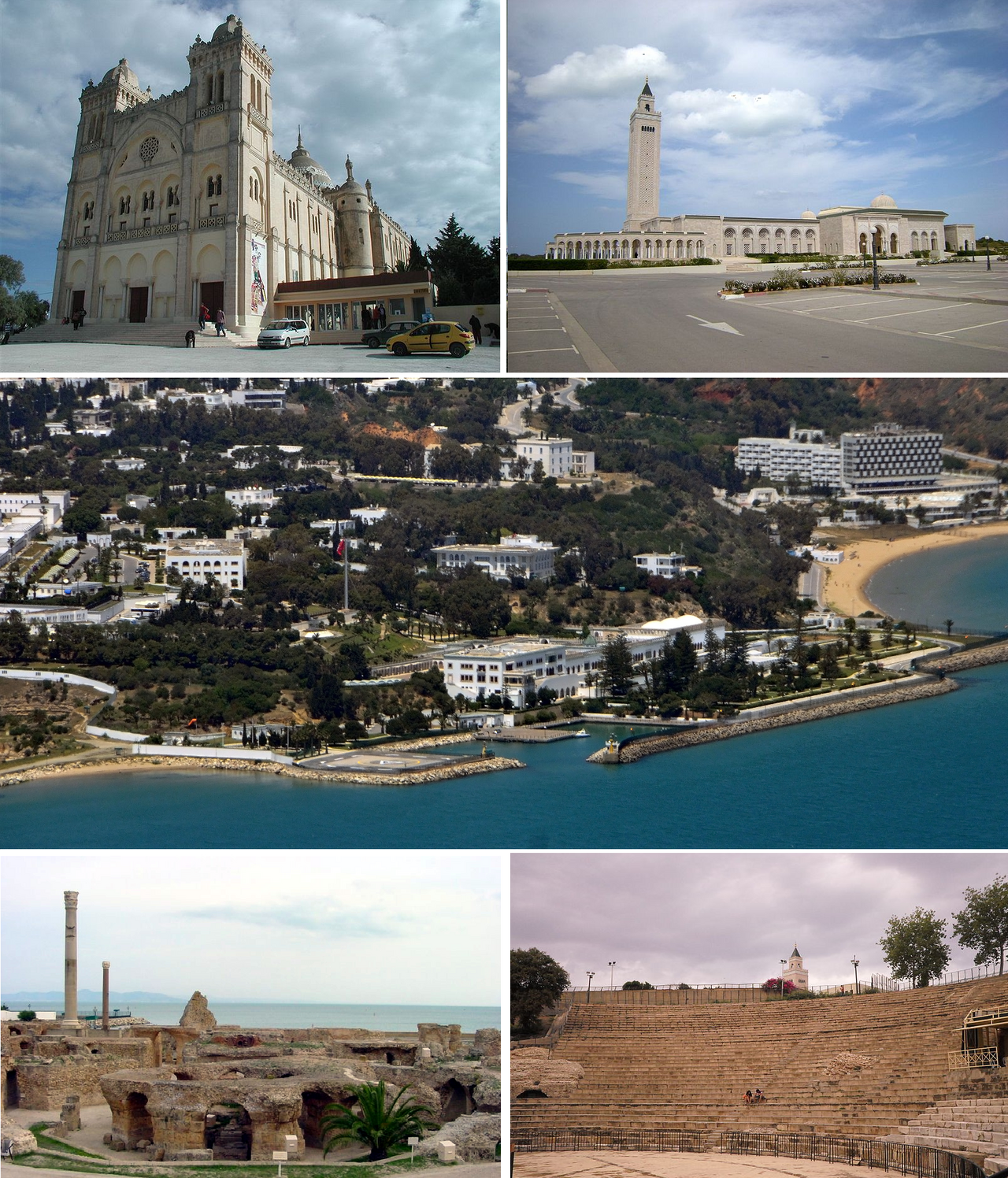
Carthage occupies a peninsula on the Gulf of Tunis, 15 kilometres northeast of the city centre, where layers of Punic, Roman, Byzantine and Arab history are stacked on top of each other in a suburb that is now one of the wealthiest residential districts in Tunisia. Founded by Phoenician settlers from Tyre around 814 BCE, it grew into the dominant naval and commercial power of the western Mediterranean before Rome destroyed it entirely in 146 BCE — then rebuilt it as an imperial city that rivalled Alexandria in size and influence. The UNESCO-listed Archaeological Site of Carthage (1979) is not a single monument but a dispersed urban field where museums, excavated terraces and massive bath ruins occupy the same hillsides as villas and a presidential palace.
Punic Carthage: from Dido’s cowhide to Hannibal’s elephants Byrsa Hill and coastal harbours
The founding myth of Carthage is one of the most mathematically ingenious in antiquity. Queen Dido — also known as Elissa, a Phoenician princess who fled the city of Tyre after her brother Pygmalion murdered her husband — arrived on the Tunisian coast and negotiated with the local Berber king for as much land as a cowhide could cover. She then cut the hide into the thinnest possible strips, laid them end to end, and enclosed the entire Byrsa hill. The word “Byrsa” in Greek means “hide,” and the name may preserve the memory of this territorial trick. Whether myth or memory, the Byrsa hill became the acropolis of Punic Carthage, the sacred and administrative heart of a city that grew to roughly 400,000 inhabitants by the 4th century BCE.
At its peak, Carthage dominated western Mediterranean trade. Its merchants controlled routes to Spain (silver and tin from the mines of Iberia), Sardinia, Sicily and the West African coast (where they may have reached as far as the Gulf of Guinea). The Carthaginian general Hanno the Navigator sailed down the African coast around 500 BCE and left a Greek-language account of his voyage, the Periplus of Hanno, which survives today. The two harbours visible today — a rectangular merchant harbour and a circular military harbour with a central island for the admiral’s command post — give the clearest surviving impression of Punic urban planning.
The three Punic Wars with Rome (264-146 BCE) are the most consequential conflicts in the ancient western Mediterranean. The Second Punic War produced one of the most audacious military campaigns in history: in 218 BCE, the Carthaginian general Hannibal Barca led an army of approximately 40,000 soldiers and 37 war elephants from Spain, across the Pyrenees, through Gaul and over the Alps in late autumn, descending into northern Italy and inflicting three catastrophic defeats on Roman armies in quick succession at the Trebia river, Lake Trasimene and Cannae (216 BCE, where approximately 50,000-70,000 Roman soldiers died in a single afternoon — one of the largest battlefield losses in ancient history). Hannibal spent 15 years in Italy but never received sufficient reinforcements from Carthage to take Rome itself. After his defeat at Zama in 202 BCE, Carthage was stripped of its empire and fleet.
The Third Punic War (149-146 BCE) ended with the Roman senator Cato the Elder’s famous insistence — reportedly appended to every speech he gave, on any subject — that “Carthage must be destroyed” (Carthago delenda est). After a three-year siege, Scipio Aemilianus broke through the walls and fought house by house for six more days. The city was burned, the survivors — roughly 50,000 — were sold into slavery, and the site was left abandoned. The persistent claim that Rome salted the earth to prevent future cultivation is a 19th-century invention; there is no ancient source for it.
Roman Carthago: baths, bishops and the third city of the empire Antonine Baths and Tophet sanctuary
Julius Caesar planned a Roman colony on the site of Carthage, and the city was formally established in 29 BCE under Augustus. Within three centuries, Roman Carthago had grown to over 300,000 inhabitants, making it the second or third largest city in the Roman Empire, after Rome and Alexandria. It served as the capital of the Roman province of Africa Proconsularis and later the Diocese of Africa, one of the wealthiest regions in the empire supplying grain, olive oil and wild animals for the Roman arena.
The most impressive surviving structure is the Baths of Antoninus, built in the 2nd century CE under Emperor Hadrian and completed under Antoninus Pius. These were the third largest Roman baths in the world, after the Baths of Caracalla and the Baths of Diocletian in Rome. Only the basement level — a vast network of pillar-supported vaulting and service corridors — remains standing today, because later populations stripped the marble cladding and upper structures for building material over centuries. The scale of the basement alone gives a sense of the ambition: the main hall would have risen some 20 metres above the current floor level.
The Tophet — a Punic sacred precinct near the harbours, now partially visible as an open-air excavation — contains over 20,000 funerary urns with the cremated remains of children and animals. This site has generated one of the most contentious debates in ancient history: Greek and Roman sources accused the Carthaginians of sacrificing children to their gods Baal Hammon and Tanit, while some modern scholars argue the urns represent a cemetery for infants who died of natural causes. The physical evidence — isotope analysis showing some children died at birth, others at age two or three, and the presence of animal bones that may have been substituted for children — supports both readings simultaneously, and the debate is unresolved.
Roman Carthage was also one of the most important early Christian cities. Tertullian, the first major Christian writer in Latin, worked here in the late 2nd century. The Council of Carthage (397 CE) produced one of the earliest canonical lists of the books of the Christian Bible. Saint Augustine, bishop of the nearby city of Hippo Regius (modern Annaba in Algeria), knew Carthage well and studied there as a young man. The city remained a major centre of Christian theology until the Arab conquest in 698 CE, after which it was largely abandoned in favour of the new city of Tunis.
Practical information
Carthage is not a single entry point but a series of sites spread across several kilometres of coastline and hilltop, all within the modern municipality of Carthage, which is a suburb of Tunis. The most efficient access is via the TGM suburban railway from Tunis Marine station, with stops at Carthage Salammbô (closest to the Tophet and the Punic harbours), Carthage Byrsa (Byrsa Hill and the National Museum of Carthage), Carthage Dermech (Antonine Baths), and Carthage Présidence. A combined ticket covers entry to the main archaeological zones, but the sites are open-air and spread out; comfortable walking shoes are essential.
The National Museum of Carthage, located on the Byrsa hill, holds the most complete collection of Punic and Roman artefacts from the site, including stelae from the Tophet and mosaics from Roman villas. The Baths of Antoninus are best visited in the morning when the sun illuminates the basement corridors. The Punic harbours can be viewed from a circular path around the outer military harbour. Most sites are open daily from approximately 08:30 to 17:00 (hours vary seasonally). The combined site ticket as of 2025 costs approximately 15 Tunisian dinars. There is no single visitor centre; orientate using the museum as a base point and walk or take the TGM between zones. Tunis offers a wide range of accommodation, with the Medina (UNESCO-listed separately) and the Lake District close to TGM connections.
Frequently Asked Questions
Did Rome really salt the earth at Carthage after destroying it?
No. The claim that Roman forces sowed the ruins of Carthage with salt to prevent future cultivation is not found in any ancient source. It appears to have been invented by the American historian B.H. Hallward in a 1930 Cambridge Ancient History chapter, possibly as a rhetorical flourish, and was then repeated as fact through much of the 20th century. The Latin phrase “Carthago delenda est” (Carthage must be destroyed) is historically attested, as is the thoroughness of the destruction in 146 BCE — Scipio Aemilianus reportedly wept as the city burned, quoting Homer’s lines about the fall of Troy. But the Romans had no practical motive to salt the land: the province of Africa Proconsularis became one of the most productive agricultural regions of the Roman Empire within a few generations, and a Roman colony was established on the site itself under Augustus in 29 BCE. Archaeologists excavating Punic and early Roman Carthage have found no evidence of systematic soil treatment. The myth persists because it makes for a satisfying image of Roman thoroughness, but it has no basis in ancient evidence and was almost certainly never true.
What is the Tophet at Carthage, and was child sacrifice really practised there?
The Tophet is a sacred precinct or open-air sanctuary located near the ancient Punic harbours, first excavated systematically in the 1920s. It contains thousands of funerary urns — estimates range from 20,000 to over 100,000 — holding the cremated remains of children (mostly under two years old) and animals, covered with stone markers (stelae) dedicated to the Phoenician deities Baal Hammon and Tanit. Greek and Roman writers, who were hostile to Carthage, described the ritual sacrifice of children there. The debate among modern scholars is genuinely unresolved. One school reads the physical evidence — the consistency of the urns, the ritual context, the ancient literary sources — as confirming sacrifice. Another school, represented prominently by scholars like Josephine Quinn and others, argues the Tophet was primarily a cemetery for children who died before or shortly after birth (a special burial ground, since young children were not normally buried in standard Punic cemeteries), with animal bones representing substitute offerings. Isotope analysis of the bones shows some children died at birth, others at age two or three, and some show signs of premature death. The most accurate current position is that the evidence is ambiguous and both interpretations remain viable — a fact that the site itself does not clearly resolve for visitors.
How long does it take to visit all the main Carthage sites, and is a guide necessary?
Visiting all the main archaeological zones of Carthage — the Byrsa hill and National Museum, the Antonine Baths, the Tophet, the Punic harbours, the Roman villas and the amphitheatre — realistically requires a full day of approximately six to seven hours of active visiting, plus travel time between sites using the TGM suburban train. The sites are dispersed over roughly 3-4 kilometres of coastline and hillside, and there is no single entrance point or shuttle service. Most signage is in Arabic and French, with some English at major monuments. An independent visit is feasible with a good guidebook or offline resource, but the sites lack the interpretive infrastructure of, say, Pompeii: the Antonine Baths in particular are difficult to read without prior knowledge of Roman bath architecture. Hiring a licensed guide from the National Museum entrance significantly improves the experience, especially for understanding the Tophet and the layering of Punic under Roman remains on the Byrsa hill. Half-day guided tours from Tunis city centre are widely available and typically cover the Baths and museum only, leaving the harbours and Tophet for independent exploration.
Sources
- S1 — Lancel, Serge. Carthage: A History. Blackwell, 1995. ISBN 978-1-55786-468-0.
- S2 — Miles, Richard. Carthage Must Be Destroyed: The Rise and Fall of an Ancient Civilization. Viking, 2010. ISBN 978-0-670-02266-3.
Spotted an error? Write to editorial@culturalheritageonline.com and we correct it the same day.