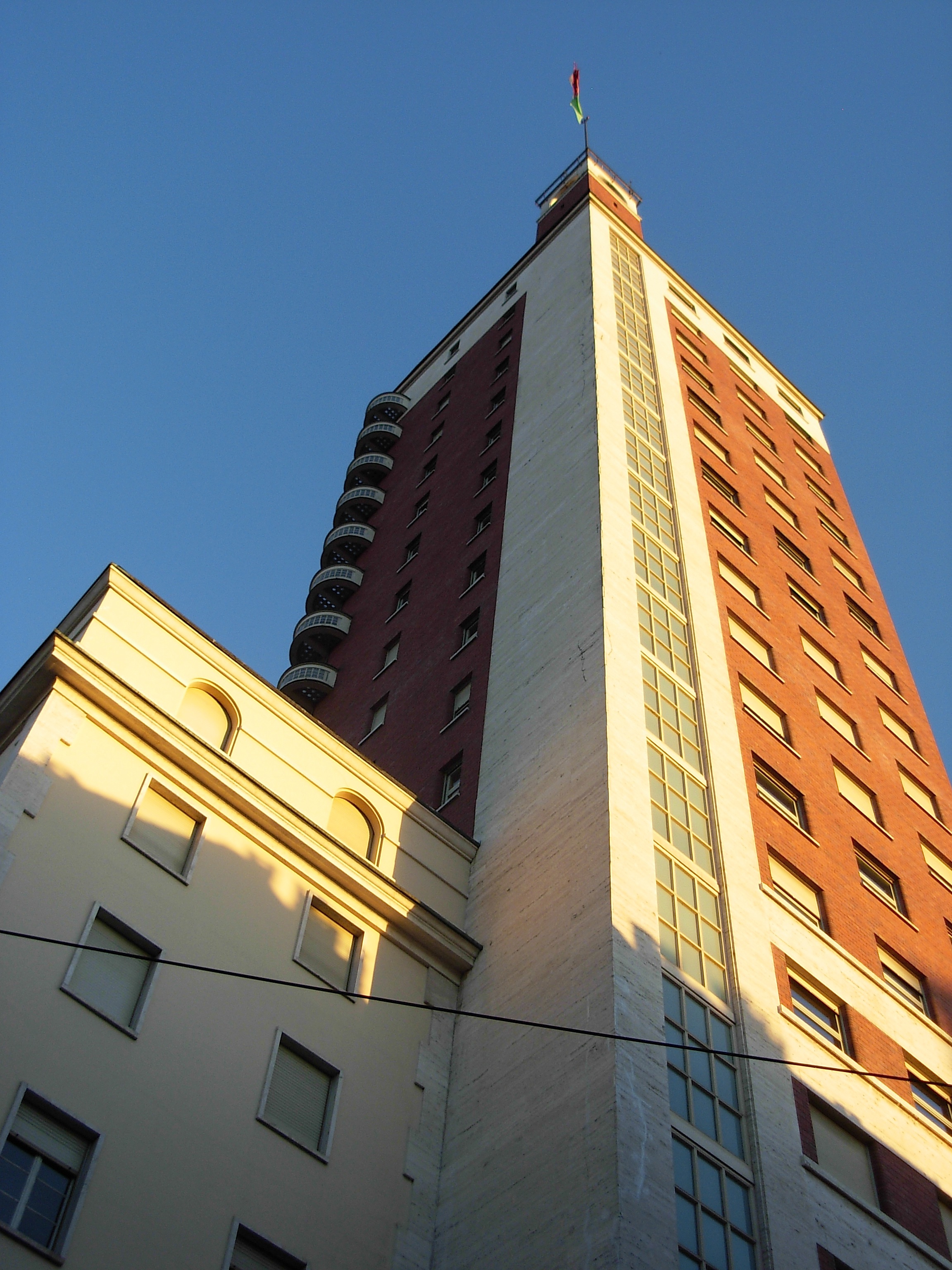
The Torre Littoria, now known as Grattacielo Reale Mutua, is a residential tower in central Turin designed by architect Armando Melis de Villa in collaboration with engineers Giovanni Bernocco and Giorgio Scanagatta, completed in 1934.

Upon its completion, the tower became the first and tallest residential building in Turin. It remained Europe’s highest residential structure until 1952, and stands as one of Italy’s most significant examples of Rationalist architecture. The building’s original Fascist-era name has since been replaced by its current commercial designation.
About Armando Melis de Villa
Armando Melis de Villa (1889–1961) was an Italian architect and urban planner who graduated from the Turin Polytechnic in 1920. He participated in the design of several pavilions for the 1928 National Italian Architecture Exhibition at Valentino Park, working both independently and with GANT (Giovani Architetti Novatori Torinesi, Young Innovative Turin Architects). Melis de Villa later taught architectural composition at Turin’s Faculty of Architecture, becoming ordinary professor in 1957.
Details
- Architects and engineers: Armando Melis de Villa, Giovanni Bernocco, Giorgio Scanagatta
- Completed: 1934
- Location: Turin, Italy
- Movement: Italian Rationalism
- Current name: Grattacielo Reale Mutua
- Significance: Europe’s tallest residential building, 1934–1952
Explore more: 102 heritage places in Torino
Frequently asked questions
Who designed the Torre Littoria?
The tower was designed by architect Armando Melis de Villa in collaboration with engineers Giovanni Bernocco and Giorgio Scanagatta.
When was it completed and what made it significant?
Completed in 1934, it became Turin’s first and tallest residential building, and remained Europe’s highest residential structure until 1952, representing a major achievement in Italian Rationalist architecture.
Why is it called Grattacielo Reale Mutua today?
The building’s original Fascist-era name, Torre Littoria, was replaced with its current commercial designation, Grattacielo Reale Mutua, reflecting its later use and ownership.
Sources
- S1 — Ciucci, Giorgio. Gli architetti e il fascismo: architettura e città 1922-1944. Einaudi, 1989. ISBN 978-88-06-11656-9.
- S2 — Danesi, Silvia, and Luciano Patetta, eds. Il razionalismo e l'architettura in Italia durante il fascismo. Electa, 1976. ISBN 978-88-435-0394-0.
Spotted an error? Write to editorial@culturalheritageonline.com and we correct it the same day.