
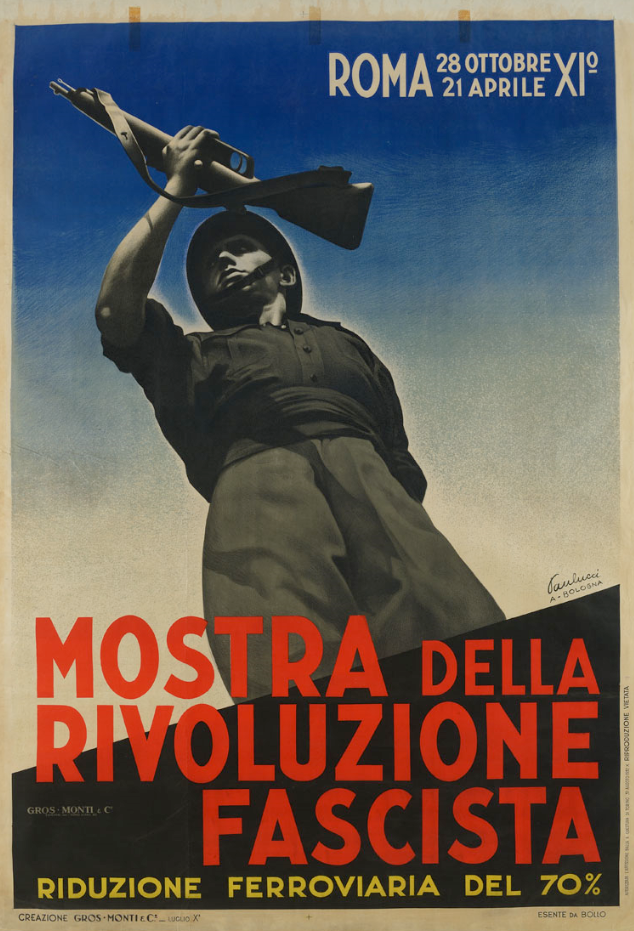
An advertising poster designed by Enrico Paulucci in 1932. Paulucci (1901–1999) was an Italian painter and scenic designer who played a key role in Turin’s artistic circles during the interwar period.
Paulucci was born in Genoa and moved to Turin in 1911, where he studied economics and law before turning to the visual arts. In the late 1920s he encountered the work of Felice Casorati, one of Turin’s most significant artistic figures. By 1929, Paulucci had founded the Gruppo dei Sei alongside painters Jessie Boswell, Gigi Chessa, Nicola Galante, Carlo Levi, and Francesco Menzio. This collective sought intellectual and artistic independence during a period of ideological pressure. The group received support from wealthy patron Riccardo Gualino and influential critics including Lionello Venturi.
About Enrico Paulucci
Paulucci’s early career was shaped by exposure to Futurism in Turin during the mid-1920s, where he worked alongside painters such as Fillìa and Enrico Prampolini. A 1928 stay in Paris broadened his artistic horizons; that year, one of his paintings was selected for the Venice Biennale. His practice extended across painting, graphic design, and scenic design, reflecting the interdisciplinary approach characteristic of avant-garde circles in interwar Italy.
Details
- Creator: Enrico Paulucci
- Year: 1932
- Object type: Advertising poster
- Movement: Associated with Gruppo dei Sei and second-generation Futurism
- Creator’s lifespan: 1901–1999
Frequently asked questions
Who was Enrico Paulucci?
Enrico Paulucci (1901–1999) was an Italian painter and scenic designer born in Genoa. In 1929 he co-founded the Gruppo dei Sei in Turin, an artistic collective that pursued creative independence during the interwar period.
What was the Gruppo dei Sei?
The Gruppo dei Sei was founded in Turin in 1929 by six artists—Paulucci, Jessie Boswell, Gigi Chessa, Nicola Galante, Carlo Levi, and Francesco Menzio—who sought intellectual freedom and artistic autonomy. The group was supported by patron Riccardo Gualino and critics including Lionello Venturi.
What artistic movements influenced Paulucci?
In the mid-1920s, Paulucci was briefly associated with Turin’s second-generation Futurists, including painters Fillìa and Enrico Prampolini. He also came under the influence of Felice Casorati, a major artistic figure in Turin, and spent time in Paris in 1928, where his work was exhibited at the Venice Biennale.
Sources
- S1 — Bossaglia, Rossana. Il Novecento Italiano: storia, documenti, iconografia. Feltrinelli, 1979. ISBN 978-88-07-60056-2.
- S2 — Pontiggia, Elena. Il Novecento Italiano. Abscondita, 2003. ISBN 978-88-8416-048-5.
Spotted an error? Write to editorial@culturalheritageonline.com and we correct it the same day.


