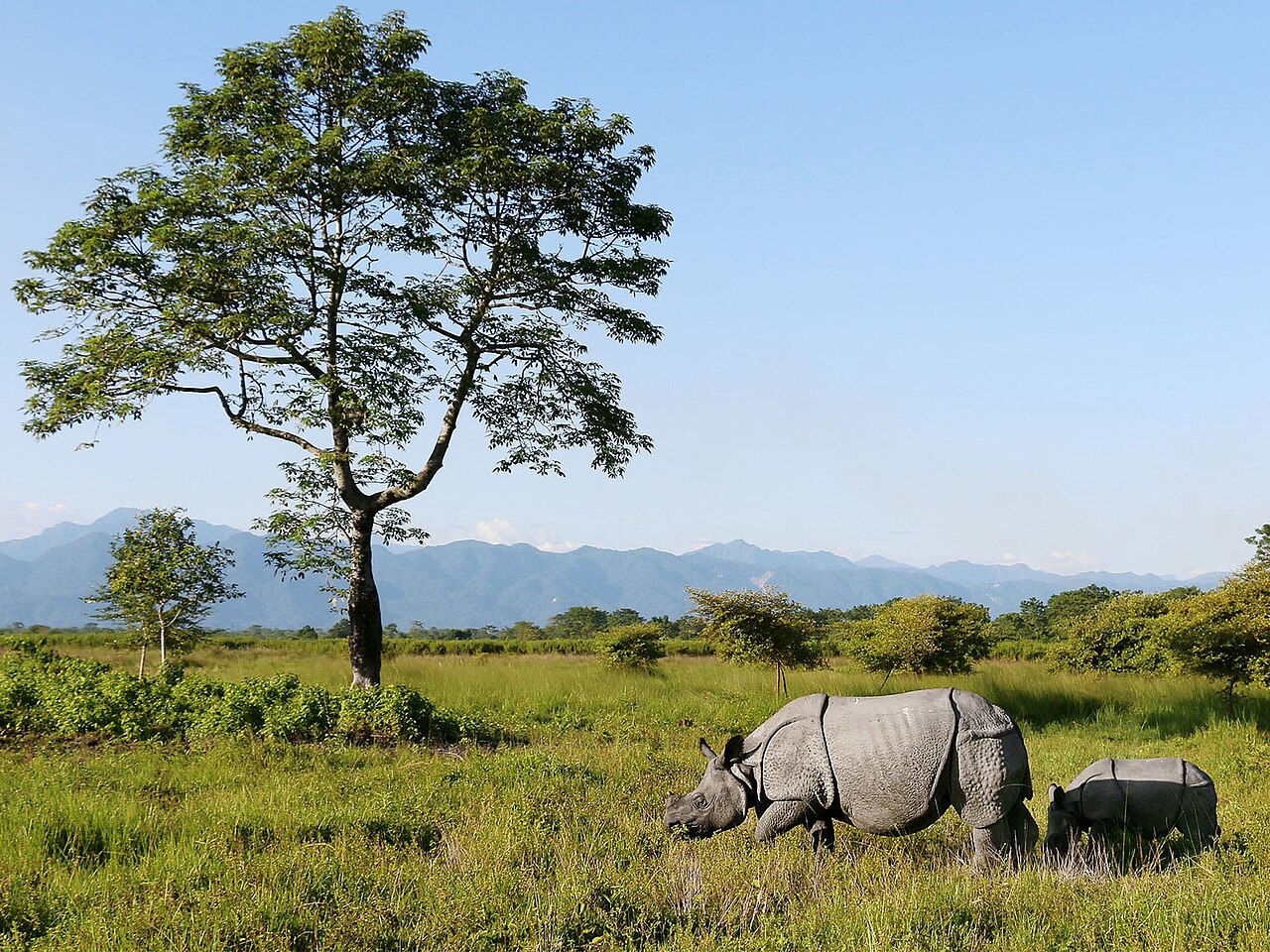
Manas National Park (মানস ৰাষ্ট্ৰীয় উদ্যান), inscribed by UNESCO in 1985 and a Biosphere Reserve, Tiger Reserve, and Elephant Reserve in the Assam-Bhutan border zone of northeastern India — a reserve of approximately 950 km² (the Manas Tiger Reserve encompasses approximately 2,840 km² including buffer zones) in the Himalayan foothills where the Manas River descends from the Royal Manas National Park in Bhutan through the Himalayan piedmont grasslands, semi-evergreen forests, and river floodplains of Assam — is one of the most dramatic conservation recovery stories in the history of UNESCO World Heritage. Manas was placed on the UNESCO List of World Heritage in Danger in 1992 following a decade of devastating armed insurgent activity by the Bodo People’s Liberation Front, which used the park as a base and killed approximately half the park’s wildlife enforcement personnel while poachers operating with impunity eliminated the rhino population (from approximately 80 Indian one-horned rhinoceros in 1990 to near zero by 2000), nearly eliminated the golden langur (Trachypithecus geei, a critically endangered primate found only in the Assam-Bhutan border zone, with approximately 5,000–7,000 individuals globally), and reduced the tiger population to critically low numbers. The park was removed from the Danger List in 2011 after a 21-year designation — the longest any UNESCO site had been on the Danger List to that date — following the political resolution of the Bodo insurgency, the return of Forest Department staff, and the success of the rhinoceros reintroduction programme (Operation Rhino, which relocated animals from Kaziranga, resulting in the current Manas rhino population of approximately 40 individuals).
Manas’s wildlife recovery landscape and the Assam–Bhutan border heritage corridor Manas River · Core zone grasslands · Royal Manas NP Bhutan · Kaziranga · Barpeta — 0 to 180 km
The Manas National Park landscape — where the Manas River exits the Bhutan Himalayan foothills through a gorge in the outer Himalayan ranges and spreads into the broad braided river channels and floodplain grasslands of the Assam piedmont — is ecologically distinct from the Brahmaputra floodplain character of Kaziranga. The terrain at Manas combines the tall elephant-grass beels of the Brahmaputra floodplain tradition (similar to Kaziranga) with the subtropical broadleaf semi-evergreen forest of the Himalayan foothills and the rocky river channels of the Manas River system, creating a greater habitat diversity than Kaziranga and a correspondingly greater species diversity: Manas holds not only the four large mammals of Kaziranga (rhinoceros, tiger, elephant, and wild water buffalo) but also the specific Himalayan-foothill species that make the Assam-Bhutan border zone unique — the pygmy hog (Porcula salvania, the world’s smallest wild pig, approximately 30 cm tall, critically endangered, with only approximately 250 individuals surviving globally in a range now restricted to three sites in Assam including Manas — the species was considered extinct from 1970 to 1971 when a small population was rediscovered in the Barnadi Wildlife Sanctuary), the hispid hare (Caprolagus hispidus, critically endangered, found in the tall elephant-grass thickets of the Terai and Himalayan foothills in small isolated populations), and the golden langur (the arboreal primate with a cream-to-golden coat found only in the Manas-Bhutan border forest). The transboundary dimension of Manas (the Royal Manas National Park in Bhutan, directly adjacent to the Indian park on its northern boundary and together comprising the Trans-boundary Royal Manas–Manas National Parks complex of approximately 2,500 km²) creates one of the largest connected protected areas in South Asia — tigers, elephants, and rhinoceros move freely between the Bhutanese and Indian portions of the park system through the border forest without encountering any physical barrier. The Bhutanese portion of the complex adds altitude (from the Manas River valley at approximately 60 m above sea level to the Himalayan peaks of approximately 4,000–5,000 m at the northern boundary of Royal Manas NP) that creates a complete altitudinal transect of Himalayan biodiversity within a single connected conservation landscape.
Barpeta (approximately 40 km west of Manas — a major centre of the Ekasarana Dharma, the Vaishnavite reform movement founded by the 15th–16th century CE saint Srimanta Shankardev that has shaped Assamese cultural and religious identity since the medieval period; the Barpeta Satra, the principal monastery of the Ekasarana tradition, holds the annual Holi festival with elephant processions that is one of the major cultural festivals of Assam) and Kaziranga (UNESCO 1985, approximately 180 km east of Manas — the principal Indian rhinoceros conservation site) are the two most important regional heritage complements to the Manas wildlife experience.
Practical information
Manas National Park is accessible from Barpeta Road (the nearest railway station, approximately 37 km from the Mothanguri gate of the park; Barpeta Road is on the main Assam Railway line between Guwahati and New Bongaigaon). By road from Guwahati (175 km west, approximately 3.5–4 hours). The nearest city with airport is Guwahati (Lokpriya Gopinath Bordoloi International Airport, 175 km from the park). By road from Kaziranga (approximately 180 km, approximately 4 hours). The park is open October 1 to March 31 annually (peak wildlife-viewing season; closed April–September during monsoon and for habitat management). Entry permits from the Forest Department at the Mothanguri Range Office. Jeep safari (the primary wildlife-viewing format; elephant-back safari is also available in the core zone at the discretion of the Forest Department). Best months: December–February (cool, dry, clear visibility in the grassland). Accommodation: Forest Department bungalows (Mathanguri, inside the park — the best situation for wildlife and atmosphere); tourist lodges at Barpeta Road and nearby. Photography: telephoto lens 300mm+ recommended. The park’s remoteness (compared to Kaziranga) and lower visitor infrastructure mean that Manas receives far fewer tourists than its conservation value warrants — wildlife encounters can be more intimate and less crowded than Kaziranga.
Frequently Asked Questions
How was Manas National Park placed on the UNESCO Danger List and how was it rescued?
The Manas National Park crisis (1990–2011 CE) is the most severe case of armed conflict-driven World Heritage site destruction in the history of the UNESCO World Heritage programme — more severe than the Taliban destruction of the Bamiyan Buddhas in 2001 (which was a one-time iconoclastic event) because it involved a sustained 20-year process of systematic wildlife elimination in a living natural ecosystem. The crisis began with the intensification of the Bodo People’s Liberation Front (BPLF) armed insurgency in Assam in the late 1980s — the Bodo community, an indigenous Assamese ethnic group, was engaged in a long-running armed conflict with the Government of India and the Assam state government demanding recognition and autonomy for the Bodoland region, of which Manas National Park and its surrounding forest occupied a significant portion. The BPLF and allied groups used the park as a base, preventing Forest Department staff from entering the core zone effectively from approximately 1990 to 2003, during which time poachers operating without interference from law enforcement reduced the wildlife to catastrophic levels: the rhinoceros population was eliminated (from approximately 80 in 1990 to zero confirmed individuals by 2000); the elephant population was reduced from approximately 2,000 to approximately 500; the tiger population fell to approximately 10–15 individuals (from approximately 50–60 in 1990); the golden langur population was reduced to critically low numbers in the Manas corridor; and the park infrastructure (guard posts, patrol vehicles, communication equipment, bridges) was destroyed. UNESCO placed Manas on the World Heritage in Danger List in 1992. The recovery began following the Bodoland Territorial Council Agreement (2003), which provided a degree of autonomy to the Bodo community and led to the BPLF’s demobilisation. Forest Department staff returned to the park from 2003–2005, anti-poaching patrols were re-established, and the rhinoceros reintroduction programme (Operation Rhino, initiated 2008, conducted by the Wildlife Trust of India and the International Rhino Foundation in collaboration with the Assam Forest Department) relocated 14 Indian one-horned rhinoceros from Kaziranga to Manas in a phased programme that resulted in natural reproduction and a current population of approximately 40 individuals. UNESCO removed Manas from the Danger List in June 2011, specifically citing the restoration of the park’s management system, the reintroduction programme, and the conservation success with tigers (approximately 25–30 individuals by 2011 census). The Manas recovery represents the UNESCO programme’s most successful “rescue from the Danger List” case to date.
What is the pygmy hog and why is Manas critical for its survival?
The pygmy hog (Porcula salvania, formerly Sus salvanius) is the world’s smallest wild pig — adults approximately 55–65 cm in length and 30 cm tall at the shoulder, weighing approximately 6–12 kg, in a species so small and cryptic (inhabiting the dense thatch-grass mats of the Himalayan foothills’ terai zone, specifically the habitat dominated by the tall elephant grass Saccharum spontaneum and Narenga porphyrocoma) that it was considered extinct from approximately 1958 to 1971, when a small population was rediscovered in the Barnadi Wildlife Sanctuary in Assam. The global population of the pygmy hog is now estimated at approximately 250 individuals in the wild (100–200 individuals, with uncertainty in the census; the IUCN Red List classification is Endangered, not Critically Endangered — revised upward from Critically Endangered in 2015 following the success of captive breeding and reintroduction), confined to three isolated patches of tall-grass terai habitat in western Assam: the Manas Tiger Reserve (the largest remaining population, approximately 30–50 individuals in the buffer zone grasslands), the Orang National Park (approximately 15–20 individuals), and the Bornadi Wildlife Sanctuary (approximately 10–15 individuals). The species’ extreme range restriction (the entire global wild population within approximately 500 km² of Assam grassland) makes it uniquely dependent on the conservation of the Himalayan-foothill tall-grass ecosystem — an ecosystem that has been reduced by approximately 98% from its historical extent (the terai grasslands once extended continuously from Pakistan’s Indus plain through Nepal, Bhutan, and Assam to the Myanmar border; the conversion to agriculture, particularly rice cultivation, has eliminated all but the small patches within protected areas). The Pygmy Hog Conservation Programme (established 1995, based in Basistha, Guwahati, and supported by the Durrell Wildlife Conservation Trust) maintains a captive breeding programme with approximately 60 individuals and has conducted successful reintroductions to both Manas and Orang since 2008 — the reintroduced animals at Manas, fitted with radio collars, have been documented reproducing successfully in the wild, creating self-sustaining populations from the reintroduced stock. The critical dependency of the pygmy hog on the same tall-grass terai habitat as the Indian one-horned rhinoceros creates a conservation alignment between the two species: the protection of Manas Tiger Reserve for the rhinoceros simultaneously provides the grassland habitat required by the pygmy hog, making Manas a site where a single conservation programme benefits multiple globally threatened species.
EXCERPT: Manas National Park, UNESCO-inscribed in 1985, is the most dramatic conservation recovery story in UNESCO history — the rhino population was eliminated by poachers during the 1990–2003 armed insurgency crisis, the park placed on the Danger List for 21 years, and successfully restored with 40 reintroduced rhinos by 2011; also the last refuge of the pygmy hog (250 individuals globally).
META: UNESCO World Heritage Sites near Manas National Park Assam India: Kaziranga National Park 180 km east (UNESCO 1985), Royal Manas National Park Bhutan (transboundary) — Assam northeast India wildlife heritage, Bodo insurgency conservation crisis recovery, pygmy hog last refuge, golden langur Assam-Bhutan border forest.
Sources
- S1 — UNESCO World Heritage Centre — Manas Wildlife Sanctuary (Ref. 338) — https://web.archive.org/web/20230601000000/https://whc.unesco.org/en/list/338/
- S2 — UNESCO World Heritage Centre — Statement of Outstanding Universal Value (Ref. 338) — https://whc.unesco.org/en/list/338/
Spotted an error? Write to [email protected] and we correct it the same day.