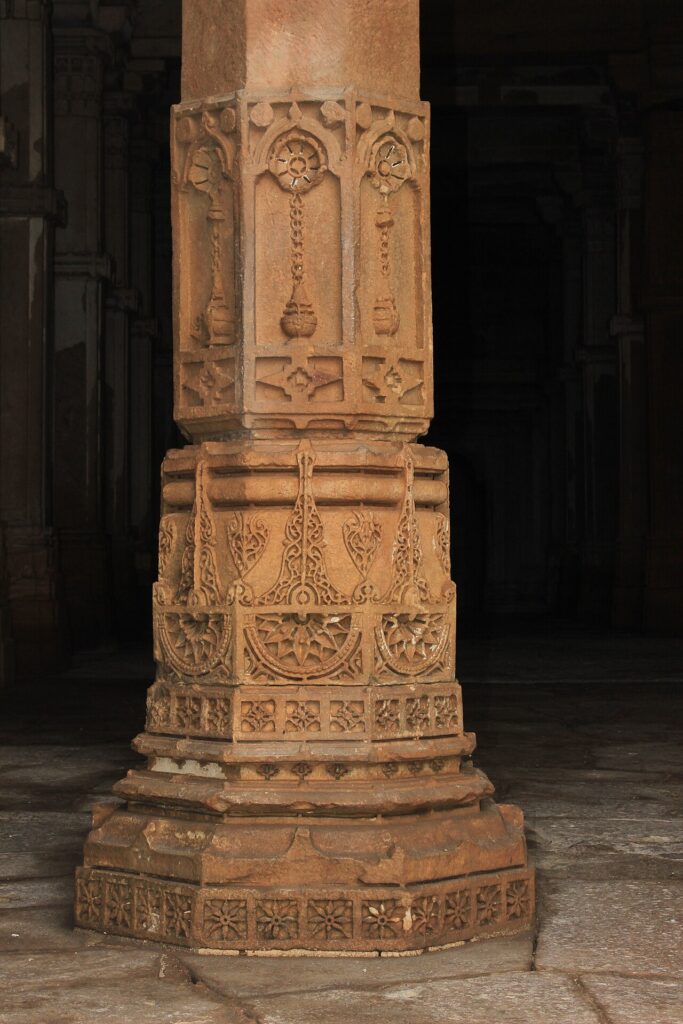
The Champaner-Pavagadh Archaeological Park (ચાંપાનેર-પાવાગઢ), inscribed by UNESCO in 2004, is a fortified city and hill sanctuary complex in Panchmahal district, Gujarat — a 16th-century city that was the capital of the Gujarat Sultanate from 1484 to 1535 CE (after the conquest of Champaner by Sultan Mahmud Begada of Gujarat in 1484 CE, who rebuilt it as his new capital Muhammedabad Champaner and made it the most elaborately planned walled city in Islamic India outside Delhi and Agra) and is now the best-preserved example of pre-Mughal Gujarat Sultanate urban planning and architecture in India. The park encompasses the Champaner fortified city area (on the plain below the Pavagadh hill, with the royal palace enclosures, the Jami Masjid, the Nagina Masjid, water-management infrastructure, and residential quarters) and the Pavagadh hill (a prominent 822 m volcanic basalt mesa above the plain, sacred in Hindu tradition as the site where the goddess Kali’s foot fell when her body was dismembered by Vishnu after Shiva’s grief at her death caused him to carry her body across the universe — the Kalikamata Temple at the summit of the Pavagadh hill, still an active Shakti pilgrimage site receiving approximately 1 million Hindu pilgrims per year for the Navratri festival, was the religious focus of the hill long before the Muslim sultanate’s conquest). The most significant single monument is the Jami Masjid at Champaner (1513 CE, built by Mahmud Begada’s successor Muzaffar Shah II) — the greatest building of the Gujarat Sultanate architectural tradition: a Friday mosque of extraordinary refinement with 172 columns in the prayer hall, five domed aisles, two tapering minarets with perforated stone lattice screens at multiple levels (the identical technique used in the stone jali screens of the concurrent contemporary Mughal and Hindu temple traditions — an architectural vocabulary shared across religious boundaries in 15th–16th century Gujarat), and an overall spatial organisation that makes it among the finest mosques in South Asia.
The Champaner-Pavagadh complex and the Gujarat heritage corridor Jami Masjid · Champaner walls · Pavagadh Kalikamata Temple · Vadodara · Ahmedabad — 0 to 55 km
The Champaner-Pavagadh Archaeological Park covers approximately 1,329 hectares — a large area that includes not only the Champaner fortified city and the Pavagadh hill but also a scatter of smaller monuments (mosques, water tanks, step wells, and residential ruins) in the surrounding countryside. The Champaner city enclosure (protected by a 4 km circuit of stone fortification walls with 16th-century gates and bastions in excellent preservation) contains approximately 17 major monuments, of which the Jami Masjid and the Nagina Masjid (a smaller but extraordinarily delicate jewel-box mosque of the same 16th-century period, with an interior of intricate stone carving equivalent in quality to the best of the Fatehpur Sikri architecture) are the most significant. The Jami Masjid’s architectural distinction rests on the specific fusion of Indo-Islamic design vocabulary: the prayer hall colonnade uses columns in a Hindu pillar-style (with the specific multi-bracket Hindu capital tradition of Gujarat Sultanate architecture) within an Islamic spatial organisation; the minaret shafts are decorated with carved stone tracery in interlocking geometric patterns identical to those of the contemporary Jain temples of Gujarat; and the overall spatial effect (the combination of filtered natural light through the jali screens, the forest of columns in the prayer hall, and the exterior minarets rising above the mosque’s skyline) is unlike anything in either the Islamic or Hindu architecture traditions taken separately — a genuinely syncretic architecture that reflects the cultural position of the Gujarat Sultanate, a Muslim dynasty ruling a predominantly Hindu and Jain population in a commercial maritime society where the three communities were in constant economic and cultural interaction. The Pavagadh hill (reached by foot pilgrimage on the 3 km path from Champaner, or by aerial ropeway) combines the ruined fortifications of the pre-Sultanate Rajput kingdom of the Chauhans of Champaner (the fort that Mahmud Begada besieged for 20 months from 1482 to 1484 CE before its fall) with the Kalikamata Temple complex at the summit — the temple’s silver shrine image is considered one of the 51 Shakti peethas (sacred seats of the goddess scattered across South Asia).
Vadodara (Baroda, approximately 47 km south of Champaner by road — the major city and transport hub of the region, with the Maharaja Sayajirao University campus, the Baroda Museum and Picture Gallery, and the Laxmi Vilas Palace — a 125-room Indo-Saracenic palace built 1890 CE, the largest private residence ever built in India and still the home of the Gaekwad royal family) and the Historic City of Ahmadabad (UNESCO 2017, approximately 145 km north of Champaner — the most important city of historical Gujarat, with the old walled city pol neighbourhood system, the intricate wooden-facade havelis, and the Shah Alam Roza mosque complex) are the two major regional heritage centres that contextualise the Champaner-Pavagadh UNESCO site.
Practical information
Champaner-Pavagadh is 47 km northeast of Vadodara (Baroda) by road (approximately 1 hour). From Vadodara: hired car/taxi is the most practical option (no regular bus service to the site itself, though buses connect Vadodara with Halol, 5 km from Champaner). By train: Vadodara Junction is a major railway station on the Delhi–Mumbai main line (direct trains from Mumbai approximately 2.5 hours by Shatabdi Express; from Delhi approximately 10 hours). Vadodara also has a domestic airport (Vadodara Airport, BDQ) with connections to Delhi and Mumbai. The Archaeological Survey of India manages the monuments within the park. Open daily sunrise–sunset; admission fees apply. The Pavagadh ropeway (cable car to the hilltop, operated by the Gujarat Tourism Development Corporation) is the most practical option for most visitors — the full trek to the summit is approximately 3 km and physically demanding. Visiting time: 2–3 hours for the Champaner city monuments (Jami Masjid, Nagina Masjid, fortification walls); plus 1.5–2 hours for the Pavagadh hill (ropeway + Kalikamata Temple visit). Best visiting months: October–March (temperatures 20–32°C, post-monsoon clarity). The Navratri festival period (September–October, 9 nights) brings enormous pilgrimage crowds to the Kalikamata Temple — spectacular culturally but difficult for site visits. No accommodation at the site; stay in Vadodara.
Frequently Asked Questions
What is the Gujarat Sultanate architectural style visible at Champaner-Pavagadh?
The Gujarat Sultanate architectural style (also called the Indo-Saracenic style of Gujarat, or the Gujarat/Mughal hybrid preceding the full Mughal synthesis — though the term “Indo-Saracenic” is more precisely applied to the 19th-century colonial revival and is not the scholarly preferred designation for the 15th–16th century Gujarat style) is one of the most distinctive and refined regional architectural traditions of medieval India — characterised by an extraordinarily skilled synthesis of Islamic spatial organisation (the mosque courtyard, the qibla wall and mihrab, the minaret as spatial and acoustic anchor) with Hindu and Jain decorative craftsmanship (the carved stone screen — jali — the multi-bracket capital, the bell-and-chain motif, the step-well profile, the carved stone column in the trabeated construction method). The Gujarat Sultanate’s specific position as a Muslim dynasty ruling a predominantly Jain and Hindu commercial community — the Jain merchant families of Gujarat (the Shroffs, the Savais, the diamond and spice merchants of Surat, Baroda, and Khambhat) were the most economically powerful social group in the sultanate, and the stone carving tradition that produced the intricate jali screens of the Jain temples at Ranakpur, Abu, and across Gujarat was available for hire by the Muslim patrons who wanted equivalent carving quality for their mosques. The result was a stone-carving tradition that crossed religious boundaries: the same workshops and sometimes the same individual craftsmen who carved the aedicule screens of the Jain Ranakpur Temple (1437 CE) carved the perforated stone screens of the Jami Masjid at Sarkhej (1451 CE) and subsequently the Jami Masjid at Champaner (1513 CE). The architectural evidence for this workshop continuity is the specific repetition of motifs — the interlocking hexagonal geometric pattern (the “Surat pattern”), the lotus medallion at the centre of jali panels, the bell-and-chain bracket (a Hindu decorative element that appears identically in Hindu and Islamic buildings of 15th-century Gujarat) — across buildings of both religious traditions. The Champaner Jami Masjid is the culmination of this tradition: its 172 columns in the prayer hall demonstrate the full vocabulary of the Gujarat pillar-carving tradition in a mosque context (the columns have the multi-bracket Hindu capital at the top rather than the standard Islamic muqarnas or block capital, creating a forest of elaborately carved columns in a space dedicated to Islamic prayer). The Mughal conquest of Champaner in 1535 CE by Humayun (the second Mughal emperor, who displaced the Gujarat Sultanate from its capital during his Indian campaign) brought the Gujarat Sultanate tradition into contact with the Mughal architectural workshop, and the Mughal architects who built Fatehpur Sikri (1569–1585 CE) drew heavily on the Gujarat Sultanate vocabulary — particularly the jali screen technique and the column-carving tradition — creating the synthesis that is visible at Fatehpur Sikri’s Bengali-roof pavilions and the Diwan-i-Khas column. The historical connection between Champaner-Pavagadh (Gujarat Sultanate, 1513 CE) and Fatehpur Sikri (Mughal, 1569–1585 CE) is one of the clearest documentary cases of architectural transmission in Indian architectural history.
What is the significance of the Pavagadh hill as a Shakti pilgrimage site?
The Pavagadh hill (822 m, a prominent volcanic basalt mesa rising from the Gujarat plain south of the Narmada river) is one of the 51 Shakti peethas (शक्तिपीठ) of the Hindu tradition — the sacred sites scattered across South Asia that mark where pieces of the body of Sati (the goddess who is the first wife of Shiva, later reborn as Parvati) fell when Vishnu’s Sudarshana Chakra (discus weapon) dismembered her body as Shiva carried it across the universe in grief after her death (Sati had died in protest at her father Daksha’s insult to Shiva; the narrative of her death and dismemberment, and the resultant scattering of body parts that creates the pilgrimage geography of Shakti worship, is the foundational myth of the Shakti peetha tradition documented in the Devi Bhagavata Purana and other Shakta texts). The specific identification of Pavagadh as a Shakti peetha rests on the tradition that Sati’s right toe (or, in some versions, her breast) fell at this location when her body was dismembered — the Kalikamata Temple at the summit is built at the spot identified as the relic site, and the silver image of Kalikamata (Kali as mother, the fierce form of the goddess) within the temple is the primary object of pilgrimage. The Kalikamata Temple’s association with the Navratri festival (the nine-night autumn festival of Navratri dedicated to the Goddess, celebrated in Gujarat with the Garba and Dandiya dance forms that are a distinctive Gujarat cultural tradition) makes the Pavagadh hilltop one of the major Navratri pilgrimage destinations in western India, attracting approximately 1 million pilgrims during the nine-night festival. The continuity of Hindu pilgrimage at Pavagadh through the period of the Gujarat Sultanate (when the hill’s fortifications were rebuilt as military infrastructure but the Kalikamata Temple continued to operate under Sultanate tolerance of Hindu religious practice) and through the Mughal period to the present reflects the specific position of Gujarat as a region where Hindu, Jain, and Islamic religious practices have coexisted with relative continuity for centuries — a continuity that is archaeologically visible at Champaner-Pavagadh in the simultaneous presence of the mosque architecture below and the active Hindu temple above on the same hill.
EXCERPT: Champaner-Pavagadh Archaeological Park, UNESCO-inscribed in 2004, is the 16th-century Gujarat Sultanate capital below the sacred Pavagadh hill — the Jami Masjid’s 172-column prayer hall with stone jali screens carved by the same craftsmen who built Jain temples, perfectly preserved city walls from Mahmud Begada’s 1484–1535 CE capital, and the Kalikamata Temple receiving 1 million Navratri pilgrims.
META: UNESCO World Heritage Sites near Champaner-Pavagadh Gujarat India: Historic City of Ahmadabad 145 km north (UNESCO 2017), Rani-ki-Vav 110 km north (UNESCO 2014) — Gujarat UNESCO heritage circuit Champaner-Pavagadh to Rani-ki-Vav to Ahmadabad, Gujarat Sultanate architecture Indo-Islamic synthesis.
Sources
- S1 — UNESCO World Heritage Centre — Champaner-Pavagadh Archaeological Park (Ref. 1101) — https://web.archive.org/web/20230601000000/https://whc.unesco.org/en/list/1101/
- S2 — UNESCO World Heritage Centre — Statement of Outstanding Universal Value (Ref. 1101) — https://whc.unesco.org/en/list/1101/
Spotted an error? Write to [email protected] and we correct it the same day.