The Sites of Japan’s Meiji Industrial Revolution: Iron and Steel, Shipbuilding and Coal Mining, inscribed by UNESCO in 2015, is a serial property of 23 component sites across 8 prefectures documenting how Japan achieved rapid industrialization in the second half of the 19th century. Between 1853, when American Commodore Matthew Perry’s squadron forced the opening of Japanese ports, and 1910, when Japan completed its first battleship in a domestically operated shipyard, the country absorbed Western industrial technology at a pace unprecedented in history — a 57-year transition that European nations had accomplished over 200 years. The inscription’s 23 components span Yamaguchi, Fukuoka, Saga, Nagasaki, Kumamoto, Kagoshima, Iwate, and Shizuoka Prefectures.
The Kyushu cluster and the southwestern industrial heartland Nagasaki · Kagoshima · Hiroshima — 60 to 280 km
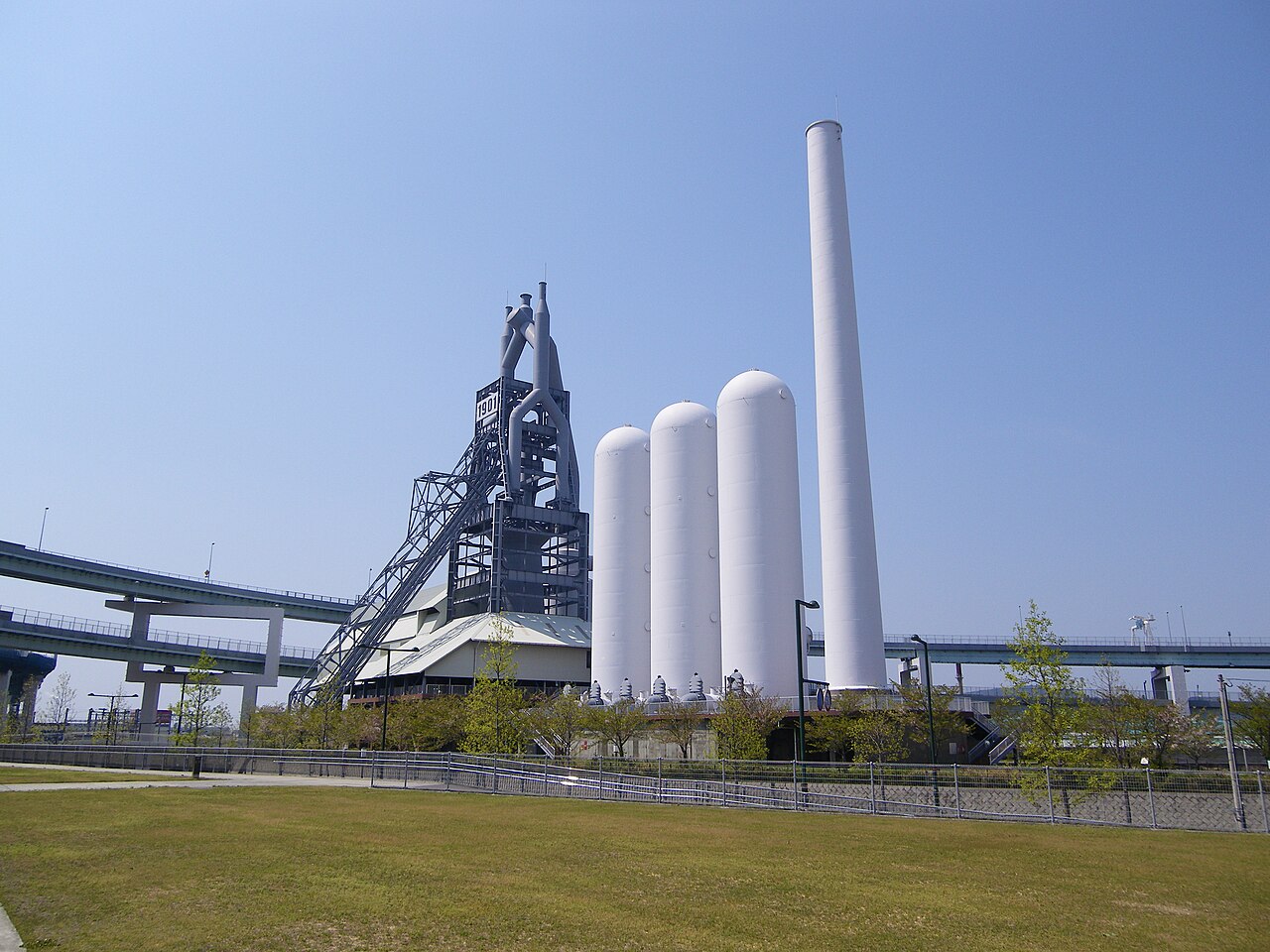
Sixty kilometres east of the Nagasaki components by Nagasaki Main Line limited express, the Saga Prefecture components of the inscription include the Miike Coal Mine and Miike Port in Omuta City — one of the largest and longest-operating coal mines in Japanese history. The Miike mine supplied the fuel for the Yawata Steel Works and the Nagasaki and Sasebo shipyards in a supply chain that made the southwestern Kyushu industrial complex self-sustaining. The Higashida No. 1 Blast Furnace at the Yawata Imperial Steel Works in Kitakyushu — the image at the head of this article — was Japan’s first modern integrated steel complex, operational from 1901. In the same year, Japan’s steel output was sufficient to supply domestic shipbuilding for the first time; the Russo-Japanese War of 1904–1905 was fought with ships built from Yawata steel and artillery cast at Kitakyushu foundries. From Kitakyushu (the primary hub for the Fukuoka components), Nagasaki is reached by Shinkansen south to Hakata and limited express west (approximately 2 hours).
One hundred kilometres south of Kitakyushu by Shinkansen to Hakata and limited express to Kumamoto (approximately 90 minutes), the Kumamoto components of the inscription include the Miike Railway Station building in Omuta and the Misumi West Port — the 1899 seaport through which the Miike mine’s coal was shipped. Kumamoto itself holds no Meiji industrial site but serves as the gateway for the Amakusa archipelago’s hidden Christian heritage and the Aso volcanic landscape. The juxtaposition of Kyushu’s Meiji industrial geography — concentrated in the coal and iron deposits of northern Kyushu — with the pre-industrial landscape of the southern Kumamoto mountains illustrates the geographic unevenness of 19th-century Japanese industrialization: some regions were transformed in a generation, others remained agricultural for another century.
One hundred forty kilometres south of Kitakyushu by Shinkansen to Hakata and Shinkansen or ferry to Kagoshima (approximately 90 minutes by Shinkansen), the Kagoshima components of the inscription are clustered at the Shuseikan complex — the 1852 Shimazu domain machine factory established to produce Western-style cannon and ships before the Meiji Restoration. The Shuseikan is the earliest industrial site in the inscription and historically the most significant: the Shimazu domain of Satsuma established it in direct response to the First Opium War (1839–1842), using Dutch technical manuals and Chinese iron-workers to produce reverberatory furnace technology before Japan had any Western contact. The Shuseikan’s Reverberatory Furnace ruins in Kagoshima City are the physical evidence of Japan’s pre-Meiji industrial preparation — the institutional and technical knowledge that made the post-1853 transformation possible. From Kitakyushu, Kagoshima is reached by Kyushu Shinkansen from Hakata in approximately 90 minutes.
Two hundred eighty kilometres northeast of the Kyushu cluster by Sanyo Shinkansen from Hakata to Hiroshima (approximately 55 minutes), the Hiroshima Peace Memorial and Itsukushima Shrine represent the 20th-century consequences of the Meiji industrial programme that the inscription documents. The Yawata Steel Works’ production capacity, built over the period 1901–1940, was directly applied to the battleship and armament production that the Hiroshima military base commanded; the industries established under Meiji were the same industries that made Hiroshima both a military target and an industrial target in 1945. The structural steel of the 1915 Industrial Promotion Hall — the Genbaku Dome — was produced by the same industrial tradition whose origins the UNESCO inscription traces to 1853. From the Kitakyushu components of the inscription, Hiroshima is 55 minutes by Shinkansen.
The Yamaguchi and Shizuoka components: the edges of the industrial arc Hagi · Izuniokada · Hiraizumi — 180 to 600 km
One hundred kilometres west of Kitakyushu by JR to Shimonoseki and local connections, the Yamaguchi Prefecture components include Hagi’s preserved castle town and the Hagi Reverberatory Furnace ruins — where the Choshu domain attempted in 1856 to build Western-style cannon using the same Dutch-derived manuals as the Shimazu domain in Kagoshima. Hagi is the birthplace of several Meiji architects: Ito Hirobumi, Japan’s first prime minister, was born in the Hagi domain and the political infrastructure of Meiji Japan was disproportionately shaped by Hagi alumni of the Shoka Sonjuku school, which was not itself a production facility but the intellectual incubator for the administrators who built the Tomioka mill, the Yawata steel works, and the naval shipyards. The Hagi inscription components — the reverberatory furnace ruins, the Ebisu-ga-hana shipyard, the Ohitayama Tatara Iron-making Site — document the pre-Restoration Choshu domain’s industrial ambitions, which were technically inferior to the Satsuma (Kagoshima) domain’s programme but ultimately more politically consequential. From Kitakyushu, Hagi is reached by JR to Shimonoseki and local limited express (approximately 2.5 hours).
Six hundred kilometres northeast of the Kyushu cluster by Shinkansen from Hakata to Tokyo and Tohoku Shinkansen north, the Iwate Prefecture component of the Meiji inscription is the Kamaishi Iron Mine — 80 kilometres east of the Hiraizumi UNESCO temples. The Hashino Ironworks at Kamaishi, operating from 1858, was one of the first iron ore mines developed using Western reverberatory furnace technology in Japan. The Tohoku region’s Kamaishi iron — the northernmost Meiji industrial component — and the Kyushu Yawata steel works — the southernmost fully integrated component — are separated by 1,200 kilometres of main island, a distance that illustrates the geographic ambition of the inscription and the national scale of Japan’s industrial transformation. For a visitor completing the full inscription, the Iwate component is best combined with the Hiraizumi UNESCO temples (see the adjacent proximity guide) as a single Tohoku circuit before returning to Tokyo and the Shinkansen south to Kyushu.
The Shizuoka Prefecture component — the Nirayama Reverberatory Furnaces in Izu City — is the component most accessible from Tokyo (approximately 2 hours by Shinkansen to Mishima and local bus). The Nirayama furnaces, established in 1856 by the Tokugawa government’s own initiative in response to Perry’s 1853 arrival, are the best-preserved reverberatory furnace ruins in the inscription: four brick chimneys approximately 15 metres high survive in the original operational configuration. The furnaces never achieved significant production before the Meiji Restoration transferred authority; they are historically important as evidence of the last Tokugawa government’s attempt at self-rescue before the political system that had produced them was abolished. From Tokyo, Nirayama is the most convenient single-site entry point to the Meiji inscription’s industrial ruins, combined with the Izu Peninsula’s hot spring landscape for a regional day trip.
Practical information
The 23-component serial inscription makes the Meiji Industrial Revolution sites impossible to visit in a single itinerary without dedicating a week or more to Japan. The practical approach is to treat the components as geographic clusters: the Kyushu cluster (Kitakyushu, Nagasaki, Saga, Kumamoto, Kagoshima) — 5 days minimum; the Yamaguchi cluster (Hagi, Shimonoseki) — 1–2 days from Hiroshima; the Shizuoka component (Nirayama) — half-day from Tokyo; the Iwate component (Kamaishi) — combined with Hiraizumi in Tohoku. The Kyushu cluster is the most significant and the most accessible: the Yawata Steel Works’ Higashida No. 1 Blast Furnace is in Kitakyushu City (JR Kagoshima Main Line from Hakata, approximately 20 minutes); the Shuseikan complex in Kagoshima is 2 minutes by bus from Kagoshima-Chuo Shinkansen station; the Nagasaki components (Glover Garden, Mitsubishi Dockyards) are in central Nagasaki. The overall inscription is managed by the World Heritage Coordinating Office in Kitakyushu, which publishes a stamped passport booklet for visitors completing multiple components — available at each component’s visitor centre. There is no single pass covering transport between components; JR Kyushu Pass (3 or 5 days) covers most Kyushu cluster transport.
Frequently Asked Questions
Why is Japan’s Meiji Industrial Revolution UNESCO inscription spread across 23 sites?
The 23-site serial inscription reflects the geographic and industrial logic of Japan’s 19th-century industrialization, which did not concentrate in a single industrial city (as the English Midlands or the German Ruhr Valley did) but developed in clusters tied to specific natural resource deposits: coal in northern Kyushu (Miike, Fukuoka), iron ore in Iwate (Kamaishi), clay for brick production and ore smelting in Yamaguchi and Kagoshima, and sheltered harbours for shipbuilding in Nagasaki, Yokosuka, and Sasebo. The serial inscription was the result of a nomination strategy that argued for Outstanding Universal Value not in individual sites — most of which had significant counterparts in Europe — but in the totality of Japan’s technology-transfer achievement: the simultaneous absorption of blast furnace technology, reverberatory smelting, steam-powered machinery, and naval engineering within a single 50-year period by a non-Western country. UNESCO’s 2015 decision to inscribe the series was controversial because it included the Hashima Island (Battleship Island) coal mine, where Korean and Chinese forced labourers worked during World War II — Japan accepted a provision requiring its diplomatic representations to acknowledge the forced labour history at information panels at each component site, a commitment whose implementation has been disputed by South Korea and periodically reviewed by UNESCO’s World Heritage Committee.
What is the Gunkanjima (Hashima Island) and why is it part of the inscription?
Hashima Island — nicknamed Gunkanjima (Battleship Island) because its concrete apartment blocks and coal-processing towers, seen from the sea, resemble a warship’s profile — is an artificial island 15 kilometres southwest of Nagasaki developed by Mitsubishi from 1887 as a submarine coal mining facility. At its 1959 peak, 5,259 people lived on the 6.3-hectare island at a density of 835 people per hectare — the highest population density ever recorded on earth for a sustained period. The mine closed in 1974 when Mitsubishi shifted to oil; the island was abandoned completely, and the concrete structures have been slowly collapsing from typhoon exposure since 1974. Hashima is part of the UNESCO inscription under the components documenting coal and steel production; it is accessible by Nagasaki ferry (25 minutes from Nagasaki Port), though the island interior access is restricted to designated walking paths due to structural instability. Approximately 100,000 tourists visit annually. The forced labour controversy attaches specifically to Hashima: an estimated 800 Korean and Chinese workers died on the island between 1939 and 1945 under conditions of forced recruitment and dangerous mining. The site’s condition — a spectacular ruin of the world’s densest urban settlement — makes it one of the most visually arresting UNESCO inscribed components in the world, though the historical complexity of the forced labour period requires the interpretive panels that the UNESCO-Japan agreement mandated.
How does the Meiji Industrial Revolution inscription relate to Japan’s other UNESCO heritage?
The Meiji inscription exists in productive dialogue with several other Japanese UNESCO sites. Tomioka Silk Mill (Gunma, inscribed 2014) documents the same Meiji period’s technology transfer in a different industrial sector — silk reeling rather than iron and steel — and together with the Meiji Industrial Revolution inscription represents the full range of Meiji industrial heritage. The Iwami Ginzan Silver Mine (Shimane, inscribed 2007) documents the pre-Meiji extractive economy that accumulated the capital the Meiji state applied to industrialization. Hiraizumi (Iwate, inscribed 2011) is 80 kilometres from the Kamaishi component, connecting the 12th-century Buddhist capital geography of Tohoku to the 19th-century industrial geography in the same prefecture. The National Museum of Western Art (Tokyo, inscribed 2016) documents the postwar cultural diplomacy conducted by the same Japanese state that built its cultural authority on the Meiji foundation. Together, these sites form a coherent narrative arc: pre-industrial commodity extraction (Iwami Ginzan) → Meiji industrial transformation (Tomioka + Meiji Industrial Revolution) → post-industrial cultural identity (NMWA Tokyo) — the full trajectory of Japan’s modernization recorded in its UNESCO heritage.
Sources
- S1 — UNESCO World Heritage Centre — Sites of Japan’s Meiji Industrial Revolution: Iron and Steel, Shipbuilding and Coal Mining (Ref. 1484) — https://web.archive.org/web/20230601000000/https://whc.unesco.org/en/list/1484/
- S2 — UNESCO World Heritage Centre — Statement of Outstanding Universal Value (Ref. 1484) — https://whc.unesco.org/en/list/1484/
Spotted an error? Write to editorial@culturalheritageonline.com and we correct it the same day.