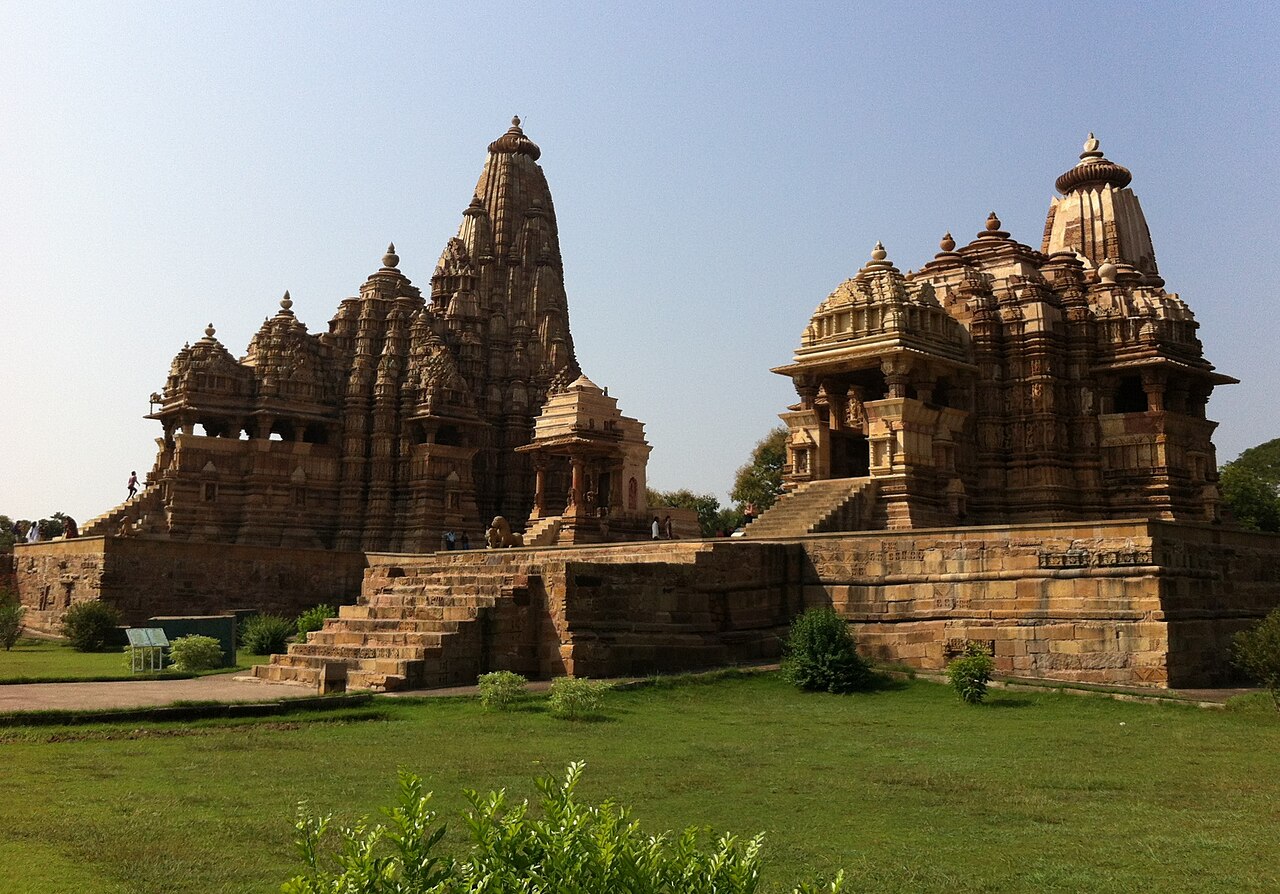
The Khajuraho Group of Monuments (खजुराहो स्मारक समूह), inscribed by UNESCO in 1986, is a complex of approximately 25 surviving Hindu and Jain temples from the 10th–11th centuries CE at Khajuraho village in Chhatarpur district, Madhya Pradesh, India — representing the architectural and sculptural apogee of the Chandela Rajput dynasty (the Chandelas ruled the Bundelkhand region from approximately 831 to 1308 CE and built approximately 85 temples at Khajuraho over the period 950–1050 CE, of which approximately 25 survive, the remainder demolished by Muslim invaders in the 12th–13th centuries or fallen to natural decay). The Khajuraho temples are famous principally for their erotic sculptural programmes on the exterior walls — the mithuna (sexual union) figures in explicit poses that have made Khajuraho the most internationally recognised site of erotic sacred art in the world — but the UNESCO inscription’s Outstanding Universal Value rests equally on the exceptionally sophisticated Nagara-style shikhara tower architecture (the soaring clustered tower forms, each temple’s shikhara composed of multiple small replicas of the main tower arranged around it in rising tiers to create a mountain-like profile, are among the finest examples of North Indian temple architecture anywhere) and on the quality of the non-erotic sculptural programme (celestial beings, musicians, devotional scenes, animals, and mythological narratives that constitute approximately 90% of the total sculpture area — the erotic scenes, though the most famous, are a minority of the total sculptural decoration).
The Khajuraho temple groups and the Madhya Pradesh heritage corridor Western Group · Eastern Group Jain Temples · Panna National Park · Orchha — 0 to 120 km
The surviving Khajuraho temples are organised into three groups: the Western Group (the most accessible, within a maintained archaeological park 2 km from Khajuraho village and town centre, containing the largest and most important temples including the Kandariya Mahadeva Temple, the Lakshmana Temple, and the Devi Jagdamba Temple); the Eastern Group (approximately 2 km east of the village centre, including both Hindu temples and the most important Jain temples — the Parsvanatha Temple, the Adinatha Temple, and the Ghantai Temple); and the Southern Group (approximately 3 km south of the village, with two surviving temples). The Western Group is the essential visit: the Kandariya Mahadeva Temple (approximately 1002–1050 CE, dedicated to Shiva, 31 metres in height to the shikhara finial — the largest and most elaborate of the Khajuraho temples, with the most densely sculptured exterior surface and the most complex shikhara composition of clustered mini-shikhara forms rising around the main tower in an explicit mountain-analogy) and the Lakshmana Temple (approximately 954 CE, dedicated to Vishnu, built in the period of the Chandela ruler Yashovarman — slightly earlier than the Kandariya Mahadeva but with a similar multi-tower composition and a particularly rich set of exterior friezes that includes the most explicit mithuna scenes at Khajuraho). The sculptural programme of the temples is organised in horizontal bands (friezes) that wrap around the exterior walls at approximately 1–2 m above ground level: the lowest frieze is typically animals and elephants; the second frieze is human figures in procession and everyday activities; the third and most prominent frieze (at approximately eye level for a viewer standing at the base of the temple platform) is the register containing both the non-erotic celestial figures (apsaras, celestial nymphs, in poses of combing hair, playing musical instruments, or applying cosmetics) and the mithuna (sexual union) figures. The erotic figures constitute approximately 10% of the total sculpted figure count across all temples; their prominence in the perception of Khajuraho derives from the explicitness of certain poses and the quality of the sculptural execution rather than their numerical dominance.
Orchha (approximately 176 km southeast of Khajuraho by road via Jhansi, accessible by bus or car from Jhansi railway station) is the closest historically important heritage destination to Khajuraho and provides a Bundelkhand Rajput architectural complement — Orchha’s temple-palace complex (the Jahangir Mahal, built approximately 1605 CE by the Bundela raja Bir Singh Deo for the Mughal Emperor Jahangir’s expected visit, with its characteristic blend of Rajput and Mughal architectural forms, and the Ram Raja Mandir, the only temple in India where Ram is worshipped as a king rather than a deity, with a military guard of honour) represents the 17th-century Chandela successors’ architectural tradition. Panna National Park (approximately 45 km southeast of Khajuraho, the Ken River gorge UNESCO tentative World Heritage site, one of India’s premier tiger reserves with Bengal tiger population approximately 50–60 individuals, also containing the Ken-Gharial Sanctuary for the critically endangered Gharial crocodile) is accessible by road from Khajuraho for a half-day or full-day wildlife excursion that can be combined with the Khajuraho temple visit. Sanchi (UNESCO 1989, approximately 370 km south of Khajuraho by road via Sagar, in the Madhya Pradesh heartland) and the Rock Shelters of Bhimbetka (UNESCO 2003, prehistoric rock paintings approximately 45 km southeast of Bhopal, 450 km south of Khajuraho) are the standard Madhya Pradesh heritage circuit extensions beyond Khajuraho.
Practical information
Khajuraho has its own domestic airport (Khajuraho Airport, KJU) with flights from Delhi (approximately 1 hour 15 minutes) and other major Indian cities — the airport is 5 km from the town centre. By train from Delhi (Mahoba railway station, 60 km from Khajuraho, then 1 hour by road) or from Varanasi (Satna railway station, 125 km from Khajuraho). The Western Group archaeological park is open daily 06:00–18:00 (sunrise is the best time for photography, when the sandstone glows orange and the tourist crowds have not yet arrived). Admission fee (foreign visitors): standard ASI combined fee for the Western Group. The Eastern and Southern groups are separately managed (the Eastern Group has Jain temple entry within an active Jain religious complex — modest attire required). The Khajuraho Dance Festival (late February to early March, 7 days) is held in the Western Group archaeological park with classical Indian dance performances against the temple backdrop at night — one of the most atmospheric heritage festival events in India. Photography throughout is permitted (no restriction on photographing the erotic sculpture, despite occasional reports of restriction). Visiting time: 2.5–3.5 hours for the Western Group in detail; add 1.5 hours for the Eastern Group Jain temples. Best visiting season: October–March (temperatures 15–30°C, minimal humidity, clear light; summer April–June reaches 45°C in the open archaeological park). Accommodation in Khajuraho ranges from basic guesthouses near the bus stand to mid-range hotels near the Western Group; quality options are limited compared to Delhi or Varanasi — arrive knowing your accommodation in advance.
Frequently Asked Questions
Why do the Khajuraho temples have erotic sculpture and what is the theological or cultural explanation?
The erotic sculpture at Khajuraho (the mithuna figures in explicit sexual union poses on the exterior walls of the 10th–11th century CE Chandela temples) is one of the most discussed topics in Indian art history, and there is no single authoritative explanation — several interpretations have been proposed by scholars, none of which is universally accepted, and the original Chandela patrons’ specific intentions are not documented in surviving textual sources. The principal scholarly interpretations are: the Tantric explanation (the erotic figures represent Tantric ritual practices or Tantric theological concepts — the union of Shiva and Shakti, of male consciousness and female energy, as the generative principle of the cosmos; in this reading, the mithuna figures on the exterior wall represent the cosmic creative energy that surrounds the temple sanctuary, which is the domain of spiritual liberation inside); the apotropaic explanation (the erotic figures serve to avert evil spirits or thunderbolts from the temple — a belief documented in Sanskrit architectural texts like the Manasara, which recommend placing mithuna figures on temple exteriors to protect the sacred interior); the liminal explanation (the erotic figures mark the threshold between the worldly realm outside and the sacred realm inside, reminding the worshipper that sexual desire is a fundamental human drive to be transcended before entering the sanctuary — the temple visitor passes through the erotic exterior to reach the transcendent interior); and the aesthetic explanation (the mithuna figures are simply part of the comprehensive representation of human life in the sculptural programme — along with celestial musicians, hunters, warriors, and devotional figures, the erotic scenes document the full range of human experience as valid subject matter for sacred art). The Chandela inscriptions and the Sanskrit texts associated with Khajuraho do not explicitly explain the erotic sculpture’s significance, which has led some scholars to suggest that the explanation was so obvious to a medieval Indian viewer that it required no commentary — the contemporary puzzle is partly a product of modern attitudes toward sacred eroticism. The percentage of erotic figures at Khajuraho (approximately 10% of the total sculptural count) is consistent with the proportion in other North Indian temple sites of the same period where erotic figures appear in a minority position within a larger sculptural programme; Khajuraho is internationally famous for the erotic sculpture specifically because the temples are exceptionally well-preserved (approximately 25 of the original 85 survive), the scale and quality of the overall sculptural programme is exceptional, and the British colonial discovery of the site in 1838 CE (by Captain T.S. Burt of the Bengal Engineers) created the pattern of Western fascination with Indian erotic sacred art that has persisted to the present.
What is the Nagara temple architecture style visible at Khajuraho?
The Nagara temple architecture style (नागर, “of the cities”, also called the Northern Indian or Shikhara style) is the dominant tradition of Hindu temple architecture in northern India from approximately the 5th century CE onward — characterised by the shikhara tower (the curvilinear tower rising over the sanctuary, garbhagriha, that is the central defining element of the temple exterior), the antarala (vestibule connecting the shikhara to the mandapa hall), and the mandapa (the columned hall where worshippers gather). The Khajuraho temples represent the fully developed late Nagara style of the 10th–11th centuries, at the moment of the tradition’s greatest elaboration before the Muslim invasions of the 12th–13th centuries CE disrupted the workshop tradition and terminated the construction of new temples at Khajuraho. The specific architectural innovation of the Khajuraho Nagara style (distinguishing it from earlier Nagara temples) is the development of the clustered shikhara: instead of a single smooth curvilinear shikhara rising over the sanctuary, the Khajuraho shikharas are composed of multiple small replica shikharas (urushringas) attached to the main tower on all four sides, arranged in rising tiers from the base of the tower to the top. The visual effect (visible most dramatically in the Kandariya Mahadeva Temple’s 31-metre shikhara) is of a mountain with multiple subsidiary peaks surrounding and ascending toward the summit — an explicit evocation of the Himalayan mountain range viewed from the plains, which in the cosmological framework of Hindu temple architecture represents the sacred mountain Meru at the centre of the universe. The 3D rhythm created by the clustered shikharas (each individual urushiringa casting a shadow across the one behind it, the light playing across the complex mass of the tower at different angles through the day) is the primary aesthetic effect of the Khajuraho temples viewed from outside, and it has no parallel in Western religious architecture, where tower forms are typically unitary (a single Gothic spire, a single Baroque dome) rather than fractal in this specific way.
EXCERPT: Khajuraho Group of Monuments, UNESCO-inscribed in 1986, is a complex of approximately 25 Chandela dynasty Hindu and Jain temples from 950–1050 CE in Madhya Pradesh — the Kandariya Mahadeva’s 31-metre clustered shikhara tower, exterior mithuna (erotic union) friezes representing 10% of the total sculpture alongside celestial musicians and mythological scenes, in the finest Nagara-style temple architecture of North India.
META: UNESCO World Heritage Sites near Khajuraho Madhya Pradesh India: Buddhist Monuments at Sanchi 370 km south (UNESCO 1989), Rock Shelters of Bhimbetka 450 km south (UNESCO 2003), Agra Fort and Taj Mahal 380 km northwest (UNESCO 1983) — Madhya Pradesh UNESCO heritage circuit from Khajuraho through Sanchi to Bhimbetka.
Sources
- S1 — UNESCO World Heritage Centre — Khajuraho Group of Monuments (Ref. 240) — https://web.archive.org/web/20230601000000/https://whc.unesco.org/en/list/240/
- S2 — UNESCO World Heritage Centre — Statement of Outstanding Universal Value (Ref. 240) — https://whc.unesco.org/en/list/240/
Spotted an error? Write to editorial@culturalheritageonline.com and we correct it the same day.