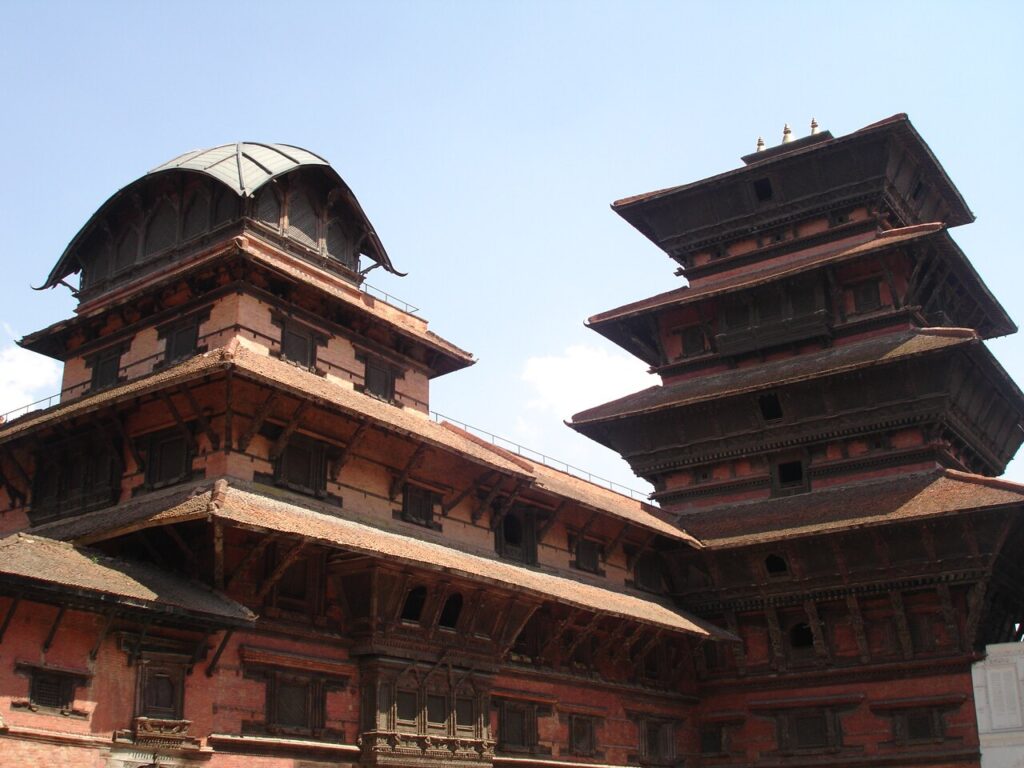
The Kathmandu Valley (Nepali: “काठमाडौं उपत्यका” — the valley at the confluence of the Bagmati and Bishnumati rivers in the central Himalayas of Nepal, elevation approximately 1,400 m), inscribed by UNESCO in 1979 as a cultural World Heritage site encompassing seven distinct monument zones, is the historic heartland of the Newar civilisation — the indigenous city-building culture of the Kathmandu Valley whose artistic and architectural tradition (the Nepal Mandala, or the spatial cosmological framework of the valley’s urban settlements) produced one of the most concentrated and diverse collections of religious and ceremonial architecture in Asia over approximately 2,000 years of continuous urban habitation from approximately the 3rd century CE to the present. The seven monument zones included in the UNESCO inscription are: Kathmandu Durbar Square (the palace square of the medieval capital of the Kathmandu kingdom, with the Hanuman Dhoka/Basantapur Palace of the Shah kings [18th–early 20th century CE], the Kumari Ghar [the palace of the Living Goddess], and a series of tiered pagoda temples); Patan Durbar Square (the central square of Lalitpur/Patan, the city across the Bagmati river from Kathmandu, with the densest concentration of Newar metal-casting and stone-carving workshop tradition); Bhaktapur Durbar Square (the royal square of the medieval kingdom of Bhaktapur/Bhadgaon, approximately 16 km east of Kathmandu, with the 55-Window Palace and the carved peacock window regarded as the finest single wood-carved window in Nepal); Swayambhunath Stupa (the “Monkey Temple” — the hilltop stupa on a steep hill approximately 2 km west of Kathmandu city centre, with the all-seeing Buddha-eyes painting on the harmika base of the spire — the “all-seeing eyes of wisdom” looking in the four cardinal directions — the most recognisable visual symbol of Nepal in international tourism); Boudhanath Stupa (one of the largest stupas in Asia, approximately 36 m high and approximately 100 m in circumference, in a valley-floor location approximately 11 km east of central Kathmandu — the primary pilgrimage centre of the Tibetan Buddhist community of the Kathmandu Valley, surrounded by approximately 50 Tibetan Buddhist monasteries and gompas); Pashupatinath Temple (the most sacred Hindu temple in Nepal — the primary shrine of Shiva as Pashupati “Lord of Animals”, on the bank of the Bagmati River, approximately 5 km east of Kathmandu — a walled complex of golden-roofed pagoda temples and cremation ghats on the river bank, where Hindu cremations take place publicly on the stone ghats beside the river); and Changu Narayan Temple (the oldest pagoda temple in the Kathmandu Valley, approximately 12 km northeast of Kathmandu on a hilltop above the Bhaktapur district, dedicated to Vishnu as Narayan, with stone inscriptions dating to approximately 464 CE).
The seven monument zones and the Newar architectural tradition Kathmandu Durbar Square · Patan · Bhaktapur · Boudhanath · Pashupatinath · Swayambhunath — 0 to 20 km
The seven monument zones of the Kathmandu Valley UNESCO inscription represent the physical remains of the Nepal Mandala — the ceremonial, commercial, and religious landscape designed according to the Hindu-Buddhist spatial cosmological framework that structured Newar urban planning for approximately 1,500 years. The Newar civilisation (the original urban population of the Kathmandu Valley, distinct from the later Gorkhali/Shah dynasty rulers who conquered the valley in 1768–1769 CE) developed a specific building tradition: the Nepal pagoda form (a multi-tiered sloping-roof wooden temple form that is considered by some architectural historians to be the source of the East Asian pagoda — the theory, debated but supported by the trading connections between the Kathmandu Valley and China that operated from approximately the 5th century CE onward, holds that the Nepal pagoda type was transmitted to China via Tibetan-Nepalese artistic exchanges and became the ancestor of the Chinese multi-eaved tower); the Newar “bahal” (a courtyard-type domestic and monastic building with a central court open to the sky surrounded by 2–3-storey residential wings, the standard building module of Newar urban architecture); and the Newar metalworking tradition (the Newar craftsmen of Patan/Lalitpur were the primary producers of the copper-gilt, bronze, and gilt-silver religious statuary that equipped Buddhist and Hindu temples throughout the Himalayan region from approximately the 6th century CE to the 19th century CE — including the iconic gilt repousse metalwork panels and figures exported to Tibet, Bhutan, and China). The 2015 Gorkha earthquake (25 April 2015, magnitude 7.8, epicentre approximately 77 km northwest of Kathmandu) caused catastrophic damage to the Kathmandu Valley monument zones: Kathmandu Durbar Square lost approximately 30 listed monuments and pagodas; Bhaktapur Durbar Square lost the Vatsala Temple and several other structures; Changu Narayan suffered significant damage; and several ancient bahal monastery courtyards in both Kathmandu and Patan collapsed. The reconstruction effort (supported by UNESCO, the German, Chinese, Japanese, and Indian governments, and multiple international conservation agencies) is ongoing as of 2024–2025 CE.
Practical information
Kathmandu is the capital of Nepal, served by Tribhuvan International Airport (KTM), the only international airport in Nepal (with connections to Delhi, Mumbai, Doha, Dubai, Bangkok, and other regional hubs from Europe and North America). The monument zones are distributed across the Kathmandu Valley and can be reached by taxi, motorcycle, or electric bus — no single efficient public transport network connects all seven. Recommended circuit: Day 1: Kathmandu Durbar Square + Swayambhunath (half-day each); Day 2: Patan Durbar Square + Boudhanath Stupa + Pashupatinath (Pashupatinath at dawn for the cremation ceremony on the ghats); Day 3: Bhaktapur Durbar Square + Changu Narayan (the two sites are linked by a local bus or a 2-hour ridge walk). Bhaktapur charges a separate foreigner entrance fee (significantly higher than Kathmandu and Patan sites). Pashupatinath is open to Hindus for the main temple; non-Hindus may visit the outer precincts and the cremation ghats area (viewing from the opposite bank of the river, where an unobstructed view of the ghats is possible). Best visiting months: October–November (post-monsoon, clearest skies, pleasant temperatures) and February–April (spring, rhododendrons in the surrounding hills, warm but clear).
Frequently Asked Questions
What is the Nepal pagoda and what is its relationship to the broader Asian pagoda tradition?
The Nepal pagoda (Nepali: “matha” or “dewal” — from Sanskrit “devakula” = god’s house) is the characteristic multi-tiered temple form of the Newar civilisation of the Kathmandu Valley — a building type characterised by two to five progressively smaller square tiers of sloping double-eaved or triple-eaved roofs stacked vertically above a square plinth, with the sloping roof surfaces covered in terracotta or gilt copper tiles, and the wooden overhanging roof brackets (struts) carved with explicit tantric imagery of sexual union (a religious iconographic programme that represents the integration of the male and female divine principles in the tantric Buddhist and Hindu traditions practiced in the Kathmandu Valley). The Nepal pagoda is most explicitly associated with the architectural corpus of the Kathmandu Valley from approximately the Licchavi period (approximately 400–880 CE) through the Malla period (approximately 1200–1768 CE), during which the three competing Malla kingdoms of Kathmandu, Patan/Lalitpur, and Bhaktapur/Bhadgaon engaged in a rivalry in temple building that produced the dense concentration of pagoda structures visible in the three Durbar Squares today. The question of the Nepal pagoda’s historical relationship to the East Asian pagoda tradition (the Chinese “ta” — “tower”, the Japanese “to/tou”, the Korean “tap”) has been debated since the 19th century CE — the theory that the Nepal pagoda form was transmitted to China via the Newar master-builder Araniko (1245–1306 CE, a Newar architect who was sent to the court of Kublai Khan at the request of the Mongol emperor in approximately 1260 CE and spent the remainder of his career in Beijing, where he built the Miaoying Temple White Stupa [1279 CE, still standing] and other buildings at the Yuan dynasty court) is historically documented in Chinese and Nepalese sources and represents a known transmission event. The broader hypothesis — that the pre-existing Chinese pagoda form itself derived from the Nepal temple type rather than from the Indian stupa independently — is more controversial and not universally accepted by architectural historians, who point to the parallel development of multi-tiered wooden-roof structures in both South and East Asian traditions without requiring direct transmission. The Kathmandu Valley pagodas themselves are distinguished from East Asian pagodas in several key structural ways: the Newar pagoda has open wooden “jali” lattice screens on each tier rather than enclosed floors; the roof tiles are of fired terracotta or gilt copper rather than green ceramic tile; the corner struts projecting from below each roof overhang are carved wooden brackets (never masonry corbels) depicting divine figures; and the primary structural element is a massive central “yupa” wooden post (the “lingam” structural column that extends from the foundation plinth through the interior of the building to the apex) that is the spiritual as well as structural centre of the building.
What was the impact of the 2015 Gorkha earthquake on the Kathmandu Valley UNESCO sites?
The 2015 Gorkha earthquake (25 April 2015, magnitude 7.8 Mw, epicentre at Barpak in Gorkha District approximately 77 km northwest of Kathmandu, depth 8.2 km) was the most destructive earthquake in Nepal since the 1934 Bihar-Nepal earthquake and caused extensive damage to the Kathmandu Valley UNESCO monument zones. The specific damage to the seven monument zones included: at Kathmandu Durbar Square, the complete collapse of the Vantapur Taleju Temple (a 9-tiered tower structure dating to the 16th century CE), the Kasthamandap (the 12th-century CE community hall that is considered the oldest surviving building in the Kathmandu Valley — a square open pavilion structure whose name “Kasthamandap” = “House of Wood” is the origin of the city name “Kathmandu”), the Maju Deval (3-tiered pagoda), and approximately 25 other listed structures; at Bhaktapur Durbar Square, the Vatsala Durga Temple (17th century CE, a major shikhara-style stone temple) and the bell tower collapsed; at Swayambhunath, the west gate collapsed and several subsidiary shrines were damaged; at Changu Narayan, the most seriously affected of the seven zones, approximately 40% of the historic structures in the complex were damaged or destroyed, including the World Peace Pagoda in the lower compound; and at Pashupatinath, several of the subsidiary Shikhara shrines on the river bank were damaged. The total number of UNESCO-listed structures damaged or destroyed across the seven monument zones exceeded 200 individual buildings. The total death toll from the earthquake in the Kathmandu Valley was approximately 5,000 (out of the total 9,000 deaths across Nepal), with the highest per-capita death toll in the historic areas of Bhaktapur (where traditional Newar brick-and-timber construction in densely packed residential neighbourhoods suffered severe collapse). The reconstruction approach adopted by UNESCO and the Nepalese Department of Archaeology follows the Venice Charter principles: (1) documentation-first (photogrammetric 3D documentation of all damaged structures before intervention); (2) authentic materials (traditional Newar-kilned brick, salwood timber, traditional Newar terracotta tile) rather than modern concrete or steel substitutes; (3) retention of all salvageable original material (even collapsed structures whose stones and timbers can be reassembled have been documented and their materials stored for re-use in reconstruction); (4) traditional craft knowledge (the reconstruction employs Newar master builders who maintain the traditional carpentry, brick-laying, and stone-carving techniques). The reconstruction is funded by a combination of Nepalese government budget, bilateral government donations (India’s contribution focused on Pashupatinath and Patan; China’s contribution on Kathmandu Durbar Square; Japan’s on Bhaktapur), and international NGO fundraising. As of 2024–2025 CE, approximately 50–60% of the damaged structures have been partially or fully reconstructed, with complete reconstruction of the most complex structures (the Kasthamandap, whose salvaged timbers were documented and stored, has been reconstructed and re-dedicated in 2022 CE) and ongoing work on the most severely damaged outlying shrines.
EXCERPT: Kathmandu Valley, Nepal, UNESCO-inscribed 1979, covers seven monument zones — Boudhanath’s 36-metre stupa ringed by 50 Tibetan monasteries, Pashupatinath’s dawn cremations on the Bagmati ghats, Bhaktapur’s 55-Window Palace, and the Newar pagoda tradition whose master-builder Araniko brought the form to Kublai Khan’s court in 1260 CE. The 2015 earthquake collapsed 200+ listed structures; reconstruction is ongoing.
META: UNESCO World Heritage Sites near Kathmandu Valley Nepal: Lumbini 280 km west (UNESCO 1997), Royal Chitwan National Park 150 km south (UNESCO 1984), Sagarmatha National Park 340 km northeast (UNESCO 1979) — Kathmandu Valley Nepal UNESCO 1979, Boudhanath stupa Tibetan Buddhism, Pashupatinath temple Hindu cremation, Bhaktapur Durbar Square Newar pagoda, 2015 Gorkha earthquake reconstruction.
Sources
- S1 — UNESCO World Heritage Centre — Kathmandu Valley (Ref. 121) — https://web.archive.org/web/20230601000000/https://whc.unesco.org/en/list/121/
- S2 — UNESCO World Heritage Centre — Statement of Outstanding Universal Value (Ref. 121) — https://whc.unesco.org/en/list/121/
Spotted an error? Write to the editors and we correct it the same day.