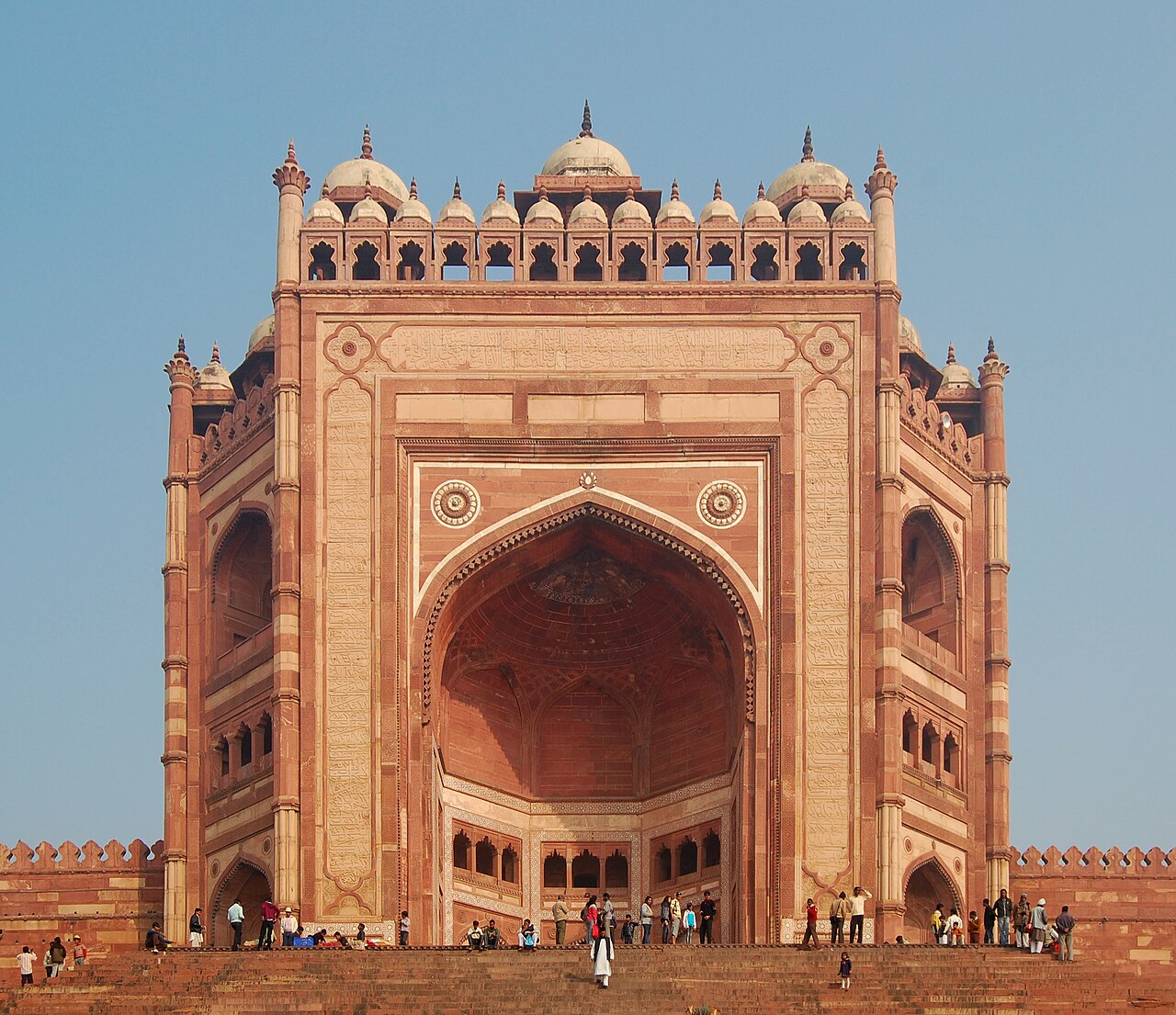
Fatehpur Sikri (فتح پور سیکری, “City of Victory”), inscribed by UNESCO in 1986, preserves the abandoned Mughal capital built in 1569–1585 CE by Emperor Akbar (جلال الدین محمد اکبر, r. 1556–1605 CE) on a rocky sandstone outcrop approximately 40 km west of Agra, Uttar Pradesh, India — the most architecturally innovative and historically significant example of a planned Mughal imperial capital, abandoned within a generation of its construction (the imperial court returned to Agra in 1585 CE and Fatehpur Sikri was never again permanently occupied) and preserving its 16th-century spatial structure almost entirely intact, making it the only complete surviving example of a Mughal imperial capital before the great 17th-century constructions of Shah Jahan in Delhi and Agra. The city was founded at the site of the dargah (shrine) of the Sufi saint Sheikh Salim Chishti (شيخ سليم چشتی, 1478–1572 CE), whose spiritual power Akbar credited with granting him an heir (Prince Salim, later Emperor Jahangir, born 1569 CE); Akbar named the city Fatehpur Sikri partly in honour of the saint and partly to celebrate the Mughal victory over the Rajput kingdoms of Gujarat and Bengal. The architectural significance of Fatehpur Sikri lies in its unprecedented synthesis: Akbar’s architects (working in Akbar’s explicitly syncretistic artistic programme, which sought to combine Hindu, Jain, Buddhist, and Islamic visual traditions into a distinctly Mughal aesthetic) produced buildings at Fatehpur Sikri that are neither purely Islamic nor purely Hindu but a genuinely novel architectural language — the Diwan-i-Khas’s central column with its unique lotus-flower capital and the radiating brackets, the Panch Mahal’s five open storeys, and the Tomb of Sheikh Salim Chishti’s carved marble jali screens are all without direct precedent in any single architectural tradition.
Fatehpur Sikri’s palace complex and the Agra UNESCO corridor Buland Darwaza · Diwan-i-Khas · Tomb of Sheikh Salim Chishti — 0 to 40 km
The Fatehpur Sikri complex is divided into two principal zones: the Jama Masjid complex (the great mosque and the Sufi shrine of Sheikh Salim Chishti, still an active religious site) and the Palace complex (the secular imperial buildings, now managed by the Archaeological Survey of India as a monument complex). The Buland Darwaza (Buland Darwāzā, “Lofty Gate”, 54 m in height, built approximately in 1601 CE to commemorate Akbar’s victory over Gujarat, the highest gateway in Asia at its construction) is the principal entry to the Jama Masjid complex: the gateway’s three-lobed arch in red sandstone, inlaid with white and black marble, is the defining architectural element of Fatehpur Sikri and the most photographed. An inscription in Persian on the archway frame reads: “Jesus, son of Mary (peace be upon him) said: The world is a bridge, pass over it, but build no houses on it. He who hopes for an hour may hope for eternity; the world endures but an hour. Spend it in prayer for the rest is unseen” — a remarkable attribution of a Sufi aphorism to Jesus in an Islamic mosque gateway, reflecting Akbar’s explicit policy of religious syncretism. The Tomb of Sheikh Salim Chishti (within the Jama Masjid courtyard, built in red sandstone in Akbar’s period and rebuilt in white marble in the reign of Emperor Jahangir, approximately 1605–1607 CE) is the primary pilgrimage site at Fatehpur Sikri — Muslim and Hindu women (particularly those seeking the birth of sons, following the precedent of Akbar’s own prayer at the original shrine) tie strings of red thread to the jali (marble screen) surrounding the tomb in a votary tradition that has continued uninterrupted for approximately 450 years. The tomb’s carved white marble jali screens (the finest marble latticework in India, each different, the marble pierced into geometric and arabesque patterns that allow air circulation while maintaining the visual boundary of the sacred interior) are both architecturally significant and the primary devotional focus of the shrine. The Palace complex entry (separate from the Jama Masjid, approximately 300 m walk) contains: the Diwan-i-Khas (Hall of Private Audience, the most architecturally studied building in Fatehpur Sikri — a single interior space where a central stone pillar with a wide lotus-flower capital at approximately 6 m height supports four diagonal walkways connecting the central column to the corners of the room, the emperor presumably seated on a throne on the central capital and his advisors seated or standing at the ends of the diagonal walkways — a spatial arrangement that may symbolise the emperor at the centre of the four religious traditions of Hinduism, Islam, Christianity, and Zoroastrianism that Akbar encouraged in his Ibadat Khana religious debate sessions); the Panch Mahal (five-storey open pavilion of 176 columns in sandstone, each storey smaller than the one below, the columns in each storey carved in a different style — plain at the base, with Hindu ornament in the middle storeys, and Jain motifs at the upper levels, embodying the syncretistic visual programme of Akbar’s court); and the Mariam-uz-Zamani’s Palace (traditionally attributed to Akbar’s principal wife, the Rajput princess from Amber known as Jodha Bai, whose room was reportedly decorated with carvings integrating Hindu iconographic elements into the Mughal architectural frame).
Agra (approximately 40 km east by road, 1 hour) is the natural base for visiting Fatehpur Sikri, and most visitors combine it with the Taj Mahal and Agra Fort in a single day. The Taj Mahal (UNESCO 1983) and Agra Fort (UNESCO 1983) are at the east end of the Mughal Agra triangle; Fatehpur Sikri at the west end. Keoladeo National Park (UNESCO 1985, approximately 18 km north of Fatehpur Sikri in Bharatpur, Rajasthan) is the closest UNESCO site to Fatehpur Sikri and can be combined with a Fatehpur Sikri visit in a single car journey from Agra (Fatehpur Sikri on the way from Agra to Bharatpur, stopping both ways). The park (approximately 29 km² of marshland at the Gambhir-Banganga river confluence, historically maintained as a hunting reserve of the Bharatpur Jat maharajas until independence) supports the most dense congregation of nesting water birds in Asia in August–September and the most diverse assemblage of migratory Siberian and Central Asian birds in India in November–February — the Siberian crane (Grus leucogeranus, Critically Endangered, IUCN) formerly wintered here in numbers of 100+, but has not been recorded at Keoladeo since 2001 CE, possibly due to drainage changes in the Ob River wetlands of western Siberia that destroyed the breeding ground population.
Practical information
Fatehpur Sikri is accessible from Agra by road (40 km, approximately 1 hour by bus or car). Regular buses depart from Agra Idgah Bus Stand (approximately 1.5 hours, inexpensive). Taxis from Agra for a round trip including waiting time cost approximately INR 1,500–2,500 and allow more flexibility. The site is open daily 06:00–18:00. Admission fee (foreign visitors): similar to other ASI-managed UNESCO sites, with a combined ticket available at some visitor services offices. Photography is permitted throughout except in some religious areas of the Jama Masjid during prayer times. Visiting time: 2–3 hours for the full complex (Jama Masjid, tomb, and Palace complex). The site is less crowded than Agra’s monuments (approximately 3,000–5,000 visitors on a typical weekday vs. 20,000+ at the Taj Mahal) and provides a more contemplative experience of Mughal architecture. Licensed guides at the monument entrance provide context that is essential for understanding the Diwan-i-Khas’s unusual spatial arrangement; the guide cost is modest and the quality variable (ask to see their government licence and choose one who demonstrates knowledge of the Akbar period by asking a test question about the Ibadat Khana). Accommodation at Fatehpur Sikri itself is very limited; Agra is the practical base. Best visiting season: October–March (cool and dry, 12–26°C; the sandstone’s red colour intensifies in winter light). The city is approximately 900 m above the surrounding plain, making it 2–3°C cooler than Agra in summer.
Frequently Asked Questions
Why was Fatehpur Sikri abandoned after only 14 years as the Mughal capital?
The abandonment of Fatehpur Sikri in approximately 1585 CE (when Emperor Akbar moved the court to Lahore to be closer to the northwestern frontier during the military campaigns in Kabul and against the Uzbek threat to the Khyber Pass region) is one of the most discussed questions in Mughal architectural history, and the traditional explanation — that the city was abandoned because its water supply failed — is almost certainly too simple and possibly incorrect. The water-supply theory originates in accounts written by later Mughal and British historians who observed the city’s abandonment and proposed practical explanations; the theory is supported by the observation that the city sits on an exposed sandstone ridge with no perennial water source within the city itself (water had to be brought from a reservoir approximately 12 km south by a system of aqueducts and tanks). Archaeological investigations by the Archaeological Survey of India and international teams have found that the water infrastructure of Fatehpur Sikri was elaborate and well-maintained, capable of supplying the population documented in the Mughal chronicles, and that there is no stratigraphic evidence of a sudden or catastrophic water failure preceding the abandonment. The military-strategic explanation is more widely accepted by current historians: Akbar’s 1585 decision to move the court to Lahore was driven by the military situation on the northwestern frontier (the Uzbek leader Abdullah Khan had taken Badakhshan from the Mughal empire in 1585 CE, threatening the Kabul pass into India and requiring the emperor’s personal military attention much closer to the frontier), and once the court had moved to Lahore, the long road back to Fatehpur Sikri (approximately 750 km from Lahore) made a return logistically undesirable. The political dimension adds a third explanation: Fatehpur Sikri’s identity as the city of the Sufi saint Sheikh Salim Chishti and of Akbar’s syncretic religious experiment became politically problematic after Akbar’s death, when his son Jahangir and grandson Shah Jahan pursued more orthodox Sunni policies; returning the capital to Fatehpur Sikri would have implied a return to Akbar’s syncretic policies that the subsequent Mughal emperors wanted to distance themselves from.
What was the Ibadat Khana and what significance does it have for Mughal religious history?
The Ibadat Khana (عبادت خانہ, “House of Worship”) was a purpose-built debating chamber at Fatehpur Sikri where Emperor Akbar (beginning in 1575 CE) held weekly inter-religious debates that brought together Muslim theologians of different schools (Sunni, Shia, Ismaili, Sufi), Hindu scholars (pandits from Banaras and Agra), Zoroastrian priests (from the Parsi community of Gujarat), Jain scholars (from the Jain community of Rajasthan), and — from 1580 CE, when a Jesuit mission from Portuguese Goa arrived at Akbar’s invitation — Catholic Christian priests. The Ibadat Khana debates are documented in detail in the Akbarnama (Emperor Akbar’s official biography written by Abu’l-Fazl ibn Mubarak, his court chronicler and closest intellectual companion), which records both the philosophical positions advanced by each tradition and Akbar’s response to them. The debates were not academic discussions but had real political and cultural consequences: Akbar’s intellectual engagement with the debaters led him to progressively de-emphasise Islamic orthodoxy in his public policies (abolishing the jizya tax on non-Muslims in 1564 CE, tolerating Hindu and Jain religious practices at court, participating in Hindu festivals), ultimately contributing to the proclamation in 1582 CE of Din-i-Ilahi (دین الهی, “Divine Faith”), Akbar’s syncretic personal religious system combining elements from Islam, Hinduism, Zoroastrianism, and Jainism — which has been variously interpreted as a new religion, a philosophical position, a political tool for managing the Mughal empire’s multi-religious subject population, or (by the strictly orthodox Muslim faction at court) as apostasy. The Jesuit mission’s accounts of the Ibadat Khana are preserved in the archives of the Society of Jesus in Rome and provide the most detailed external documentation of the debates from a non-Mughal perspective — the Jesuit letters describe Akbar’s genuine curiosity about Christian theology and his apparently sincere consideration of conversion, which the Jesuits (possibly optimistically) interpreted as imminent. Akbar did not convert to Christianity, but he maintained the Jesuit mission at Fatehpur Sikri (and later at Lahore and Agra) throughout his reign, in one of the most sustained early-modern cross-cultural intellectual exchanges between European Catholicism and South Asian religious thought.
What is the significance of the Tomb of Sheikh Salim Chishti within the Jama Masjid?
The Tomb of Sheikh Salim Chishti (built in Akbar’s reign and rebuilt in white marble by Emperor Jahangir approximately 1605–1607 CE) is significant both as an architectural masterpiece and as a continuously active site of veneration that links the Mughal imperial founding narrative (Akbar’s prayer to the saint for an heir, answered with the birth of Prince Salim/Jahangir) with the living Chishti Sufi tradition. The Chishti Order (Tariqat al-Chishtiyya, founded by Moinuddin Chishti in Ajmer in the 12th century CE) is the most widely practised Sufi order in South Asia, with tens of millions of followers in India, Pakistan, and Bangladesh. Sheikh Salim Chishti’s tomb is one of the most important secondary shrines in the Chishti network, receiving hundreds of thousands of visitors annually who come to the shrine primarily not as tourists but as pilgrims seeking the spiritual intercession of the saint — specifically for the granting of children, following the tradition of Akbar’s prayer. The ritual of tying red threads to the marble jali screen (the screen woven from translucent white marble in geometric patterns, each panel uniquely designed, providing ventilation to the shrine interior while marking the boundary between the secular world and the sacred tomb chamber) is practised by pilgrims who tie a thread to request a boon and return to cut the thread when the boon is granted. The threads accumulated on the outer face of the jali screen form a visual texture of red over white marble that is completely different from the jali’s original clean geometric appearance in the Mughal period — the accumulation of votive threads is a living transformation of the architectural surface by centuries of devotional practice. The Chishti Sufi tradition of qawwali music (devotional singing in Persian, Urdu, and Braj Bhasha in the particular musical style developed at the Chishti dargahs) is sometimes performed at Sheikh Salim Chishti’s tomb during Urs (death anniversary celebration), the same musical tradition that became the basis for the Qawwali genre associated internationally with Nusrat Fateh Ali Khan.
EXCERPT: Fatehpur Sikri, UNESCO-inscribed in 1986, preserves the complete 1569–1585 CE Mughal capital of Emperor Akbar abandoned after 14 years — the Buland Darwaza’s 54-metre gate with Jesus’s words in Persian, the Diwan-i-Khas enigmatic throne pillar, the Tomb of Sheikh Salim Chishti’s white marble jali screens with 450 years of votive threads — 40 km from Agra’s Taj Mahal and Agra Fort.
META: UNESCO World Heritage Sites near Fatehpur Sikri India: Taj Mahal and Agra Fort 40 km east (UNESCO 1983), Keoladeo National Park Bharatpur 18 km north (UNESCO 1985), Hill Forts of Rajasthan 220 km west (UNESCO 2013) — Uttar Pradesh-Rajasthan UNESCO corridor from Fatehpur Sikri to Agra’s Mughal ensemble.
Sources
- S1 — UNESCO World Heritage Centre — Fatehpur Sikri (Ref. 255) — https://web.archive.org/web/20230601000000/https://whc.unesco.org/en/list/255/
- S2 — UNESCO World Heritage Centre — Statement of Outstanding Universal Value (Ref. 255) — https://whc.unesco.org/en/list/255/
Spotted an error? Write to editorial@culturalheritageonline.com and we correct it the same day.