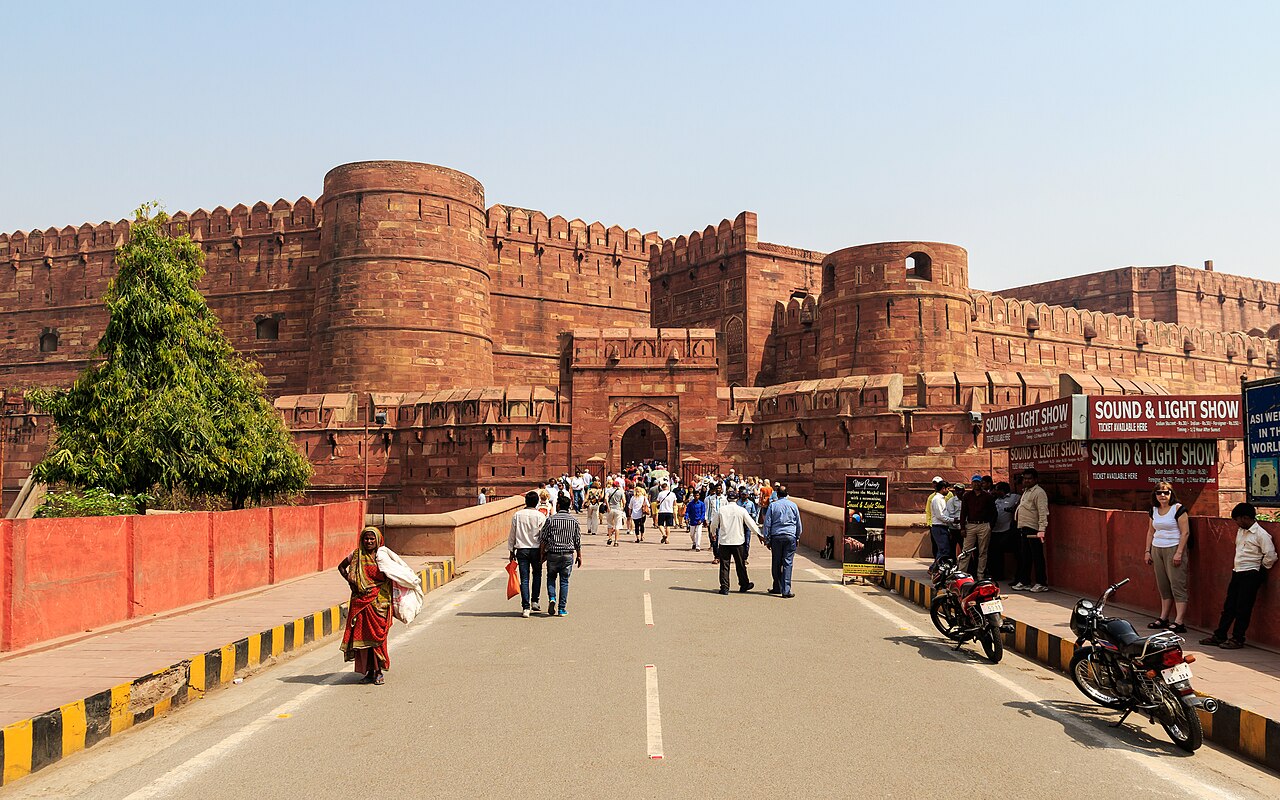
Agra Fort (آگرہ قلعہ, also Lal Qila “Red Fort” of Agra, or Qila-i-Akbari “Fort of Akbar”), inscribed by UNESCO in 1983, is the principal Mughal imperial fortress on the Yamuna River at Agra — a red sandstone fortification complex of approximately 94 hectares enclosed within double walls approximately 70 m in height above the moat, containing the principal palaces, courts, mosques, and administrative buildings of the Mughal imperial court from the reign of Emperor Akbar (r. 1556–1605 CE, who began the current fort on the site of the earlier Lodi dynasty mud-brick fort) through Emperor Aurangzeb (r. 1658–1707 CE, who removed the imperial court to Delhi but used the Agra Fort as the prison of his father Shah Jahan). The Fort’s construction across the reigns of four emperors (Akbar, Jahangir, Shah Jahan, and briefly Aurangzeb) produced an architectural ensemble that spans approximately 130 years of Mughal aesthetic development: Akbar’s massive red sandstone construction (the outer walls, the two main gates, and the original palace buildings) in the rougher sandstone tradition of early Mughal military architecture transitions within the fort to the exquisite white marble palace buildings added by Shah Jahan (the Khas Mahal private palace, the Musamman Burj octagonal tower, the Nagina Masjid private mosque) in the refined polished marble-and-pietra-dura tradition of his reign — a single complex embodying the complete arc of Mughal architectural style from military strength to refined court luxury.
Agra Fort’s palace complex and the Yamuna heritage landscape Taj Mahal · Musamman Burj · Diwan-i-Khas — 0 to 2.5 km
The principal entry for visitors is through the Amar Singh Gate (the southern gate, the only gate currently open for public access — the Lahore Gate, the principal western gate used by the Mughal court, is restricted to Army use as part of the Indian Army compound that occupies approximately two-thirds of the fort complex). The Amar Singh Gate leads through a double-chicane entry (designed to prevent cavalry charges from directly entering the fort by requiring a 90° turn within the gatehouse) into the Elephant Gate courtyard (so named for the stone elephant statues that once flanked the inner entrance, removed in 1668 CE on the orders of the iconoclastic Emperor Aurangzeb who objected to figurative sculpture in a fortification). The surviving heritage buildings accessible within the public section of the Fort include: the Jahangiri Mahal (Emperor Jahangir’s palace, built entirely in red sandstone in a blend of Mughal and Indian Hindu architectural elements — the carved brackets, the hanging eaves, and the jali screens are Hindu architectural forms integrated into the Mughal spatial programme, an explicit acknowledgment by the Hindu converts among Akbar’s building workshop of the indigenous Indian architectural tradition); the Khas Mahal (Shah Jahan’s private palace, in white marble, with the marble grape-vine sculptural relief in the central court representing the refined decorative programme of Shah Jahan’s court artists); and the Musamman Burj (the octagonal marble tower on the river-facing wall, the last residence of Emperor Shah Jahan during his imprisonment by Aurangzeb 1658–1666 CE — from the Musamman Burj’s north-facing windows, the dome of the Taj Mahal 2.5 km upriver is visible, a view that has generated the most romanticised narrative in Mughal history: that Shah Jahan spent his final years gazing at the mausoleum he built for his wife). The Diwan-i-Khas (Hall of Private Audience, in white marble, used by the emperor for private meetings with high officials and foreign ambassadors) is on the eastern terrace overlooking the Yamuna. The Nagina Masjid (Gem Mosque, the small private mosque built by Shah Jahan for the ladies of the imperial harem, in pure white marble, accessible through the Khas Mahal complex) is one of the most finely proportioned mosques in India. The Moti Masjid (Pearl Mosque, built by Shah Jahan 1646–1653 CE, in pure white marble, one of the most technically perfect mosques in the Mughal tradition — the slightly convex floor plan compensates optically for the curvature of the earth visible across the large courtyard, so that the mosque pavement appears perfectly flat from the entrance doorway) is in the Army-restricted section and not accessible to visitors.
The Taj Mahal (UNESCO 1983, approximately 2.5 km southeast of the Fort along the Yamuna riverbank) is the natural complement to an Agra Fort visit — the two UNESCO monuments define the two ends of the Mughal imperial Agra landscape, connected by the riverside walk or the road along the river. The combination of the Fort visit (showing the Mughal court’s living environment) and the Taj Mahal visit (showing the Mughal court’s funerary tradition) provides the most complete understanding of Mughal imperial culture in a single day available anywhere in the world. Itimad-ud-Daulah’s Tomb (Itmad-ud-Daula, the tomb of Mirza Ghiyas Beg, father of the Empress Nur Jahan and grandfather of Mumtaz Mahal, built 1622–1628 CE, approximately 3.5 km north of the Fort across the Yamuna by road) is the first Mughal monument to be built entirely in white marble (preceding the Taj Mahal by approximately 3 years), the first to incorporate pietra dura stone inlay as a primary decorative element rather than a supplementary one, and the building that established the white marble + inlay template that Shah Jahan would perfect at the Taj Mahal — sometimes called the “Baby Taj” for its stylistic relationship to the Taj Mahal, though it preceded the Taj Mahal in the building sequence.
Practical information
Agra Fort is located in central Agra, approximately 2.5 km west of the Taj Mahal along the Yamuna riverbank. It is accessible by foot from the Taj Mahal (35–45 minutes riverside walk), by auto-rickshaw or cycle-rickshaw (10 minutes, recommended for the return journey), or by e-rickshaw. The Fort is open daily 06:00–18:00, closed on certain Indian national holidays. Admission fee (foreign visitors): similar to the Taj Mahal; the combined Taj Mahal + Agra Fort ticket provides a small saving. Archaeological Survey of India’s audio guide (available in multiple languages at the ticket office) provides context for the principal accessible buildings. Photography is permitted throughout the visitor-accessible areas. The Army-restricted compound (approximately two-thirds of the fort’s area) contains the Moti Masjid, the Jehangir’s private bath complex, and several other buildings not accessible to visitors — no civilian access is permitted to this section under any circumstances. Visiting time required: approximately 1.5–2.5 hours for the accessible visitor area. Combined Agra Fort + Taj Mahal + Fatehpur Sikri day trip from Delhi is achievable by express train (Gatimaan Express, Delhi–Agra in 1 hour 40 minutes, daily) with a car hired from Agra for the Fatehpur Sikri segment (40 km each way). Best visiting season: October–March (comfortable temperatures 15–28°C); avoid May–June (temperatures up to 47°C). The Agra Fort light-and-sound show (evening, in Hindi and English on alternate nights, spectacular use of the Fort’s architectural setting for the narrated Mughal history) is one of the best heritage sound-and-light shows in India.
Frequently Asked Questions
What is the history of Agra Fort before the Mughal period?
The site of Agra Fort has been fortified since at least the 11th century CE, when it is mentioned in the chronicles of the Ghaznavid dynasty as a mud-brick fortification called Badalgarh. The Lodi dynasty (the Afghan Afghan dynasty that ruled the Delhi Sultanate 1451–1526 CE) maintained the fort as a principal military garrison, and the Battle of Agra (1505 CE) between the Lodi Sultan Sikandar Lodi and his rebel brother Alam Khan took place in the vicinity of the fort — it was Sikandar Lodi who transferred the Lodi capital from Delhi to Agra in 1505 CE, making Agra the seat of the Delhi Sultanate for the last two decades of Lodi rule. The Mughal conquest of the Delhi Sultanate began at the First Battle of Panipat (21 April 1526 CE), where Babur (first Mughal emperor) defeated and killed Ibrahim Lodi using the Mughal innovation of field artillery (borrowed from the Ottoman military technology that Babur had observed in his Central Asian campaigns) against a numerically much larger Lodi force. After Panipat, Babur’s forces entered Agra, where the treasury of the Lodi sultan contained the famous Koh-i-Noor diamond (the “Mountain of Light”, then known as the Samantik Mani), which Babur records in his autobiography (Baburnama) as being presented to him by the son of the Raja of Gwalior who had served the Lodi court. The current red sandstone fort was built by Emperor Akbar (r. 1556–1605 CE) beginning in 1565 CE on the site of the earlier Lodi fortification: the construction required 4,000 workers and approximately 8 years to complete the outer walls and gates, using red sandstone quarried from Fatehpur Sikri, approximately 40 km southwest. The Akbar-period construction (the outer walls with their distinctive curved bastions, the Lahore Gate, and the Delhi Gate) forms the structural core of the current Fort; the Shah Jahan period additions (the white marble palace buildings in the eastern and northeastern sections) are the fine-art additions to the earlier military structure.
Why are two-thirds of Agra Fort not accessible to visitors?
The restricted section of Agra Fort is occupied by the Indian Army’s 1 Corps Headquarters (the central command of one of the Indian Army’s operational-level military formations), a military use that has continued since the British Raj period (the British military occupied the Fort as a cantonment from the late 18th century, converting sections of the palace buildings to barracks, offices, and storage, a use inherited by the Indian Army after independence in 1947). The Moti Masjid (Pearl Mosque, the most architecturally sophisticated structure in the entire Agra Fort complex), several Mughal bath complexes, the Diwan-i-Am (Hall of Public Audience, where the Mughal emperor received petitions from the public, a large open court with colonnaded pavilions), and approximately 40 additional Mughal-period structures are in the restricted military section. The Archaeological Survey of India (ASI, the Indian central government agency responsible for the conservation of all UNESCO-inscribed and nationally protected monuments) and the Ministry of Defence have held intermittent negotiations since the 1980s over the possible transfer of portions of the restricted zone to civil heritage management — the most recent public discussion of this potential transfer was in 2015, when the ASI submitted a proposal to the Ministry of Defence identifying the Moti Masjid and Diwan-i-Am sections as priorities for civilian heritage access. As of 2024, no transfer has been implemented, and the restricted section remains under Army control with no civilian visitor access. The UNESCO World Heritage inscription covers the entire Fort complex including the restricted sections — UNESCO’s periodic monitoring reports have noted the presence of military use within the inscribed property but have not issued formal findings of inadequate protection, as the Army’s presence has not caused documented physical damage to the heritage structures (the Army buildings within the restricted section are generally utilitarian and separate from the historic fabric).
What is the connection between Agra Fort and the Mughal succession crises?
Agra Fort was the physical arena for three of the four major Mughal succession crises, a pattern that reflects its role as the central repository of Mughal imperial legitimacy — the emperor who controlled Agra Fort and its treasury controlled the Mughal state. The first crisis occurred in 1540 CE when the Afghan Sher Shah Suri (شير شاه سوري) defeated the Mughal Emperor Humayun at the Battle of Bilgram and occupied Agra Fort, forcing Humayun into a 15-year exile in Persia — the Fort served as the capital of the Sur Empire (1540–1555 CE) before Humayun recaptured it in 1555 CE. The second crisis was the War of Succession of 1658–1659 CE: when Emperor Shah Jahan fell critically ill in 1657 CE, his four sons fought for the Mughal throne; Prince Aurangzeb defeated his brothers and then confined his father Shah Jahan in the Agra Fort (specifically in the Musamman Burj tower) for the remaining 8 years of Shah Jahan’s life (he died in the Fort in January 1666 CE). The third crisis was the Mughal civil war of 1712–1720 CE: after Emperor Aurangzeb’s death in 1707 CE, the Mughal throne changed hands five times in 5 years; each succession battle involved the capture of Agra Fort as a prerequisite for claiming imperial legitimacy (whoever sat on the Mughal throne in Agra Fort’s Diwan-i-Am was acknowledged as the emperor by the Mughal noble class). The Fort’s treasury (which reportedly contained the accumulated wealth of six generations of Mughal emperors, including the Koh-i-Noor diamond and the Peacock Throne built for Shah Jahan at a reported cost of 6 million rupees) was ultimately looted by the Persian emperor Nadir Shah during the 1739 CE sack of Delhi and Agra — the Koh-i-Noor and the Peacock Throne were taken to Persia, from where the Koh-i-Noor eventually reached the British East India Company (it was surrendered by the last Sikh Maharaja Duleep Singh in 1849 CE under the Treaty of Lahore and is now set in the Crown of Queen Elizabeth The Queen Mother, part of the British Crown Jewels in the Tower of London).
EXCERPT: Agra Fort, UNESCO-inscribed in 1983, is the Mughal imperial fortress on the Yamuna at Agra — red sandstone outer walls by Akbar (1565), white marble Musamman Burj tower where Shah Jahan was imprisoned 1658–1666 with a view of the Taj Mahal 2.5 km east, Jahangiri Mahal palace blending Hindu and Mughal architecture — the central arena of Mughal succession crises for 200 years.
META: UNESCO World Heritage Sites near Agra Fort India: Taj Mahal 2.5 km east (UNESCO 1983), Fatehpur Sikri 40 km west (UNESCO 1986), Keoladeo National Park Bharatpur 55 km east (UNESCO 1985) — Agra’s UNESCO triangle in Uttar Pradesh, 200 km south of Delhi’s Red Fort (UNESCO 2007) and Humayun’s Tomb (UNESCO 1993).
Sources
- S1 — UNESCO World Heritage Centre — Agra Fort (Ref. 251) — https://web.archive.org/web/20230601000000/https://whc.unesco.org/en/list/251/
- S2 — UNESCO World Heritage Centre — Statement of Outstanding Universal Value (Ref. 251) — https://whc.unesco.org/en/list/251/
Spotted an error? Write to editorial@culturalheritageonline.com and we correct it the same day.